Cartoon Network, 2015. ISBN 9781760123208
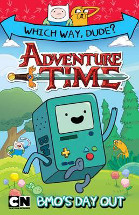
BMO is the cutest, tiniest little robot in the Land of Ooo but the
future of Ooo is in the hands of the reader because at the end of
each chapter it is up to the reader to decide what happens next. By
solving riddles, puzzles and codes the reader can alter the
characters' paths thus leading them on to new adventures. It's a
chance to let BMO be the hero for once. Along the way the reader
gathers Adventure Minutes and the challenge is to read the book many
times, make different choices and try to better the number of
Adventure Minutes gained.
A new take on the popular Choose Your Own Adventure format, written
in the present tense to increase the pace and sense of urgency, this
is likely to appeal to those who enjoy cartoons and computer games
and can visualise the action. They will enjoy its interactivity as
they try to solve the puzzles, and the challenge to gain Adventure
Minutes gives that competitive element that is a characteristic of
the gaming environment.
If we are looking to capitalise on the interest in cartoons and
computer games that our younger readers are so familiar with,
offering them that in print format may be the way to hook them into
a whole new world of adventure.
Barbara Braxton
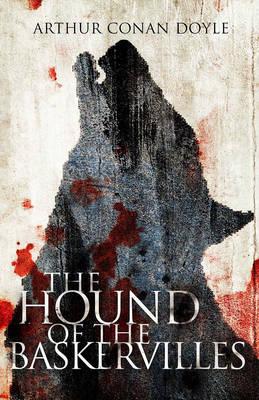
The Hound of the Baskervilles by Arthur Conan Doyle
Ill. by David Mackintosh. Alma Classics, 2015 (First published in
1901-02). ISBN 9781847494962
Highly recommended. Themes: Myth and mystery; Detective story. I
confess to never having read a Sherlock Holmes text before, and I
apologise to devotees of Arthur Conan Doyle works; but I do claim to
have viewed interpretations of the detective tale in screen texts
and regularly enjoy a good Crime and Detective narrative. This book
has been republished as a 'Classic' tale for a new generation of
readers and it is worth reintroducing the younger generation to the
original Sherlock Holmes as he makes sense of small inconsequential
clues to uncover the mystery of the Hound of the Baskervilles. The
Hound has been the part of the legend of the Baskerville family in
their life on Dartmoor in England, and its lingering evil influence
reappears with fatal consequences. Holmes, and his faithful and more
trusting friend - Dr Watson, together become entangled in solving
the mystery of the threatening menace of the Hound on the moors.
This story is written in the language of the late 19th and early
20th century, with extensive description and sentences and
vocabulary that are definitely not from the digital era. ' . . .
though I have not finally made up my mind whether it is a benevolent
or malevolent agency which is in touch with us, I am conscious
always of power and design.' (p45) However for any young reader
prepared to journey back in time, this is a wonderful excursion into
history in both a literary sense and in opening up a window into a
time and place that cannot be revisited except through the pages of
a book. And there is a compelling mystery that needs solving as
well. (This text also includes some background notes about Conan
Doyle and the characters within the narrative.)
Carolyn Hull
Ralf by Jean Jullien
Frances Lincoln Children's Books, 2016. ISBN 9781847808189
(Age: 4+) Recommended. Fire, Dogs, Animals, Pets, Family. This
unusual family pet, Ralf, gets into many places he is not welcome.
He is found in the bath when Mum is taking a shower, under Dad's
feet when he is ironing, in between Mum and Dad when they go to bed,
lying across the family as they watch television. Dad orders him
out, and so he goes, off to his kennel where he can sleep all alone.
Here everything is very quiet, but Ralf smells something, and
realises that the house is on fire. He tries to get back inside but
cannot get through the little door, stretching his body as he
wiggles through. He runs upstairs but cannot wake anyone, so decides
that he will get the firemen. They arrive in the nick of time, and
Ralf's elongated body makes a superb rescue slide for them to get
from their window to the ground. After this Ralf is welcome
everywhere, and his elongated body is enough reason for them to buy
a bigger house.
Gwendal le Bec and Jean Juillien have collaborated to produce Ralf,
and it is hoped that they will produce more stories of this
complexity, layering stories of families and their pets alongside
fun and adventure and a heart stopping moment when the family is
saved by the dog. Deceptively simple, the text is supported by a
wondrous illustrative technique, with bold colours, black line
drawings and cartoon like words usually shouted at Ralf.
Fran Knight
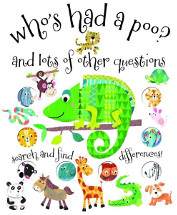
Who's had a poo? And lots of other questions by Anton Poitier
Ill. by Tracy Cottingham. The Five Mile Press, 2016, ISBN
9781760400781
(Ages: 3-5) This 'spot the difference' book is quite a unique
concept, but it does not seem as well thought out as it could be.
Each spread features the same animals but on each page one or more
of the animals have moved or been altered and the reader is asked to
spot the difference/s. The target audience of pre-schoolers are
asked to spot such things as 'who is splashing water around?', 'who
is now upside down?' and 'who is taking a nap?'. Some of the
questions require the reader to compare a page with the previous
one, for example when looking at which animals have swapped places
or changed colour. Some require more analytical skills, such as 'who
is ready for lunch?' which requires the reader to infer meaning from
the animals' behaviour (for example, the panda is holding bamboo and
the duck is diving down into the water). Others provide humour, such
as 'who's done a poo?' which is sure to make pre-schoolers giggle.
The beauty of this book is the opportunity it provides to kick-start
conversations between adult and child. It asks the reader to
investigate each page closely and in some parts to make some
inferences from what they see. Parents who use the book well will
help children develop their analytical skills by discussing how they
know the dog is ready to play or what makes the crocodile look
fierce. However, it is a little limited in allowing this as on some
pages there is only one animal that has moved or changed. For
example, in 'who's showing off?' only the peacock is showing off as
he has his feathers spread; the other animals are unchanged. In
addition, some other questions are very simplistic (eg. 'who's had a
baby?' and 'who's found a friend?').
This will work well as a one on one shared activity with parent and
child rather than as a group read-aloud or for independent perusal.
Some children may tire of this quickly after they already know the
answers, while others may enjoy repeat readings.
Nicole Nelson
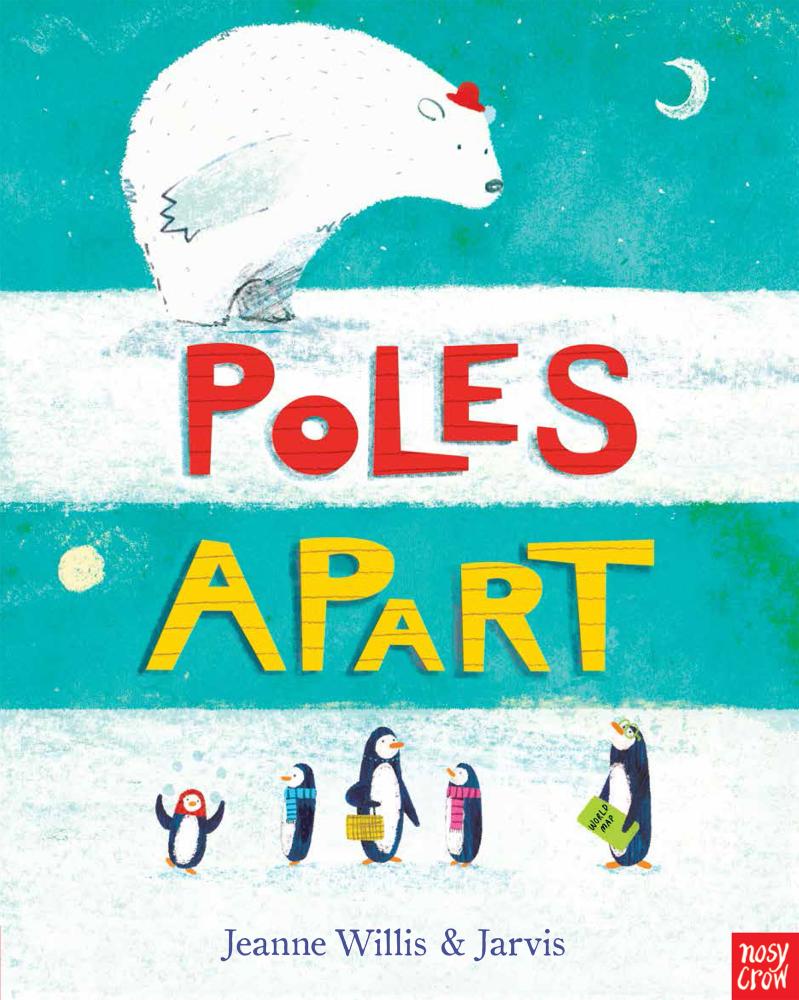
Poles apart by Jeanne Willis
Ill. by Peter Jarvis. Nosy Crow, 2014. ISBN 9780857634924
Picture book. Everyone knows that penguins are found at the South
Pole not the North Pole. But when the Pilchard-Browns get lost on
the way to their picnic. things change. Mr and Mrs and Peeky, Poots
and Pog find themselves floating on an iceberg that drifts through
days and nights until they discover a strange something on another
iceberg. It turns out to be Mr White the polar bear who tells them
that the South Pole is 12 430 miles in the opposite direction!
But Mr White has always wanted to go to the South Pole and so the
Pilchard-Browns follow Mr White - always on the lookout for a picnic
place. The ice floe they are on isn't safe with killer whales
floating around, and America was too busy - and it wasn't home. Even
though England was charming it still wasn't home. And so the journey
continues, through countries large and small as they make their way
south. But still no place is home, not even for Mr White.
This is a quirky story, aptly named for the theme that runs through
it that even though we can follow our dreams there is a place for
each of us that is home. Just as we journey through life we can meet
many different types who can still be friends even though everything
about us is poles apart. It could be a good read-aloud for new
students starting school for the first time to show that friends can
come from many different places, as well as reaching out to those
new to this country so they can see themselves in a story. It might
even serve as a vehicle for a class version - if Mr White and the
Pilchard-Browns visited all the countries represented in our class,
where would they go? It could be an engaging introduction to getting
to know each other, as well as mapping.
More to this than meets the eye.
Barbara Braxton
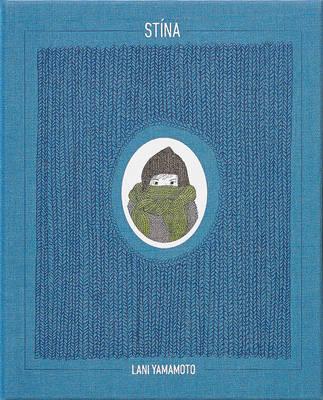
Stina by Lani Yamamoto
Bloomsbury, 2016. ISBN 9781851778584
(Age: 5+) Highly recommended. Scandinavia, Cold, Friendship,
Iceland, Inventions. Stina does not like the cold. Even in summer
she bypasses the pool, and avoids the evening breeze. She loves to
be home snuggled up tightly within her duvet. But in winter, she
cannot even go outside, the cold is too much. She prepares for
winter by bringing in lots of wood, putting aside a store of food,
having a basket of wool ready to knit, building a pile of books to
read. She is fully prepared to stay indoors the whole winter long.
She knits warm clothes, socks and mittens, invents ingenious ways of
getting her food from the kitchen without leaving her bed and of
getting food from the fridge without getting a chill of cold air
when the door is opened. But one day she peers out of her window and
sees some children playing in the snow. She wonders what the snow
would taste like.
A sudden storm blows the children to her door, and she lets them in.
They are surprised at how warm it is inside her house and take off
their outer layers. She teaches them how to knit, makes them cocoa
and learns how to whistle.
When they leave she is alone. She decides to do something about it
and uses her sewing machine to make an outside coat from her duvet
and goes outside to meet her new friends, finding that running
around and laughing makes her very warm.
This delightful story of friendship overcoming hurdles was first
published in Icelandic in 2013 and published for a wider audience by
the Victoria and Albert Museum, London in 2015. It is quite
wonderful in presenting the universal quest for friendship, and the
detailed illustrations make a wonderful contrast to the styles we
are used to.
Lani, who has lived in Iceland for twenty years was fascinated with
the way Icelandic nicknames work. Her Icelandic title, Stina
Storasaeng means 'girl with big duvet', and from that idea, Lani
developed the tale of a young girl whose house is a prison because
of her fear of the cold. Winning the Nordic Council for Children and
Young People's Literature Prize, is a highlight in her career.
Fran Knight
Princess, the scoundrel, and the farm boy by Alexandra Bracken
A New Hope : Star Wars Episode IV. Chirpy Bird, 2015. ISBN
9781760125097
(Age: 9 - low teens) Highly recommended. I am a relatively new Star
Wars fan. having only watched the new movies I was not really
familiar with the Star Wars Books and I found this book really
interesting and exciting.
I liked the way the book was written in the 3rd person and was told
from each of the main characters' point of view. It was a good way
for me to get to know each of the characters and understand their
personalities.
Leia was my favourite. She was very brave and always did what she
thought was right, even if it seemed risky. I really related to her
and loved how clever she was and how she was both physically and
mentally strong.
The book was very easy to read and well suited to readers from 9 -
low teens. Highly recommended to Star Wars fans and others who enjoy
adventure and action books.
Hannah C.(yr 6 student)
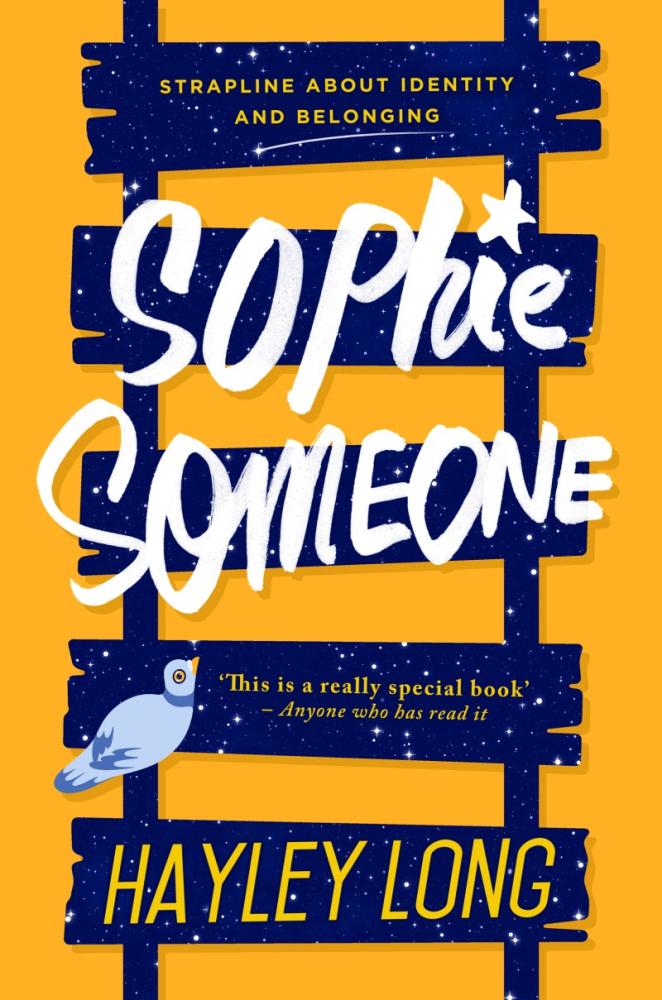
Sophie Someone by Hayley Long
Hot Key Books, 2015. ISBN: 9781471404801
(Ages: 12+) Recommended. Within this heart-warming tale, Sophie
tells her life story, in the only way she dares tell it: code
language. Sophie's describes her early life, in which she moved with
her mother from an unknown place to Brussels where the majority of
the story takes place. She describes the way that her family settle
into this new abode, and takes the reader into her school life where
she meets her best friend, Comet, a character who makes a recurring
appearance within the novel. Throughout the story, Comet and Sophie
go on a few adventures, which guarantee a gripping tale, as well as
explore the ins and outs of friendship, and that sometimes, there
are things that are difficult to talk about, even to your best
friend.
The relationships explored in the novel are compelling, each with
its own unique and distinct lesson for the reader, and which are
revealed at appropriate and respective points of the novel. The
relationships that Sophie has with her family are relatable and
truly express real family dynamics, as well as highlighting the
importance of family.
The main themes within the novel are that of the importance of
self-identity, trusting our moral compasses, being who we are
despite the odds, realising that it's never too late to challenge
ourselves and never giving up; lessons which are not only vital for
personal growth and development, but also to ensure a memorable and
inspiring novel.
From the beginning of the book, Sophie's unique writing style is
demonstrated. She uses code words amongst regular language, in order
to tell her story and although this may make for a challenge for
younger audiences, the context of the words often allow for an easy
translation. Sophie Someone has vibrant, realistic characters that make
for an engaging read, as well as an opportunity for the reader to
unravel Sophie's story along with her. This novel was a truly
beautiful read, in which I looked forward to reading every page, and
helping Sophie uncover the secrets she was so desperate to learn. Sophie Someone is not a book that is easily forgotten.
Daniella Chiarolli (Student)
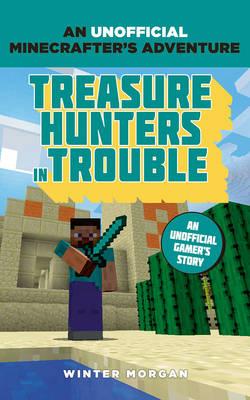
Treasure hunters in trouble by Winter Morgan
An Unofficial Minecrafter's Adventure bk 4. Bloomsbury, 2015.
ISBN: 9781408869673
(Age: 7-9)For Minecraft fans. Winter Morgan's Unofficial
Minecrafter's Adventures are written purely for young
Minecraft gamers. She writes in an easy to read style with her
action adventure peopled with very simplistic characters who are
involved in an episodic treasure hunt. True fans enjoy her Minecraft
story lines, filled with familiar creatures, fighting battles,
traversing underground and above ground landscapes - swamps, caves
and farmlands. This pixelated 3D block-building game is a worldwide
phenomenon and many junior novels and player guides have been
published for the enthusiasts.
This is the fourth book of the series and Henry, Lucy, and Max have
been captured. Kyra and Steve are joined by Alex and Will on their
quest to save their friends. Unfortunately, they are sidetracked by
the lure of treasure, battle slime balls, use Parkour to travel
across the mountains, discover treasure in underground caves and
battle the Ender Dragon.
The story ends with a promise of another book to come, with Steve
investigating their journey home through the dangerous jungle.
Rhyllis Bignell
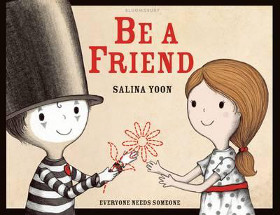
Be a friend by Salina Yoon
Bloomsbury, 2016. ISBN 9781619639515
(Age: 4+) Highly recommended. Friendship, Being different, Miming.
Dennis loves to mime his stories during show and tell. He tells a
story quite differently form the others in his class, wearing his
top hat and striped jumpers. While the others climb the tree, Dennis
is the tree, but looking at the other children playing together, he
realises that he is lonely. He feels there is an invisible wall
between them all, one that they cannot see through. But one day as
he kicks his imaginary ball, it is kicked back to him. Her name is
Joy and she can see him quite well, and the invisible wall is now a
mirror. The two are very similar and do many things together,
attracting the attention of the other children, who can see Dennis
now as well.
This charming little story about friendship will have wide appeal.
Children will be encouraged by the story to see past their
differences and look for the similarities, to celebrate the
differences, to create friendships with others in their class.
Salina Yoon's Penguin books will be well known to younger
readers and this one has the same theme, that of friendship, but
told for a slightly older group. Her pared back illustrations will
intrigue readers, following Dennis' journey to friendship and
delighting in his difference. This beautifully presented hard cover
book done in sepia tones will also introduce the idea of mime to a
younger class, one they can practice along with Dennis and Joy.
Fran Knight
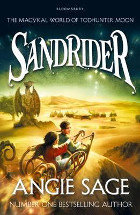
Sandrider by Angie Sage
The Magykal World of Todhunter Moon bk 2. Bloomsbury, 2015.
ISBN 9781408869420
(Age: 9+) Highly recommended. Themes: Magic, Fantasy, Adventure.
Angie Sage's second book in the TodHunter Moon trilogy, will
delight fantasy readers with its rich cast of characters, exotic
locations, powerful and appealing descriptive language, and the
well-crafted scenes involving mystery, Magyk and mayhem. The main
character Tod enters the story much later; Sandrider opens
with the dragon Spit Fyre observing the sorcerer Oraton-Marr
depositing the Orm Egg in the care of a young boy in the Desert of
the Singing Sands. Each section begins with a dark sketch of an Egg
Timer and a countdown to the dragon egg hatching. The wizard kidnaps
the apothecary's baby daughter to ensure the egg is cared for.
Kaznim her big sister determines to look for her kidnapped sister,
steals the egg timer and unfortunately stumbles through an unstable
Way meeting an injured Sam Heap and Marwick.
Kaznim ends up in the snowbound city of Castle, where she meets
TodHunter Moon, apprentice to the Extraordinary Wizard Septimus
Heap. Here the pace of the story becomes faster, more and more crazy
characters are involved and the plot develops in complexity. There's
a transforming jinni Jinn Knee, beware of his tiger form, dark
witches lurking in the forest, a wild sled race, Tod's best friends
being taken for Snow Sprites, a malicious ghost and an evil queen.
Will they reach the Egg before it hatches or will the new baby Orm
imprint on the evil sorcerer giving him unlimited Magyk powers?
Angie Sage's Sandrider celebrates the importance of charting
your own course, valuing friendships and developing resilience.
Rhyllis Bignell
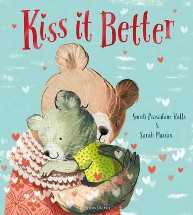
Kiss it better by Smriti Prasadam-Halls
Ill. by Sarah Massini. Bloomsbury, 2016. ISBN 9781408845639
(Ages: 2-6) Recommended. This book is a joyous celebration of how
kisses can make everything better. It is filled with visual symbols
of love; there are hearts on every page and lots of physical
affection by way of hugs and kisses. The text tells and shows us all
the times when a kiss can heal ('when you're down in the dumps', 'if
you've scraped your knee') and of all the things that kisses can say
('I love you so much', 'can we be friends?', 'I'll miss you'). The
author gives different types of kisses fun names that children and
their parents will love adopting into their own vernacular; there
are be-brave kisses, cheer-up kisses and go-to-sleep kisses that
shout monsters, shoo! The warm, slightly retro illustrations have a
wonderful texture, particularly in the patterned clothing worn by
the animals, and their soft warmth helps to capture the comfort that
kisses can bring. The family of bears used in the illustrations add
to this feel with their rounded, soft and cuddly style. The rhyming
text flows beautifully in most places. It ends by reminding young
readers that 'sometimes grown-ups need kisses, too!' and that
'EVERYTHING feels better with the help of a kiss!' This is a joy to
read aloud and the illustrations are divine. It is an uplifting tale
with a simple message for young and old about how we have the
ability to comfort those we love with a kiss as well as being a
reminder to parents that the most important thing they can give to
their children is love. It also provides a vocabulary for parents to
help their children vocalise how they are feeling and what they need
to feel better.
Nicole Nelson
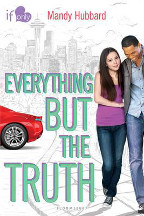
Everything but the truth by Mandy Hubbard
Bloomsbury, 2015. ISBN 9781619636606
(Age: 14+) Everything but the Truth is a novel that speaks
to the reader about the struggle between social status defined by
monetary wealth through the genres of romance and drama. This novel
by Mandy Hubbard is one in a collection of the 'If Only' line which
is a group of novels written by various authors containing the same
genres as 'Everything but the Truth'. Hubbard's novel focuses on a
teenage girl, Holly Mathews, whom has lived in a single parent
family for the majority of her life, often experiencing financial
hardship as her mother works to put them in a better monetary
situation. Holly's mother's efforts are successful when she is
employed by a very ritzy and expensive retirement home for the rich,
wealthy and luxurious, which places Holly in the perfect position to
meet the possible man of her dreams through his newly allocated
grandfather. Due to an unfortunate turn of events, Holly finds
herself in a situation where the truth about her may interfere with
the chance of romance she has stumbled into and her mother's new
job. Holly finds herself torn between doing what is best and doing
what is right. With collage around the corner and her life-long best
friend slowly becoming distant and her choice about the truth
becoming more and more urgent, Holly learns the importance of the
relationships in her life. Everything but the truth is a novel rich with moral decisions
and meaning as well as having a strong and relatable story in the
terms of financial wealth and social status. This book contains
romantic themes and may be suited to an older teenage audience (+14)
and lovers of romance and drama. Overall, this book provides a great
solution to any reader's cravings for the genres of romance and
drama in novels while still being strongly relatable and a hard book
to put down.
Sarah Filkin (University student)
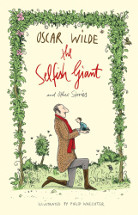
The Selfish Giant and Other Stories by Oscar Wilde
Ill. by Philip Waechter. Alma Classics, 2015. ISBN 9781847494979
Themes: Fairy tales, Moral stories. This is a collection of moral
tales that demonstrates Oscar Wilde's story-telling skills. The
stories remind us of the dangers of wealth; that generosity and
kindness are valuable attributes; that love and sacrifice are
beautiful, but not always recognised and valued. Many of the stories
are fairy tales in the sense that they have talking animals and
faraway kingdoms that interact with the characters in solving
unusual problems. The characters themselves display quirks of
behaviour that could only exist in a fairy tale. And there is not
always a positive 'happy-ever-after' ending, but often there is a
lesson that can be learned from the failings of the story
participants.
This is a reprinting of a selection of Wilde's early stories from
the late 1800s and consequently the language is fairly traditional
and is more ornately descriptive than contemporary writing styles.
Some younger readers may get lost in the descriptive detail and
language, but there is a glossary at the back of the book to
describe some of the terms used. At the end of the book there is
also some biographical detail (in detail appropriate for younger
readers), as well as a summary of each story. Simple line drawings
are sparsely scattered through the stories.
Young readers that enjoy the challenges of the intricacies and
sophistications of writing from the 19th Century will enjoy this
collection of stories.
Carolyn Hull
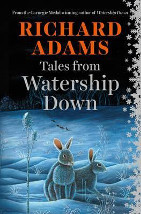
Tales from Watership Down by Richard Adams
Oneworld Modern Classics, 2015. ISBN 9781780747897
Originally published in 1996 to follow Watership Down these
stories successfully extend the experience for lovers of the
original rabbit novel. The later generations of rabbits are told the
stories of their heroic ancestors in fables which teach about
courage, loyalty and resilience in the face of great challenges and
danger. The book opens with rabbit legends, which would be very
suitable for reading aloud, followed by stories of rabbit adventures
featuring many of the characters from the original novel including
Bigwig, Hazel, Campion and Woundwort; even Kehaar the gull makes an
appearance. Some of the text seems a bit dated, the boy rabbits are
the protectors, they have all the daring adventures and get to do
the heroic deeds while the girls are helpful and sensible while
being a bit inscrutable; and the landscape is very English,
reminiscent of that inhabited by Peter Rabbit. However, for the
lovers of Watership Down, also recently re-published, this
book extends the experience and will be enjoyed by both adults and
middle school readers who don't want to let those characters go.
Sue Speck