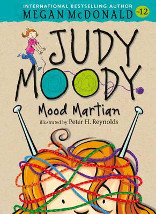
Ill. by Peter H. Reynolds. Judy Moody bk 12. Walker Books, 2015. ISBN
9781406357837
(Age: 7-9) Recommended. Themes: School stories, Family Life,
Emotions, Friends. Judy Moody returns in Judy Moody, Mood
Martian, and the young girl we know and love, the emotional,
messy, quite contrary has disappeared! Just for a short while
luckily! It's Backwards Day at school and she double-dares herself
to change into the Queen of the Good Mood for just one week.
"Star-spangle bananas," her mother exclaims when a radically
transformed Judy appears the next morning. Judy is transformed, red
hair slicked back, all her clothes match and she even laughs at
little brother Stink's jokes. Her mood ring is painted with purple
nail polish to signal she'll be in a good mood all day. Mr. DDOT
(Todd backwards) even introduces the class to palindromes. With her
success of staying in a positive frame of mind all day, she decides
to continue the positive top-secret experiment for a week. She even
decides to ask Jessica-A plus-Finch for advice.
With the help of lots of finger-knitting and making the right
choices Judy Moody finds the week challenging. Her family thinks she
been invaded by an alien! Once again, Peter R. Harvey's cartoons add
to the drama and humour of the story, Martian Judy and the rescue of
the finger knitting from the toilet bowl are memorable!
This is a wonderful addition to the Judy Moody series, it will
delight the fans.
Recommended for 7-9 year olds
Rhyllis Bignell
Assembly of shapes by Danielle Weiler
Ranga Books, 2015. ISBN 9780987546715
(Age: 16+) Highly recommended. 'I need a place, just for me, a place
to escape, a place to just be. If I could create an assembly of
shapes on endless pages I do believe my life would be complete.'
The main character, Chas is an intense character, so skilfully drawn
that the reader feels they know him and the suburb he lives in.
Chas is working his way through year 11 and has lots of secrets. He
doesn't know who his father is, he's in love with his best friend's
girlfriend and he is an 'undercover' artist.
This book is about relationships. Relationship with family, friends,
and self are all put under the microscope in this captivating story.
The writing style is compelling and the situations portrayed so
realisticly as to be shocking and thought provoking. Chas grows in
maturity as he tackles the challenge to achieve his dreams,
seemingly against all odds. He has unexpected champions and foes as
the story unfolds, culminating in unexpected tragedy.
The power of this book is the reality of the situations the young
characters find themselves dealing with. There is much to discuss
and explore.
'I've finally done it. They will all be safe. And this is the sole
reason for my sacrifice.'
Linda Guthrie
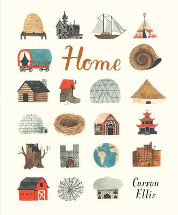
Home by Carson Ellis
Walker, 2015. ISBN 9781406359428
(Age: 4-8) Highly recommended. Housing. Homes.
Imagination. Buildings. Carson Ellis is an artist and illustrator
whose unique naive style is showcased in her debut picture book Home.
She is known for her artistic covers on band albums and backdrops
and for her illustrations in the Wildwood series written by
her husband, Conor Meloy. Here her pen and ink illustrations use
dark tonal colors, with solid lines and small, quirky touches to
create mood and interest. There is a fairytale quality to her work,
the characters stylishly dressed with princesses and pirates. Each
setting and each home waits to be explored, studied and discussed.
She takes us on a journey around the world and even into space; the
Moonian's home is in shades of grey, with the colourful Earth, a
small ball in the distance viewed through a large circular window.
From a home in the country, we are taken on a journey past flats in
the city, to Indian palaces with underground lairs. Animals' homes
are included as well as spiders' webs and birds' nests. The old
woman who lives in the shoe is surrounded by her multicultural
family drumming, swinging, climbing, sliding and balancing on a
tightrope, having fun. Mythical places - underwater Atlantis, a
Norse god home are shown in detail. With contrasting scenes placed
side by side we see the a Slovakian duchess and her stately home
next to a Kenyan blacksmith's small abode. As the pages are turned,
each new painting is a celebration of the imagination. The text is
simple, engaging and questioning. Where is your home? Where are you?
In the final pages, Carson is peering out the window of her
two-story home asking the reader to think about their own place.
Highly recommended for 4-8 years and for Early Years Geography and
History lessons.
Rhyllis Bignell
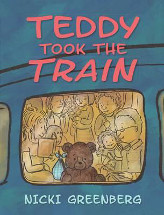
Teddy took the train by Nicki Greenberg
Allen & Unwin, 2015. ISBN 9781760112134
(Age: 3-5) Recommended. Teddy bears. Poetry. Lost
and found. Trains. The market place is bustling as Dot and Teddy are
finishing the shopping, they race after Mum to catch the early
train. The train is crowded, Dot squeezes in to get the window seat,
whilst Mum sits beside her in her wheelchair. They see diggers,
skyscrapers and a runaway balloon. Dot's excitement on arrival at
the station, dancing and splashing in the puddles is suddenly marred
by a realization. Did the train take Teddy, or did teddy take the
train? Sitting on her mother's lap whilst the station attendant
Peter (a quite dark figure) talks to them, Dot's imagination
takes over and she can see Teddy enjoying a picnic with friends at
Bear Bend. Ted's journey home is long and tricky, he's caught in a
crowd, tumbled down a riverbank and left alone to watch cloud
patterns in the sky. After Dot's tea and her bath, she becomes a
little teary, Ted is lost, she's missing her her best friend.
The rhyming story builds momentum, like the rhythm of a train on the
tracks, until we read the refrain - The train took Teddy... No!
Teddy drove the train! Dot's in bed and Mum's reading to her when
they hear the whistle blow, it is the seven-oh-two. Someone is there
on the doorstep with a very special surprise.
Nicki Greenfield's illustrations combine the use of ink, pencil,
acrylic with digital graphics and scanned objects. Cartoon sketches
and caricatures fill the train carriage and market, with the
backgrounds flooded with darker colours. As the story picks up
speed, Dot's hair becomes wilder and more exuberant.
A delightful picture book, asking to be read aloud at home,
preschool, kindergarten or school.
Rhyllis Bignell
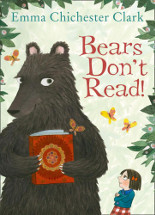
Bears don't read by Emma Chichester Clark
HarperCollins, 2014. ISBN 9780007425181
Bear is not like the other grizzly bears in the woods. While they
are perfectly happy doing bear things like fishing, Bear is bored.
"Oh, life is lovely," he thought. "Tra-la-la and all that! But is
this it?" he wondered. "Is this all there is?"
Then one day, Bear discovers a book. And inside it were pictures of
bears just like him, but there were also a lot of words and even
Bear knew that they meant something, even the tiny ones. But what?
So he decides to go into the town to find out, to find someone who
will teach him to read. But instead of being greeted by a band of
willing helpers, he is met by people fleeing and the police riot
squad! Until he meets Clementine.
As well as being a charming story, this book celebrates Bear's
determination and acknowledges that reading is not an easy task,
something the target audience will be able to empathise with.
Clementine's patience mirrors that of the early childhood teacher
and the ending is delightful. Even though bears are depicted as
fierce and scary, the illustrations are soft and gentle supporting
the words to show a different side of this species. Emma Chichester
Clark has a distinctive style that has seen her win many awards for
her illustrations and this is another superb example.
Barbara Braxton
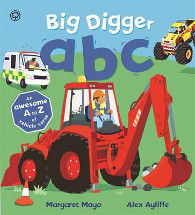
Big Digger ABC by Margaret Mayo
Ill. by Alex Ayliffe. Awesome Engines. Hachette, 2015. ISBN
9781408332696
(Age: 3-6) Recommended. Subjects: Transport, Boats, Cars, Trucks,
Road vehicles. Margaret Mayo and Alex Ayliffe have rolled out
another fun picture book in their Awesome Engines series.
From ambulances through to quad bikes to zooming rockets Big
Digger ABC is filled with transport on land, under the sea and
into the sky. Margaret Mayo's fun short verses use descriptive
phrases, sounds and actions that are great to read aloud, youngsters
will soon be reading along too! There's the Express Train,
super-fast and speeding, the ice-breaker, crack, crack, cracking and
the narrowboat chugging through the canals of England. Underwater
robots dive to find lost treasures while the eXtra big wheels of the
monster trucks race around the track.
Alex Ayliffe's layered papercut illustrations and her vibrant use of
colours showcase each of these awesome engines.
This is an exciting alphabet book for young ones who love trains,
planes and all types of transport.
Rhyllis Bignell
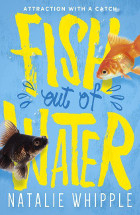
Fish out of water by Natalie Whipple
Hot Key Books, 2015. ISBN 9781471404306
(Age: 16+) "People like to think fish don't have feelings - it's
easier that way - but as I watch the last guppy squirm in his bag,
his eyes seem to plead with me. I get the sense that it knows just
as well as I do that bad things are on the horizon."
Mika loves fish but her plans for the summer holidays come awry when
her estranged grandmother arrives unannounced. This sets the scene
for a difficult family reunion as old grievances resurface and
conflict ensues. The characters are lightly drawn, yet the reader
can relate to the complications life presents them.
The characters in this novel are all fish out of water. Alzheimers,
cultural differences, socioeconomic differences, and educational
differences are all explored in this novel. While it lacks
complexity, and can be predictable at times, this novel does show
the power of forgiveness in resolving difficulties in relationships.
While there is, of course, a love interest in this book, the most
nuanced relationship is that between Mika and her grandmother. It is
these segments that bring the book to life and allow the reader to
experience the complexities of Alzheimers.
Linda Guthrie
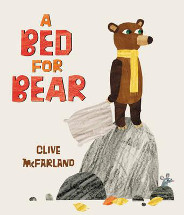
A bed for Bear by Clive McFarland
HarperCollins, 2014. ISBN 9780062237057
(Age: Preschool - Yr 2) Winter is coming and it is time for bears to
hibernate. But Bernard Bear did not want to sleep in the bear cave.
It was too noisy, too big and too crowded. But he must find
somewhere . . . and soon. So he sets out to find a bed that is just
right for him.
Frog's lilypad looks nice but it is not made for a bear and wet is
not comfortable. And Bird's bed is too windy and Rabbit's is too
small. Will Bear ever find a bed that is just right for bears? And
how will a teeny, tiny mouse help a big bear find a bed?
Even though the theme of creatures looking for that which is just
right for them and trying all sorts of options is common, this is a
charming tale that has a sense of newness and novelty about it.
Illustrated with no extraneous detail apart from the focus of the
text, the characters take centre stage, each one original and
quirky. The text has a repetitive element that young children will
join in with and they will delight in trying to find Mouse in the
pictures. It could be a great introduction to investigating where
animals live as well as challenging them to think of the
characteristics that a bear's bed should have before Mouse solves
the problem.
There is also the issue of Bear destroying all the beds he tries
without apologising or helping to fix them which could set up some
discussion about ethical behaviour at the child's level.
An intriguing debut for this author/illustrator that, like good
picture books do, offers more than initially meets the eye.
Barbara Braxton
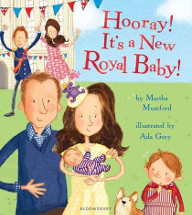
Hooray! It's a new royal baby! by Martha Mumford
Ill. by Ada Grey. Bloomsbury, 2015. ISBN 97814088 65712
(Age: 4-7) Royal family, Children, Siblings, Humour. The third book
in the series of stories following the royal offspring born in the
United Kingdom, is full of fun and promise just as the other two,
with a parallel theme of how an older child will deal with the birth
of a sibling.
The palace is in heightened anticipation, the nursery is being
readied, with the mobile being hung, the teddies all put in order
and the bassinet rocking horse polished. Royal Baby George helps his
aunt and uncle hang balloons on the royal gate but he begins to
wonder about the New Royal Baby playing with his toys. He is not so
sure that he wants someone else playing with his dinosaur and when
the New Royal Baby arrives home, George is a little underwhelmed.
His mother gives him a goldfish of his very own, but the changes in
the New Royal Baby begin to interest him as well. This book gently
leads the readers to see just how the two children will get along,
underlining the ways they can play together, and the role of the
parents in facilitating this. By the end of the book George is happy
to play with the New Royal Baby as it is much more interesting than
the goldfish. The last few pages will have parents laughing as well.
Boldly illustrated the fun of being parents is very much apparent
with a few side issues being gently dealt with. The euphoria of the
birth of a royal baby is infectious and this book will be just as
popular in Australia as in the UK, along with the other two, Shhh!
Don't wake the royal baby, and Happy birthday, royal baby!
Fran Knight
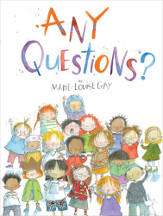
Any questions? by Marie-Louise Gay
Allen & Unwin, 2015. ISBN 9781760113179
(Age: 6+) Writing, Imagination. The process of writing is given a
wildly funny and unusual outing in this heavily illustrated book by
Canadian author, Marie-Louise Gay. She tells of the amazing range of
questions asked by a class of children, and leads them through the
process of writing a book. From the blank page she adds colour and
characters, asking the children for their ideas and suggestions.
Each suggestion leads to a page of illustrations suggesting a story,
so the white paper and the questions about polar bears may lead to a
story of a polar bear in a snowstorm, or the purple paper may lead
the children in another direction entirely. The colour of the paper
is important in pushing ideas forward. From there different ways of
adding words to the paper are exposed. Some write down a series of
words, some phrases, these are added to the paper as ideas
spawn and the story develops. Illustrations fill the pages adding to
the excitement of the developing story as Gay encourages children to
write.
This colour filled picture book encourages teachers and students to
write, giving them a scaffold to do it, while being an entertaining
read as well. The story which this class develops is told at the end
with all the additions by each child involved. As a model for use in
the classroom, it has merit, and may encourage members in the
classroom to try their hand at writing.
Fran Knight
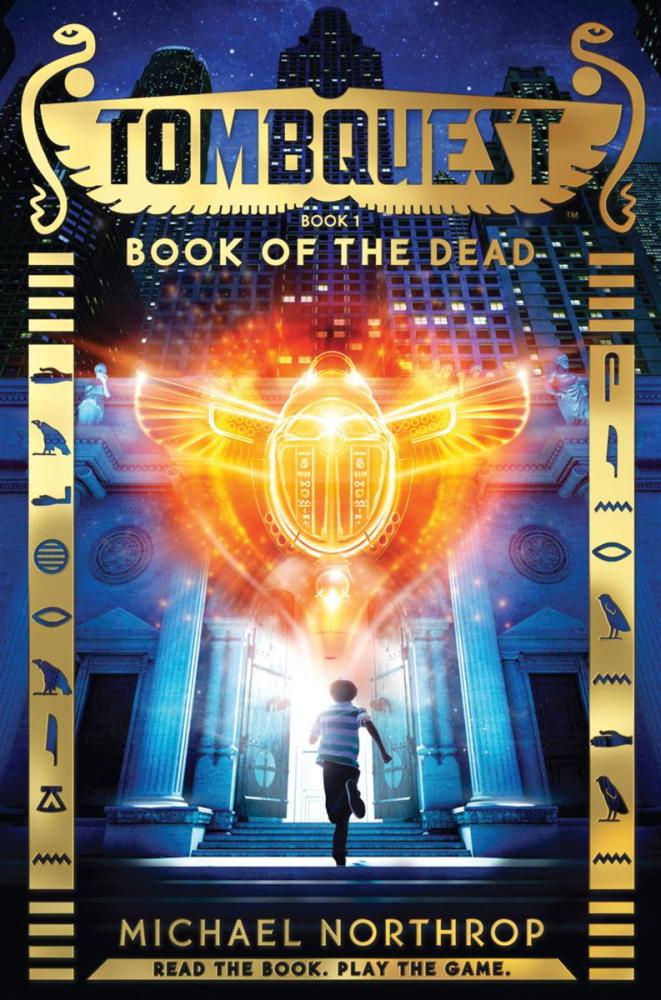
Book of the Dead by Michael Northrop
Tombquest series, Book 1. Scholastic, 2015. ISBN
9781743629246
(Age: 10+) Themes: Egyptology, Adventure stories, Good & Evil,
Museums. Another series from Scholastic where the reader has to wait
patiently for the next instalment to be published. This is a dark
story more suited to readers over 10 than the recommended Year 3
audience. Over five novels the two young protagonists are caught in
a dark adventure, as an ancient Egyptian evil is unleashed, mummies
are awakened and a plague of scarabs invades the underground
tunnels.
Alex Sennefer's suffering from a fatal illness, nothing can help
him. He leaves the hospital and very quickly is embroiled in the
mysteries at his mother's work place, the Metropolitan Museum of
Art. She is an Egyptologist, involved in a secret society, who
carries a powerful magic amulet at all times. She knows that the
answers to Alex's getting better is hidden in the Lost Spells of the
Egyptian Book of the Dead.
Alex and his best friend Ren are drawn in to fight a Death Walker,
who has 3000 years to plan his revenge. There is a real darkness to
this story, as they fight evil, are confronted by a thousands of
stinging scarabs killing the animals in Central Park and engage in a
battle in abandoned underground railway tunnels.
This a confronting story, the bad guys are violent and scary and
Alex and Ren are so caught up in the battle, the reader knows little
about their characters and their friendship.
For readers over 10 years.
Rhyllis Bignell
Love and other perishable items by Laura Buzo
Allen & Unwin. 2015. ISBN 9781760112424
(Age: 14-18) Highly recommended. Young adult fiction. Originally
this debut novel from Laura Buzo was published as Good oil
and commended in the CBC Older Readers offerings of 2011. It was
further shortlisted in the 2011 Prime Minister's Literary Awards.
Now re-issued with a new title, this is a wonderfully funny, tender
and compellingly engaging read. Buzo has a marvellous knack of
writing real life with a completely authentic and convincing voice
which resonates strongly throughout her novels.
When 16 year old Amelia lands herself her first job - part-time at
her local Woolies - as so many young people do, she meets 21 year
old Chris, final year uni student. Outwardly a gauche awkward teen
and an extroverted 'class clown' with a six-year age gap that seems
an insurmountable chasm, these two 'click' with immediacy as they
discuss every conceivable topic from quality literature to feminism
to pulp movies with gusto and passion. And of course, fall in love -
though not without obstacles. Amelia is smitten from the start but
despairs of Chris ever regarding her as more than the quirky 'young
'un', while Chris stumbles from fantasy perfect woman to
unsuccessful pursuit, all the while falling more and more
convincingly for Amelia.
Not only the main characters but those secondary and even on the
periphery of this story are drawn so utterly real and the plot
unravels with warmth and wit, absorbing the reader who is drawn into
this melee of personalities with ease.
There is an intriguing and subtle comparison of the two
personalities revealed through their alternate narrations.
Apparently 'uncool' Amelia has in fact developed far more
sophisticated coping mechanisms to deal with her stresses with
family life and school than the generally perceived 'cool' Chris,
who resorts to over-indulgence in alcohol and recreational drugs to
escape from his own troubles.
The parallels which can be drawn between Amelia's English reading
list (and frustrations with the curriculum and her teacher) and the
gradually evolving relationship between herself and Chris are also
delightful, as the reader is invited to predict the eventual outcome
between these two distinctly likeable characters.
Highly recommended for mature readers of around 15 and up, you won't
go wrong with this one.
Sue Warren
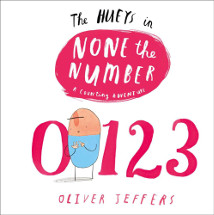
The Hueys in none the number by Oliver Jeffers
HarperCollins, 2014. ISBN 9780007420698
(Age: 3-6) Recommended. How do you explain the concept of none,
nothing, zero? That something that isn't even there is something?
This is one of the most difficult mathematical concepts for very
young children to understand, given that they are still very much in
the concrete stage of development, yet given its importance in maths
it is one of the most critical. And in this charming counting book
Oliver Jeffers manages it perfectly.
Using his quirky characters The Hueys, he builds up the idea by
adding one to none to get a blue telephone and then two beds until
the big day building up to a crescendo of items that are suddenly
taken away leaving none. Jeffers doesn't confine himself to the
usual objects found in counting books - each collection is a story
in itself like the seven oranges being balanced on things. Why would
you try to balance an orange on something? Or the teddy-shaped
parcel that becomes everything from a tennis racquet to a train set.
And the nine seagulls that steal Frank's chips just invite the young
listeners to share their own stories.
Oliver Jeffers has a knack and a reputation for making the ordinary
extraordinary and this third adventure of these lovable characters
is no exception.
Barbara Braxton
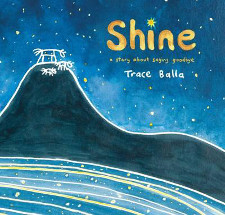
Shine: A story about saying goodbye by Trace Balla
Allen & Unwin, 2015. ISBN 9781743316344
(Age: Preschool + ) 'Far, far away and long, long ago, on a
beautiful planet, amongst the golden stars there lived a young
horse. He was so kind and bright, so sparkly and shimmery, that
everyone called him Shine.' Shine galloped with the other horses
under the smiling moon until one day he met Glitter, the loveliest
horse he had ever seen and soon Sparky and Shimmer had come to make
a beautiful family. But sadly and too soon, Shine had to return to
the stars and Glitter, Sparky and Shimmer are heartbroken, crying an
ocean of golden tears and climbing the high mountain of grief until
they finally see and understand the overwhelming size of the love
they shared. And far above, the brightest star of all shines on them
and brings them peace.
Trace Balla wrote this book for her niece and nephew when they lost
their dad, suddenly and unexpectedly. Even though it is so difficult
to explain the inexplicable to young children, it gave them a moment
of peace and beauty and moments are sometimes all you can get at
such a difficult time. But it also gave them reassurance that they
were still surrounded by love, and hope that, in time, they would see
their Shine shining down on them.
We tend to think of death as adult-business but whenever an adult
dies there is so often a young child deeply affected and trying to
come to terms with the loss, not quite understanding the finality
and perhaps blaming themselves for not being good enough. Whatever
the circumstances of the death, it is essential that the child knows
they were loved deeply and will continue to be so, and this story
not only shows that but celebrates it. It acknowledges and allows
the sadness of all those left behind, the grieving process is
accurately depicted as a huge, steep mountain to climb that will
take time but it also shows that it can be conquered and that there
is still joy in the world. Little people don't have the vision to
see beyond the horizon and so a story like this gives them some
comfort that eventually the hurt starts to heal and the love shines
through. They have not been abandoned, they are not lost and they
are still loved.
Because school is often the one constant in the child's life at this
time and particularly if the child is not involved in the final
farewell process, it often falls to the teacher to provide the
support that is needed and having a story like Shine to
share gives them a starting point to share and talk with the child.
It is gentle, it is reassuring and based on the belief that 'We all
come from the stars, we all go back to the stars' it can be shared
without risk of contradicting any religious beliefs.
Sadly, this particular copy will not be added to the collection at
my school - it is on its way to a little person who needs it right
now and who will get great comfort from it. I thank Carolyn Walsh
from Allen & Unwin for making that possible.
Barbara Braxton
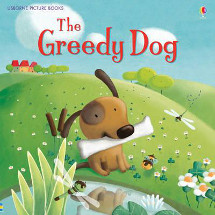
The greedy dog by Rosie Dickins and Francesca di Chiara
Usborne Picture Books, 2015. ISBN 9781409584841
(Age: Preschool - Yr 2) Dog is always hungry and his thoughts are
always about food. Even though he had already had a slice of steak,
half a ham and a whole string of sausages, he was thinking about his
dinner. In the market town it is market day and his nose leads him
to the butcher's stall where there are all sorts of delicious doggy
delights - in particular, a big juicy bone that is irresistible.
Carefully, he sneaks up and snatches it, hightailing it out of town
before anyone can catch him.
Delighted with his daring and his success, he runs until he comes to
a river and the cool water reminds him he is thirsty and needs a
drink. But as he bends over the water, he sees another dog with a
bone, fat and juicy and bigger than his. He is determined to have
it.
This is a retelling of The dog and his reflection, a fable by Aesop
that dates back hundreds of years. Written in an entertaining way
and brought right up-to-date with lively, colourful illustrations it
provides the platform for a discussion about being content with what
we have as well as a springboard to other fables, their format and
messages. Are stories meant to entertain us or educate us, or is
there room for both? It could be the start of having even very young
students start looking below the surface for the juicy bones beneath
- the message that the writer is trying to help us understand.
But even without the philosophical discussion, it just a lovely
story to read aloud to our youngest readers.
Barbara Braxton