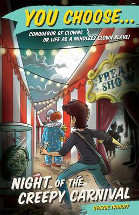
Random House Australia Children's, 2015. Night of the creepy carnival. Bk 5. ISBN 9780857986696 Alien invaders from beyond the stars. Bk 6. ISBN
9780857986719
(Age: 9+) Highly recommended. When I received my first copies of
books from this series I road tested them on my grandson who is
somewhat of a reluctant reader. In fact, he was staying at my place,
picked them up and didn't put them down until he'd finished each. To
me that's a pretty fair indication of how they will be received in
your library. These latest two have gone to another young man who
might enjoy them and I await his response eagerly. I know I'm pretty
hopeless - I couldn't get past 3 choices until I was exterminated so
I hope he does better!
George has cleverly taken all the great aspects of gaming and
transformed them into book form where readers can challenge
themselves to achieve the end goal. While primarily aimed at Middle
Primary to Upper Primary these can be enjoyed by readers of all ages
and certainly, if you have readers who struggle these would be a
superb choice as the level of engagement and the appeal of the
subject matter are perfect. Readers will persist with their reading
quite naturally as they attempt to navigate their way through all
the pitfalls of each story.
Clowns are considered very sinister in our family so the Night
of the creepy carnival is well named and I didn't like being
caught out by them at all! Aliens are marginally less scary but
still enough to appeal to those readers who like a good safe fright.
I remember so well how my own girls used to love the 'choose your
own adventure' format (especially The famous five series!) and
think the timing of bringing this style of fast paced interactive
reading back to the attention of a new readership is perfect.
Highly recommended for readers aged around 9 and up. Do you have
what it takes?
Sue Warren
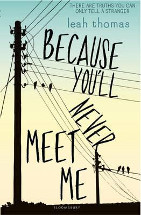
Because you'll never meet me by Leah Thomas
Bloomsbury, 2015. ISBN: 9781408862629
(Age: 11+) Recommended for able readers. Themes: Disabilities;
Coming of age; Genetic experimentation; Science fiction; Friendship;
Bullying; Loneliness. In this well-written debut novel by Leah
Thomas, the two central characters write to one another to overcome
the isolation of their lives that are debilitated by unusual
physical conditions. Ollie lives a virtual electricity-free
existence with his mother, isolated from the community around him
because of his 'allergy' to all things electrical (we discover
later, that his condition influences him negatively, but that he
impacts electrical devices too). He is quirky and honest, and makes
an effort to be positive in all things; his life has always been in
this non-electric bubble - no phones, television, internet, so
effectively he is living a virtual-Amish lifestyle. Initially there
is only one visitor - a medico-scientist who links him to another
teen living in Germany, to whom he connects honestly via letters.
The German teen, Moritz, was born with no eyes and yet is able to
'see' using echo-location, he also has a Pacemaker to overcome his
cardio-myopathy. His angst and distress with his life is expressed
honestly and with some pathos as he deals with a school bully and
his social isolation. Ollie and Moritz will never meet . . . the
electricity from the pace-maker would be mutually destructive and
their differing perspectives of life are impacted by their culture
and experience, so initially the 'friendship' appears to be
completely one-sided.
When Ollie is visited by a local girl, Liz, whose friendship changes
him, he shares the impact of her life and 'spark' into his life with
Moritz. Tragedies happen for both boys, but eventually the history
of some 'experimentation' that has created their unusual physical
expressions becomes the focus of the book as Moritz reveals the
drama of their shared history.
The circumstances of this book are not realistic, but the characters
express real emotional responses to difficult circumstances, and
their normal teenage concerns will connect with a young adult
readership. Readers who enjoy John Green fiction will enjoy this
book. It has light-hearted moments, and pathos, and although the
circumstances are not real, it is easy to identify with the two
lonely and isolated teens and empathise with their pain, but also to
see that there is some hope for their future.
Carolyn Hull
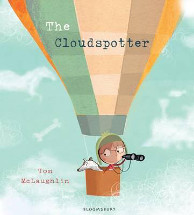
The cloudspotter by Tom McLaughlin
Bloomsbury, 2015. ISBN 9781408854969
(Age: 4+) Recommended. Clouds, Imagination, Daydreams, Friendship.
Franklin is a cloudspotter. He spends the day with his binoculars
and backpack spotting all the clouds in the sky. He imagines them to
be all sorts of things and then imagines himself to be part of them,
in them, on them or driving them. One day a scruffy dog begins to
hang around Franklin. Franklin has no friends and decides that he
does not need any so when the dog stays around more often, becoming
part of his daydreams, he does something about it. He makes a hot
air balloon and puts the dog into the basket and sees him off.
But he soon realises that he misses the dog, the dog had become his
friend. Fortunately the air balloon snags on a tree and the two are
reunited. They can now watch the clouds together and have adventures
together.
This is a lovely story of friendship, of not seeing a friend nearby
until it is almost too late, of doing things together.
I loved the soft illustrations, conjuring up the feel and look of
various clouds in the sky, drawing them to suggest the images the
child sees in them.
As a lovely tale of friendship or as an introduction to a group of
lessons about clouds and their formation, or lessons outside looking
at clouds this book will prove to be most helpful.
Fran Knight
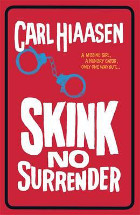
Skink No Surrender by Carl Hiaasen
Orion Children's Books, 2014. ISBN 9781780622194
(Age: 12+) Recommended. Themes: Internet dangers; Environmental
issues; Adventure. A young teen meets an unusual environmental
warrior while waiting on the beach for his cousin who is due to go
away to boarding school. This girl does not show up and eventually
it is revealed that she has run away with someone she met on the
internet. The environmental warrior who lives as a virtual hermit,
but who is also a returned soldier and former governor and is also
apparently 'dead', decides to help Richard find his cousin. They
embark on an amazingly risky search through the alligator populated
swamps and rivers of Florida.
This is an exciting rescue and although it stretches believability
on many occasions, is still an engaging adventure story. Hiaasen
introduces environmental themes that are linked loosely through the
story, with references to a presumed extinct woodpecker and the
protection of loggerhead turtles laying their eggs on the beach.
Carolyn Hull
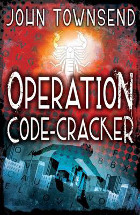
Operation Code-Cracker by John Townsend
Black Cats Series. Bloomsbury, 2015. ISBN 9781472906816
(Age: 8-10) Recommended. Themes: Codes, Spies, Mystery, Adventure.
The Black Cats series written by popular British authors
targets the newly confident and high interest-low reading age
audience. The chapters are shorter, some illustrations are included
and the novels are structured to build reading confidence.
John Townsend's Operation Code-Cracker is filled with spies,
action, adventure, clues, codes and car-chases. Max is staying with
his father in his old run-down house in London. When his football
disappears into the neighbour's yard, Max is caught up in a spy
network. The creepy man Max calls The Child Catcher has been
watching the father and son, knows all their routines and recruits
the ten year old boy to help in a situation of national security.
The reader is drawn into the action with codes and puzzles to solve,
Max's special skills help to save the situation. Max enlists his
Gran's help they hop in her pink Morris Minor convertible, and race
across London to save Miya who has been kidnapped. A surprising
ending brings this story to a thrilling conclusion.
Rhyllis Bignell
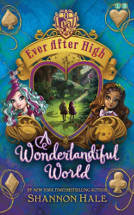
A Wonderlandiful World by Shannon Hale
Ever After High Series. Hachette, 2015. ISBN 9780349131870
(Age: 9-12) Shannon Hale's Ever After High trilogy comes to an
exciting conclusion in A Wonderlandiful World. This
fairytale world is filled with aptly named, colourful characters,
overflowing with fairy puns and unique language. With embellished
borders and flowery phrases, themes of good and evil, magic and
mayhem, this is definitely a story the fans will enjoy.
This story shifts the focus to the Wonderland characters, Maddie
Hatter, Lizzie Hearts, Kitty Cheshire and Cedar Wood who is
Pinocchio's daughter. There is a mysterious force overpowering Ever
After High and everything is badly affected. The evil Jabberwocky
has been released from prison and is determined to destroy Ever
After. As the Ever After students magically change into objects -
Apple White's face turns rosy red and a branch sprouts out of the
top of her head, the Wonderland characters become real - Cedar's
body transforms from wooden to human. Other students change into
animals, the furniture comes alive and the school grounds fade to
black and white. There are mad chases, unexpected events and even
the Narrator has problems continuing the story. Maddie is forced to
become the narrator and her friends are caught up in the evil magic,
as this fast-paced and crazy adventure comes to a surprising end.
For fairy tale fans from 9-12.
Rhyllis Bignell
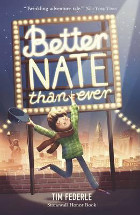
Better Nate Than Ever by Tim Federle<br>
Walker Books, 2015. ISBN: 9781406361537
(Age: 13+) Highly recommended. The warmth and humour of the main
character, Nate, make this book a really great read that will appeal
to all ages.
Nate, has big aspirations, but is trapped in a small town. His best
friend, Libby helps him plan an escape to Broadway where he hopes to
make his dreams come true by winning a role in a musical version of
ET. This story waltzes you along with the adorable Nate and
surreptitiously feeds the back story of love, relationships, family,
forgiveness and hope.
The story gently and thoughtfully touches on the small town response
to a young man who wants to sing on Broadway.
'My sexuality, by the way, is off-topic and unrelated. I am
undecided. I am a freshman at the College of Sexuality and I have
undecided my major, and frankly don't want to declare anything other
than "Hey jerks, I'm thirteen, leave me alone. Macaroni and cheese
is still my favorite food - how would I know who I want to hook up
with?"
The reader can't help smiling and laughing and completely relating
to the main character, Nate, as he bravely negotiates New York City
and the cut throat world of Broadway auditions, ably supported by
Libby, Freckles and Heidi.
Linda Guthrie
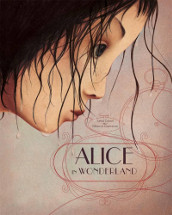
Alice in Wonderland : Down the Rabbit Hole a Modern Retelling by Lewis Carroll <br>
Retold by Joseph Rhatigan and Charles Numberg. Ill. by Eric
Puybaret. Koala Books, 2015. ISBN 9781742761411
The 150th celebration of Alice's Adventures in Wonderland by
Lewis Carroll this year, was the impetus for publishing this picture
book retelling of part of the classic tale. Young readers are
introduced to Alice, the White Rabbit and a few of the animals that
inhabit the topsy-turvey world down the rabbit hole, in a way that
retains the magic of the original but in a simplified, modern style.
Sitting on the river bank Alice is having an ordinary day when a
white rabbit ' . . with pink eyes, a red jacket and a great big
pocket watch' runs by. Being a curious girl, Alice follows him and
finds herself falling down the hole only to see the rabbit disappear
down a hallway at the bottom.
Alice has a disconcerting time either drinking or eating cake,
making her smaller or bigger in an effort to access the beautiful
garden on the other side of a tiny door. There she meets Mouse,
Duck, Eaglet and Dodo before once again following the rabbit and
finally coming across the Blue Caterpillar who helps her return to
normal size. As Alice wonders how to get back to the riverbank she
knows that what lies ahead will not be so ordinary after all.
The phrases which are most remembered from this early part of the
story such as 'Curiouser and curiouser!' and 'Oh my ears and
whiskers how late it's getting' are retained in this retelling which
is but a small part of the whole and certainly much more accessible
for young readers than the original.
The richly coloured illustrations help the reader manage the
absurdity of Alice's situation as we look down on a shrinking Alice
and up at her growing. The animal characters have a human feel
dressed as they are in top hats and coats especially the White
rabbit as he zooms through the pages focussed on his watch. The
background plants and trees have a surreal look with the last page
hinting at other characters yet to come with a tea party setting in
the distance and a smiling cat perched in a tree.
Sue Keane
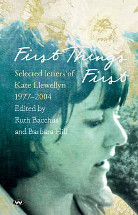
First Things First: Selected Letters of Kate Llewellyn 1977-2004 edited by Ruth Bacchus and Barbara Hill
Wakefield Press, 2015. ISBN: 9781743053645
(Age: 16+) Highly recommended. Ruth Bacchus and Barbara Hill are
researchers at Charles Sturt University (Bathurst). They have
compiled an anthology of letters written by Kate Llewellyn to her
friends and fellow authors and writers.
Kate Llewellyn (poet and author) has published many notable works,
including her most recent book, A Fig at The Gate (2014).
These letters have the reader peeking into Kate's life to see her as
funny, vulnerable, weary and energetic. The letters give insight
into her simple pleasures such as making Christmas cakes, growing
seeds and gardening. They also describe her as a writer, from
miserable experiences as a writer in residence to pleasant surprises
such as a reviewer (SA's Katherine England) actually reading her
work when Kate's experience was that many reviewers had not actually
read her work.
They also reveal an author who was constantly on the move and had
opinions on feminism that were bold for their day.
'I took a taxi home and the driver said I was the third drunk lady
he had driven that night and wondered what was going on in the town
and I said 'It's the Women's Arts Festival, mate, and there's about
a thousand of us in the same state'.
Kate, and the recipients of the letters, are still alive.
Opportunities to hear her speak lend authenticity to these letters
and reinforce the frankness and honesty with which she writes.
Linda Guthrie
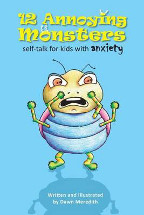
12 annoying monsters: Self-talk for kids with anxiety by Dawn Meredith
Shining Press 2013. ISBN 9781876870669
As a teacher, Dawn Meredith has encountered and worked with many
children suffering from anxiety - anxiety so debilitating that it
interferes with their daily lives. As a sufferer herself she felt
she had something to offer them to help them help themselves and so
she has written this book in which she talks directly to the child
to help them understand their fears and then overcome them.
Using language they can understand but which treats them with
dignity and acknowledges their intelligence, she explains what
anxiety is and invites them to analyse their feelings, offering
lists of words that will help describe them. She also offers
step-by-step suggestions for getting in control such as breathing
deeply, letting yourself go floppy and banishing the bad thoughts.
Because she has already taught the child about the physiological
effects of feeling anxious, these steps connect directly to this and
so make sense. That in itself is calming and helps the sufferer
understand that they can be in control.
She then tackles the twelve annoying monsters that are the most
common causes of anxiety in children such as 'Bad things always
happen to me'; 'Everything must be perfect'; 'I'm all alone and no
one loves me' and 'It's my fault.' For each one there is an
explanation of the message the monster is giving showing that the
monster is wrong, is a liar, or is pathetic and then offers
suggestions for self-talk to drown out its voice and practical steps
to banish it. Apart from all of the great advice in this book, the
fact that it's available shows that no one is alone with their
fears, they are not freaks but a member of a larger group all with
the same feelings, and offers the sufferers some comfort. 'No one
would bother to make the time and energy to write such a thing if
your fear was unique and isolated - you are not alone in this' can
be the message that starts the road to recovery and control.
Given that as teacher librarians we are often the first port of call
when someone wants a title that will help a child in a specific
situation, this is a must-have on the shelves and worth a whisper in
the ear of any students you know that need it. More information is
at the author's website.
Barbara Braxton
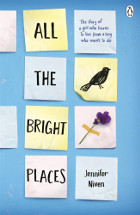
All the bright places by Jennifer Niven
Penguin, 2015. ISBN 9780141357034
(Age: 16+) Recommended. Suicide. Grief. Mental Illness.
Bullying. This is the first YA novel from an established American
author, and in this poignant and heart-wrenching novel she addresses
some very complex issues that have personally shaped her life.
Recent YA novels, like John Green's The Fault in our stars,
have addressed serious and challenging issues of life and death and
this novel by Niven is in a very similar style; pathos and humour
interwoven with the challenging issues of family grief, mental
illness and suicide. All the bright places begins with a suicide rescue as the two
central characters meet while both are staring at the ground from
the high vantage of the school bell tower. 'Is this a good day to
die?' is the opening line. From this precarious start, we are
introduced to Theodore Finch and Violet Markey, who are both dealing
with weighty issues in their life; one who is obviously troubled by
grief and the other unique in his tenuous and unusual hold on life,
sanity and the world. Their encounter begins a friendship and
eventually a romance that takes them wandering through their home
state, all the time gathering unusual memories and experiencing the
roller-coaster ride of romance, mental illness and the life-altering
grief that comes with an untimely death. This sounds incredibly
grim, and yet there is real humour and joy as we see life through
the eyes of the charming yet strange Theodore, and the
slowly blossoming Violet. The impact of grief on Violet is to rob
her of creativity, and yet Theodore seems able to draw out of her a
new vision of the world and of life. References connecting the
central characters to the words of Virginia Woolf and other literary
masters who battled (and lost to) depression, are scattered
throughout the book. Relationships with adults are secondary in this
book, but seen through the eyes of the young people, we get a
glimpse of the difficulty that depression, mental illness and grief
are for teens. The adults too, are battling their own issues, and
counselling and strategies to move forward are not clear cut.
Bullying and violence issues are also highlighted in the book and
demonstrate that young people do not deal well with mental illness.
School is not always a good place to find 'bright places'.
My concern with this book is that the issues it deals with may be
too weighty for some young people to handle well. Recommended, with
some trepidation, for 16+ readers, as identifying the vulnerable is
not always easy, and this book may be too confronting for some,
particularly for those battling their own mental health issues.
However the book's transformation to film will invariably mean that
younger readers will be wanting to read this too.
Carolyn Hull
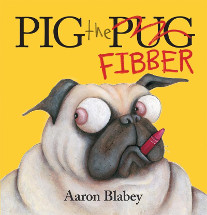
Pig the fibber by Aaron Blabey
Scholastic, 2015. ISBN 9781743629062
(Age: 4+) Highly recommended. Humour. Lying. Relationships. The
irrepressible Pig the Pug is back with Blabey's hilarious dog
staring out from the front cover, a crayon in his mouth, the word
Pug crossed out and fibber overwritten. Pig's eyes are nervously
darting to the left, knowing he has done something wrong and waiting
for his discovery, a story already developed to explain what
happened. So much on the front cover! And the fun continues inside
as we see the poor sausage dog, Trevor, lounging cheerily on his
bed, unaware of the blame about to be apportioned to him.
I love Blabey's work. His rhyming stories are filled with interest
and layers of meaning. They appeal to the reader and listener, to
the child and the adult, the discussion ensuing from the tightly
controlled stories always a treat, while the illustrations so full
of character and mirth, are sure to engage any reader in the
insights offered into human behaviour.
As the reader turns the pages of this book, Pig's misdeeds are
shown. Each double page has Pig doing something wrong, and then
blaming the hapless Trevor. Many children will recognise the
character, friend, sibling or foe who blames them for someone else's
bad deeds, and so will turn the pages to see how this story is
resolved.
Pig wants to get at the bag of biscuits placed in a high shelf. He
lets off a huge stink, blaming Trevor, of course, which clears the
room, and while no one is about scrambles on a chair to get at the
bag, with disastrous consequences.
A lovely story of greediness, of blaming others, of lying to get
your own way, children will laugh out loud at Pig and his antics,
and love the resolution where the long suffering Trevor still has
enough compassion in his heart to help Pig in his convalescence.
Fran Knight
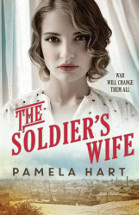
The soldier's wife by Pamela Hart
Hachette, 2015. ISBN 9780733633737
(Age: Upper Secondary students) Well recommended. This is a story
of a society in 1915 where women stayed at home looking after their
children. Ruby is just married and Jimmy has gone to war. She finds
a position with Mr Curry's city merchant timber yard. She comes
under scrutiny from the two junior clerks who find a woman in her
position difficult to accept. Mr Curry's son is the Lieutenant in
her husband's force and as the story continues this is the link that
helps Ruby survive, for being a woman in an important position is
not a welcome sight. When her badly injured husband returns, Jimmy
has difficulty with her having job. His injuries and their inability
to communicate sensitively, lead to an almost fatal finale. It's a
time when women had to step in to help with the war overseas but the
returning soldiers had their horrendous nightmares and physical
issues to deal with and Jimmy was wanting to return to the time of
bliss when he left Australia's shores.
It's a compassionate story, no doubt very common and least
understood, even today. Ruby is portrayed as a caring, sensitive and
brave woman, who understood the people she worked with and tried to
understand the husband who came home.
It is a well described story of the times and emotions of the
characters involved. So many stories have been written and this is
realistic, strong and believable.
The text is clear and the style belongs to the era.
Sue Nosworthy
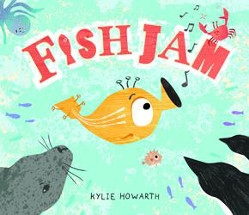
Fish jam by Kylie Howarth
Five Mile Press, 2015. ISBN 9781499800982
(Age: 3-8 years) Toot the fish loves making noise. He swims through
the sea 'scooba-dooba-diddly-dooo'-ing and
'beep-bop-bubbly-booo'-ing, but none of the other sea creatures want
to play with him because they think he is too noisy. Toot is pretty
downhearted. He can't stop making his loud, musical noises but he
keeps being told to 'shhh' and 'shoo!' It isn't until Toot is
unexpectedly swallowed by a huge blue whale that he finds a place
where he fits right in - in the band living inside the whale's
stomach!
This fun picture book uses simple, large illustrations and texture
created through layered colours and printing. Bold writing gives
precedence to the sounds being made by Toot and the other sea
creatures, encouraging young children to make the sounds themselves.
Toot himself is a funny looking fish which highlights the musical
theme of the story. He is the colour of a brass instrument, has a
horn for a nose, clarinet buttons on his back and a guitar tail. The
illustrations focus on facial expressions and emotion as Toot
becomes sadder and sadder as he is shushed and shooed by the other
animals. We also see the anger of the great white sharks as they
shoo away Toot with their stern eyes, sharp teeth and oversized
'SHOO!' The second-to-last page folds out to show the inside of the
whale and the band of sea animals.
This book contains limited narration with only 6 sentences
throughout. Told largely through illustrations, and with the aid of
the dialogue and sounds made by the sea animals, this story is
useful for encouraging inferential comprehension and prediction.
Young children will also enjoy reading the story themselves using
the illustrations and their own imagination.
The last page explains, in a simple sentence, the concept of scat
singing, where nonsense syllables are used instead of words to sing
a song. It encourages the reader to use their own voice as an
instrument and make up their own sounds to make a song. In addition
to its usefulness in text comprehension it would be great to use
when teaching melody and in encouraging children to experiment with
making music. The style of the writing and the illustrations invite
children to become active participants, and is a perfect text for
discussion and involvement.
Nicole Nelson
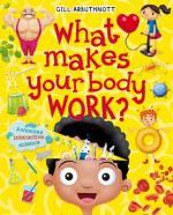
What makes your body work? by Gill Arbuthnott <br>
Ill. by Marc Mones. Bloomsbury, 2015. ISBN 9781472908865
(Age: 9-11) This is a subject every youngster is curious about,
themselves and their body. This book gives the reader information
about various systems and parts of the body, as well as activities
to demonstrate the points made. It will be a useful addition to the
bookshelf for Primary students or Teachers looking for simple
information and experiments.
The brightly coloured pages have simplified textual information
accompanied by either labelled diagrams, as in a cross section of
the human skin, or engaging coloured cartoon styled children adding
information in speech bubbles. The text helps younger students
understand by making comparisons to familiar objects, such as the
blood system related to different sized roads and the surface area
of the villi in the gut equating to a tennis court.
'Try it Yourself' sections accompany almost all chapters giving easy
step by step instructions for the reader to follow, and an
explanation of what they should observe. If equipment is needed
simple diagrams accompany the description.
Thankfully, there are some chapters at the end under the heading
'You can't try it yourself' which include the urinary, reproductive,
hormone and immune systems.
The inclusion of a glossary and some websites, of British origin, to
enable the young researcher to gather more information adds depth to
the information given. An index enables a quick search when looking
for a specific word, while the contents page gives an easy reference
to each chapter.
Sue Keane