Book Island, 2015. ISBN 9780994109873
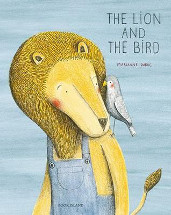
(Age: 4+) Recommended. Originally published in French in Canada and
now published in more than 15 countries around the world, this is a
heart-warming tale of an unlikely friendship between an
overall-wearing lion and a bird with a broken wing. There are 40
double pages here, but only around 20 with text. Furthermore, each
contains only one sentence, often only one word. The limited text
means that the illustrations have to do most of the work, and they
do this so well. The artwork is spectacular. It is soft and textural
with an earthy colour palette of browns, blues and greens. In a
minimalist style, Dubic puts onto each page only those elements
which help to tell the story and show the passing of time. There is
a cinematic, silent film quality here; you could just as easily
ignore the text altogether and the artwork would do the job just as
well. High quality paper adds to the earthy feel of this book and
the matte illustrations suit the solidity of the thick pages.
The story itself is about a lion who takes care of a bird with a
broken wing when the rest of the flock fly away for the winter. Soon
the pair is enjoying the winter together: reading in front of the
fire, taking sleigh rides and keeping warm out of the snow. Blank
pages help to show the all-encompassing whiteness of the snowy
weather. Soon the warm weather is back and the bird must re-join his
flock. The reader waits anxiously alongside the lion to find out
whether his friend will join him for the winter again.
This is a gentle and emotive tale exploring themes of friendship,
change and loneliness. It is perfect for working with children on
inference and exploring how we can tell a story with pictures alone.
It also lends itself to discussions around seasons and change as the
changing landscape is an integral feature of the book. This is a
wonderful title for one on one sharing as it allows for rich
discussion and up-close appreciation of the illustrations.
Nicole Nelson
Trigger Mortis By Anthony Horowitz
Orion Books, 2015. ISBN: 9781409159537
(Age: 16+) Highly recommended. This book was read in one sitting, as
it just refused to be let go. The Ian Fleming Estate provided
Anthony Horowitz with original, unpublished writing for this book.
This book reacquaints the reader with M, Moneypenny, Pussy Galore
and a range of dastardly villains guaranteed to keep you on the edge
of your seat.
007 is in a deadly mission against the Soviet organisation SMERSH
and Korean Jason Sin. He must enter a Grand Prix race and save the
American Space Program. The stage is set for action at its most
thrilling.
The story is fast paced and so well written the reader is almost
pulled along from one heart stopping event to the next. Horowitz has
spared no effort in providing authentic detail for Grand Prix racing
and the massacre at No Gun Ri. He also relates the inner thoughts of
007 in such a natural way the reader almost feels the thoughts are
their own.
An interesting inclusion in this story is the tension where 007 is
deciding whether to dispatch a character. His 007 status explained,
he makes a decision the reader is at first confronted by. The James
Bond in this book is a man of Ian Fleming's times who is challenged
by the sensibilities of the modern world. It makes great reading.
Linda Guthrie
The Mirror World of Melody Black by Gavin Extence
Hodder & Stoughton, 2015. ISBN 9781444764628
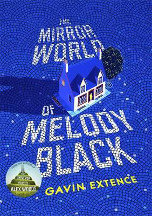
(Age: Adult) Highly recommended. 'You have a choice about what you
put into the public domain.'
This book is really difficult to put down. It tells Abby's story
from her perspective as Abby spirals into a manic episode following
finding her neighbour dead in the flat next door.
Abby is inspired in her mania - brilliant ideas and fashion choices
emanate from the page as she describes her adventures. Is it
possible for the reader to identify the point where Abby tips into
madness? The writing is compelling and there is a very real sense
that the writer has first-hand experience with this mental illness.
The author's note at the end of the book put this in perspective and
adds an authenticity to the writing.
Abby's very supportive psychiatrist plays a key role in rescuing
Abby as she plummets into depression. It is while undergoing
treatment in hospital that Abby meets Melody Black and the
significance of the title of the book becomes clear.
Another key aspect of the book is the development of the
relationships in Abby's life. The incredible resilience and caring
of the family and loved ones standing by Abby throughout her episode
and the mysteriously satisfying remote relationship with poet
Miranda Frost are detailed with humour.
Linda Guthrie
Azizi and the Little Blue Bird by Laila Koubaa and Mattias De Leeuw
Book Island, 2015. ISBN 9780994109866
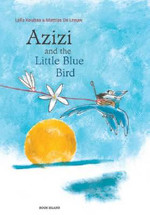
(Age: 5-12) Recommended. Picture book. Azizi lives in a country
dominated by two greedy rulers. They feast and feast and expand with
both food and power. They have captured all the blue birds in the
land and have locked them up in their palace.
Azizi feels he and his people are shrinking while the rulers expand.
One night an escaped blue bird visits Azizi and together with a
trail of threaded flowers they embark on a plan to free both the
birds and people.
This story can be enjoyed both as a modern fairy tale, or as a
symbol of people power overthrowing a cruel regime. According to the
website the events in
this book are based on a true incident: 'in 2010/2011 when,
during the Arab Spring the internet was censored and/or shut down
during the uprisings, in an attempt to prevent protests from
spreading over the region. The little blue birds - have you already
guessed it?- refer to Twitter. '
The author is Dutch and the original text has been translated by
David Colmer.
This is a large format picture book and the illustrations by Mattias
De Leeuw fill each page with strong lines and bold colour.
I recommend this book for primary school libraries and children from
5 to 12 will enjoy this story at its many levels.
Jane Moore
Counting Stars by Keris Stainton
Hot Key Books, 2015. ISBN 9781471404634
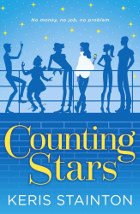
(Age: Adult) Anna is eighteen and desperate to leave home and begin
her life. Her passion is to work in the theatre. While on work
experience she is offered a job in Liverpool and decides to take the
plunge and move there.
She shares a flat with characters who are also finding their way as
young adults. Each character has an intricate and moving story, told
well. The characters are well drawn and have the reader at turns
sympathising and cringing in embarrassment.
An underlying and important element of this story explores the
ethics and dangers of chronicling your life (and the lives of
others) using social media. Anna's very public diary is her way of
making sense of her maturing world, and she soon comes to find there
are consequences for her and those she reveals through her vlog.
This is a book about romantic relationships. It sensitively explores
the tricky issues of sexual harassment, inappropriate relationships,
abusive relationships and gay relationships. It is, however, the
explicit descriptions of the more intimate scenes in these
relationships that moves this book into the adult range. This is
unfortunate as the story holds much for, and is well suited to, the
young adult reader.
Linda Guthrie
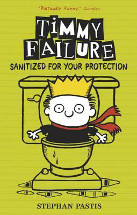
Timmy Failure: Sanitized for your Protection Stephan Pastis
Walker Books, 2015. ISBN 9781406363494
(Age: 9 yrs+) Recommended. Timmy Failure is back again, seeking
greatness and world domination as the CEO of Failure Inc., formerly
Total Failure Inc., detective agency. Whilst modesty is not part of
Timmy's nature his natural tendency to take a simple situation and
cause extraordinary havoc has not diminished. Sparkling comedic
writing combined with quirky line drawings makes Timmy a winner not
a failure.
This episode in the ever eventful life of our hero, revolves around
a road trip to Chicago during spring vacation to relocate Doorman
Dave, Timmy's mother's boyfriend. But this simple holiday is getting
in the way of Failure Inc. solving a case. The funds raised by YIP
YAP to buy books for poor Yergi Plimkin 'a boy from somewhere that
is not here' have gone missing. Timmy is of course focussed on
solving the case which takes up all his thinking and deductive
powers.
Further complications include Total, the polar bear, leaving a path
of destruction and bonbon papers behind him, The Moskin family who
travel with them, and Timmy overhearing his mum and Dave talking
about marriage.
Forced to go on the run with Mollie Moskin in an effort to finally
solve the case and hopefully confront the culprit, leads to even
more chaos and hotel staff on the verge of a breakdown. Finally
Timmy is apprehended himself and returned to his mother whilst the
case solves itself and Timmy makes someone's night 'because
detectives are tough and decent men'.
This is a delightful romp, easy to read and funny enough to laugh
out loud at. Some of the word plays and chapter headings like 'Suite
dreams are made of this' and 'Grapes and Wrath' may not resonate
with some students but certainly added to my enjoyment of the book.
Sue Keane
Guinness World Records 2016 by Guinness World Records
Guinness World Records 2016 by Guinness World Records
Guinness World Records, 2015. ISBN 9781910561010
(Age: All) Recommended. The Guinness World Records book
needs no introduction. Chock full of incredible new records, strange
trivia and interesting illustrations, it is a must for every library
and a book full of appeal for the reluctant reader.
Some of the most eye catching entries include the tallest man (251
cm. tall) and a page of incredible extreme body modifications
(tattoos and facial flesh tunnels). All are portrayed with colourful
photos that grab the imagination. New entries include waterfalls,
apps, manga, drones and pirates as well as other interesting topics.
For those who want their reading a bit more focused there is a Table
of Contents which includes headings like Sports, Science and
Engineering, Animals, Humans, Adventurers and Extreme Exploits to
name a few. An index is also available and would be helpful for
those who want to target particular records. Enthusiasts can also go
to the website,
and get extra information and background stories by reading the book
and finding the answers to questions.
Once again Guinness World Records 2016 will be sure to
astound readers as they flick through amazing records and photos, or
read in more depth about the staggering things that people can get
up to and the incredible animals that can be found. This is a must
for libraries and would make a great present for children with
inquiring minds.
Pat Pledger
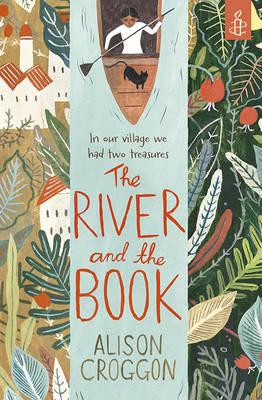
The River and the Book by Alison Croggon
Walker Books, 2015. ISBN 9781925081725
(Ages 12+) Recommended. The River and The Book has been
acknowledged by Amnesty International for addressing human rights
abuse in cultural, and economic terms. Poetically written this book
will be an asset to for its literary and thematic content. Simbala
is the Keeper of the Book and as the women in her family before her
is an important member of the village in which she lives. People
come to consult the Book for many reasons but Sim is the only one
who can touch it or read its messages. The book contains the history
and soul of the village, and like the oracle has the answers to all
the villager's questions.
The River is the life blood of the village bringing life and riches
as well as providing transport. Droughts cause the river to fail but
when developers upstream reduce the flow and begin polluting the
River, neighbouring villages are turned against each other. When
consulted the Book offers a one word answer to the problem,
'Change.' However change arrives in the unexpected form of Jane
Watson, a foreigner intent on writing about the river people, who
befriends Sim but betrays her trust, steals the Book and disappears.
Desperate to return the book to its rightful place Sim travels down
the River in search of the thief, vowing to only to return when she
has recovered the treasure. Along the way she meets a variety of
companions, and eventually settles in the city, still searching for
Jane. She finally discovers Jane is working at the University and
has published a book highlighting the plight of the River and the
people who rely on it for their living.
Why someone would assume they had the right to take a community's
most precious property is foremost in Sim's mind and could be a
stimulus for deep discussion between students in an exploration of
human rights and ethics. The divide between cultures and the assumed
rights of westerners is foremost but the book is also an
introduction to discussions surrounding development, pollution and
change.
Sue Keane
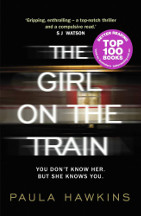
The girl on the train by Paula Hawkins
Doubleday, 2015. ISBN 9780857522320
(Age: young adult) Crime fiction, Alcoholism, Marital relationships.
After reading some fabulous reviews I bought this at Dymocks last
week and spent the rest of the week reading. It certainly grabbed me
and I wanted to piece together the jigsaw puzzle of Rachel's life as
she stumbled from one failed attempt at getting herself together
after another. One night, drunk again, she finds herself near her ex
husband's house. She sees something but is uncertain as to what it
is and struggles to remember the next day, waking bruised and
bleeding. But it is the same night that their neighbour Megan,
disappears, and Rachel is drawn into the investigation. She is sure
she knows something, but lies to get the attention of the missing
woman's husband and becomes an intrusion in the police
investigation.
She has seen this couple on the train every morning as she goes to
work. Fired for being drunk some months before, she still travels
into the city but when the train stops for a signal change she
watches the house, a few doors from her old house, and its
occupants, Megan and Scott, creating a romantic life for them. But
now Megan has gone, Rachel still haunts her old house much to the
anger of her replacement, and despite attempts by her ex husband and
the police to keep her at bay she persists, trying to remember what
she has forgotten.
The book is told through three women's voices, Rachel, Megan and
Anna, the new wife, in varying chronological order, giving the
reader the background while the story progresses. I was hooked as
many people have been, and I enjoyed the character of Rachel, trying
to overcome her alcoholism, trying to juggle aspects of her
splintered life.
This is a little potboiler, it has many twists and turns, it
certainly keeps you hooked, and the last chapter is very scary: it
is enjoyable and will make an equally enjoyable but forgettable
film. Borrow it from your library.
Fran Knight
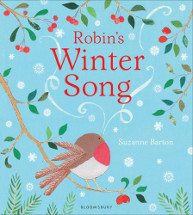
Robin's Winter Song by Suzanne Barton
Bloomsbury, 2015. ISBN 9781408859148
Picture book. Themes: Seasons - Winter. A beautifully illustrated
story of young Robin as he discovers the true meaning of 'Winter' in
the Northern hemisphere. As some animals make plans and preparations
to avoid or escape or to prepare for the privations that lie ahead,
Robin considers what he might need to do. Eventually he discovers
the joy and beauty of the winter season. Colour is used carefully in
this book, and muted tones in contrast to the Robin's red breast
make this book a visually appealing exploration of the season from
Robin's perspective. This does not contain any unusual plot twists
or unique understanding of Winter, and the hibernating bear
definitely places this story in a non-Australian setting, so it is
not a picture book that would be a 'must-have' on Australian
shelves. But it is a gentle and joyful exploration of Winter and the
changes in seasons.
Carolyn Hull
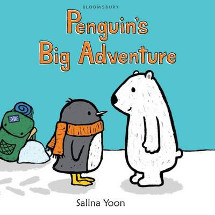
Penguin's big adventure by Salina Yoon
Penguin series. Bloomsbury, 2015. ISBN 9781408868713
(Age: 3+) Recommended. Friendship, Adventure, North Pole. When
Penguin decides to visit the North Pole, he says goodbye to several
animals who are his friends. He consults his map and loads his
backpack with things he will need. He says goodbye to Emily, busy
sewing a quilt, then Pumpkin who is busy building a basket, and
finally Bootsy, braiding a rope. On the way north he meets other
friends he has met in previous adventures. Reaching the North Pole
he is ecstatic, and turns cartwheels, throws confetti and erects a
sign. But there is no one there. Eventually a polar bear wanders by
and each is a little uncertain of the other. But becoming friends,
they explore the pole together, until Penguin's friends fly in from
further south to take him back home. After all the best part of
having an adventure is coming home.
This is a charming book in the series about Penguin. For younger
readers it will introduce them to the idea of north and south poles
and what animals live in each place; it will teach them about the
environment of the North pole, and perhaps introduce the idea of
explorers who went there. Younger readers will know that Penguin has
some very good friends, some who will do anything for him, even
traveling from one end of the world to the other, and that he has
met another friend, one who is left a map. Younger readers may be
able to predict what might happen in the next book, and sympathise
with Penguin making friends in this book. The black outlined
illustrations are clear and colour filled, making some aspects of
the North Pole easily identified for younger readers.
Fran Knight
The Story of the Lost Child by Elena Ferrante
Neapolitan series. Text, 2015. ISBN 9781925240511
(Age: Adult - senior secondary) This is the concluding volume in
Elena Ferrante's Neapolitan series. The first three books
show Lenu and Lila growing up in a slum in Naples. Though Lila has
an audacious intelligence she leaves school early, marries a brute
and works at a demeaning job in a sausage factory while Lenu forces
herself on through university and becomes a writer about feminist
politics when she marries into a northern family with influence. In
this final volume the action returns to Naples which is as turbulent
and corrupt as ever. Lenu, now a successful writer and having an
affair with Nino, her childhood friend who is now a brilliant and
radical academic, returns to the slum district where they grew up.
She continues to have a tempestuous relationship with Lila, who now
is mastering the new technology of computing. Lenu's family and
friends initially reject her but eventually accept her new situation
and enjoy her success although they show no interest in her writing
as such. Lila is now a respected business woman, while the Fascist
gangsters the Solaro brothers are still her declared enemies. When
Lenu realizes that Nino has always been and always will be
unfaithful she rejects him and grows closer to Lila, particularly as
they are both pregnant. The babies, girls, seem destined to relive
the friendship of their mothers, especially as Tina, Lila's child,
is precocious and beautiful, as Lila always was, while Imma is more
insecure as Lenu has always been. However, Tina, aged four,
disappears from the street and is never found. The Solaro brothers
have clashed with Lila and her partner and are suspected but seem to
be determined to help. Lila's behaviour becomes more erratic while
Lenu's career continues to flourish. Lila becomes more nihilistic
and questions the value of life; she examines the history of Naples
and finds endless examples of cruelty being replaced with kindness
which is then swamped by more cruelty.
In the background of the novel the politics of Naples and Italy
repeat this pattern. The 1950's and '60's struggle between the
Communists and the Fascists is replaced by different political
allegiances but the one point of consistency is corruption which
reaches into even the most respected levels of academia as well as
politics and business. Lenu's mother-in-law, an aristocrat from an
'old' family, blames those with intelligence but with no traditions.
Lenu realizes that she herself is still an outsider in some cultural
circles, but also that all in the community condone corruption by
turning a blind eye to it. Lila, however, believes that there are no
options as the law is ineffectual. Lenu's daughters leave Italy and
she herself leaves Naples. She has her greatest success when she
writes the story of her friendship with Lila and the loss of Lila's
child, which parallels the story of the two dolls the girls lost in
childhood.
The writing is powerful and fierce in its portrayals of love,
loyalty, friendships, family relationships and politics. The themes
are most particularly female friendship, the relationships between
mothers and daughters and the influence of place. The coarse
language and attitudes of the local Neapolitans is vividly captured
as is the hypocrisy of the cultured classes. Ferrante juxtaposes the
crudeness of the local dialect with the purity of Italian to
emphasize class distinctions but while social position and morality
are not necessarily linked leaving the slums of Naples tends to be
regarded as a victory.
The novel can be read as a stand alone and is recommended for
competent readers. It powerfully deals with the issues of women's
friendships and family lives, and with the political and social
issues in Italy in the second half of the twentieth century.
Jenny Hamilton
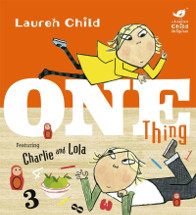
One thing by Lauren Child
Orchard books, 2015. ISBN 9781408339008
(Age: 6+) Highly recommended. Numbers, Family. Making numbers funny
is quite a task, and Child achieves it with ease as her two
protagonists Charlie and Lola get ready to go to the shops with Mum.
She gives them ten minutes to get ready, but when Charlie works out
all the things she must do in those ten minutes and how long each
will take, she is nine minutes short. On the way to the shops, Lola
asks how many ducks are following them, and the birds are counted,
then the leaves in the tree. From single digits, one, two or three
trucks, to tens of things to millions and squillions, each number is
given a thing to be, ensuring the reader understands how big that
number is in what it represents. A wonderful way to reinforce
numbers and counting.
After their one hundred and fifty six steps to the shops, the girls
debate what they are able to buy: is it one thing or two things. Mum
gives them the choice of no thing, so one is settled. They then take
eleven minutes to make up their minds, and when home, after Lola has
used up all her stickers sticking them on a variety of numbered
things in the street, debate whether Lola will have one of three
badges from Charlie, and after being offered no thing, happily takes
one thing, the title of the book.
This is a delight, I loved the way Child shows the number in
numerical and written form, with the sequences of numbers one each
page, the smallest to the largest being represented in a way younger
readers will understand. It will be an infectious read, one children
will want to hear read out loud to them over and over again. I
laughed each time I read it, finding more things to look at, picking
out more and more detail in the enticing illustrations.
Fran Knight
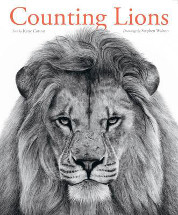
Counting lions by Katie Cotton
Ill. by Stephan Walton. Frances Lincoln Children's Books, 2015. ISBN
9781847807212
(Age: all) Highly recommended. Animals, Endangered animals,
Illustrative technique. A seemingly simple counting book with the
most engaging illustrations of animals so close hairs can be
counted, the very fact that these animals can be counted points to
many being endangered or having reduced numbers as Virginia McKenna
makes clear in her informative introduction.
Each of the animals represented reflects a different environment and
way of life, and the almost poetic text points out some of their
features which younger children will delight in, but sometimes a
question at the end of each piece of text will increase their
sensitivity to the plight of these animals.
So one lion stares at the reader, sitting in its place in the
savannah, watching his rough and tumble pride, content to watch and
wait. Then two gorillas, three giraffes, four tigers and five
elephants, followed by six Ethiopian wolves, seven penguins, eight
turtles, nine macaws and ten zebras invite the curious reader to
read the text and look more closely at the glorious pencil
illustrations. At the end of the book is a fact file about each
animal's place in the world and here the endangered or threatened
position of each is given.
What a wonderful counting book, introducing young children to the
numbers one to ten and encouraging them to count the animals on each
page. What a beautiful book to discuss illustration, but what an
informative book for the curious, the questioning, those who wonder
why these beautiful animals are threatened and question what can be
done. One child will use this as a tool to learning to count, small
groups of readers will love looking at this together, classes will
use this as an introduction to their work about endangered animals.
Fran Knight
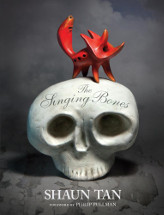
The singing bones by Shaun Tan
Foreword by Philip Pullman. Allen & Unwin, 2015. ISBN
9781760111038
(Age: 8 to adult) Highly recommended, Grimm's fairytales, Sculpture.
A foreword by Philip Pullman sets the scene. He would rather see the
stories of the Grimm Brothers presented without illustrations, than
repeat the soft and pretty images of books in the past. But seeing
Tan's sculptures of the grotesque and weird creatures, he is
satisfied that here is someone who is able to reveal these tales for
what they are.
With that forward in mind, opening this beautifully presented book
of Tan's sculptures set alongside excerpts from each of seventy five
tales, is quite mesmerising.
Dipping in I found some favourites: Brier Rose, Six
Swans, Snow White, The Juniper Tree and so on,
while I came across some I have not heard of: The Three Snake
Leaves, The Bearskin, The Lettuce Donkey to
name a few.
Each story is presented in a few paragraphs, and the facing page has
a stunning photograph of Tan's sculpture about that story.
Amongst the many which stand out for me is Rapunzel. The
brief outline tells us of this beautiful young girl having to let
her hair down for the sorceress to enter the high tower. The long
slim piece of clay stretches skyward, and only the small round face
on top shows us that this is Rapunzel, her hair falling straight
down to the ground. What sorrow and imprisonment is shown in this
tiny image. No Disneyfied young woman with luxuriating tresses
leaning out of her window for the handsome prince below, only a girl
detained without hope of escape. Bearskin was a story I had
not heard before, so I read a complete version in my Maurice Sendak
copy of Grimm's Tales (The Juniper Tree, 1973) to find out
about a soldier who while good at fighting has no way of supporting
himself during peace. Someone offers to support him for seven years
but he must not cut his hair or change his clothes nor pray. The
soldier eventually realises the devil is waiting for him to slip up
and take his soul. An amazing story of courage and resilience, of
temptation and honouring one's parents, Tan's sculpture looks like a
piece of carved wood, with the soldier's face peering out from the
enveloping bearskin. Readers will have lots to think about when
looking at the little piece, wondering why it is presented in this
way.
Grimm's Tales, so much a part of Western literature, exemplify the
basic tenets underlying life, be they sins like greed or envy, or
virtues like looking past appearance or honouring promises. These
stories are given a different aura through Tan's work: his curious
creatures will make readers think, setting aside illustrators of the
past who have seen fit to gentrify them.
An introduction by scholar, Jack Zipes, gives a potted history of
the Grimm Brothers and their work, and is followed by an extensive
bibliography with summaries of the stories and words by Shaun Tan
outlining the influences on his enigmatic work. A book to be
savoured: one that will add a difference to any study of Grimm's
Tales in the classroom.
Fran Knight