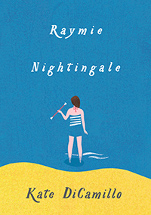
Candlewick Press, 2016. ISBN 9781406363135
(Age: 9+) Highly recommended. Friendship, Grief, Single parents,
Aged care, Competition. When her father leaves, Raymie is
distraught. She joins a baton twirling class in the hope of winning
Little Miss Central Florida Tire 1975, so having her picture in the
paper to lure him back home. She knows that doing a good deed will
sit well with the judges and tries to find one. But her soul does
not seem to be getting much bigger. At the class she meets two other
hopefuls, Louisiana and Beverly, each of whom have quite different
reasons for being there. Beverly is a take it as you see it type of
girl, no holds barred, straight talking and often abrasive, while
her cynical comments about baton twirling, cat homes, families and
the outrageous Ida Nee will have the reader laughing out loud.
Louisiana is an orphan but quietly determined and lives with a very
odd grandmother, always on the lookout for the authorities who may
take her to a children's home. All three girls are quite different
but come to work together to achieve their goals.
But the class does not turn out as it should, partly because of the
antics of the very odd teacher, Ida Nee, and Raymie decides to read
to someone at the aged centre instead of going to class, so
embroiling Louisiana and Beverly in her attempts to retrieve the
library book which she loses under one aged person's bed. Beverly
wants to sabotage the baton competition, while all Louisiana wants
is to get her cat, Archie back. Losing any possibility of winning
the money for baton twirling, the girls decide to take matters into
their own hands and go to the cat shelter to get Archie, making use
of Beverly's skills.
A very funny, darkly humorous episode at the end sees Louisiana in
hospital with an array of parents and caregivers arriving to tend to
their girls. Raymie's soul becomes larger as she develops
friendships and helps solve some of their problems, while accepting
that her father is not returning.
Beautifully written, this tale is most appealing in detailing the
lives of three young girls who do not quite fit in and are certainly
not what they seem. The story evokes understanding and pathos,
sympathy and humour as The Three Rancheros set out to right some
wrongs.
Fran Knight
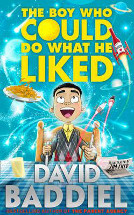
The boy who could do what he liked by David Baddiel
Ill. by Jim Field. HarperCollins, 2016. ISBN 9780008167813
(Age: 7+) Highly recommended for young readers aged 7+. (Alfie is a
little older, but the story is easily accessible for a younger
reader.) Family. Rules and routines. Children's behaviour.
Alfie lives a fairly boring life; at least his classmates tell him
so. At home he lives a fairly regulated life, with documented
routines for every aspect of life. But Alfie is not dreadfully
unhappy, or worried by this. But his normal structured existence is
ruffled a little the night his parents cannot get their normal
babysitter, and the new sitter injects a little magical spark of
mayhem when she says, 'Do what you like!' There is a little hint of
the Fairy Godmother in her ability to make significant change
without doing much at all... and she is incredibly and
breath-takingly ancient!
This is a charming story, without the syrupy inclusion of the 'moral
of the story' type ending. In fact the simplicity of the tale and
the charming way that Baddiel introduces the routines of Alfie's
life will appeal to all young readers. The amusing 'fart in the bed'
scenario will also entertain young readers.
Carolyn Hull
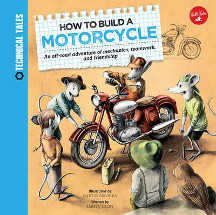
How to build a motorcycle: A racing adventure of mechanics, teamwork, and friendship by Saskia Lacey
Ill. by Martin Sodomka. Quarto, 2016. ISBN 9781633220577
Known as 'The Marvelous Mouse Mechanic' following his construction
of and adventures in both a miniature plane and a miniature car, Eli
is somewhat full of himself and much to the dismay of his best
friends Hank Frog and Phoebe Sparrow, he is now determined to build
a miniature motorbike. However, along with the talented pit crew
they band together and set to work. As they start working, they
encounter many unexpected obstacles, teaching them (and the reader)
about the different parts that make a motorcycle work. Through hard
work and perseverance, the three friends learn about mechanics and
teamwork as they work together to build a miniature motorcycle,
ready for the big race.
But an accident during trials puts lives, friendships and the race
on the line. Is winning everything?
This is the third in this series that weaves the building of
everyday objects into a story of friendship. Detailed illustrations
explain the overall functions of the engine, clutch, brakes,
distributors, as well as many other parts of the motorcycle and how
they all go together to make it work demonstrating the principles of
movement and motion and physics in a practical way that helps
younger readers to understand them more clearly. More for the
independent, mechanically-minded reader, this series certainly has a
place on the shelves of those with makerspaces or trying to
encourage a greater interest in STEM. It fits E for Engineering very
well!
Barbara Braxton
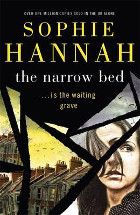
The narrow bed... is the waiting grave by Sophie Hannah
Hodder and Stoughton, 2016. ISBN 9781444776096
(Age: Adult - Senior students) Pairs of friends are being murdered,
each having been given a small, handmade book, empty of words but
for a few lines of poetry. When comedian Kim Tribbeck hears of this
she remembers being given just such a book by a man at one of her
shows a year ago. As she tells the Culver Valley police
investigation team, she discarded the book and can't remember the
venue but, being alive, she is an important link to the killer.
However, Kim has no friends, she is famous for her comedy but also
for being prickly and unapproachable. Her marriage has failed and
she has ended her sexual relationship with another man, why then was
she given a book, and why is she still alive? The narration shifts
between excerpts from a yet unpublished draft of Kym Tribbeck's
memoir interspersed with dated accounts of the murder team's
investigation with diversions into their everyday lives and
relationships. There are also emails from Kym's publisher,
journalism from the ultra-feminist Sondra Halliday and short modern
day parables which hint at the killer's motivation.
Sophie Hannah has a number of novels in the Culver Valley police
series, some of which have been produced for television so I may
have missed some of the back story but I found the police characters
a bit sketchy and Sondra Halliday more of a caricature. The main
character is convincing and reminded me of the Girl on the train
protagonist, damaged and insecure but with a bravery we respect and
a dark, self-deprecating humour that keeps the story interesting.
The killer is not hard to guess and the motivation a bit strained as
is the ending but fans of this author, adults and senior students,
will devour it and look for more.
Sue Speck
Interview with Michael Grant
ISBN: 9781405283410.
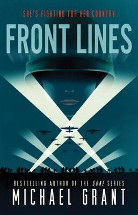
Bestselling YA author Michael Grant is in Australia and New
Zealand to promote Front
Lines, the first book in his blockbuster new YA
series, Soldier Girl.
Welcome to ReadPlus, Michael.
Q: Do you write with a particular audience in mind?
A: I have had the great advantage as a writer of having paid my dues
down in the trenches, by which I mean writing work-for-hire jobs for
packagers. Packagers are middle-men who manage long-running series,
or at least that's what they were when we (my wife Katherine and I)
worked for them.
So, long before I sat down to write books that were purely mine (or
ours) I'd co-authored something like seventeen Sweet Valley
Twins, a bunch of Girl Talk books, all kinds of Disney
projects involving Mermaid, Aladdin, Duck and
Mouse and a bunch more stuff I barely remember.
All of that happened before Katherine and I sort of declared our
independence from packagers with Animorphs. Animorphs
was huge. It ended up running to 60 books, with more than 30 million
sold. So we were 'overnight sensations' who'd already written 50 or
so books. Animorphs was the first time Katherine and I had complete
control, so we had to think about the potential readers. We had a
lot of experience but still, we collected all the scientific
evidence we could find, summoned experts, and. . . Nah, none of
that. Our idea of the audience was, 'Whoever reads Goosebumps.'
On the theory that, 'That's a lot of kids.'
Many people have, over the years, written about how dark and
disturbing Animorphs was, how it snuck in philosophical
themes and moral gray zones and frequently questionable heroes.
Nothing about Animorphs was age-appropriate. It was a dark
concept, and being true to character and story took us to dark
places. So we went.
We didn't care then about 'appropriate,' and I don't care now. The
notion that Kid X at age Y can read A but not B, is bizarre to me.
Don't we all want kids to read? Do we think the best way to
accomplish that goal is by snatching the books that interest them
out of their hands? Kid X can and should read whatever Kid X wants
to read. If it's too much, Kid X will stop and go read something
else.
When I was 9 years old I was reading Ivanhoe and Oliver
Twist and Hardy Boys and Tom Swift and my
dad's Playboys and I turned out. . . well, okay, bad
example. But these are books not heroin. This is a good addiction.
We all want people of all ages reading, right? So, let's let them do
that.
As to whether I'm writing for male or female readers my first
reaction is puzzlement. I mean, I'm a guy but I read Little
Women when I was a kid. I don't recall feeling any less
masculine as a result. I read Nancy Drew, too, along with Hardy
Boys and Tom Swift and classics like Ivanhoe
or Oliver Twist. Was I not supposed to read Anna
Karenina because it's about a girl? Did I breach gender
protocol by reading Jane Austen and the Bronte sisters?
You know Frankenstein? Written by a woman. So. . . girl
book?
I mean, other than as a marketing concept, what does any of that boy
book, girl book thing even mean? The rough working definition of
Young Adult literature is: books where major characters are under
the legal drinking age. But I think even drawing sharp lines there
is wrong, let alone further subdividing by gender. 'They kiss.' Girl
Book! 'They explode.' Boy book! Really?
I feel sometimes a need to check my calendar to make sure I haven't
fallen into a wormhole and re-emerged in the 1970's.
Look, I've written or co-written 150 plus books. From Animorphs
and Gone and BZRK I've gotten letters from readers
thanking me for exactly the stuff that some would have called
inappropriate. I've lost track of how many now-grown readers have
written to say that because of Animorphs they became human
rights lawyers or scientists. Thousands of letters and Tweets saying
I used to hate to read, then I found Gone. You know what
letter I've never gotten? The one that says I was traumatized by
your books. Or the one that says, I'm a boy and I was horrified to
discover there are girls in your books.
Basically, when I write I have a story to tell. I have characters. I
will be true to my characters and my story and if the results are
not quite right for this demographic niche or that slice of
audience, well, too bad, I guess. They can go read some other book.
Do I write for girls? For boys? For parents? For teachers? For
homeless people who pick my book out of a trash bin? Yes. And also,
no. Because while I'd love everyone to read every single word I ever
write, (I believe that's the Fifth Circle of Dante's Hell) I'm not
writing for anyone. I'm not even writing for myself. I'm telling a
story I made up, about some people I made up, because I like doing
that, and they pay me.
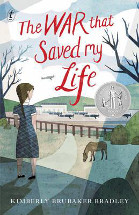
The war that saved my life by Kimberly Brubaker Bradley
Text Publishing, 2016. ISBN 9781925355642
(Age: 9+) Highly recommended. Disability. World War 2. Children in
war. Winner of many awards (Newbery Honor (2016), Schneider Family
Book Award for Middle School (2016), Odyssey Award (2016), Dorothy
Canfield Fisher Children's Book Award Nominee (2017), Goodreads
Choice Award Nominee for Middle Grade and Children's (2015)) The war
that saved my life is a moving and uplifting story of Ada, a young
girl with an un-repaired clubfoot, who overcomes incredible odds, in
her fight to save her life. Living in poverty in London, with a
cruel and neglectful mother who hates her for her clubfoot, Ada is
not allowed outside and sees only the small world that is available
to her from the upstairs window. She looks after her little brother
Jamie, and slowly and painfully teaches herself to walk. When war
threatens and children are evacuated to the country to be safe, Ada
and Jamie go to live with Susan, a grieving woman who doesn't want
them. There Ada teaches herself to ride Butter, the pony living in
the paddock belonging to the house, and gradually Susan and the
children begin to trust each other and love grows. She learns to
read and watch for German spies, but there are many difficulties to
overcome - not the least the mother who may take them away again.
Worthy of all the awards that it has won, this book is an uplifting
read of one girl overcoming incredible odds. The reader is carried
along by the story of Ada's trials and triumphs, not just the
physical ones of teaching herself to walk and to ride a horse, but
her emotional ones of learning to trust adults and making friends.
Set against the story of World War 2, the author subtly gives the
reader an insight into the life of poor people in the 1940's, their
attitude to physical disabilities, class, children who favour their
left hand, as well as the bombings, the evacuation of children, food
rationing and watching for spies. The content and the flowing
narrative would also make it a great read-aloud as a class novel.
Beautifully written, this book has wide appeal with its themes of
overcoming adversity, adventure, history and family and coming of
age.
Pat Pledger
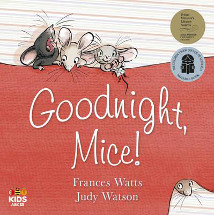
Goodnight, mice by Frances Watts
Ill. by Judy Watson. Harper Collins, 2016. ISBN 9780733335303
(Ages: 1-5) Recommended. Board book edition. This is a board book
edition of the CBCA 2012 Notable Book and winner of the Prime
Minister's Literary Awards 2012. Goodnight, mice is a
rhyming story that follows three mice as they get ready for bed with
help from their mother and father. Even the youngest of children
will be able to relate to the mice's bedtime routine. There are
touches of gentle humour that young children will find funny, such
as father getting all wet at bathtime. The relationships between the
mice are warm and affectionate and the illustrations and text
highlight the joys of simple time spent as a family and portray the
warmth and cosiness of a happy, loving home. A board book edition is
apt for this title, as even the youngest children will enjoy the
easy listening rhyme and the colourful illustrations make it
appealing for independent exploration. The flow and rhythm of the
story cannot be faulted and is a joy to read aloud. A perfect
bedtime story.
Nicole Smith-Forrest
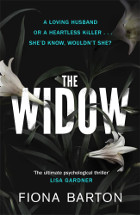
The Widow by Fiona Barton
Bantam Press, 2016. ISBN 9780593076224
(Age: 15+) Recommended. Psychological mystery. Secrecy, Journalists.
Missing children. When the police begin to ask questions, Jean
Taylor defended his husband, refusing to believe that he could have
committed the crimes he was accused of. Then their was no reason to
keep quiet - but what did she really know about the man who was
accused of kidnapping and paedolphilia.
Told from the point of view of five people, Glen, the accused man,
Dawn the grieving mother of an abducted child, A reporter Rose, the
policeman who won't give up the search and Jean the widow, this is a
rivetting mystery that keeps the reader biting their nails as the
story unfolds.
Not only does it explore the life of a woman who is down trodden,
isolated and trusting, it also explores the exploitation that the
popular press makes of the victims and the trials of the police
trying to solve a really difficult case.
To write more would give away too much but The widow is a
great thriller that will keep you on the edge of your seat and one
definitely recommended for who those who like psychological
mysteries.
Pat Pledger
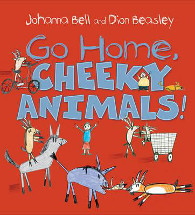
Go home, cheeky animals! by Johanna Bell
Ill. by Dion Beasley. Allen & Unwin, 2016. ISBN 9781760291655
(Ages: 3-7) Recommended. This is a sequel of sorts to Bell and
Beasley's previous collaboration, Too many cheeky dogs,
which itself stemmed from Dion Beasley's cheeky dog brand of
t-shirts. There is a wonderful story behind the cheeky dogs project
(see the website )
and the series provides many teaching opportunities beyond the text
itself. This sequel uses the same textual techniques, same
illustration style and the same setting as Cheeky dogs. It has a
story map in the endpapers as well, this time showing where all the
cheeky animals did their cheeky business! The rough pencil
illustrations that look like they have come straight from a child's
drawing book are not highly technical, but they are effective and
children will relate to them.
As with its predecessor, this book has been created with an
indigenous audience in mind but will appeal to children of all
backgrounds. It also has the potential to kick start a discussion
about feral animals in Australia (goats, camels, etc.) and the real
problems they create. Children will love the humour in the
illustrations (the animals drink from milk cartoons, and push their
babies in trolleys and prams) and the crazy antics of the cheeky
animals (eating grandpa's pants, stealing the lunch). Mum tries
shooing, Dad tries yelling at them, Uncle stamps his feet and Aunty
waves a big stick. But even the police can't help when the cheeky
animals are on the rampage! This is great fun and will be a big hit
with fans of Cheeky dogs.
Nicole Smith-Forrest
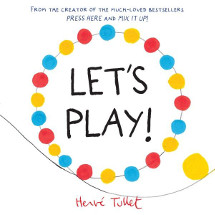
Let's play by Herve Tullet
Allen and Unwin, 2016. ISBN 9781760292980
(Age: 3+) Recommended. Following instructions, Wordplay, Humour. A
companion to Press here and Mix it up, this board
book offers great fun to both reader and listener, as little fingers
follow the instructions on each page.
The single line and yellow ball draws people's eyes across the page
and the simple question,'do you want to play?' invites the reader to
turn the page to see what will happen. Over the next few pages the
reader is invited to press the page and again follow the ball on the
line. The line becomes wavy with the ball jostled about, it does
loop the loops, and increases in number, and then colour, each time
with an instruction, but soon things become more complicated and the
ball goes into a black cave, then we see a double page of colour
wash, then colours and squiggles again.
The reader is lead through a whole range of words describing what is
happening: so they might use press, or middle, top or bottom, there
might be words to describe the path they re traveling, or green and
red traffic lights to obey.
All of it is highly amusing, involving the reader in play with each
page as it is turned, regaling them with things to do, instructions
and things to see. Children will laugh out loud as they move through
the book, each page evoking a response. Children will participate in
the actions asked by the book and be a willing player either by
themselves, with a parent or group.
The simple line drawings will encourage children to try things out
for themselves and some may use the idea to invent their own 'Let's
play' images.
Fran Knight
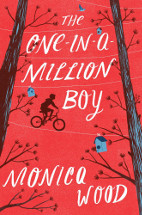
The one in a million boy by Monica Wood
Headline, 2016. ISBN 9781472228369
An amusing and warm friendship develops between an eleven year old
boy scout and Miss Vitkus, a one hundred and four year old lady,
when he volunteers for yard work to earn a badge for service. The
lad's obsession with Guinness World records, his quirky outlook and
impeccable manners appeal to the woman who has no time for the
shallow time wasting of other well - wishers in her mature years.
The voice of the boy is never heard despite his interviews with the
woman about her long life experience which are recorded in chapters
for a school project. Clever authorship reveals the disarmingly
honest questions he asks by the style of the responses which the old
lady voices with equal honesty and candour.
For reasons revealed early in the book, Quinn, the lad's father
presents himself to Miss Vitkus to continue the yard work and odd
jobs on the boy's behalf until the end of the agreed period. The
boy's parents have been married and separated and Quinn has spent so
much time away from his family whilst touring in music bands that he
has become estranged from his son.
Guinness World records are important and recurring in the narrative.
By their nature they are superlative, yet the categories include the
mundane, the pointless and the ridiculous. One old lady's relatively
unremarkable life is shown to have had highs and lows of joy and
suffering (leading to hard earned wisdom) which are as meaningful to
her as that experienced by the most famous or accomplished
individual. Miss Vitkus' trust and friendship must be earned and
Quinn works hard in many senses to build a relationship with her,
partly to establish an emotional connection with his son who is only
ever referred to in the text as 'the boy'.
Regret, particularly due to inaction rather than mistakes presents
often in this story and characters in various situations are
revealed to agonise over whether failures may be amended and
disasters salvaged. Everyday decent people are the characters
playing out their lives in this book and I liked that the author
refrained from including unrealistic or uncommon elements which
would have detracted from readily identifiable normal life.
Whilst I did not find the tale particularly moving or captivating, I
suspect that it may be deeply meaningful to many.
Rob Welsh
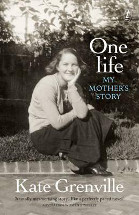
One life. My mother's story by Kate Grenville
Text, 2015. ISBN 9781925240962
Highly recommended. Kate Grenville, the author of The Secret
river and Sarah Thornhill amongst other novels,
explains this biography of her mother as an attempt to describe the
life of an individual who was part of a social class that is largely
ignored in historical writing. However, Grenville needs no excuse or
rationale; the story is beautifully told and gives her mother, Nance
Gee nee Russell, 1912-2002, the dignity she deserves. It is also a
very enjoyable read. There is no authorial voiceover or explanatory
commentary, but this is clearly the story of women whose aspirations
were stifled by societal expectations. Nance was born to Dolly and
Albert Russell, an unhappily married couple who made a career from
hotel keeping until the Depression hit in the early 1930s. Nance and
her older brother were boarded out for a number of years, Nance at
first with a very rigid and unloving Catholic spinster and then in a
convent, despite not being Catholic. She was fortunate to have
several years of excellent schooling in Sydney before being forced
back to a country school where few boys and even fewer girls stayed
past leaving age, and standards were low. Nance wanted to be a
teacher but this was emphatically rejected by her mother, and
instead was sent to Sydney to train as a pharmacist. She was
apprenticed to a martinet and struggled to understand the university
lectures. No-one had money, because of the Depression, and Nance,
lonely and poor, at times thought life too hard to be worth living.
There were very few girls studying and the attitude to them was
disparaging. When Nance qualified she was paid less than male
graduates and she missed the bonds of family life. However, she had
met inspiring young women and had learnt that she could have some
control over what happened to her. She ran a pharmacy and had a love
affair with its owner. She could have married any one of several
young men but eventually chose an inspiring young communist lawyer.
When war broke out she was disillusioned by his attempts to evade
service and she realized that secrecy and subversion were essential
parts of his character. She saw too that while despite his evasions
she loved him he admired her rather than loved her. They had two
children and Nance daringly planned to run a pharmacy again. The
business was a success but in the early fifties there was no child
care available; her mother failed her despite offering support and
her husband could not imagine doing more than he did about the
house. Nance sold the pharmacy, built a house with the money and had
another child, Kate. Nance tried again later to have a business but
even in the late fifties child care was not available.
Love of family was a dominant theme of her life, despite a difficult
relationship with her mother, and her children were a constant
delight to her. Another theme is the necessity to make the most of
one's talents. She believed that the unexamined life is not worth
living and this is a theme of her later life in particular. The
writing is engaging and the character of Nance believably
established. The social history of the times is accurately
reflected. This book is highly recommended.
Jenny Hamilton
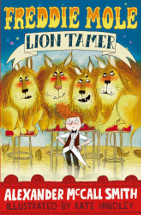
Freddie Mole: Lion tamer by Alexander McCall-Smith
Bloomsbury, 2016. ISBN 9781408865859
(Age: 8+) Highly recommended. Humour. Circuses. Adventure. Lions.
Freddie wants to help out his parents. His mum works on ships and is
often away months at a time, and dad works hard but it never makes
quite enough to cover the needs of his family and those of his
injured brother. So when Freddie is offered a holiday job at the
circus he accepts wholeheartedly. Here is the answer to his family's
problems. He is well able to help out around the circus, but when he
realises that the work involves being the understudy for some of
acts, he is dumbfounded. But his 'can-do' attitude overcomes his
fear and he succeeds where those before him have given up. So he
climbs the ladder to reach the platform where he is to be swung
between the trapeze artists and braves the lions in the lion taming
act.
Readers will have their hearts in their mouths as he realises that
the net has not been activated beneath the trapeze artists, or that
he must be the lion tamer in the lion's act when the lion tamer runs
off to Peru. But all works out well in the end, with the lions so
old that they have lost their teeth and their claws worn down with
age, and a proud mum and dad in the audience.
Freddie is an exuberant, positive young lad, and easily engages the
reader with his fears which must be overcome for the good of the
family. The illustrations add to the fun of the tale and a
conservation message lies beneath some of the circus details. A
stress on being positive is a winner in this charming story for
middle primary people.
Fran Knight
Tricky twenty-two by Janet Evanovich
Headline, 2015. ISBN 9781472201652
(Age: 14+) Recommended. Crime fiction. Humour. Biological warfare.
Stephanie Plum is back for the umpteenth time, solving crime while
looking for bail absconders in Trenton, New Jersey, the home of her
birth. She is an amazing character, seriously flawed, unable to make
up her mind between high school sweetheart, Morelli, beloved of her
family, and the outrageously cool Ranger, a security expert.
In this laugh out loud episode, Stephanie is called to take a young
man to court but instead finds him dead. He is one of a college hall
called Zeta, one that some of the powers at the school would like
closed down. But looking further, Stephanie becomes aware of a
locked cellar where experiments with fireworks have been going on,
and breaking in finds aquaria full of fleas.
Blood in the fridge sends Lula into hysterics, and the links between
blood, fleas and a top security biological warfare laboratory now
closed down, becomes clear.
There follows a heart-stopping ride as Stephanie is kidnapped by the
insane professor, seriously upset that his plans were not funded,
and handcuffed and drugged to allow him to take her blood.
What the blood is for will make some readers squeamish, but as
Ranger has a tracking device on all of his cars, he is able to find
her, but only after she has managed to get free.
The relationships between Stephanie and her family as well as
Morelli and Ranger are enough to keep the reader reading and
laughing, while the plot line of the mad professor is an added bonus
to keep the pages going over. Each of the main characters is quite
engrossing, and the background characters, Lula, Vinnie, Stephanie's
parents and grandmother have developed lives of their own in this
escapist series. Grandma always finds some gossip relevant to the
work Stephanie is doing at the time, while at one of her funeral
home viewings, and somehow the streets of Trenton always find their
way into the book. The background setting is always clearly
delineated and Evanovich talks of it with a sound knowledge and
affection which is enthralling.
Fran Knight
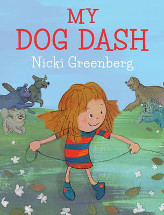
My dog Dash by Nicki Greenberg
Allen and Unwin, 2016. ISBN 9781760110673
(Age: 3+) Highly recommended. Pets. Dogs. Snails. Ownership.
Responsibility. Humour. The irony of the name, Dash, for her pet,
becomes obvious when the first double page is turned to reveal a
snail. Kids will laugh uproariously at the young girl and her pet
snail, taking it off to puppy school, introducing it to her friends
and relatives, taking it for a walk, teaching it to sit and stay.
All the things a child does with a pet dog are portrayed in this
story, teaching younger children about the responsibility of having
a pet but using humour and wit to press home the points being made.
Without being obvious, the humour behind the story will display the
things a child can do with a pet dog and make them aware that there
are times when a pet can cause mayhem, like sliding up a visitor's
nose, or leaving a mess, or stealing food from the table. Or worst
of all, eating through a pile of books!
But one night Dash disappears. The images of the whole
sleep-deprived family out searching for the lost snail will cause
readers to laugh out loud as they sympathise with the family forced
to search through the night with their flashlights for a snail. And
the surprise ending will cause more fun. The illustrations are just
wonderful, with the little snail meandering across most pages,
living its own life, oblivious to the work going on about it as the
young girl tries to keep it as a pet. Kids will engage with this
book, opening up discussions about their pets and pet ownership, the
joys of keeping a pet and perhaps some of the downsides, the keeping
of snails, and the role of parents when there is a pet in the house.
Fran Knight