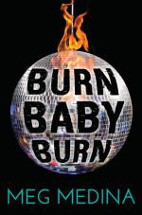
Candlewick Press, 2016. ISBN 9780763674670
(Age: 14+) Recommended. 17 year old Nora Lopez lives in New York
during the terrible year of 1977. The heat is scorching and there is
a killer on the loose. But that's not all Nora has to face - her
family is spiralling out of control, with her mother having
difficulty paying the rent and brother Hector becoming
uncontrollable and befriending drug dealers.
In a story of resilience set against a fascinating historical
backdrop, Medina brings to life the difficulties that Nora faces
with courage and thoughtfulness. With her father only interested in
his new family and not paying his way, it is she who must interpret
for her mother, and try and avoid the increasing violence of her
younger brother. When she meets a cute boy at the deli where she
works, she and her friend Kathleen know that Sam the Man, the serial
killer, is murdering young couples, and they both wonder if it is
safe to go out on dates. Her teachers are encouraging her to go to
college but all Nora wants to do is reach the age of 18 when she can
leave home and become independent, without the family worries that
are so overwhelming.
I enjoyed the thread of feminism that weaves its way through the
story, with Kathleen's mother an ardent believer in going to rallies
for women's rights. She takes the girls along with her on marches.
Nora too is clever with non-traditional skills of woodwork and these
skills will ultimately help her in a resolution to her problems.
Friendship plays an important part of the story, and the
relationship between Nora and Kathleen will leave readers asking
questions about when it is right to tell family secrets and seek
help from friends.
There are some big themes here: not only is there the simmering heat
that erupts in violence in the city, and the threat of a serial
killer on the loose, but the family dynamics are dire. In the
author's note at the back Medina talks about her theme of juvenile
domestic violence that is rarely touched on in young adult novels
and the novel being a 'celebration of people who find their strength
even in the worst circumstances'.
This would make a great literature circle book, with lots of themes
to be discussed.
Pat Pledger
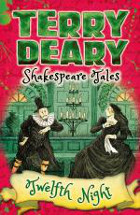
Twelfth night by William Shakespeare, retold by Terry Deary
Terry Deary Shakespeare Tales series. Bloomsbury, 2016. ISBN
9781472917836
(Age: 8+) Highly recommended. Theatre. Another in Deary's retelling
of Shakespeare's plays will help introduce this play to a new
audience. One of his best loved plays, Twelfth night is
often presented on the stage around the world and has been made into
countless film adaptations.
Here it is presented as a story and stripped back to its bare
essentials. John and Jane are at Richmond Palace to watch Master
Shakespeare's latest play, 'Twelfth night'. Through their eyes
we see the court and its splendour, Queen Elizabeth, now coming
towards the end of her life, the courtiers pressing their advantage
and the play set out before them. Their story and observations make
a fascinating backdrop to the play which tells of deception, just as
Lord Essex deceives the Queen. The two children could see that Essex
and his armed men, were up to no good and using the suit of armour
in the hall were able to defuse the plot by Essex's guards.
So the play continues, the parallels between what is actually
happening and the play's plot gathering speed. Both come to a
satisfactory conclusion and readers will have a sound grasp of the
play, while infusing some details about Elizabethan life. A
postscript about Essex's true attempts to overthrow Queen Elizabeth
rounds off the short book. This is one in Deary's series presenting
Shakespeare's plays in an abridged story version which will acquaint
younger readers with an outline of each play. Behind the play
presented is a story of young people involved in some way with the
play, giving a perspective which will appeal to the readers.
Fran Knight
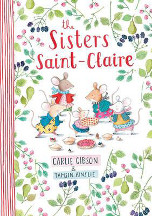
The Sisters Saint-Claire by Carlie Gibson
Ill. by Tamsin Ainslie. Allen & Unwin, 2016. ISBN 9781760291563
(Age: 6+) Recommended. Themes: Animals, Cooking, Family, Rhyme. The
youngest mouse in the Saint-Claire house is a magnificent pastry
baker and cook . . . but is too little to leave the house and go to
the market to sell her wares. Then one day she is able to convince
her family that she is big enough to go with her siblings, even
though she is small. Despite initial poor sales, eventually a Royal
patron proves that her culinary skills are worthy of attention,
despite her small size.
This is a gentle rhyming tale with a French twist and mousy
characters illustrated in a naive style by an experienced
illustrator (whose work is reminiscent of the style shown in Angelina
Ballerina; but whose skilful work also appears in other works
eg the covers of the Matty and Bill novels for Young
Readers).
Carolyn Hull
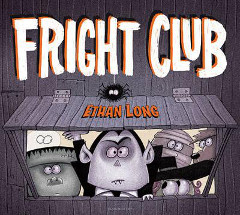
Fright club by Ethan Long
Bloomsbury, 2016. ISBN 9781681190433 (Age: 4+) Highly recommended. Halloween, Ghost and ghouls, Monsters,
Humour, Board book. In the midnight hour, Vlad has called a meeting
of the Fright Club, designed to get his friends run through their
scariness for Halloween. His friends include Frankenstein, a witch,
a wolf and a mummy. There are three things they need to practise
before Halloween: ghoulish faces, scary moves and chilling sounds.
Unfortunately, their faces wouldn't even scare a daddy long legs and
Vlad is extremely disappointed. A knock at the door reveals a rabbit
intent on joining their club. Rabbit is sent away and Vlad returns
to his teaching role. Just as Mumford's eyes are boringly popping
out of his head, there's another knock at the door and the rabbit
has returned, this time with her lawyer Frances Foxx. Vlad shuts the
door in their faces and tries to get his monster friends to focus.
But rabbit returns with her critter friends complete with banners
and lots of noise. They pound on the door and show their amazing
scary steps and frightening screams, scaring the Fight Club to bits.
A compromise is reached and Operation Kiddy Scare is set to be the
best Halloween yet.
This is a wonderfully dark and devious story, designed to have
readers laugh out loud at the implications of Vlad and his club
refusing entry to rabbit and her friends.
A wonderful read aloud, full of information about Halloween which
seems to be gaining more interest in Australia, but also giving an
underlying lesson in compromise and working together.
The funny illustrations help make this board book a joy to read.
Fran Knight
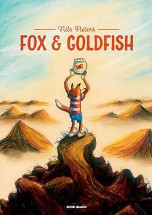
Fox and Goldfish by Nils Pieters
Book Island, 2016. ISBN 9780994128218
(Age: 7+) Highly recommended. Picture book for older readers.
Themes: Adventure, Friendship, loss, remembrance, pets. As soon as
this book is opened, the reader knows that there is a different
journey to what would be expected from the cover illustration. The
opening words by Nils Pieters,
a Belgium author, sets the scene: Oh Goldfish, my friend
Maybe your time has come,
But I just can't let you go like this . . .
It is obvious that Goldfish is unwell and Fox is distraught for his
friend, so he takes him on a quest to see the wonders of the world.
They fish off tall rocks and splash in the sea, ride a motor bike
through the desert of Utah, view fabulous mountains, trek through a
tropical forest, and even catch a rainbow. Fox drags Goldfish behind
him on ski trip and together they look at earth from outer space.
Then it is time for Fox to let Goldfish to go: Okay, my friend,
Now you can go.
The joy of discovery that Fox and Goldfish experience is expressed
without words through the vivid illustrations painted in bold,
bright colours. There are only the six lines of narrative in the
book and it is the strange memorable drawings that make such an
impact. The theme of friendship shines throughout the book. Fox is
such a good to make sure that Goldfish's last days on earth are so
memorable. He has also make some wonderful memories for himself to
treasure as he sits in front of Goldfish's memorial stone. The theme
of impending loss is handled so positively that it will be an
inspiration for many not to be overwhelmed by grief but to do
wonderful things and make happy memories to last.
This is a moving book that will appeal to all ages.
Pat Pledger
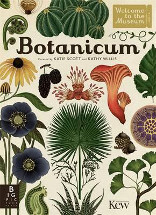
Botanicum by Katie Scott and Kathy Willis
Five Mile Press, 2016. ISBN 9781783703944
(Age: 8+) Museums, Evolution, Plants. As with Historium and
Animalium this beautiful book will make an excellent library
book which some children will chose to use. Students will need to be
shown this book and when they dip inside will be amply rewarded.
As with any museum, each double page is like a gallery, inviting
students to look closely at the detailed illustrations by Scott and
then read Willis' words.
Again, reminiscent of wood block prints of the past, the highly
detailed illustrations beg the eyes to look closely and deeply,
lingering over the intricacy of the pictures shown, taking int he
text and all it offers. Some illustrations, like the Giant Sequoia
are pictured across the double page, increasing its interest to
readers, its placement underlining it size. Information about its
size, plant group if belongs to and where it can be found is given
underneath along with references to the illustrations. Kids will be
amazed at the information and pictures given in this book. Seven
chapters are given in all, starting with The First Plants, moving on
to Trees, Palms and Cycads; Herbaceous Plants; Grasses, Cattails,
Sedges and Rushes; Orchids and Bromeliads and finishing with a
chapter on how plants have adapted to the environment. All in all a
fascinating book to read or dip into, to use as a reference or just
gathering information. A detailed index is given at the back between
the most glorious of endpapers.
Fran Knight
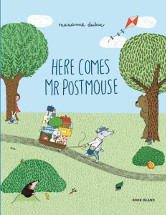
Here comes Mr Postmouse by Marianne Dubuc
Book Island, 2016. ISBN 9780994128201
Recommended. Themes: Picture Books; Animals. The winning feature of
this book by French-Canadian author Dubuc is the detailed pen and
ink style cartoon illustrations which show the homes of the animals
to which Mr Postmouse delivers his parcels and letters. The text
accompanying these illustrations are printed in a very tiny font
which signposts that they are to take a 'back seat' to the quirky
and cute illustrations that show the cross-sections of the animal
homes, revealing lifestyles of the families inside - for example,
the 7 level bunny bunk bed.
Young readers (particularly pre-readers!) will love browsing the
illustrations for the quirks of family life revealed both above
ground, behind closed doors and under water.
Carolyn Hull
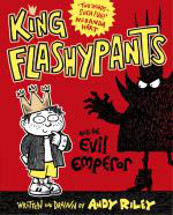
King Flashypants and the Evil Emperor by Andy Riley
Hodder Children's Books, 2016. ISBN 9781444929591
(Age: 9+) Highly recommended. King Edwin is a kid and a king. He
rules Edwinland and is loved by everyone. (especially on Fridays
when he spends his pocket money on chocolate and shares it with
everyone). Minister Jill helps King Edwin run the country while evil
Emperor Nurbinson continually plots to steal Edwinland from them
all. How will a cow disguised as a dragon be the downfall of the
kingdom? Will the people of Edwinland be easily swayed? How does
shaving 2 sheep help Edwin hide his crown? Can Edwin become a guard
in Nurbinson's army and spoil Emperor Nurbinson's plans? By the way,
his people call him King Edwin. You will have to read the book to
find out why he is called King Flashypants in this story. King Flashypants and the Evil Emperor is a hilarious read and
highly recommended for readers aged 9+ . Thanks to funny events like
itchy bums and characters with crazy names, reluctant readers will
be laughing all the way to the end. The text is descriptive and
moves quickly. It is scattered with funny cartoons and readers will
be hanging out for the next King Edwin adventure.
Kylie Kempster
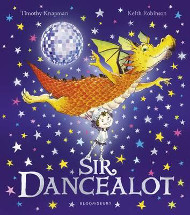
Sir Dancealot by Timothy Knapman
Ill. by Keith Robinson. Bloomsbury, 2016. ISBN 9781408846995
(Age: 4+) Recommended. Themes: Dancing, Humour, Alliteration/Rhyme,
Monsters, Reconciliation. Sir Dancealot lives in times of old and
his great skill as a dancer makes him a winner against all opponents
(including bogglesnots, beasties and monsters). That is until he
meets his match in the light footed and daring Dragon who has
mastered the fearsome art of Dance! The Dragon is a formidable
competitor and a dance-off . . . on ICE . . . is proposed to find a
winner. Who will survive as the winner?
This is a lovely tale with alliteration, rhyme and wonderful
illustrations with warts, fangs and dance moves. Friendship is the
winner after a dangerous move on the ice creates a sinking feeling
for the pirouetting pair. The illustrations are bright, and
endearing and bold colours and the silver mirror ball and stars on
the cover will cause this to leap from shelves into the waiting
hands of young readers.
Carolyn Hull
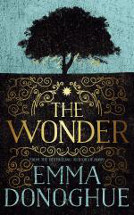
The wonder by Emma Donoghue
Picador, 2016. ISBN 9781509818396
(Age: 16+) Highly recommended.
Emma Donoghue is the bestselling author of Room, shortlisted for the
Man Booker Prize in 2010, now an award winning film. That book was
about a young boy and his mother held captive in a room by a child
abductor. With this latest book, The wonder, Donoghue ventures into
the world of historical fiction - it is set in the Irish Midlands in
the 1850s, a time of fervent religion mixed with superstition, and
bog marshes that could easily sink a body. In this story also, the
child is like a prisoner under constant watchful guard, and there is
an undercurrent of suspicion of abuse.
Anna, the child, has been extolled as a wonder, a miracle from God,
she has not eaten for months but seems healthy nonetheless. She is a
'fasting girl' - one of a number of recorded cases of girls and
women hailed for surviving for long periods without food, in
the sixteenth to twentieth centuries. Lib, a nurse trained in the
latest medical approaches by none other than Florence Nightingale
herself, is hired by a local committee to observe the child and make
a report at the end of her two weeks of observation. A no-nonsense
believer in science, Lib is determined to expose any trickery, and
she sets about ensuring there is no secret smuggling of food.
However, as her observations record the gradual deterioration in
Anna's health and she is shocked into realising she is also
complicit in starving the child, Lib has to decide what action she
should take.
At the heart of the story is an analogy with the fairy story of
Rumpelstiltskin, where a young girl is compelled to weave straw into
to gold because of her parent's boastings. Her debt to the strange
little man who comes to her aid can only be broken by guessing his
name. So there is the play between Anna and Lib, of guessing games
and riddles, which creates a kind of friendship between the two. But
Lib gradually comes to realise that she has to do more than just be
a friend, she has to take action.
This book is an intriguing mix of fairy story, science and religion,
each contributing to the puzzle that Lib has to solve. In addition
there is a thread of romance as she is befriended but also
confronted by the charming yet astute young journalist William
Byrne. The tension builds as Lib comes closer to working out the
truth and realises that she alone can save the child. Is she clever
enough and brave enough to do what is needed? I found I couldn't put
this book down in the last chapters - it is a gripping yet very
satisfying story because it is clearly written from a real
understanding of the world of the child, of parent-child
relationships, the complexities of child abuse, the power of
religious and superstitious beliefs, and the individual struggle
with conscience and finding the courage to take a stand against the
prevailing group. It's a fascinating and thought-provoking book -
highly recommended, and has my vote for best book for 2016.
Helen Eddy
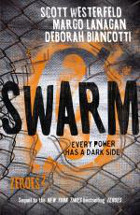
Swarm by Scott Westerfeld, Margo Lanagan and Deborah Biancotti
Zeroes bk 2. Allen and Unwin, 2016. ISBN 9781925267242
(Age: 14+) Recommended. Thriller. Super heroes. 'Every power has a
dark side'. Reading the second in the Zeroes series takes
the reader on a dark, scary and unexpected trip on the wild side.
The Zeroes - Ethan (Scam), Nate (Bellwether), Thibault (Anonymous),
Kelsie (Mob), Riley (Flicker) and Chizara (Crash) have made
themselves an underground nightclub where they are experimenting
with crowds and controlling their powers. One night two other
Zeroes, Coin and Glitch, take to the dance floor and the Zeroes find
that not only are there more people out there who have super powers,
but a powerful person, Swarm, is out to harm them. On the track of
Swarm, the friends find themselves in deadly danger, and Swarm's
actions make them face some issues. Bellwether's confidence is
severely challenged; Mob has to face the dark side of her power;
Anon realises that he doesn't belong anywhere; Crash has to question
the morality of her actions while Ethan faces trying to fit in.
An exciting second novel, this finds the characters growing and
working out the limits to their powers. There are lots of unexpected
moments and it is difficult to predict just what is going to happen
next. Lots of action and suspense kept me glued to the page but the
personal conflicts that each character faced brought plenty of heart
wrenching moments as well.
This is one dark, frightening and thrilling ride. There are some
rather horrific deaths that are not for the faint hearted and the
conclusion leaves the reader reeling from the shock of it, and
desperate for the next instalment.
Pat Pledger
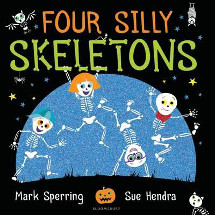
Four silly skeletons by Mark Sperring
Ill. by Sue Hendra and Paul Linnet. Bloomsbury, 2016. ISBN
9781408867143
(Age: 5+) Recommended. Humour. Skeletons. Bodies. Verse. Four silly
skeletons named Fred, Sid, Belle and Bill live at the top of a very
steep hill. Lucky for them their dear old Aunt June lives near the
bottom of the hill and she is very sensible. The four do some very
silly things, slipping on a banana skin, overfilling the bath,
hitting a ball with the tennis racket and smashing a vase. But sweet
Auntie June is there to put things right. One night they become
entranced with the music that they hear. They dance and jive, leap
and swish, all over the top of their hill. Auntie June calls out
very sensibly to take a torch but they do not listen, and fall over
the cliff. They become a jumble of bones at the bottom of the cliff,
and Auntie June must try to put them together again. She gets out
her sticky glue and attaches the bones together. But she does not do
it at all correctly and the four silly skeletons are arranged a
little differently.
This is a very cute rhyming cautionary tale. It reminds readers
through a fun story, of taking note of your elders, of taking
precautions when out at night, of watching where you are going. It
will raise gales of laughter from the intended audience and readers
will want to write their own 'Four silly skeletons' verse. The
luminous illustrations add to the fun of the story and an astute
teacher will have skeletons ready to be cut out and danced across
the pin up board, and use the tale to introduce work on the body.
Fran Knight
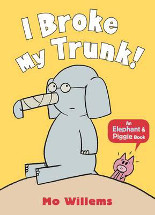
I broke my trunk! by Mo Willems
An Elephant and Piggie book. Walker Books, 2011. ISBN
9781406373592
(Age: 3-6) Recommended. Humour. Injury. Picture book. Animal
characters. Friendship. Mo Willems manages to entertain with few
words and simplified illustrations (and all text in speech bubbles);
and young children will love this! With few colours and few words,
Elephant tells the convoluted reason for his injured trunk. This
begins as a recount of the events leading to his injury (akin in
style to the fable, The giant turnip), but leads to a twist
connected to his friendship with Piggie. The simple explanation is
the basis of the humour, but this is then compounded and magnified
when Piggie also gets his own 'broken body part'!
It is a crazy story with silly illustrations, but very appealing for
a young audience aged 3-6.
Carolyn Hull
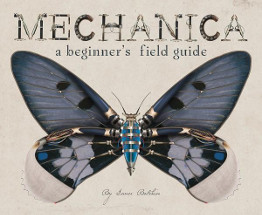
Mechanica by Lance Balchin
Five Mile Press, 2016. ISBN 9781760401085
(Age: All) Highly recommended. Picture book for older readers,
Technology, Machines, Environmental destruction, Extinction, Science
fiction, Dystopia. Machines have taken over the role of animals in
this dark view of our future, where the continued use of fossil
fuels has caused the environment to collapse, species have become
extinct and large areas of the world uninhabitable. Built to replace
the work done by animals (for example, a mechanical bee was
developed to propagate the crops) these interbred with drones built
for surveillance purposes when the world descended into war. Their
offspring are presented in this highly imaginative and compulsive
picture book, set out like a scientific catalogue of a new species.
What began as drones escaped into areas beyond human reach and
meeting the mechanica, designed by man to replace the animals lost,
their offspring become the most intricate and beautiful of
creatures, darkly mechanical, steam punk in their design and
absorbing in their detail.
Each verso page has the most imaginative of illustrations, depicting
one of these mechanica. One I particularly like is on page 23:
Interfectorem Apis (scientific name) or Killer Bee, and beneath is
given information about where it is found, how it was developed and
why it is called a killer bee. An example of its power is given and
then facts about the mechanica: its weight, length, speed, power
source, sensors and origin. Each fact adds to the knowledge of this
bee, giving hints about why it was created in the first place and
how dangerous it now can be. It is a formidable bee, and the
illustration is staggeringly beautiful. Readers will be enthralled
at the detail given, the mechanical elements of the creature and its
possibilities. And this is only one of a dozen or so creatures,
which aided by a useful index will be enjoyed by readers of all
ages. An afterword tells how the person who complied this catalogue
has found a real butterfly, so adding a note of optimism to this
bleakly dystopian story.
Readers from a young age to adult will pour over these pages,
looking at every detail of these creatures.
This powerful image of our future will resonate with many readers,
stunned by the destruction of our global environment and concerned
at the advance of war technology.
Fran Knight
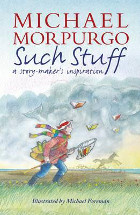
Such stuff: A story-maker's inspiration by Michael Morpurgo
Ill. by Michael Foreman. Walker Books, 2016. ISBN 9781406364576
What a master storyteller Michael Morpurgo is! His body of work and
his reputation are both completely awe-inspiring. This unparalleled
weaver of dreams who was the UK Children's Laureate from 2003-2005,
with over 100 books to his credit (many translated into other
languages) and numerous awards, has provided those of us who are such
admirers of this work with an unprecedented insight into his
writing. This is truly a joint production. When Michael's brother
suggested that so many people always ask about how the stories come
to life it would be a good idea to write about it, Michael took up
the idea with enthusiasm. It was natural to involve his long-time
illustrator and collaborator, Michael Foreman, who has often
provided him with the germ of an idea for a story. And along with
his wife, Clare, he began the task of collating anecdotes, excerpts and
background information for the brilliant format of this book.
The story of each book begin with Michael's recount of the first
idea, sometimes a real life incident, a media story, an historical
fact or a yarn from someone met in a pub. He discusses how the
pieces of each story then come together, to be woven into one
narrative. At times, many such singular ideas all combined into the
one book. Then follows an excerpt from the book in question, these
selected by Clare and lastly, a few pages of information that
provide back story to the particular theme of each all fascinating
and interesting aspects of the relevant title.
As an indulgence I must share this from the chapter on 'I believe
in unicorns': We know the best parents and the best teachers do this, change
lives. So often forgotten are the best librarians, dedicated
people who go quietly about their business of trying to encourage
reading. For many children who are not read to at home, or who
have been frightened of books, or bored by them, at school, a good
library and good librarian can change the life of a child, by
judicious and sensitive recommendations, by arranging book groups,
by readings, by inviting authors in to talk to children.
Thank you Michael both for that positive affirmation of our
profession but also for the joy you bring to our lives with your
superb writing.
I highly recommend this to you for students who are interested in
the process of creative writing, for lovers of Michael's work and
for your own professional reading. This one stays firmly on my own
shelf!
Sue Warren