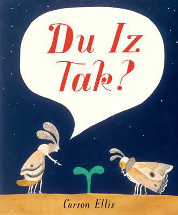
Ill. by Carson Ellis. Walker Books, 2016. ISBN 9781406368413
(Age: 3+) Recommended. Language. Insects. Seasons. Read aloud.
Insects will never look the same again after readers have wandered
through this inviting book, eagerly sharing the language that the
insects are given to speak. From the title, to every word on every
page, children are encouraged to work out what is being said, and it
is not that difficult for eager minds to do this, imagining what is
being said and developing their own responses.
The amazing changes in a garden are explored with insects speaking
to each other, many asking questions of the other about the garden
they are in and what is happening in it.
Over the whole year, many things happen in the garden: a caterpillar
strolls to the end of a stick where it becomes a chrysalis,
eventually becoming a moth which has one bright night to find a
mate, a small shoot appears above the ground and then grows into a
plant which flowers and then dies when the snow falls, only for the
seedlings to appear again the following year, ladybirds fly into the
garden along with small insects, ants, spiders, birds and beetles,
mushrooms rise up and then fall away, flowers appear then die, and
all the while the insects make use of the plant in the centre of the
garden, using their unusual language.
The arresting and highly detailed illustrations make full use of the
white of the page, with the same plant and stick placed on every
page, showing how they change over the year. Readers will have fun
following images as they change, replicating the changes made
through the seasons while reading the book aloud will add another
level of humour to the classroom. A wonderful introduction to a
class garden encouraging children to look more closely at what
surrounds them and how things change over a year.
Carson Ellis' first novel, Home
appeared on the New York Times bestseller list and her work can be
viewed on her website.
Fran Knight
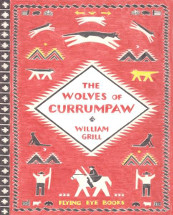
The wolves of Currumpaw by William Grill
Flying Eye Books, 2016. ISBN 9781909263833
Wolves. Hunting. Conservation of wildlife. New Mexico
History. At the turn of the century in New Mexico, European settlers
not only clashed with the native population but they also brought
farming methods which displaced native animals. Wolves were
particularly targeted for their attacks on stock. In the contest
between man and beast it is inevitable that the wolves were hunted
almost to extinction using cruel methods like trapping and
poisoning. One of the last was a legendary wolf which came to be
known as King Lobo. Wolf hunter and naturalist Ernest Thompson Seton
is called in, eventually trapping his cunning prey, but at the last
moment he questions the killing of such noble animals. In this
graphic retelling of Seton's short story, Lobo: The king of
Currumpaw 1898, William Grill beautifully puts the story in
perspective with a lovely sense of place and time. The pastel
illustrations graphically tell the story both in series of small
pictures and double page spreads. The text lightly links the images,
inviting sharing the large format book and reading aloud; there is
much to look at while listening to the story. Seton's legacy is that
his changed attitude led to him devoting the rest of his life to
conserving American wildlife especially wolves. His inspiration,
nearly 100 years later led to the reintroduction of wolves into
Yellowstone National Park.
Younger readers will find the pictures easy to follow but may need
help with the text. Older readers may find a lot to discuss in the
evolution of man's relationship with wild animals and how attitudes
may be changed over time and through experience. There is a lot to
learn too from the graphic storytelling in the illustrations.
Sue Speck
Not just a piece of cake, being an author by Hazel Edwards
Brolga Publishing, 2015. ISBN 9781922175809
Recommended for budding writers, adult fans and anyone who loves to
read autobiographies. Memoir by author of best-selling There's
a hippopotamus on our roof eating cake and author of
over two hundred picture books and novels. Hazel Edwards' writing
journey has taken her from Nepal mountaineering with spirited women,
walking the Milford Track in New Zealand, to Antarctic adventures.
Her approach to life's challenges shows her spirit of adventure and
her passionate desire to encourage readers from a very young age.
She loves to share her love of literature with all ages.
What a delight to read all the humorous hippo antics and adventures.
Imagine being stopped by the police with a large stuffed toy hippo
strapped in the passenger seat. Many little grubby hands cuddling
the animal have required some very ingenious cleaning solutions.
Hazel's one hundred random hippo memories are funny, poignant and
show just how much the character is loved around the world. A
country mum learnt to read sharing them with her Prep child whilst
the Australian Government gifted a set of books to Princess Mary on
the birth of her daughter. These much-loved books printed in
Braille, shared in Auslan, became plays and even a film.
An important part of her writing career is publicity, packed days
sharing her stories with parents and toddlers, kindergartens and
primary and secondary schools. The carefully planned days are filled
with author talks, book signings, question time - just how much does
an author earn, and creative writing sessions. Book Week
is one of the busiest times of the year, a logistical challenge,
sometimes a navigational dilemma as well. Losing her voice is a
common occurrence and Hazel even provides tips to soothe a sore
throat - bananas perhaps.
This autobiography is an enjoyable read and provides motivation and
gives insight into the life of a busy author.
Rhyllis Bignell
Phoenix burning by Bryony Pearce
Little Tiger Press, 2016. ISBN 9781847156709
(Age: Young adult) Highly recommended. Themes: Revenge; Junk-Punk;
Dystopian; Religious cults; Survival; Challenge; Trust and betrayal.
The first book in this series, Phoenix Rising, introduced
the reader to the world of post-cataclysmic environmental disaster,
where the ocean is a seething mass of caustic junk, roiling in the
corrosive waters that take life rather than support it. In Phoenix
Burning, the second book of the series, we join the junk pirates as
they variously fight one another and work together to solve a
mystery and to recover the missing component to enable their
salvaged energy system to become functional. In the process Toby and
Ayla must work through their sabotage and distrust of each other to
complete the task that they cannot achieve alone. This takes them
into the enclave of the sun-worshippers - a cult that engages in
bizarre rituals as part of their religious fervour. They must work
together to steal what they need, while being involved in complex
challenges, where loss means they become silent monk-like devotees
and winning means they become blind but 'holy'. (This is a little
like a Hunger Games fight to avoid death and where winners bear the
burden of their win.) Toby and Ayla's relationship is always going
to be challenged because of their family history, but Pearce has
cleverly woven a tale where we are able to detect a growing but
fraught dependence on one another and a hint of closeness, but with
trust in jeopardy.
The winner of this text is the very different setting, where
normality has been so badly damaged by environmental disaster. The
ocean is a chemical wasteland, detrimental to life. The problem this
has created for the world and the survivors has created a fantasy
environment that is unlike any other. Sailing on a pirate ship where
everything is cobbled together using junk salvaged from the sea or
the spoiled shores allows for some impressive imagination leaps.
Pearce writes in a compelling and exciting way and from the prologue
we realise that there is danger to follow.
This is a book that can be highly recommended to YA readers (male
and female), particularly those who have enjoyed Hunger Games
and other dystopian literature.
Carolyn Hull
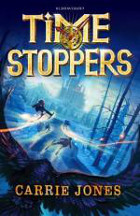
Time Stoppers by Carrie Jones
Bloomsbury, 2016. ISBN 9781408872581
(Age: 9-11) Recommended. Annie Nobody's life is truly sad; she has
survived placements in eleven foster homes, and now she is placed
with the Wiegles in their filthy trailer with their pack of dogs.
Her carers treat her like a slave and make her sleep outside into
the snow, where she is forced to sleep with the dogs. Things become
worse for her, when an evil force chases her through the forest. In
the same town Mount Desert, twelve-year-old Jamie Alexander's family
life is also difficult. His grandmother and father are really
trolls, waiting for him to turn thirteen because trolls love to
feast on human's bones and brains!
At the very last minute, Annie and Jamie are rescued, then swept
away on snowmobile-hovercraft to the magical city of Aurora. Their
rescuer is a dwarf called Eva, who is rather opinionated and sassy.
This supernatural place is filled with magical creatures protected
by a woman named Miss Cornelia. Annie Nobody has a purpose, a
special role - she is a Time Stopper with magical powers. The
townsfolk expect her to save them from the evil Raiff.
Carrie Jones' novel is one of darkness and light, of action-packed
adventures, fantastical creatures and is filled with a range of
quirky characters. The protagonists rise up to meet the challenges,
as they begin to draw on their inner strength, their resilience and
start to believe in their own capabilities. The story ends with a
cliff-hanger and sets up the beginning of the Time Stoppers
series. The exposition and rising arc of the narrative are extremely
dark and confronting, and this may be of concern to a younger
reader.
Rhyllis Bignell
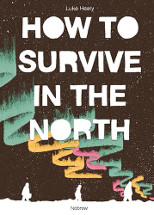
How to Survive in the North by Luke Healy
Nobrow, 2016. ISBN 9781910620069
Themes: Arctic exploration, survival, Inuit/Eskimo women,
resilience. This graphic novel interleaves three stories, two based
on factual accounts of expeditions to the arctic and one
contemporary fictional thread about a disgraced academic who happens
to find the arctic accounts in the university archives. All three
are about poor decision making, endurance and survival by taking
control and making the best of a bad situation. The book opens at
the lowest point of each storyline, differentiated by colours which
help the reader throughout the book. The two arctic exploration
accounts are linked by Wrangel Island somewhere between Canada and
Russia (a map would have been informative). The first captained by
Bob Bartlett who heroically trekked over the ice to Russia to get
help when their ship was crushed and the crew marooned on the
island. The second expedition 7 years later was to claim the island
for Canada. Again the group was trapped on the island and the Inuit
seamstress, Blackjack, was left to look after an injured member of
the party (who later died) while the others went to get help. Her
story makes this worthwhile reading, with only a cat for company she
endures extreme hardship, teaching herself to use a gun to hunt for
food, resilient even though she has no idea if anyone knows she is
there. The account of the first expedition was less well articulated
and the fictional thread has the complication of the academic being
disciplined for having had a homosexual relationship with a student,
not something a young reader may understand. Older students might
find some life messages in these flawed characters and the book is
interesting for its graphic design and accessible illustration
style.
Sue Speck
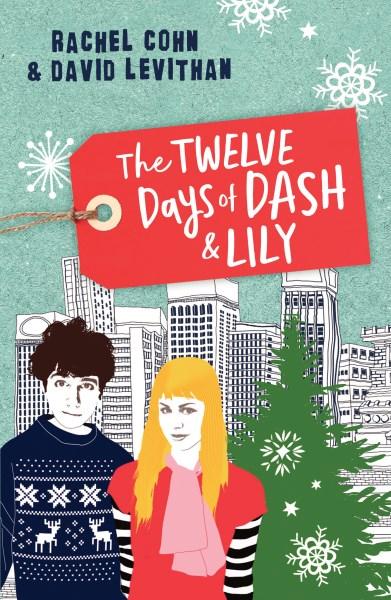
The twelve days of Dash and Lily by Rachel Cohn and David Levithan
Dash and Lily bk 2. Allen & Unwin, 2016. ISBN
9781760293826
(Age: 15+) Recommended. Following the success of Dash
and Lily's Book of Dares, Cohn and Levithan have
collaborated again to bring the likeable pair back in a Christmas
tale. Lily has had a very tough year with her grandfather suffering
a heart attack. She has taken on much of his care, and her usual
optimism has begun to flag. She has had no inclination to do the
usual Christmas planning that she loves so much, and her romance
with Dash seems to be flagging as well. Dash, her brother Langston
and her friends decide to get together to help Lily recover the
Christmas spirit.
With typical humour, Lily and Dash tell their stories in alternative
chapters. It is not as light hearted as Dash and Lily's book of
dares, as this time the story concentrates on the themes of
change and communication. Lily is finding it very difficult to come
to terms with the change in her grandfather's health, as are her
parents who are arguing seriously about where to live for the first
time. She is also finding it difficult to communicate her feelings
to Dash, who also doesn't make his feelings known either, so the two
of them seem to be at odds at times. But Dash is determined to cheer
Lily up and with the help of his friend Boomer, brings in a
Christmas tree to start off the twelve days of Christmas. From then
on, there are quite a few adventures around New York told in the
authors' humorous style and which will really appeal to anyone who
likes reading about stories set in that city.
Some of the advice about communication, change and love will also
resonate with readers, as they follow the plight of the two young
people.
This is sure to be a hit with readers who like to enjoy the holiday
season with a Christmas story that is engrossing and enjoyable.
Pat Pledger
My Lovely Christmas Book
Bloomsbury, 2016. ISBN 9781408883679
(Age: 7+) Recommended. Craft. Puzzles. Colouring in
activities. A book to appeal to anyone who enjoys craft, puzzles and
making things, My lovely Christmas book is sure to give many
hours of pleasure to the lucky recipient of this book. Beautifully
illustrated with gorgeous patterns and colours, it will have
immediate appeal. There is the opportunity to paste in a photo at
the beginning to make it personal, and then the following pages have
vivid decorations that can be made into paper chains. This is
followed by a Christmas tree maze for the problem solver to work out
as well as other puzzles throughout the book. Christmas decorations
can be coloured in or cut out to decorate the Christmas tree and
there are many craft ideas to make, like an angel and snowflakes. Of
particular interest for me was the ability to cut out and make the
decorative gift cards and place name cards, very useful for last
minute gifts and Christmas settings.
The reader is also encouraged to do lots of creative writing, with
the book going through the twelve days of Christmas as well as
having diary entries and poetry. There are spots to make Christmas
card lists and ones of presents for friends and family and the
opportunity to do drawings and doodles.
This would make a great present to give before the twelve days of
Christmas come along, as it would result in some lovely decorations
around the house and many creative activities being undertaken.
Pat Pledger
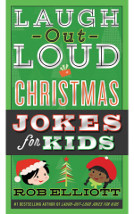
Laugh-out-loud Christmas jokes for kids by Rob Elliott
HarperCollins, 2016. ISBN 9780062497918
(Age: 6+) Recommended. Jokes. Christmas. There are lots of laughs in
this latest joke book from Rob Elliott. Kids will delight in the
wacky humour - although adults may groan at some of the jokes. There
are many of the favourite Knock Knock jokes that kids love
eg.: Knock, Knock
Who's there?
Muffin
Muffin who?
Naughty kids get muffin for Christmas
There are hundred of jokes that will delight children who love
telling jokes to each other and adults. They will have lots of fun
dipping into the book and finding their favourites and tricking
friends and family. Here is another sample: Why was the snowman so mean?
Because he was coldhearted.
Cute little illustrations are scattered throughout the book, which
is a small paperback size, ideal for newly independent readers as
well as older children.
This would be a great Christmas stocking filler or a fun book to
have in the classroom to get a smile on children's faces during the
countdown to Christmas.
Pat Pledger
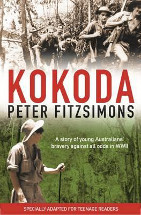
Kokoda by Peter Fitzsimons
Hachette, 2016 . ISBN 9780734417435
(Age: 12+) Recommended. Peter Fitzsimons has done an excellent job
of creating a teen edition of his book Kokoda. The text
reads like a novel yet there are no fictional elements and the work
does justice to the amazing exploits of those 'ragged bloody heroes'
without the inclusion of content inappropriate for teens. The
stunning performance of a poorly trained, inadequately supplied
militia, who fought to the death to stop a ferocious enemy, whilst
grossly outnumbered, sickened by tropical diseases and suffering
malnutrition, is the main focus of this book.
As an Australian who is proud of those who gave military service to
our country, I am simultaneously conscious of the need to avoid any
hint of glorification of war in literature. Fitzsimons shows
unashamed reverence for those who endured almost impossible
conditions in the New Guinea jungle as he recounts the courage shown
by military units and the almost unbelievable bravery of
individuals. Whilst doing so, he emphasises terrible suffering,
almost unimaginable fear and the trauma, both physical and mental,
which affected those soldiers for the rest of their lives.
The exploits of these soldiers have become legendary in the
Australian mindset and it is important that we are reminded of the
historical facts, to help us remain grounded, avoiding myth and
imaginative dramatisation. In explaining the significance of the
'chocolate soldier' militia and the enormous respect that the 39th
Battalion earned, Fitzsimons does not shy away from acknowledging
the fact that the 53rd Battalion largely failed its military
objectives and did not serve with distinction. Importantly, the
author notes that these servicemen had completely inadequate
training and suffered from terrible organisation and planning in the
early stages of the operation. Similarly, Fitzsimons is to be
commended for having the courage to openly criticise the Australian
General Blamey for his arrogance, ignorance and incompetence during
the campaign. Further, the author is also bold enough to voice that
General Douglas MacArthur was similarly incompetent and that many
Australian and American lives were wasted due his idiotic orders
influenced by an inflated ego and an unawareness of reality due to
being nowhere near the action. This is important, given that
MacArthur was accorded heroic status by a tame press and film
industry.
I recommend this book to teenagers of 12+ years and to adults who
will enjoy it whilst learning a great deal.
Rob Welsh
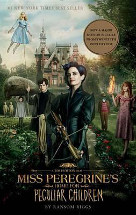
Miss Peregrine's home for peculiar children by Ransom Riggs
Quirk Books, 2016. ISBN 9781594749025
(Age: Young adult) Recommended. This is a quirky fantasy tale of a
young boy's quest to uncover the story behind his grandfather's
dying words in very unusual circumstances. The fantasy tale reveals
a community of very peculiar children locked in a time loop, and
their struggles to overcome an attack from an unusual source.
The story is very readable once you get past the first few chapters
where the main character is undergoing psychological struggles and
treatment. The book also includes some very bizarre photographs (set
in 1940's).
There is nothing unsavoury in this story but it is most unusual and I
can recommend it for young adult readers.
Carolyn Hull
Home in the rain by Bob Graham
Walker Books, 2016. ISBN 9781406368239
(Age: 4+) Highly recommended. Families, Relationships, Rain, Home.
This story of family and home replicates themes Graham has always
used, ones which are persistently asked for by readers of all ages,
ones picked up eagerly when seen in the library, classroom or shop.
My now 35 year old son was not a reader, but when a book seller came
to town and set up his display, my son ran to the Bob Graham books,
recognising their familiarity, grabbing them with a please buy these
for me look to his parents, and sitting down to read in the shop.
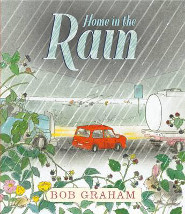
This will be just as eagerly sought by younger readers, as Francie
and her mum and only just showing new baby sister drive home from
Grandma's house in the teeming rain. They are caught between huge
lorries plying the motorway, one of which pushes their little red
car onto the verge. In the parking bay they take a rest from the
incessant rain and traffic, and eat the lunch that grandma made for
them. After drawing her family's names on the windows Francie asks
her mum about her new baby sister. She is interested in what this
new baby will be called. Mum tells her that no name has been chosen,
but when an idea comes she will know. They go on their way, with the
rain and then hail still making their journey difficult. At a
service station, mum has an idea about a name, and so Francie is
able to write that name on the car's window, just as she did with
her own and her parents.
Bob Graham has the ability to make a small moment one of
significance and portent. A child and her mother deciding on a new
name for a baby sister is full of significance for this small
family, with their father working away from home and grandma also
living far away. It will not have been noticed by any other person
but for this family, it is remarkable. And this is reflected in the
beautiful drawings, as the sun comes out guiding their way back
home.
Graham uses his masterful technique to bring the feeling of their
journey to life, as they are squeezed between the many trucks on the
highway, slowed by the rain, shown in large white lines across most
of the pages. Their small car is diminished by the stream of trucks,
but it stands out in the sea of grey, while the edges of the pages
and the highway are tinged with blackberry bushes and small animals,
bringing the countryside into view. Each page offers a perspective
to think about: the highway signs pointing to home, the sweets found
in the car pockets, mum kicking off her shoes to rest, the other
people at the service station, the view of the oil rig out to sea,
perhaps showing us where dad works. I love every page and all who
pick up this book will too.
Fran Knight
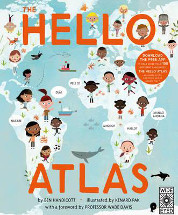
The Hello Atlas by Ben Handicott
Ill. by Kenard Pak. Wide Eyed Editions, 2016. ISBN 9781847808493
(Age: Primary) Recommended. Theme: Language; Social Atlas.This is a
language atlas that can be read - but it is also linked to a
child-friendly free downloadable App that 'speaks' basic phrases in
each of the languages that is highlighted in the pictorial Atlas.
The book is organised by Continents, highlighting the array of
languages that are spoken and gives basic information about the
'age' and features of these languages. Following this main page are
picture pages with basic phrases used by each language. (Used in
conjunction with the App, a child could also learn how to pronounce
each phrase as well as see it written - a valuable feature for a
book about language.) Even Antarctica has languages highlighted -
for the researchers and scientists who are stationed there. Note:
Only a small number of Aboriginal languages are highlighted in
Australia, but it does mention that there are more that exist.
The text also indicates where languages are at risk of extinction
and why, and also why it is good to retain an original language. For
children just learning that their own language is not the only one
in use in the world, this book makes a delightful resource,
particularly when used in conjunction with the App (easily
downloaded from the App Store or Google Play.)
Recommended (Particularly as a School Library resource for Primary
Schools)
Carolyn Hull
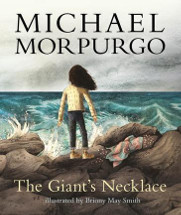
The giant's necklace by Michael Morpurgo
Walker Books, 2016. ISBN 9781406357127
(Age: 9+) Highly recommended. Coming hot on the heels of my review
of Michael's Such stuff is this absolutely beautiful short
story/novella which is both poignant and thrilling. And of course,
now I also want to know the 'prompt' for this particular story.
A family is on their annual summer holiday on the Cornish coast in
the same cottage in which they always stay. As usual the secluded
little beach is all theirs and for the entire stay, Cherry, the
youngest in the family, has been vigilantly collecting perfect pink
cowrie shells and stringing them into a 'giant's' necklace much to
the amusement of her four older brothers.
On the last day of the holiday Cherry is short of her target by only
about a hundred shells and knows that she can achieve her goal.
Knowing the child is safe on the beach the family go back to pack up
ready for the next morning's departure leaving Cherry with her
fixation.
But when the weather turns bad and the sea turns worse Cherry is cut
off from her usual path home. At first she is frightened but
realises she should be able to climb the cliff to safety. A strange
light from a cave attracts her attention midway and she finds
herself in an old copper mine where two old-fashioned Cornishmen are
working away. They sense her distress, warm her and comfort her and
eventually the younger man leads her to the surface and she is able
to find her way home.
No spoilers here - to find out the twist in the tail/tale you will
have to read it for yourself.
Beautifully presented in a small hardback with stunning
illustrations and delicious glossy pages, this is a treat for the
senses.
Highly recommended for readers from around nine years up.
Sue Warren
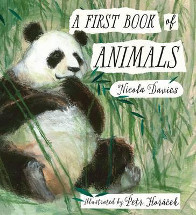
A first book of animals by Nicola Davies
Ill. by Petr Horacek. Walker Books, 2016. ISBN 9781406359633
(Age: 7+) Recommended. Animals. Poetry. A large format, hard-covered
book filled with glorious illustrations of a vast variety of animals
on our planet, accompanied by poems of varying styles and length,
each of which talk about their habitat will be pored over by younger
readers. They will read the poems out loud or share them with
friends, laughing at the antics of the animals presented, but also
taking in a great deal of information.
Entitled A first book of animals, it is not what most would
expect, a tome with lots of pictures and a catalogue of information
in a non fiction style, with perhaps maps and a fact file. Instead
we find poems of varying length and style, some blank verse, others
with rhyming lines or stanzas, some almost like limericks, but all
readable and accessible for younger readers. The illustrations give
the pages pizzazz with most colourful and engaging pictures,
covering the whole double page. Younger readers will love searching
out the various things in the background of each page against which
the animal is set.
I loved the pages on the zebra and the camel, and can now work out
the difference between the one humped and two humped camel.
The contents pages show the book is divided into five sections: Big
and small, Colours and shape, Animal homes, Animal babies and
Animals in action, and each section contains about a dozen animals to
consider. Younger readers will learn about using a contents page and
be able to select which animal they wish to look at in detail.
Fran Knight