Candlewick Press 2016. ISBN 9780763672331
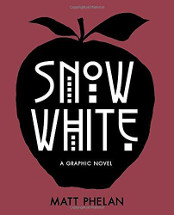
The classic story of Snow White is a dark one; her mother dies, the
wicked stepmother usurps her father's love and is jealous of her.
She survives a murder attempt and briefly finds friendship in the
seven dwarfs only to be poisoned; rescue comes only at the last
minute. This graphic adaptation embraces that darkness and imbues it
with 1920s style. It opens with the 'glass coffin' scene but here
'White as Snow' lies in Macey's Christmas window display with NYPD
crime scene tape in the foreground. The detective interviews a
street urchin, one of 'the Seven' and then the story flashes back to
the beginning. The monochrome pencil and ink illustrations and foggy
winter setting effectively suggest the coldness of Snow's life
making the rare splashes of colour quite startling. The stepmother
is a famous Zeigfeld Follies star who has enthralled her father and
the magic mirror is replaced by a ticker tape machine which seems
not only to have protected them from the stock market crash but also
to emit statements about who is the most beautiful. The Seven are a
group of motherless street urchins who protect Snow when she is
alone on the streets and take her in. When the inevitable happens,
the investigating detective is the one to give the kiss and wake
Snow adding colour to all of their lives.
The visual storytelling is multi layered. A quick read with little
dialogue but the attention to detail reveals a great cast of
well-drawn characters and an authentic feel of Depression era New
York. Not for the very young but a popular story cleverly retold. Classroom
ideas are available.
Sue Speck
Rain stones by Jackie French
Angus & Robertson, 2016. ISBN 9781460753170
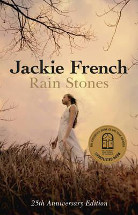
(Age: 10+) Highly recommended. Rural Australia. Drought. This newly
presented edition celebrates twenty five years since this book was
first published. With a new cover and an edition in ebook format,
times have changed, but not the charming set of stories reflecting
life for young people in rural Australia.
The opening tale, Rain stones is a story which tells of life
in rural Australia during a drought where mum must work in the town,
Helen must get tea ready while dad works on the old pump getting
what little water there is into the dam for the few sheep left on
the property. French breathes life into this scenario as Helen
strives to follow up the story about Aboriginal people bringing rain
through special stones. She asks the local historian and finds that
one of the boys in her class has Aboriginal heritage. She talks to
his father but seemingly to no avail, until both groups meet to
encourage rain. It remains a wining tale of coming together in
drought ridden Australia, and reflects values now part of that time.
In 'Afternoon with Grandma', a visit by a family to their
Grandma with Alzheimer Disease sees the two children told to go into
the garden, where they meet a girl they think is their cousin and
play with her learning all about her life and dreams. It is only
talking with their mother that they learn that their Gran's dreams
were the same.
In the third story, Ben meets Jacob at the swimming pool for lessons
and realises that he is blind, while another story concerns the
dinosaurs living in the hills around Canberra. All stories are quite
delightful, revealing the early writing of Jackie French for a new
generation of her avid readers.
Fran Knight
Rather be the Devil by Ian Rankin
John Rebus series. Orion Books, 2016. ISBN 9781409159414
(Age: Senior secondary to adult) Highly recommended. Cold case.
Crime. Edinburgh. John Rebus though retired, hasn't put away his
interest in crime or the criminals in Edinburgh. A cold case
stimulates his interest; the death of wealthy, promiscuous Maria
Turquand in a room at the Caledonian Hotel was never solved. Her
murderer was never found despite there being a notorious rock band
and all of its hangers on staying at the same hotel that night. Away
from the old 'Cal', Edinburgh's criminal underworld has seemingly
flexed its muscles when crime boss Darryl Christie is assaulted and
Big Ger Cafferty is the prime suspect.
Siobhan Clarke and Malcolm Fox have to put aside their differences
and work together with Rebus, not always a welcome partner in their
investigations. Christie's criminal dealings are of interest to
revenue and customs, particularly possible money laundering through
his betting shops. The fact that he's been assaulted could mean he
owes money, or there may be a takeover bid for his Edinburgh
businesses.
Rebus has a history with Cafferty so is a useful go-between for Fox
and Clarke, but is regarded with distrust by the hierarchy in the
force. He can be a loose cannon which is of course, part of his
charm.
Links between the cold case, old money and a struggle for supremacy
in the Edinburgh underworld lead the investigation in circuitous
routes, but who is pulling the strings? Is Cafferty a spent force?
Is Rebus' health a problem?
Rankin gives us the old Rebus forging ahead breaking rules, putting
himself in danger in pursuit of the perpetrators of crime, and of
course Clarke and now Fox are teamed with Rebus to make a familiar
and satisfying triumvirate. And for those who love the haunts of
Edinburgh, there are descriptions of both the known and unknown of
this city, so beloved by Rebus and his creator, Rankin.
Mark Knight
The Memory Book by Lara Avery
Quercus Children's Books, 2016. ISBN 9781784299248
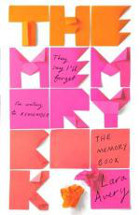
(Age: 13+) Themes: Terminal illness, Dementia, family, friendship,
love, debating. In her final year of High School Samatha McCoy has
been diagnosed with the rare genetic disease Niemann-Pick Type C in
which cholesterol builds up in the liver leading to blockages in the
brain causing a type of dementia which is always fatal, usually
before age 20. Her close knit family is struggling to deal with her
diagnosis, wanting to keep her safe at home avoiding stress by
finishing the year home schooling. Academically gifted, Sam has won
a scholarship to New York University, her memory offers her the
chance to escape her small home town and emulate her feminist icons
on the world stage. Sam has to fight to retain her aspirations,
'Health stuff I can take but don't take away my future' p10. While
not socially adept Sam has strategies for fitting in and she has
found her niche at school by joining the debating team. Her
immediate aims are to win the Nationals and the give the
valedictorian speech at her school graduation. She musters all the
arguments and strategies that make her such a good debater and
fights for her goals. One of these strategies is to write a journal
for Future Sam 'the more I record for you, the less I will forget.
The more I write to you, the more real you will become' p12. In the
journal we learn about family and friends, about parties and
boyfriends, all the normal things important to 18 year old girls.
But there is also a slowing down, a movement from denial to
acceptance; a move towards family, old friends and the sights and
smells of home; a narrowing of focus worrying less about goals and
more about now.
Terminal dementia is a horrific diagnosis but we find courage,
persistence, love and strength demonstrated by the characters. The
love interest is a bit forced and the main character seems younger
than 18 but it is an interesting and emotional journey. Middle
school girls will love this book and anyone drawn to novels about
struggling with terminal illness.
Sue Speck
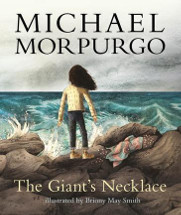
The giant's necklace by Michael Morpurgo
Ill. by Briony May Smith. Walker Books, 2016. ISBN 9781406357127
(Age: 10+) Recommended (with reservations for sensitive children)
Themes: Ghosts; Death. Young Cherry, the only girl in her family, is
keen to finish the excessively long 'Giant's Necklace' (a shell
collection on a string) before the family leaves their beachside
holiday home. Unfortunately, her focus on finishing the task
prevents her from noticing the changing sea conditions, and this
prevents her from leaving the shore safely. Her attempts to climb
the cliff to escape the wild seas leads her to the old abandoned tin
mine, where she encounters ghosts from a long ago mine collapse.
Although Morpurgo cleverly leads the reader to think this is a story
of survival, it is actually a ghost story and might be quite
confronting for readers too young to deal with the grief-washed
ending.
Morpurgo writes very engagingly with metaphor dripping from the
pages, and simple scenarios of family life revealed in a way that
children can connect to. The challenging theme of lives lost though
may mean that this is one of Morpurgo's books that may need to be
discussed with the child reader, rather than just placed in their
hands. The illustrations by Briony May Smith are colourful and in a
naive style, and perhaps may wrongly hint at a more light-hearted
story.
Carolyn Hull
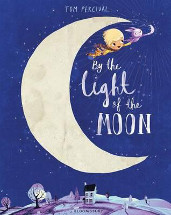
By the light of the moon by Tom Percival
Bloomsbury, 2016. ISBN 9781408852118
(Age: 3-6) Moving house is a difficult time for adults and young
children, their familiar rooms and play spaces are gone.
Ivan's old house had always been so warm and friendly. This new one
was NOT.
When Ivan cannot fall asleep in his strange new bedroom, he sits up
and stares out of his window. A magical shimmering ball of light
falls in the garden and he dashes downstairs to see what it is. Ivan
is led on a nighttime escapade past rocks, streams and flowers.
Suddenly the light changes into Moji a small friendly magical
creature, who paints the world with moonlight. Ivan becomes a brave
boy following Moji on a special adventure, up into space flying by
the stars and the moon. Moji's magic paintbrush illuminates the sky,
moonbeams shine down on Ivan's new house. Dancing through the
deepest forests and diving under the sea, Ivan's courage grows as he
holds Moji's hand.
When Moji paints the word home across the night sky, Ivan realises
that he can make new memories in his new house.
Tom Percival's computer-generated backgrounds use broad brushstrokes
in muted tones. A palette of blues, pinks, blacks and greys brings
the night setting to life, as motion lines create movement around
the stylised characters. By the light of the moon is a
gentle magical story, just right for those times when young children
need reassurance.
Rhyllis Bignell
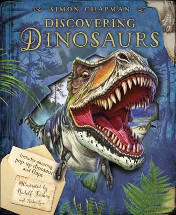
Discovering dinosaurs by Simon Chapman
Ill. by Rudolf Farkus and Mike Love. Bloomsbury, 2016. ISBN
9781408194614
(Age: 7+) Highly recommended. Dinosaurs, Non fiction, Fossils. The
spectacularly ferocious image of a Tyrannosaurus Rex on the front
cover is a winning invitation to this book with lift the flaps and
pop ups about the perennial favourite topic, dinosaurs. I can't
imagine too many people, kids and adults alike, moving past this
book on the shelf. I picked it up immediately, reveling in the feel
of this over-sized hard cover book and its thick pages revealing a
host of hidden things telling me more about dinosaurs than I had
read for a while.
Any good non fiction book is armed with a contents page, index and
glossary and these, apart from an index are offered in this book,
teaching young readers how to access information.
An introduction by Simon Chapman gives us the background and readers
will love the 'boys own adventure' lifestyle he seems to lead.
The first double page introduces the reader to the time periods
under discussion, Triassic, and the lift out flaps on each page
reveal the Jurassic and Late Cretaceous periods, placed over a map
of the world. Each double page thereafter reveals a different area
of the world and the dinosaurs particular to that area. So the first
page introduces the reader to where and when the dinosaurs first
appeared on earth, followed by the velociraptor, amongst many
others. Each double page tells us about the dinosaur with a fact box
of all those curious bits of information young children absorb. Some
pages have full page illustrations, some have many smaller pictures,
some pages have lift the flaps and some have pop outs. It all leads
to the last pages, one of which talks about their extinction while
the next tells us about fossils and what they show us. All in all a
fascinating addition to the range of books about dinosaurs which I
am sure will be well read. A forward thinking teacher, parent or
librarian might like to show kids how to use it carefully.
Fran Knight
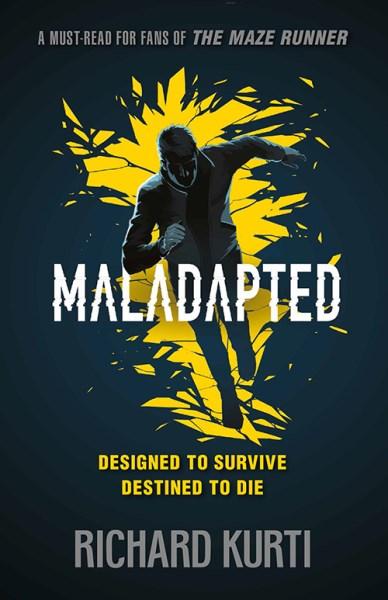
Maladapted by R. Kurti
Walker Books, 2016. ISBN 9781406346299
(Age: 13+) Recommended. Science versus Religion in this fast-paced
dystopian adventure. Cillian, a budding mathematician, is the sole
survivor of a terrorist attack on the Metro (subway). Triggered by
the trauma, hitherto untapped superpowers enable Cillian to save
himself. Sadly, his father's parting word, 'Gilgamesh', quickly
becomes his quest.
Within hours, Cillian's home is burgled and he knows he must look
for the answers to the sole clue to his real identity. But there is
another lost soul for him to meet in Foundation City. Tess is an
orphan. She was raised by an extreme religious group, 'Revelation'
who were responsible for the subway disaster and every other attack
on the high tech ruling elite. Tess is sent to observe and
ultimately destroy Cillian but the pair become friends, united by
their distaste for the extremism on both sides.
Of course the friends endure, but it is clear they have unfinished
business in Foundation City. In Maladapted, characterisation
is not one of Richard Kurti's strengths so readers looking to get to
know Tess and Cillian, will be disappointed. However, the
electrifying plot commands you to keep reading and we can expect
that the main characters will be fleshed out in the ensuing series.
Maladapted is crafted to satisfy fans of the Maze Runner
and Divergent series or similar novels in the popular
dystopian/sci-fi/horror category.
Deborah Robins
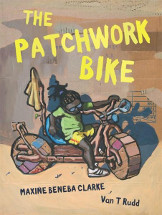
The patchwork bike by Maxine Beneba Clarke
Ill. by Van T Rudd. Hachette, 2016. ISBN 9780734416681
(Age: all) Highly (Highly x 2) recommended. Humour. Africa.
Ingenuity. Working together. Families. Village life. On the edge of
the No-Go desert, there is not much to work with to have some fun
with your friends. But this one boy and his brothers find much to
keep themselves occupied, whether it be sliding down the sandhill,
climbing the Fiori tree, or avoiding their fed up mum. But the best
thing is riding the bike he and his brothers made, with its bent
bucket seat, handlebar made from twining branches, tin pot handles
and wood cut out wheels. The boys can go anywhere in their bike,
over the sand hills, or riding through the village or the fields.
Many times they must stop and do some running repairs, but they
always have a lot of fun.
The infectiously funny story of boys and their home-made bike will
invite comment and delight as younger readers marvel at their
ingenuity and will eagerly try to replicate what the boys have done.
The illustrations are wondrous, with their thick black outlines and
block colours rendered on recycled cardboard with intriguing
stickers on each piece. The background of the village with its
mud-for-walls houses, sparse fields, few trees, sand hills and
abandoned car will alert the readers to the paucity of these
children's lives, and perhaps make them reflect on the richness of
their own. The stunning illustrations will provide a talking point
for the reader as they hunt out clues about the lives of these boys,
and perhaps think about why the long suffering mother is fed up. I
love the introduction of speed using a bold brush of colour across
the page and was further intrigued by the use of shadows throughout
the book, underlining the heat of the day. There are very few
picture books available for our students set in Africa and this
makes a welcome addition to any class looking at children outside
their own experience.
Clarke has had many short stories, non fiction and poetry published
in Australia and this is her first picture book. The illustrator,
Rudd, too presents his first picture book for us, and I can only
hope they produce more.
Fran Knight
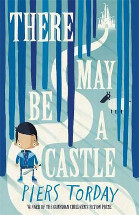
There may be a castle by Piers Torday
Hachette, 2016. ISBN 9781848668621
(Age: 10+) Recommended. On the wordless turquoise cover, a stylised
path winds its way to a distant castle while the blurb simply
states, 'like I said, kid, it's your story. Are you ready?' There may be a castle is a multilayered story, told through
the eyes of two narrators, Mouse Mouse Mallory a small
eleven-year-old boy, a procrastinator, a thinker whose constant
companion is his stuffed toy donkey Nonky and his older sister
Violet. Her personality is opposite to her brother's: she is
confident and feisty like her hero, a pirate queen. Mouse hates
Christmas, as every year they travel to their grandparents' house on
Christmas Eve. Even with dire weather warnings, Mum bundles the
children out of the house and settles toddler Esme in her car seat.
The car ride is fraught with tension, and in a minute in snowy
dangerous conditions, the car crashes. The SUV rolls down a steep
hill, the windscreen shatters and Mouse who has undone his seatbelt
is catapulted out into the snow. His mother bleeding and unconscious
and his sisters hang upside down in the car, Esme safe in her car
seat while Violet is trapped by her seatbelt.
This is the turning point of Torday's narrative, clearly delineated
by chapters and font styles, the two tales unfold. Mouse wakes up in
a magical land inhabited by strange characters, knights, monsters,
giant dinosaurs and a large talking donkey. He cannot look back;
there is an enemy lurking in the woods. He is constantly encouraged
and cajoled to 'maybe find the castle,' that lies ahead. Meanwhile
Violet has to confront the consequences of the car crash; it is up
to her to save her mother and sister.
Just like Christmas cake that exploded on impact, leaving crumbs in
the car and scattered on the snowy ground outside, Torday leaves
plenty of clues for the astute reader along the way to the
culmination of the story. While each of the main characters shows
great resilience and resourcefulness, the reader also needs to
persevere at times with different storylines and the individual
quests.
This story is challenging, a dark and compelling story, at times
nonsensical with the annoying minstrel's lengthy songs, but most of
all it is confronting. There may be a castle is suited to a
more mature, discerning preteen reader.
Rhyllis Bignell
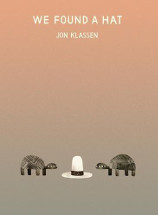
We found a hat by Jon Klassen
Walker Books, 2016. ISBN 9781406347517
(Age: 3+) Highly recommended. Sharing. Problem solving. Humour. Two
turtles find a hat. They try on the hat in turns and find that it
looks good on both of them. But there are two of them and only one
hat. They decide that the best thing to do is to leave the hat,
because it would not be right if one has a hat and the other does
not. But their eyes tell a different story. As they watch the sunset
together they find their thoughts and eyes are drawn back to the hat
on the ground behind them. Later going to sleep, their eyes remain
open, watching the hat. When one falls asleep the other creeps
towards the hat, asking the other what he is thinking. He tells his
friend that he is dreaming of them both wearing the hat. Each has a
hat in his dream and the other turtle, satisfied that this solves
the problem, falls asleep beside his friend.
Readers will know that this solution satisfies both turtles, that
the hat which loomed as a problem between them has been reduced in
its significance and they are content. Their eyes are closed and
they sleep.
Divided into three chapters, Finding the Hat, Watching the Sunset
and Going to Sleep, children will love reading each section as the
story unfolds, offering possible solutions to the problem. The
wonderful sepia illustrations with pages of single colour against
which the turtles and hat, are initially shown as small figures
within the panorama of the desert. But as the problem looms, the
figures become larger, almost filling the pages.
But the eyes tell the story of trust, of friendship, of longing, of
teetering on the path of deception, of coming together as friends
again - themes which could be discussed with a group of children
either in a class, group or at home.
The third in a series of books about a hat, I want my
hat back (2011) and This
is not my hat (2012) this book will be equally well
received, its charming style, infectious humour and instantly
recognisable themes making it a book kids and adults will pick up to
read and share.
Fran Knight
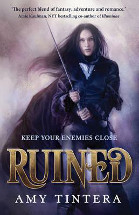
Ruined by Amy Tintera
Allen & Unwin, 2016. ISBN 9781760290641
(Age: 14+) Recommended. Fantasy. Romance. Emmeline of Ruina, needs
to restore her rightful place in her country and help regain its
independence. But she has been exiled, her mother and father killed
and her sister, Olivia, imprisoned. And unlike them she does not
have the powers of the Ruined, relying instead on her skills at
swordsmanship and her own cleverness.
She plans to infiltrate the enemy's stronghold and help her sister
escape. She kills Princess Mary of Vallos taking her place as the
betrothed of Prince Casimir of Lera (Cas). Following this is a story
of the growing romance between Em and Cas, as the two are now
betrothed. Beautiful and expensive gowns, detailed with relish,
different customs and a growing rift between Cas and his parents
causes some hesitation on Em's part, as the need to free her sister
becomes secondary to her growing love for Cas. She becomes less sure
of herself and the reason she is in this place. In captivity
Olivia's powers have grown and Em's indecision has created a
distrust between the two girls.
A solid fantasy read, the background of the rivalry between the two
kingdoms is nothing new but the writing is fast paced and the
romance enough to impel any reader to turn the pages.
Fran Knight
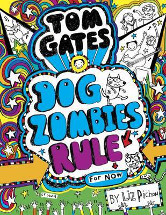
Dog Zombies rule for now by Liz Pichon
Tom Gates series bk. 11. Scholastic, 2016. ISBN 9781743812563
(Age: 8-11) Recommended. Liz Pichon's Tom Gates series is
extremely popular; the diary style format includes the creative
doodles, small cartoons, thought bubbles her fans love. The
easy-to-read text includes an array of appealing fonts and styles,
handwriting, bubble writing, emphasized words, block writing and
words made out of patterns. The placement of text and illustrations
along with the large line spacing is great for high interest-lower
reading age students.
Tom has agreed to help his best friend Mark who is moving house and
needs to find a pet-sitter for a few days. Of course, at school
Marcus Meldrew finds out and begins to tease Tom, will it be Mark's
pet snake? Tom begins to worry and doodle, his sister Delilah has
allergies and his parents do not actually know about the promise.
This is just another day in the life of Tom Gates. Marble the
hamster arrives with a long list of instructions and takes up
residence in Tom's room. Yes, he loves to run all night on his
hamster wheel!
Tom has big plans for his band Dog Zombies, to write more songs and
to make spectacular music. Unfortunately getting more sleep proves
difficult with Marble the hamster active all night and the constant
chiming of the cuckoo clock. Annoying Delilah proves to be an easy
task for Tom.
Nothing in Tom's life is dull or boring and he finds trouble
wherever he goes. Filled with family dramas, band rehearsals,
pet-sitting problems and the ups and downs of Tom's school life, Dog
Zombies Rule For Now is another amusing and entertaining
addition to the series. Liz Pichon also includes opportunities for
craft activities and suggestions for story writing.
Rhyllis Bignell
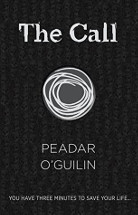
The Call by Peadar O'Guilin
David Fickling Books, 2016. ISBN 9781910989203
(Age: 16+) Centuries after humans drove the Sidhe (fairies) from
Ireland into the dark world of the Grey Land, society struggles to
survive as the supernatural creatures inflict a horrifying revenge.
Every child is suddenly seized without warning at some stage of
their adolescence. They are transported in a single moment to the
hideously terrifying world of the Sidhe where they are hunted and
most often captured and tortured to death for the amusement of their
tormentors.
All are returned to Ireland, however approximately nine out of ten
are killed and the survivors bear terrible wounds and disfigurements
from their ordeal. The corpses are mutilated and deformed by fairies
as an example to those who have not yet been 'called', as a warning
of the unspeakable pain and suffering which they will be subjected
to when caught.
Unable to escape their land, the dwindling Irish population faces
societal collapse and survival dominates every aspect of life. From
the age of ten, children attend special colleges where they are
subjected to gruelling physical exercise to develop strength and
stamina whilst engaging in high level self defence techniques. Their
entire education centres upon being as prepared as they possibly can
when they are called, finding themselves naked and alone in an alien
world where they will be sadistically hunted.
Having survived polio, central character Nessa has a walking
disability. She knows that surviving her call is made monumentally
difficult by being unable to flee as swiftly as most. Despite this,
she feels that she must survive and devotes her life to
accomplishing every aspect of her training as well as she can. If
the prospect of indescribable violence and pain in a nether world is
not enough, Nessa and her peers suffer vicious bullying from fellow
students who seek to dominate in a real world where normal teen
relationships and hormones remain. With students trained to survive
by killing before being killed, fights in the survival college can
maim and to be called when injured invites almost certain death.
Strong female characters exist in this story and they are shown to
be self-reliant and capable of defending themselves. Threats and
acts of violence perpetrated by male characters upon females makes
for uncomfortable reading however.
The linear progression of Nessa's experience is interspersed with
chapters describing what happens to other students from the school's
various year levels when they are called to the Grey Land.
The author describes this tale as grim which is a significant
understatement. Some scenes are nightmarish but what disturbed me
most was the degrading, unending pain and misery endured by humans
who were enslaved and grossly disfigured to provide service to
captors. Descriptions of clothing made from human parts was
sickening. Whilst many teenagers enjoy horror themes, aspects of
this novel could be described as extreme.
Suggested minimum 16 years.
Rob Welsh
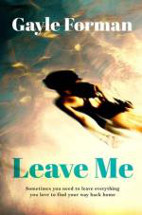
Leave me by Gayle Forman
Simon and Schuster, 2016. ISBN 9781471156786
(Age: Adult) Themes: Identity; Family; Responsibility; Illness;
Stress; Adoption. Adult Novel. Every working woman who also bears
the burdens of family life will resonate with the emotional
struggles of the central character in this story for adult readers.
Maribeth is a 44-year-old juggling many things - stressful career in
an industry with unforgiving deadlines; two dearly loved twin
pre-schoolers and their busy schedules; finding time for intimacy
with a husband she loves; negotiating friendship changes and the
busyness of life in a big city. This juggling act falls apart
completely when she experiences a heart attack and a subsequent
bypass. Suddenly her world freefalls into unfamiliar territory and
her sense of self and her emotional needs cartwheel into places that
she is unprepared for and unwilling to address. So she leaves! With
no warning, and little thought for those around her, she transplants
her life into a different city, reconstructing herself little by
little as she explores her history and her reason for being. With no
identity, she manufactures something from nothing and connects to
people around her who slowly help her to rebuild her sense of self
and allow her to uncover the secrets that she has wound tightly
under her new façade. As an adopted child, the story also weaves her
search for her biological history into her search for identity and
emotional security.
Although there would be few people who would consider Maribeth's
abandonment of her family as a solution to their problems, the
mid-life emotional journey that she travels as a mature working
mother and career woman is certainly a 21st Century voyage into the
complications of stress, achievement, desire and responsibility. I
am past her stage of life, but I certainly felt and remembered some
of her angst as she attempted to keep everyone and everything afloat
around her, while feeling that she was drowning under the weight of
it all. Maribeth's reinvention of herself, was perhaps necessary as
she dealt with her own mortality, the physical consequences of Heart
surgery and the emotional trauma that created her selfish
introspection. Not happy reading, but well written; and she doesn't
drown, but there is hope as she learns to swim in a new and healthy
way.
Carolyn Hull