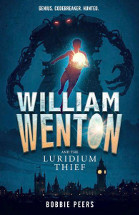
William Wenton and the luridium thief by Bobbie Peers
William Wenton bk 1. Walker, 2017. ISBN 9781406371703
(Age: 9+) Highly recommended. Norwegian film director Bobbie Peers'
debut children's novel is a written like a cinematic thriller packed
with action, intrigue and drama. His creative attention to detail is
outstanding, with the purpose built bots supporting the cybernetic
world filled with advanced technology.
The story begins with a grandfather's disappearance, resulting in a
family fleeing to hide in a small town in Norway. A secret
ingredient called luridium holds the key and there are sinister
forces that will stop at nothing to find it.
Eight years ago, William's grandfather, a world-famous cryptographer
and inventor, disappeared into a tunnel deep in the London
Underground taking a secret with him. Now William and his parents
live a secret life afraid to be discovered. William hides out in his
bedroom honing his code-breaking skills, researching famous
cryptographers and creating puzzles, continuing his grandfather's
legacy. When the Impossible Machine arrives at the local museum, he
disobeys his parent's instructions and slips away to solve the
encrypted puzzle. Of course, this is a trap and after his
achievement is publicised, he is kidnapped and taken to the
mysterious Institute for Post-Human Research. Here young candidates
undergo testing for their supreme scientific and technological
abilities. What an amazing and unusual environment filled with
cybernetic bots, robotic plants, even a Cosmotorium. William
befriends another candidate Iscia and together they investigate his
grandfather's disappearance, the reasons why he left and the
mysteries of the intelligent metal. William Wenton and the luridium thief is a journey into an
incredible new world where technology and science are celebrated.
This novel received the Norwegian Ark Children's Book Award in 2015.
Peer's imaginative and intense cybernetic world add excitement and
danger to William's dangerous quest for the truth, and this would
make an exciting class novel for Upper Primary students.
Rhyllis Bignell
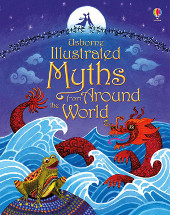
Usborne illustrated myths from around the world by Anya Klauss
Usborne, 2016. ISBN 9781409596738
What do Demeter and Persephone, Finn MacCool and the fish of Maui
all have in common? Well, they are included in this collection of
stories from around the world, beautifully illustrated by Anya
Klauss.
In times long past before the truth was known, many of the things
like the sun's passage across the sky or the formation of the land
were a mystery to those observing them so they made up stories to
explain the particular phenomenon. Even though they came from
far-flung places and diverse peoples their common thread was to
explain the seemingly inexplicable so that the world made sense to
them. Whether it involved giants, mythical beings and creatures,
magic or sorcery, each story sought to demystify and through their
telling through generations across thousands of years they have
endured, even though science may have intervened to expose the
truth.
As well as being a wonderful introduction to these sorts of stories
and embracing a range of cultures, such myths can also be the entry
point into scientific investigations for young and not-so-young
scientists. If Maui did not fish the North Island of New Zealand out
of the sea, how did it get there? If the changing of the seasons are
not caused by Demeter's love and loss, how are they formed? A great
way to link literature and science and start our students on their
own quests.
Barbara Braxton
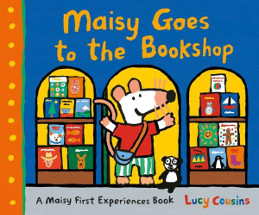
Maisy goes to the bookshop by Lucy Cousins
Maisy's first experiences series. Walker Books, 2017. ISBN
9781406369847
(Age: 3+) Recommended. Bookshops. Books. In the series, Maisy's
first experiences, which includes stories of Maisy as she goes
camping, or visits the library or goes to a hospital, the wonderful
Maisy is put into situations which may be new to some readers,
showing them what to expect and helping to diffuse any concerns they
may have.
In this book, Maisy is off to a bookshop for the first time.
Once inside she sees rows of shelves with books and finds it
difficult to select just one. She looks at several before making up
her mind. Ostrich the book shop owner shows her his favourite book,
one about birds, then she spies her friends, Charlie, Cyril and
Eddie. Each has their own favourite and can imagine themselves in
the story. They then go to the cafe for a treat, and Maisy pays
Ostrich for her book, receiving a receipt. On leaving the bookshop
Maisy catches the bus to her friend's house to give her the newly
purchased book as a present, and they read it over and over again,
as well as out loud.
A charming book with Cousins' very familiar black outlined images of
Maisy and her friends, the tale introduces younger readers to the
delight of books and using their imaginations to be part of the
story. Words relevant to visiting a bookshop are used, introducing
the reader to specific words used for book buying and reading. A
wonderful introduction for younger readers.
Fran Knight
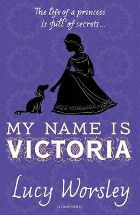
My name is Victoria by Lucy Worsley
Bloomsbury, 2017. ISBN 9781408882016
(Age: 10-14) Highly recommended. Historical fiction. Miss V. Conroy
is a very good girl. She is quiet, well-mannered and wants to
obey her father Sir John Conroy, the comptroller of the household of
the widowed Duchess of Kent. When her father takes her to Kensington
Palace to be the companion to the young Princess Victoria, she finds
that she is expected to spy on her and report back to her father.
Princess Victoria is being brought up under the Kensington System,
which aims to keep her isolated and dependent on Sir John and her
mother and keep control when she becomes queen.
Lucy Worsley, described as the 'much loved TV historian', has
written an engrossing and fast paced tale of the two young girls.
She has chosen to give them an alternative history. Even though
Queen Victoria's letters and diaries suggest that the two were
enemies, Worsley has written a story presenting the scenario that
the two did become friends, while ensuring that the historical
period and background are accurate.
There is plenty of intrigue in the Kensington household and Worsley
has the skill to bring this period to life as well give an indepth
description of the cruel Kensington System which made Victoria so
unhappy. The reader gets to know the characters of the two young
girls and can empathize with Miss V. Conroy who is torn with the
dilemma of what she should tell her father, and Princess Victoria, a
headstrong and determined girl who has to contend with very
difficult circumstances.
Worsley introduces My name is Victoria on YouTube.
Well researched and absorbing My name is Victoria will
become a favourite of readers who enjoy historical fiction.
Pat Pledger
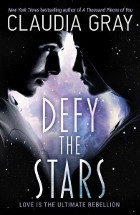
Defy the stars by Claudia Gray
Hot Key Books, 2017. ISBN 9781471406362
(Age: 14+) Highly recommended. Science Fiction. Artificial
intelligence. Robots. Space travel. Relativity. Pollution. Earth is
dying, and there is a war between it and Genesis, one of the colony
planets. The people of Genesis have closed down access to their
planet knowing that Earth will only destroy it the way their own has
been destroyed. In a raid on Genesis, Noemi a brave young pilot
boards a ship and meets Abel, a mech warrior from Earth. Programmed
to obey commands from humans, Abel at first seems like any other
robot to Noemi, but gradually she realises that he is no ordinary
mech, instead he is unique and has the ability to dream.
This is a truly fascinating, exciting and engrossing story. The
reader is swept along as Noemi and Abel fly through space trying to
find the parts that will enable them to block access to Genesis and
save the other young pilots who were preparing for a suicide
expedition to fight Earth. They travel to various colony worlds each
unique and intriguing, and meet the Vagabonds, a group who sail
forever in the stars. Life on board the space ship and on the colony
planets is vividly described and each of the characters is fully
realised.
What makes this a stand out novel though is the theme of what makes
a human. The gradual realisation by Noemi that Abel is more than a
robot makes her question all she has been brought up to believe. If
he has the ability to dream and to feel, is he then more than a
machine? Perhaps he should be given the right to make his own
decisions about whether he will die for Genesis. But then what will
happen to Noemi's world?
With a low-key love story, a high octane plot, and a stunning
exploration of what it means to be human. Defy the stars is a
riveting read. I can't wait for the next in the series.
Pat Pledger
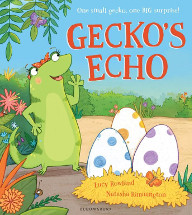
Gecko's echo by Lucy Rowland
Ill. by Natasha Rimmington. Bloomsbury, 2017. ISBN 9781408859506
(Age: 4+) Recommended. Animals. Families. Breeding. Rhyming story.
Underlining the adage of strength in numbers, mother Gecko in
protecting her eggs from the marauding thieves, needs to get help
from other geckos in her neighbourhood.
Told in rhyme, the story begins with the mother Gecko waiting for
her eggs to hatch, sweeping the area in front of her cave. The next
morning a snake slithers by, seeing a gecko and licking his lips at
the thought of gecko eggs for breakfast. But Gecko warns him that
she has one hundred other geckos inside her cave ready to come to
her aid at a shout. He quickly leaves. Similarly an eagle thinks
eggs would be a good feed and is told the same thing, flying away.
But when a rat calls wanting those eggs, he is not so easily fooled
by her threats, and takes a step closer. Children will laugh out
loud at the way the mother gecko protects her eggs, and be charmed
by her bravery.
Told in rhyming couplets the verse lends itself to children
predicting the rhyming word at the end of the couplet, while
learning some of the verses will be an easy task. Following the path
of the eggs from egg shapes to cracking open to reveal new baby
geckos will be a natural way for classes and families to talk about
babies, birth and family increase. The illustrations add
another level of humour to the tale and counting the one hundred
geckos on the middle double page will keep many children amused for
quite a while.
Fran Knight
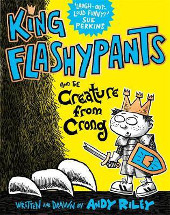
King Flashypants and the creature from Crong by Andy Riley
Hodder Children's Books, 2017. ISBN 9781444929607
When is the recommendation of 50 serves of vegies a day a good
thing? When you are king and not very old you need someone to help
you run the kingdom, some advice is good and some not so good, like
the recommendation everyone should have 50 serves of vegies every
day. Read this thrilling adventure to find the answer.
King Edwin Flashypants sets off to prove he is a proper king by
defeating the terrifying monster that gets bigger and grows more
eyes every time someone tells the story of it. King Edwin
Flashypants with his adviser and friend set off to save Edwinland and
prove that he is the rightful king. Emperor Nurbison on the other
hand is trying to do everything in his power to ensure King Edwin
Flashpnats is unsuccessful in his quest. King Edwin Flashypants and
his group encounter a number of trials along their journey and they
need to use their team work to try and overcome, while Emperor
Nurbison does his best to ensure that King Edwin Flashypants is not
successful. Who will triumph to become the rightful king of
Edwinland?
A funny story written in a way that will appeal to readers of
various reading abilities, it will have everyone laughing.
Karen Colliver
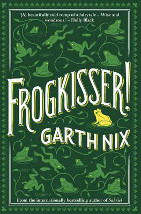
Frogkisser by Garth Nix
Allen and Unwin, 2017. ISBN 9781760293512
(Age: 10+) Highly recommended. Fantasy. Humour. What a delight to
pick up another fantasy by Garth Nix. He is one of my favourite
authors and I was not disappointed in this hilarious, thought
provoking and stirring fantasy adventure. Princess Anya is on a
quest to rescue a frog, who is not a frog but a prince who has been
turned into one by Anya's evil stepstepfather because he was in love
with Anya's sister, Morven. She is rather reluctant to move from the
library where she is comfortably ensconced, learning some magic
tricks, but she has made a 'sister promise' and knows that she will
have to do something about Prince Denholm. Accompanied by Ardent,
one of the Royal Dogs, she travels through the Kingdom of Trallonia,
trying to get the ingredients she needs to make a lip balm to use
when kissing the frog.
The humour is so infectious. I laughed out loud every time Gerald
the Herald (one of many) appeared and the news that he gave about
Anya was hilarious. Even the nickname Frogkisser will make the
reader chuckle as Anya valiantly goes on her quest. She meets many
strange creatures on the way, like the thief turned into a newt and
an otter turned into a strange being, as well as a princess turned
wizard, and many many frogs. I loved the Royal Dogs as will any
person who is a dog lover.
Underlying the fun of Anya's quest, is her gradual understanding of
responsibility. She is a princess, with many privileges, but she
begins to realise that with privilege comes an obligation to do the
right thing for her people. Although I waited for a prince to come
along for Anya, Nix didn't fall into the trap of having her kiss a
frog and find her true love – instead he concentrates on her
personal growth and quest. This is very refreshing.
There are some unexpected twists and turns all making for a very
enjoyable tale. In his acknowledgements at the end Nix
mentions Robin McKinley, Diana Wynne Jones and Lloyd Alexander among
others as influences on his work, and readers who have enjoyed works
by these authors are sure to enjoy Frogkisser as well. And if they
are not familiar with those authors then readers will be in for a
treat if they try books written by them.
Pat Pledger
Pat-a-cake series
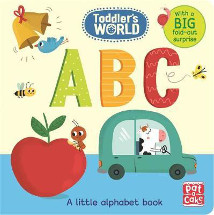
Hodder and Stoughton, 2017. ABC. ISBN 9781526380029 123. ISBN 9781526380050 Colours. ISBN 9781526380043 Animals. ISBN 9781526380036 On the Move. ISBN 9781526380012 Funny Faces. ISBN 9781526380005
(Age: 1-3) Recommended. 2017 has seen the release of six new
toddler's world learning board books from Pat-a-cake. Titled
ABC, 123, Colours, On the Move and Funny
Faces, each book is sturdy, vibrant, full of pictures and
ideal for very young children. Each page is filled with simple and
colourful illustrations paired with very simple wording. Pages are
thick and strong which is perfect for excited little hands. At the
end of each book, children are surprised with a large pop-up which
is a wonderful conclusion to each theme. Additionally, Funny
Faces has a 'look and laugh' mirror which is said to stimulate
baby's vision and help recognize the faces of the people they love.
Overall, the six books in the release are wonderful additions to a
toddler's library as they are excellent early learning resources.
Keely Coard
It's my pond by Claire Garralon
Translated by Sarah Ardizzone. Book Island, 2016. ISBN
9781911496021
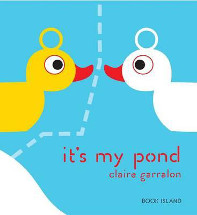
(Age: 4-7) Recommended. It's My Pond follows a number of
different coloured ducks who claim 'it's my pond' until black duck
helps them realize that it can be everyone's pond.
With repetitive text, it can be used as a potential take-home reader
for slightly older ages, but additionally is a good resource for
children learning their colours and counting.
Keely Coard
Fox and the jumping contest by Corey R. Tabor
Balzer and Bray, 2016. ISBN 9780062398741
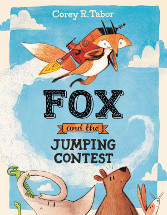
The animals are having a jumping contest - Elephant, Bear, Rabbit,
Turtle, Frog and Fox have all entered - and Fox is determined he
will win. He even imagines how good the trophy will look perched on
his mantlepiece.
But Fox isn't particularly good at jumping so he figures if that
trophy is going to have pride of place in his loungeroom he will
need a bit of assistance. So while the other animals practise, he
schemes and plans and builds. His solution? A jetpack that he paints
to match his fur hoping the other animals won't notice - so it is
clear that he knows he is cheating.
On the day of the contest with the bird judges all ready and perched
high in the branches the animals show their talents. Frog does well
and gets extra points for style; Turtle doesn't do as well and
Elephant less so. Bear was loud and Rabbit was spectacular. And then
it was Fox's turn . . .
This is a story with a twist, and it's a twist that can spark some
great discussion points which are perfect for getting young children
to start to think critically, to philosophise and to empathise. Fox
with his jetpack strapped to his back disappears so high in the sky
that the judges can't wait for him to return so they begin the
awards ceremony. But just as Rabbit is about to receive the trophy,
Fox falls back to Earth and plops into it and takes first place. The
final scene shows Fox standing back admiring the cup on his
mantlepiece, right where he had envisioned it would be.
But does Fox deserve it? Has he cheated? Were there written rules
about external assistance or were they just assumed? Why do we have
rules? How do the other animals feel about the win? What about
rabbit? Has there been fair play and sportsmanship? What is the
twist in that final scene and was it a reasonable way to solve the
problem? What does 'compromise' mean?
Careful exploration of the text, verbal and visual, offers a lot of
depth to this story and it deserves re-reading to get the most from
it. For example, Elephant doesn't mind that she cannot jump well
because she is "good at other things" and that in itself could
provoke another discussion about how we all have our strengths so
comparisons are not always fair. Even very young children have a
strong sense of justice and with the pictures enriching the words so
well with their extra detail and action there is much to examine and
ponder.
Life and literature are full of characters who are determined to win
regardless and this is a surprisingly good story that can introduce
even very young children to contemplate, at their own level, the
philosophical question of does the end justify the means and giving
them an opportunity to start thinking on a more abstract level, from
different perspectives and consider what is not being said.
One to get brains moving . . .
Barbara Braxton
Usborne illustrated traditional stories
Usborne 2016. ISBN 9781409596721
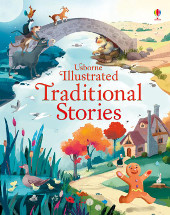
This is a collection of 17 stories from around the world that have
been passed on from generation to generation so they are now part of
our literature but which don't fit into the fairytale
classification. Stories like The Boy who Cried Wolf, The
Gingerbread Man, Baba Yaga and The Little Red Hen
sit alongside not-so-well-known ones like Tam Lin and The
Fisherman and the Genie.
With lovely illustrations throughout and with a luxury padded
hardback cover, this is one of those must-have volumes in your
teacher's toolkit that you can take out and share whenever there is
a spare minute or two, continuing the tradition of passing them on
to a new generation.
Newly independent readers will also enjoy them as the familiar
stories, larger font and short story format will make them an easy
bedtime read. This series is filling a niche for younger readers
that has been empty for some time.
Barbara Braxton
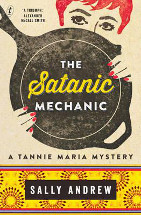
The Satanic mechanic by Sally Andrew
Text, 2016. ISBN 9781925355130
(Age: senior secondary to adult) Highly recommended. Crime fiction,
South Africa, Food. Tannie Maria is out of her depth. She cooks
beautifully, and often recommends recipes from her beloved Klein
Koroo and her family to her love lost correspondents at the Klein
Koroo Gazette where she works as the Dear Jane writer. The letters
she receives fill her with love for these people who have a need to
write to someone with their problems and her advice often begins and
ends with food. But she cannot solve her own problem. She has a
boyfriend, Detective Henk and they get along very well, particularly
after their involvement in the first of these novels, Recipes
for love and murder (2015). But try as she might, the final
act of love brings back so many painful memories of her abusive
husband who died some years before, that she cannot feel anything
but guilt and powerlessness at the thought.
She confesses this feeling and is advised to seek counseling and
ends up at an unusual PTSD group run by a man called the Satanic
Mechanic. Here the group sits in a circle in the middle of a laager
made by beat up rusting cars and vans grouped around a fire which
often holds food cooking for them to eat after each session, and
here they tell their stories. But someone is not who they seem, and
one man is killed during the evening.
The recent murder of a Bushman who took a mining company to stop the
desecration of their land, has caused anger amongst the community.
Detective Henk is investigating this murder and does not want Tannie
Maria to be involved, but with the death at the counseling group,
she is involved.
He breaks off their relationship because he cannot bear to see
another love die, and Tannie Maria accepts his decision.
But a last meeting at the PTSD group sees the resolution of the
murders and Tannie Maria at last confessing her guilt at her
husband's death.
This is a wonderful tale from South Africa, involving many
ingredients: a mining company and its plunder of Bushman land,
jealousy and guilt, counseling and PTSD. And above all, Tannie
Maria's marvelous recipes. The second book delves more into her back
story and brings this wonderful cook even closer to the readers.
Fran Knight
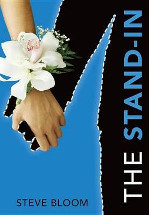
The stand-in by Steve Bloom
Carolrhoda Books, 2016. ISBN 9781512410235
(Age; 14+) Highly recommended. Bildungsroman. Brooks Rattigan is the
stand-in and the book's narrator. Desperate to be accepted into
Columbia University AND able to afford the fees, working class
Brooks founds his own business, escorting rich nerdy graduates to
their dances and formals. Celia Lieberman does not approve of the
date her parents have arranged and behaves much like Caterina in
Shakespeare's The taming of the shrew. The ending is thus
foreshadowed.
Complications arise when Brooks' best friend, The Murf, feels that
Brooks is abandoning his roots. He doesn't approve of Brooks' blind
ambition to attend the elite university, or his method of funding
it. Brooks' deadbeat father, himself a Harvard graduate, lets him
down and discourages him. Brooks is also attracted to a very
shallow, very beautiful high society girl. To make matters worse,
Shelby has a very jealous ex-boyfriend.
After a few initial spats, during which Celia is a very ungracious
date; she becomes the only person who is demonstrably supportive.
Both Celia and Brooks develop into the kind of friends who can rely
on each other. This is important because, much to our delight, no
two characters in fiction could possibly experience quite so much
bad luck.
Steve Bloom's concept is fresh and no doubt the movie rights have
already been secured. The characters and their relationships are
hilarious because Bloom knows exactly what they should do and say.
Brooks is sometimes inspiring - at others contemptible but we must
like him. We admire his grit to succeed in the face of failure - to
respect women yet exploit their situation at the same time. Most of
all we like that he falls for the one girl he started off hating.
Brooks Rattigan is a paradox and so are we.
Deborah Robins
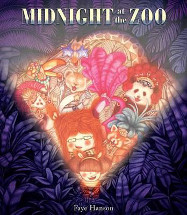
Midnight at the zoo by Faye Hanson
Five Mile Press, 2016. ISBN 9780763689087
(Age: 4-7) Recommended. Faye Hanson's beautifully created,
intricately detailed and vibrant colourful illustrations add to the
delight of reading Midnight at the zoo.'
Max and Mia's class are off to the zoo for an exciting adventure.
They've studied the map presented at the beginning of the story and
hope to see the ring-tailed mongoose, the red pandas and the
flamingos.
In their loud animal print bedroom with the 'Explorashon HQ' tent,
the brother and sister prepare for their special day. They are
definitely animal fans; everything in their bedroom has a pattern or
design, from their backpacks to pyjamas. In the morning, Max and Mia
'trundle like elephants to the car, cling like monkeys' to say
goodbye to Mum and even nibble their early snacks like lemurs.
Twenty excited children and one wide-eyed teacher enter through the
zoo gates filled with excitement. 'But not the flick of a tail or
swish of a whisker can be seen.' After a very disappointing day, the
teacher leads her class towards the exit. Without a headcount,
eighteen students and the teacher board the bus, whilst two are left
behind. Max holds his sister Mia's hand and with a torch from his
backpack, they look for a way out. In front of them, a locked wooden
door appears; what are they going to do?
As the clock strikes midnight, they are welcomed into another world
filled with animated creatures, fiery fireworks and fantastic
scenes. They discover flouncing flamingos, mischievous monkeys,
lanterns illuminating laughing lemurs and kingly cats. Max and Mia's
fantastic night-time adventures end with a comforting sleep nestled
in the fur of a majestic lion and lioness. Daytime comes and as they
reunite with Mum, they cannot wait to share their amazing adventure.
Fay Hanson's lively story Midnight at the zoo is filled with
fun alliteration and with charming descriptions. At times, the blue
text is hard to read as it blends in to the black of the night
scenes. Teachers reading this to a class may question the ratio of
one adult to twenty excitable children and the idea that she did not
know about Max and Mia's problem! The story ends with a magnificent
midnight map of the zoo, fountains of fireworks, colourful costumes
and dancing animals are illuminated.
Rhyllis Bignell