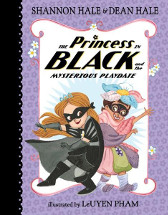
The Princess in Black and the mysterious playdate by Shannon Hale and Dean Hale
Ill. by LeUyen Pham. The Princess in Black book 5.
Candlewick Press, 2017. ISBN 9780763688264
(Age: 5-8) Highly recommended. My favourite princess is back and
this time she is having a playdate with Princess Sneezewort.
Unbeknowns to her a monster has followed her from the goats' field
and is terrorising the children who have pets in the park near
Princess Sneezewort's palace. When Princess Magnolia hears of the
threat she quickly dons her Princess in Black attire and goes to the
rescue. Princess Sneezewort follows the directions for becoming ' a
monster battling hero' and dressing herself in a disguise of
blankets, becomes the Princess in Blankets, and goes to the pets'
rescue as well.
Filled with funny moments and humorous illustrations, this episode
shows that with a bit of help, anyone could be a hero. The
friendship portrayed between the two princess, both as their
ordinary selves and then as heroes, is heart warming. The two
friends have such fun playing dress-up slam and karaoke jam and
playhouse romp and snack-time stomp. When they vanquish the monster
it is time for a victory dance with the Goat Avenger and they slap
hands, they wiggle bums and say 'Callooo!'
This series of books come highly recommended. The characters are
well developed and most likeable and will appeal to a wide range of
children. The delightful drawings complement the warmth and charm of
the story, which is also action packed for readers who enjoy
adventure. Readers will have lots of fun searching for the monster
who is very adept at hiding.
I look forward to further exploits of the Princess in Black and her
trusty friends.
Pat Pledger
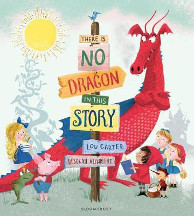
There is no dragon in this story by Lou Carter
Ill. by Deborah Allwright. Bloomsbury, 2017. ISBN 9781408864906
(Ages: 4-7) Recommended. Fairy Tales. This is Lou Carter's first
picture book and her background in teaching has evidently helped her
create this engaging and clever story. Similarly to Nick Bland's The
Wrong Book, the reader is addressed directly, making them feel
a part of the story. 'This was supposed to be a story about a dragon
who captured a princess . . .' but Dragon has gone off in a huff ('I
will not capture any icky, frilly princesses today', he says) and
gone searching for a story where he gets to be the hero for once. He
traipses around fairy tale land, pleading with well-known characters
to be the hero in their stories. He offers to save the Gingerbread
Man from that Fox and to save the Second Little Pig from that Big
Bad Wolf. -No, no no, that's not how it goes. There is NO DRAGON in
this story- is the refrain. A fantastic picture map shows him being
turned away repeatedly, by Goldilocks, Hansel and Gretel, and Little
Red Riding Hood. NO! they all say. He is just trying his luck with
Jack when his bad timing sees him become part of the story, altering
its path and throwing fairy tale land into chaos. What everyone
really needs now is a dragon to be the hero! Can he summon up the
courage?
Young children will love identifying all the familiar fairy tale
characters depicted within the story. It may even encourage them to
revisit them or seek out those unfamiliar to them. The book could be
used to inspire creativity in storytelling as it shows how
introducing an unexpected character or event can change a story's
trajectory and how it isn't always necessary to follow a traditional
story pathway. It could even be used to discuss stereotypes and how
we can break free of them, both within the stories we tell and
within our own existence. Dragon is a fantastic character who is
easy to empathise with; he wears his heart on his sleeve, is full of
exuberance and determination, and is just a little crazy. The
illustrations are fantastic, particularly the dark pages showing the
fairy tale characters stumbling around and making a mess of their
stories. A great read aloud, especially for fairy tale fans.
Nicole Nelson
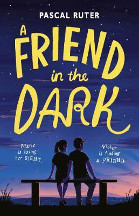
A friend in the dark by Pascal Ruter
Walker Books, 2017. ISBN 9781406372601
(Age: 12+) The novel A Friend in the Dark is a sweet story that
makes its readers evaluate their prior knowledge of blindness and
becoming blind. Written in a way that makes you wonder about the
universe and all that is around you, A Friend in the Dark is
captivating and thoughtful. The story revolves around Victor who
lives with his dad (an antiques trader), and is a failure when it
comes to school and being social. He is good friends with a boy
called Haisam, and while Haisam (the Honourable) is a genius (who
plays chess every day with his father, and is believed to be all
powerful and all-knowing according to Victor), Victor, himself, does
what he can to scrape by and not cause trouble. This all changed one
day when a classmate starts to take notice of Victor, and he
suddenly (and as a surprise to everyone) gets a decent mark at
something he has no clue about, particularly, maths. Where did this
knowledge come from? Why is his classmate Marie taking much more
notice of him that she usually does? Maybe there's something deeper
going on here than a classmate taking pity on a peer who is dismal
in the academic setting . . .
The book A Friend in the Dark is written in a soft way that allows
readers to understand the mind and thoughts of Victor. The style of
writing, perspective, and themes in this book are like the preferred
writing style of John Green and his young adult novels; true love,
mystery, and a strong first-person perspective. This novel would be
well suited for teens and young adults (12+) because of the
character development, concepts, and themes. This book gave a
different light to some concepts and developments that others may
find relatable in life; whether it's school, social life, family
life, or even medical issues, this book is warm and easy to read
with its relaxed and characteristic narration style. A Friend in the
Dark is definitely a friend for those who love to get lost in a
fictional world.
Sarah Filkin
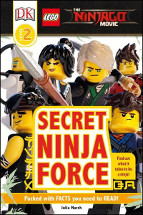
Secret Ninja Force by Julia March
DK Readers. Lego, 2017. Level 2. ISBN 9780241285534
(Age: 6+) Recommended. In Secret Ninja Force the reader will
find out about the ninja heroes of the Lego Ninjago movie. The
personalities of the six friends are explored as well as Master Wu
who gives them excellent advice about being ninjas. Their strengths
are details and weapons explained, all with bright illustrations
that aid the narrative.
Level 2 has been designed for the child who is beginning to read and
introduces characters that will be very familiar to fans of the Lego
Ninjago movie. It is ideal to read aloud for the child who is
fascinated by the movie, but also is an ideal book for the newly
emerging reader to tackle, because of the popularity of the subject
matter.
Containing 48 pages, a table of contents, a quiz and an index as
well as a note to parents, Secret Ninja Force will have
instant appeal for children and was quickly grabbed by my six year
old grandson.
Pat Pledger
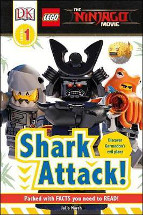
Shark Attack! by Julia March
Level 1. DK Readers. Lego, 2017. ISBN 9781465461933
(Age: 4-6) Recommended. In Shark attack! readers will meet Lord
Garmadon, the villain of the Lego Ninjago move. He is the most evil
man in Ninjago City and he has built up a Shark Army with special
weapons and vehicles in an effort to take over the city. The ninja
must defeat him and his army.
This has instant appeal for any child who likes Lego and who has
seen the movie. Level 1 is for the child who is beginning to read.
It doesn't look like a reader, but it contains short sentences and
words that children will be familiar with and will have no trouble
pronouncing. The illustrations are colourful Lego figures which
complement the text and give clues to what is going on.
The book has a table of contents with 24 headings as well as an
index at the back, making it seem much more like a book than a
reader. There are 24 pages in the book and a 5 question quiz that
children will enjoy doing. The note to parents is helpful as well.
Well designed and produced, with a hard cover and the popular Lego
figures, this is sure to be a hit with children and is likely to
lure a child to begin reading.
Pat Pledger
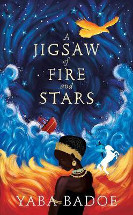
A jigsaw of fire and stars by Yaba Badoe
Zephyr, 2017. ISBN 9781786697981
(Ages: 14+) Highly recommended. The story starts with a treasure
casket thrown into the sea as a ship sinks. Inside is a pillow of
gold dust, and another of diamonds, a bamboo flute, a jewel studded
dagger, and a tapestry cloth wrapped around... a baby, a black
African baby, who is blissfully unaware of the fire and oil, and
people drowning around her. It sounds like the beginning of a
fantasy story, a foundling washed up on a shore and rescued by a
circus troupe, brought up to dance on a pony in the circus ring.
There are many elements of a fantasy adventure: the eagle Priss who
guards and protects the baby floating in the casket and remains at
her call whenever she is in danger; there are the circus twins,
Cobra, the green-eyed boy who can call up snakes, and Cat the fierce
girl who hurls daggers. Other characters make up the bizarre troupe
- Mama Rose, Redwood, Midget Man, Mimi and Bizzie Lizzie. These are
the people that Sante knows as family, yet there is another family
somewhere, ghosts in the shadows, that come to her in dreams, a
mystery that she yearns to find the answer to. But seeking the
answers puts her and her friends in grave danger.
However this is not some story set in a mystical other world, it is
here and now in Spain, and reminders of the modern world intrude,
things like television, mobile phones, the Internet. There are
police, the 'black-boots', and there are malevolent criminals like
Miguel and Grey Eyes. The story uncovers serious issues such as
'illegal migrants', human traffickers and sex slavery. Sante and the
circus troupe are just one group of people trying to live 'beyond
the grid', avoiding attention and possible arrest, not sure who to
trust, staying together in their tight little group and always
moving on. A jigsaw of fire and stars is a very beautiful magical story
encompassing modern day issues in a way that may be easier for
younger people to deal with. It is completely enthralling, and would
be a book enjoyed by both teenage readers and adults. The author
Yaba Badoe is a Ghanaian-British filmmaker whose focus has been on
stories of black African women, but often also incorporating
traditional Ghanaian folktale. It makes for a unique approach to
telling a story of complex issues that is very imaginative and also
satisfying.
Helen Eddy
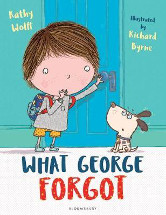
What George forgot by Kathy Wolff
Ill. by Richard Byrne. Bloomsbury, 2017. ISBN 9781408884027
(Ages: 3-7) George is off to school. He knows he has forgotten
something but he can't quite remember what. He remembered to wake
his mum (with a running bear hug) and to put on his brand new
superhero watch. He has even remembered to tell his dad his three
funniest pirate jokes. So what is he forgetting? Could it be...
oh yes, his shoes! Phew! says George as he boards the bus without
his pants...
George's morning routine is sure to amuse readers, with the text and
playful illustrations both contributing to the humour of the story.
From the mess he leaves in his wake to the hairy-foot tickle
inflicted on his sleeping father, there are plenty of opportunities
for laughter. George is a great, happy character with so much
enthusiasm for the important things in life (like inventing a flying
backpack-putting-on machine) that he simply can't remember those
other things (like putting his pants on).
Parents and children will identify with this morning struggle and
giggle at George's funny antics. They might also be squawking at
him: Your pants, George, you have forgotten your pants!
Nicole Nelson
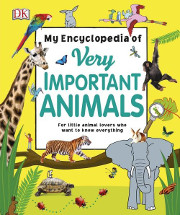
My encyclopedia of very important animals
Dorling Kindersley, 2017. ISBN 9780241276358
Anyone who has spent time with little people, particularly boys,
will know that they often gravitate to the non fiction collections
of the school library where they can get a THICK book (very
important) and then pore over the pictures for hours at a time. If
the pictures and diagrams are of high quality then they can absorb a
lot of information from them even if they can't manage the text yet.
In this new publication from non fiction experts DK the editors have
mastered combining stunning illustrations with just the right amount
of text to support the beginning reader, often only one sentence and
using vocabulary that is appropriate to the age group whilst not
'talking down.' Divided into four sections - All About Animals;
Amazing Animals; Animal Antics and More Very Important Animals - it
begins with a clear explanation of what animals are, differentiating
them from plants, and then moves on to those of land, sea and air.
Using lots of colour, a clear, clean font of a good size, labels,
speech bubbles and other literary devices, the young reader is taken
on a journey through the animal kingdom that they will return to
again and again, all the while honing their reading skills as they
want to know more than just the pictures can tell them. At the back
they are introduced to the concept of a glossary which explains the
meaning of some of the more unusual words they might encounter like
amphibian and exoskeleton, as well as an index that will help them
find just what they are looking for.
With more and more research emerging about the need for children to
develop basic literacy skills using print if they are to use and
interpret online information efficiently and effectively, this is a
must-have addition in both the school and home libraries.
Barbara Braxton
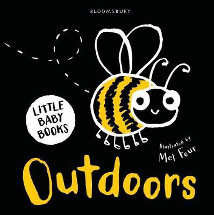
Little baby books: Outdoors ill. by Mel Four
Bloomsbury, 2017. ISBN 9781408873786
(Ages: 0-2) Board book. High-contrast pictures. Animals. The other
book in this new series for the very youngest of children is Everyday.
Both feature bold black and white pictures with pops of coloured
foil on each page. The shine of the foil will draw baby's eye as
well as providing a tactile element. Each double page has one word
(bird, ladybird, bee, snail, butterfly) and features an illustration
of outdoor things (leaves, flowers, etc.) The visually beautiful and
high-contrast illustrations will engage the developing eyes of very
young infants. This is a perfect first baby book but older babies
and toddlers will also enjoy it, especially due to the shiny foil
inlays. Older infants will also be able to point to and name the
objects and creatures on the pages.
Nicole Nelson
Letters to the lost by Brigid Kemmerer
Bloomsbury, 2017. ISBN 9781408883525
(Age: 14+) Highly recommended. Themes: YA Romance; Grief;
Relationship; Family; Juvenile Justice; Photography; Alcoholism.
This is a story of the compounding distress of grief and loss; a
story of two young teen lives irreconcilably altered by different
tragic circumstances who happen upon each other through their words
on a page - delivered at a graveside. Their twisted and distorted
realities make them vulnerable and uncertain, and as strangers they
bond as they share with one another truths that they could not say
face-to-face. This dialogue enables them to come to grips with all
that is happening in their lives and leads them to a relationship
that could all come unravelling very fast if they actually knew who
it was that they were unburdening themselves to. The complexities of
grief and the impacts that it has when those who grieve feel an
element of guilt, are part of the burden for the teen protagonists,
Juliet and Declan. The two letter writers (and eventually email
correspondents writing under assumed names) are both reeling,
pushing people away in real life and hiding from help, but the
lifeline of their correspondence gives them hope and draws them
together. This is not a Romeo and Juliet saga, but it does have some
of the anguish of a developing young relationship built on shaky
ground.
The secondary characters in this book are winningly portrayed -
Declan and Juliet's teachers, who care in an above-and-beyond way
and see through the masks that are exposed to the world; friends who
are robust in complexity and yet are strongly loyal, and are not
stereotyped; family members who themselves need to deal with the
torturous path of recovering from loss. This aspect of the book
makes this a multi-layered romance and exploration of deeper
relationship issues, but while still retaining clever plot
development and nuanced characterisation. The power of photography
to capture a moment is also used in an intriguing way through this
story.
Note: No inappropriate language issues - rare in YA fiction and very
much appreciated.
Carolyn Hull
Do you know about space? by Sarah Cruddas
DK Publishing, 2017. ISBN 9780241283820
What is space? Where does space really begin? Why is Jupiter stripy?
What is a light year? How are rockets launched?
There are few parents of young, curious children who have not been
confronted with questions like these as their offspring begin to
realise that there is a world even larger than the one immediately
around them and they want to find out more.
So here is the answer - a new publication by DK that uses children's
questions and an inquiry approach to provide the answers. Using
extraordinary photos and clear diagrams supported by child-size
bites of text over 200 common questions about space have been
answered at a level that the child will understand. Yet there is
enough information for the really curious to want to investigate
further. For example, in 2007 tiny animals called tardigrades
survived for 10 days in space outside a spacecraft - but what is a
tardigrade? (You can find out here.)
There are even quick quizzes that encourage them to read the text
closely, including picture captions, critical information literacy
skills.
DK have a sound and deserved reputation for bringing non fiction to
young readers in a way they can access and engage with and this new
addition is no exception. Ideal for the eyebrow-raising questions
for parents who can get themselves off the hook by suggesting they
use the book to find out together, yet tantalising enough for those
with a need to know more.
Barbara Braxton
Wigglesbottom Primary: The toilet ghost by Pamela Butchart and Becka Moor
Wigglesbottom Primary book 1. Nosy Crow, 2014. ISBN
9780857634269
(Age: 6-8) Recommended. School. Junior novel. With three stories in
one book the emerging reader will have lots of fun with the
hilarious toilet ghost, a stinky shoe that can tell the future and
an itchy carpet.
Each of the stories is about 30 highly illustrated pages, with
medium sized print so that young readers will know that they have
moved on from the picture book format. The reader is introduced to
Miss Riley the teacher and the 15 class members as well as Mr Harris
the deputy headmaster, in a double page welcome. The personality of
each child comes out with the clever illustrations that are also
very funny as the story progresses. The toilet ghost is sure
to tickle the funny bones of readers as they imagine the boys
refusing to go to the toilet because of the ghost and the image of
Mr Harris in shorts after he was soaked.
More fun and games can be had in The stinky shoe of fortune
as children enjoy the pranks of Miles and his shoe while in The
curse of the itchy carpet, children will have fun with the
idea of a teacher with ants in her pants.
As well as gaining much enjoyment from the stories, children will
also be able to see the power of peer group pressure in persuading
everyone that things are happening in a certain, albeit humorous way.
Pat Pledger
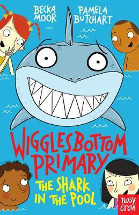
Wigglesbottom Primary: The shark in the pool by Pamela Butchart and Becka Moor
Wigglesbottom Primary book 2. Nosy Crow, 2015. ISBN
9780857634818
(Age: 6-8) Recommended. Humour. Three more stories of primary school
mayhem from the Red House Children's Book Award shortlisted author,
Pamela Butchart. This time the children are afraid that there is a
shark in the pool while they are having their swimming lessons. Then
Gavin is sure that he has found a dinosaur bone in the school garden
while the class members are convinced that the play parchute can
make them invisible.
This was just as funny as the first in the series The toilet
ghost, and will have children rolling in the aisle with the
antics of the class. Kids will gain an good idea of how rumours can
be spread and panic ensue as things happen in the pool in The
shark in the pool. Then everyone will be interested in the
idea of finding a dinosaur bone in the garden with Dinosaur
Bones and will thrill to the idea of a parachute making you
invisible in The parachute of invisibility.
All the stories are quite original and very funny with great twists
at the end. The illustrations are fabulous, especially the shark
with its enormous teeth and greatly add to the fun of the stories.
The poor teachers handle the mayhem very well and are
sympathetically portrayed.
A great book for the emerging reader, who will have lots of fun
reading this.
Pat Pledger
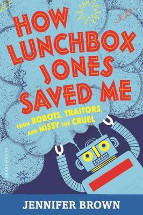
How Lunchbox Jones saved me from robots, traitors and Missy the Cruel by Jennifer Brown
Bloomsbury Publishing, 2017. ISBN 9781681194417
(Age: 10+) Highly recommended. How Lunchbox Jones saved me from
robots, traitors and Missy the Cruel finds Luke stuck in the
robotics team. Sure, he likes computer games but he hasn't a clue
about robots. The rest of the team is a bit weird too. There are the
two Jacobs who look identical but aren't identical, Missy the Cruel
(she just makes Luke's life miserable) and there is also Lunchbox
Jones. Luke freezes every time he sees him and the rest of the
school seems scared of him too. As if year 7 isn't hard enough! Luke
is also angry at his older brother for joining the marines and no
matter what he says he can't get his grandfathers to accept he
doesn't play football. How Lunchbox Jones saved me from robots, traitors and Missy the
Cruel is an excellent interpretation of the trials and
tribulations of students in middle school. Readers will appreciate
Luke's family worries as well as the school issues he faces. Anyone
interested in robots will enjoy the robotics theme and if they have
read other middle school themed novels like Diary
of a wimpy kid then they will enjoy this too. The story
telling is descriptive and relative, exploring family, friendship
and school life.
Kylie Kempster
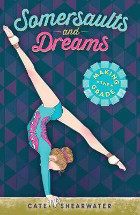
Making the grade by Cate Shearwater
Somersaults and Dreams bk 1. Egmont, 2015. ISBN 9781405268783
(Age: 9-12) Gymnastics. School life. Friends. Family.
Thirteen-year-old gymnast Ellie happily lives in Cornwall with her
ship-builder father, artist mother and younger sister Lucy. Her
dream however is to be an Olympic gymnast like her aunt. With help
from Fran, her local coach, Ellie wins a scholarship to the
prestigious London Gymnastics Academy. Ellie boards at
Head-Over-Heels House with the other out-of-town gymnasts. Twins
Nancy, Tam, and their mother Mandy, who looks after the house, make
Ellie feel welcome and help her settle in.
Ellie faces many challenges, she worries about her own gymnastics
skill levels and she hasn't taken her Grade 2 compulsory exam. Queen
bee Scarlett, another team member, delights in commenting on Ellie's
abilities, and she bullies her relentlessly. While Ellie is at the
Academy she searches for the truth about her Aunt Lizzie who fell
from the beam at the Olympics. This stopped the British team from
winning the gold medal and ended her sporting career.
Emma their coach is there to support and encourage the team to
strive for their best. 'Gymnastics will teach you discipline and
teamwork. It will give you courage and self-belief.' Ellie loves the
academy, developing her skills on the floor, balance beam and other
equipment. Surrounded by her friends, she loves the business of
school, sharing the house with her friends and finding time for
socialising.
When Ellie brings Tam and Nancy to her home in Cornwall, she
introduces them to boating activities, boat races and family fun.
Cate Shearwater's Making the grade focuses on finding your
secret ingredient, your life-balance with your training and
dedication. This is the first in the Somersaults and dreams
series is a great read for girls from 9-12 years of age.
Rhyllis Bignell