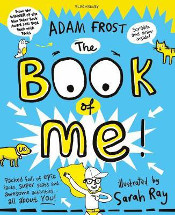
Ill. by Sarah Ray. Bloomsbury, 2017. ISBN 9781408876817
(Age: 7-10) Recommended as a 'gift book'. Themes: Identity; Facts;
Humour; Interactive Book. The Book of Me is an example of an
interactive book - where the reader gets to fill in details about
themselves, draw their own cartoons, find out some interesting and
quirky facts, laugh at Dad jokes and answer questions and
consequently make their own book. It is illustrated in a style that
lovers of Diary of a Wimpy Kid would be familiar with - a
humourous naive cartoon style. This is not really a book for a
library collection, but it would make a wonderful gift for a 7-10
year old about to embark on a holiday where they might need an
activity pack or to give to child recuperating after an operation.
Written for a UK audience, there are the occasional pages that might
miss the mark for an Australian child. However the Australian facts
on the upside-down page for the 'Land Down under' will cause a
smile.
Give this book with a pencil or coloured pens and it would make a
quirky humourous gift.
Carolyn Hull
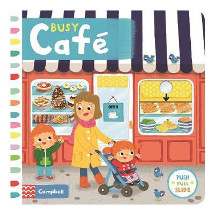
Busy cafe by Louise Forshaw
Busy series. Pan Macmillan, 2017. ISBN 9781509828739
(Age: 0-4) Recommended. Busy cafe is one of nine board books
in the Busy series by Campbell Books, and in my opinion is
fantastic! This little book captured the imagination of my 3 year
old and was the starting point of lots of interesting conversations
about our daily life and how the cafe world works. The book has push
and pull tabs and a spin mechanism that shows the changes in the
cafe; whole food to cut up or eaten foods, full to empty cups; and
were a hit!
The illustrations by Louise Forshaw are bright and enticing, and the
speech bubbles have great questions that also allowed us to do some
counting, searching of the page and discussing favourite foods. The
words follow a simple rhyme which was mastered by the 3rd reading
and also assist to teach children the process of ordering, paying
for and collecting food in this scenario.
The other books in the series include Busy bookshop, Busy
farm and Busy vet and I feel that they would be good
resources to help teach children learn about places and people in
our community while enjoying a fun interactive story. Target
audience: Up to 4 years.
Lauren Fountain
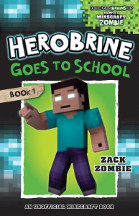
Herobrine goes to school by Zack Zombie
The adventures of Herobrine book 1. Scholastic, 2017. ISBN
9781742765907
(Age: 8-9) The Adventures of Herobrine book 1: Herobrine goes to
school is another series by Zack Zombie, aimed at children who
both love the game Minecraft and possibly his previous series The
Diary of a Minecraft Zombie. This book is written from the
perspective of Herobrine who has entered the human world as part of
a collaborative experiment, but is the only Minecraft character in
the town. The overarching topic of the book is of how Herobrine does
not fit in and all that comes with that scenario in a middle school
setting.
It does have a lot of relatable experiences for children, including
a school bully, liking a girl and having to learn new things (like
dancing to fit in at the school dance). I can see how this story and
Herobrine's attitude of getting on with it, and not taking too much
to heart could be of benefit to lots of children, but I felt like I
was consistently comparing it to Zack Zombie's last series and in my
opinion it is nowhere near as good. It is easy to read but lacks the
humour of Diary of a Minecraft Zombie, and my 7 year old
reader did not find it as engaging. Fluent readers from around 8-9
years old would probably like this story, and enjoy reading about
the softer side of Herobrine, who in the game is not really a
character but more of a superstition who many say they have seen
appear in the game and claim to be quite creepy! Although we may not
have enjoyed this book I am sure that die-hard Minecraft fans around
8 years and up would like it as an easy read with some relatable
settings.
Lauren Fountain
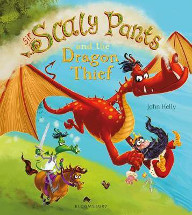
Sir Scaly Pants and the dragon thief by John Kelly
Bloomsbury, 2017. ISBN 9781408856062
(Age: 4-7) Recommended. This is the second story about Sir
Scaly Pants the Dragon Knight and is just as
entertaining as the first. This time the king is kidnapped by an
evil dragon and Sir Scaly and his clever horse Guinevere, go to the
rescue. After traipsing past a cyclops, a warty witch and a
long-haired lady, Sir Scaly discovers the king tied up to a flagpole
on the top of a very tall dragon tower.
Then he and Guinevere have to use all their wits to work out a way
to rescue him.
The reader is introduced to 'The story so far' in an explanatory one
page rhyme which describes how a knight raised him, how he went to
Knight School, beat a smelly giant and became the King's champion.
Then the story continues in humorous rhymes which are a joy to read
aloud. The allusions to myths and fairy tales, like Rapunzel, will
also appeal to astute readers, who will also appreciate the twisty
ending.
John Kelly has been shortlisted for the Kate Greenaway Medal and his
illustrations, bold and very colourful, will certainly appeal to his
young audience. The evil dragon is a joy to behold, gripping the
king in its forelegs and the looks on all the faces of both people
and animals will have young readers giggling aloud.
This is an uplifting and very humorous story that will have instant
appeal to young readers and listeners.
Pat Pledger
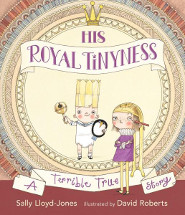
His Royal Tinyness : A terrible true story by Sally Lloyd-Jones
Ill. by David Roberts. Walker Books, 2017. ISBN 9781406324662
(Age: 4-8) Highly recommended. Humour. Siblings. Babies. Told from the
point of view of "the most beautifulest, cleverest, ever-so-kindest
Princess with long, flowing wondrous hair," this is the tale of a
family that was happy until a new ruler was born, "His Royal
Highness, King Baby". The story goes on to describe the terrible
trials that Princess Marianna has to put up with, as His Royal
Tinyness burps his way to his first birthday, when all the family's
friends and relatives meet to celebrate this wondrous occasion.
Told in a very amusing narrative, the first year of the baby is
described, while the little girl, resplendent in yellow tights on
her head to denote her beautiful hair, learns to put up with no
longer being the centre of attention in her kingdom. The addition of
funny little sayings in parentheses like Marianna describing herself
as (lovely in all her ways) greatly enhances the humour and will
have readers laughing out loud. The ending is tender and loving and
leaves the reader feeling uplifted as the little girl shows her love
for her brother.
David Roberts' illustration are fabulous. I loved the retro images
of the parents in their 70's outfits, bell bottom trousers on the
father and hippy dresses and clogs on the mother but what really
stood out for me was the addition of child-like drawings that
Marianna drew showing the life that enfolds around her and just what
she thought of the progress of her baby brother.
This would be a welcome addition to any house where a new baby is
expected and would provide a humorous discussion point and read
aloud in the classroom where families are being discussed.
Pat Pledger
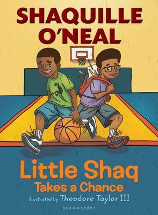
Little Shaq takes a chance by Shaquille O'Neal
Ill. by Theodore Taylor. Bloomsbury, 2016. ISBN 9781619638785
(Age: 6+) Recommended. Themes: Talent; Friendship. Little Shaq loves
basketball and he is good at it but is a little worried that he
might not be good at art. He doesn't really want to try something
new (including trying new foods). These struggles are happily
overcome with the support of friends and family.
This early chapter book is a simple and encouraging look at family,
growing up and talents. Written by a very famous basketballer, it is
an unpretentious view of the journey through life for the talented
Little Shaq. The bright illustrations are appealing and helpful for
an early chapter book reader as they transition from picture books
to novels.
Carolyn Hull
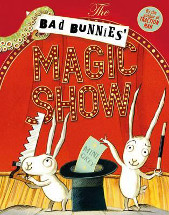
The bad bunnies' magic show by Mini Grey
Simon and Schuster, 2017. ISBN 9781471157608
(Age: 5+) Recommended. Magic. Magicians. Deception. A slight change
in plans means that The Great Hypno has been unavoidably detained
and is replaced by the two bunnies, Mr Abra and Cadabra. The two
bunnies take over the magic show usually put on by The Great Hypno,
changing a fish into an octopus, using one of the bunnies as a
target for knife throwing, changing a bird into a beast, and sawing
a woman in half. All is done with the magic wand and the words, Hey
Presto, reminding readers of days gone by when this sort of
entertainment was far more usual than it is today. People reading
the story with the children will have fun recalling the fairs, fetes
and circuses which once were common in towns and cities alike.
Television shows about magicians too seem now a thing of the past,
and so this will rekindle interest and teach the words and images
that went with this form of entertainment.
Mr Abra and Cadabra go on their merry way, eventually using
hypnotism to get the audience asleep to steal from them, but the
woman sawn in half comes to the rescue of The Great Hypno and all is
well.
A wonderful read aloud story, I can imagine children and adults
alike putting on various voices of the people involved, searching
for The Great Hypno, detained by the bunnies and looking closely at
the images that make up a magic show. Great fun and gloriously
illustrated, with lift the flap pages adding to the intrigue.
Fran Knight
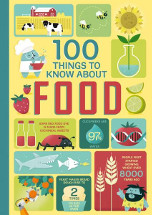
100 things to know about food
Usborne, 2017. ISBN 9781409598619
This is a fascinating journey through the world of food that will
not only appeal to budding young chefs but to anyone who likes to
eat. Presented with lots of colourful illustrations with
hundreds of simply expressed facts that are readily accessible to
newly independent readers, it begins with an explanation of why we
need to eat, the sorts of basic elements we need to have, like fats,
carbohydrates, proteins, minerals and vitamins and then takes us on
a journey of the most diverse and interesting topics. Who knew
that hating Brussels sprouts could be in your DNA; that you should
never bake meringues on a rainy day; or that the national fruit of
Jamaica contains a deadly poison? Readers can find out about
why farmers rent bees, the last meal served on the Titanic, even
about the Frenchman who ate an entire plane between 1978 and 1980.
This is the sort of book that attracts young boys in particular, as
they sit around a library table each sharing the same book and
sharing the most outrageous pieces of information they can
find. Despite the knowledge that they gain about the topic,
the sheer enjoyment of the activity, and the affirmation that
reading is not only useful but fun are enough to ensure that this
book deserves a place in the collection.
As is usual with Usborne non fiction, information literacy skills
are supported by a glossary, and an index, as well as pre-selected Quicklinks
which take the learning even further. Another one for the
information-hungry, daughter-of-a-chef Miss 6. She is going to be
surprising her father with her new knowledge!
Barbara Braxton
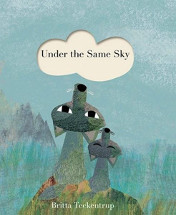
Under the same sky by Britta Teckenrtup
Caterpillar Books, 2017. ISBN 9781848575868
(Age: 4+) Recommended. Peace, Sharing. Under the same sky
reflects the theme that we are all born under the same sky, with the
same needs and wants, we share the same feelings even though we are
spread across lands far away.
In brief spare phrases the author delivers this message in terms
that can be understood by all readers, and supported with
wonderfully evocative illustrations of animals looking up to our
shared sky.
Britta uses the technique of collage and printmaking to create her
illustrations and made more interesting with cutouts along the way,
allowing children to turn a page and peek into what went before,
phrases reprised in the next illustration. It adds another level of
intent for the reader, already absorbed by the depiction of skyward
looking animals. Groups of each species are shown on each page and
then to underline the theme, all of them are shown together on the
last double page. Readers will not miss the theme of the story that
no matter who or what we are we share the same emotions, loves and
fears, and so should work together.
Fran Knight
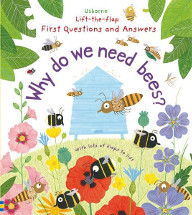
Why do we need bees? Katie Daynes
Ill. by Christine Pym. Usborne, 2017. ISBN 9781474917933
Type the title of this book into a search engine and you instantly
get millions of results including this video, such is the
importance of this tiny creature to the welfare of the world. For
without bees to pollinate the plants there are no plants and
therefore no food to sustain people or animals.
So it makes sense to make our very youngest scientists and botanists
aware of the critical need to protect these creatures as they carry
out their important work and this new release in the Usborne
Lift-the-Flap series does just this.
Using the question-and-answer format that little children themselves
use and which lays the foundations for inquiry-based learning, the
role of bees is explored in six double page spreads. Each
starts with a key question such as what are bees?; why do we need
bees?; and where do bees live? and this is then supported by a more
focused question, the answer to which is hidden under a flap.
Delicately illustrated but sturdily constructed as a board book,
each page offers much to explore and learn, with both the questions
and answers in simple sentences and vocabulary that young readers
understand. And for those who want to know more Usborne Quicklinks
supplies vetted weblinks
to satisfy.
Children are curious about the world around them and we know that as
parents and teachers we can't always answer all their
questions. Helping them understand that there is information
to be found in books and their questions can be answered is a first
step in the development of their information literacy, and learning
that you can dip and delve into books as your interest is piqued and
that you can readily return to what you discover is invaluable.
Even though this is a lift-the-flap book, a format normally
associated with the very young, it contains a way into non fiction
that is perfect for early childhood and could serve as a model for
presentation for older students required to investigate the world
around them as they learn to pose questions as well as answer them
succinctly. An interesting way to introduce keywords,
note-taking, summarising, paraphrasing and using your own words!
A book that has riches beyond those given to us by its subject!
Barbara Braxton
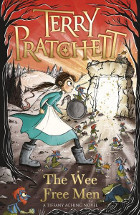
The Wee Free Men by Terry Pratchett
Tiffany Aching book 1, Discworld book 30. Corgi
Childrens, 2017. ISBN 9780552576307
(Age: 10 - Adult) Highly recommended. Fantasy, Locus Award for Best
Young Adult Novel (2004), Mythopoeic Fantasy Award Nominee for
Childrens Literature (2004) (2016), Parenting Book of the Year Award
(2003), WH Smith Teen Choice Award (2003). Terry Pratchett needs no
introduction. An award winning author, he has excelled himself in The
wee free men, which introduces the spirited Tiffany Aching.
First published in 2003, this 2017 edition will delight another
group of readers with its feisty young witch-to-be and the horde of
wee free men in their kilts who help her chase down the wicked queen
who has stolen her baby brother. The wee free men is an absolute delight to read. Pratchett's
unique sense of humour is evident on every page as he manipulates
words in the best possible way. Not only does he make the reader
laugh aloud at some of his descriptions and dialogue, but he also
makes the reader think about the power and use of the written word:
"Tiffany thought a lot about words, in the long hours of churning
butter. 'Onomatopoeic', shes discovered in the dictionary, meant
words that sounded like the noise of the thing that they were
describing, like 'cuckoo'." pg. 129.
Tiffany is a brilliant young girl who longs to be a witch. Sensible
and practical, she knows that it is the right thing to go and rescue
her brother even if he is annoying. Granny Aching is her
grandmother, a powerful shepherdess, who looked after all the sheep
and lambs on the chalk lands and protecting those who don't have a
voice and from her Tiffany has learnt about doing the right thing
even if it is hard. As the story progresses the reader will grow in
understanding with Tiffany as she works out what is important if you
have power, sympathize with her as she sorts out her feelings for
her brother and laugh at the antics of the wee free men.
This would be an ideal book to give any reader as an introduction to
fantasy and lovers of fantasy who have not tried Terry Pratchett's
wonderful books before will be in for a wonderful read.
Pat Pledger
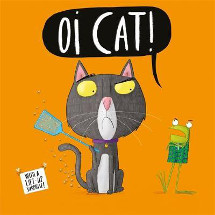
Oi cat! by Kes Gray and Jim Field
Hodder, 2017. ISBN 9781444932515
(Age: 4+) Highly recommended. Cats, Rhyme. Oi frog and Oi
dog, the previous books in this wonderfully subversive series,
tell us that the rules are simple: cats do not sit on mats and dogs
do not sit on frogs. These rules have come of course, from the frog,
so the cat must now find another rhyming word that can be used for
him to sit on, the phrase, 'the cat sat on the mat' being terribly
passe.
The obvious answer is gnats, but readers will quickly surmise that
the cat is upset by the nasty nipping gnats and so must move on to
another rhyming word. So the fun and games continue, with rhyming
words being offered, but all being found wanting. Lark belongs to
shark, and armadillo to pillow, dogs sit on logs, lemurs on
streamers, and trolls sit on dolls. The very funny illustrations
underline the humour of the text and readers will laugh out loud at
the ludicrous pairings offered, as well as the animals and lists of
rhyming words.
The dog seems to be most interested in the cat's bottom, causing
readers to shriek with laughter, as they well know that dogs and
cats do sniff around this particular part of other animal's anatomy,
and they will laugh too at the different meanings for the word bat
or the pageful of rhyming words for cat. All in all the book offers
immense fun for the readers who will predict, laugh and engage with
this highly amusing text accompanied by wonderful illustrations. And
the lift the flap on the last page will be infectious, readers
wanting to take turns at finding out what is beneath the flap. Have
your whiteboard marker ready for all the suggested rhyming words
which will be offered.
Fran Knight
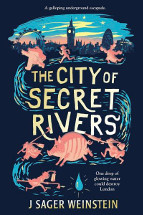
The City of Secret Rivers by Jacob Sager Weinstein
Walker Books, 2017. ISBN 9781406368857
(Age: 9+) We stood there for a moment, the drop of water and I.
And then we both leapt at once. Hyacinth Hayward has
accidently unleashed magical powers flowing under London. The
shambling Saltpetre Men have kidnapped her mother and the Toshers
want to trap her in the sewers. Then a giant pig in a swimsuit,
Oaroboarus, insists on an underground tea party, but Lady Roslyn has
other plans. The clock is ticking and Hyacinth must figure out who
to trust.
For those children who like books such as A Series of
Unfortunate Events, where good needs to conquer evil, this is
a must read for them. It is easy to read with the text being
relatively large. Weinstein has written a book that is extremely
imaginative with clever little twists and turns. It is full of
action, humour and descriptive language that truly brings alive the
repulsive stench associated with sewers. Historical places in London
have been cleverly interwoven throughout the storyline.
Hyacinth is a strong lead character, ably supported by Lady Roslyn.
Their friendship strengthens as the story unfolds.
Themes such as friendship, perseverance and adventure run strongly
through the book. This book will sit nicely alongside other fantasy
books on the shelf and is the first in a trilogy. Suitable for ages
9 and up.
Kathryn Schumacher
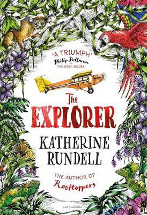
The explorer by Katherine Rundell
Bloomsbury, 2017. ISBN 9781408885284
Highly recommended. Like a man-made magic wish, the aeroplane rose
into the sky. It did not stay there for long. Fred has always
dreamed of becoming an explorer, of reading his name among the lists
of great adventurers. But when his tiny plane crashes in the Amazon
jungle on his way back to England, his dreams suddenly become all
too real. Fred, Con, Lila and Max are stranded without hope of
rescue, and their chance of getting home feels terrifying small. The
pilot dies and the children are forced to survive alone for days
until Fred finds a map that leads them to a ruined city and a
secret. Except, it seems someone has been there before them...
This book was fast-paced, warm and descriptive. Themes such as
resilience, survival, adventure, hope and friendship are developed
as the book unfolds. The words used by Rundell allow you to feel the
heat of the jungle, taste the unusual foods including tarantula
eggs, share the highs and lows the children experience and see
friendships develop between children who are all extremely
different. It would make a fantastic read aloud, but it is not for
the faint hearted as it is 399 pages, but the text is relatively
large. I can imagine a class completing some amazing visualisation
activities based on the rich, descriptive language Rundell uses.
This is a must-have in the library.
Kathryn Schumacher
How to resist: Turn protest to power by Matthew Bolton
Bloomsbury, 2017. ISBN 9781408892725
(Age: Secondary - Adult) Recommended. Matthew Bolton was Citizen
UK's lead organiser for the national Living Wage Campaign whereby
different community groups united to win the 'national living wage'
for low-paid workers. In this little pocket-sized book he shares
what he has learnt about campaigning on social justice issues -
'practical tools and principles to show how people can get together
and make change happen'. He puts great emphasis on democratic
participation, helping people to be effective citizens. It would be
really useful for students of Civics and Citizenship to read this
book, to go beyond the feel-good protest march, and gain the sense
of empowerment from actually uniting and achieving goals through
well-planned strategies.
History students would also gain greater insight into civil rights
movements of the past. Bolton reveals how the famous incident where
Rosa Parks refused to give up her seat on the bus was not just
frustration at the end of a long hardworking day; Rosa had been
active in the civil rights struggle for ten years before the bus
action. But at the right moment her action captured national
attention.
Similarly the strategy of 'action in the provocation of
overreaction' is illustrated by the events of Selma 1964-65. Selma
was chosen by Martin Luther King and other key civil rights leaders
precisely because of its reputation for violent conduct towards
African Americans. The violence directed towards a peaceful march at
Selma drew national attention and became impossible to ignore.
Other strategies are revealed in the book - with lessons learnt from
the failures as well as the successes. There are many useful tips,
but none more useful than the Iron Rule - shift from trying to solve
people's problems for them, to building the capacity of people for
collective action and political change. It is a great lesson. I
think all readers could learn something from this guidebook.
Helen Eddy