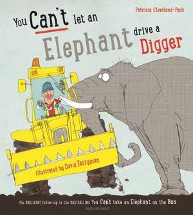
You can't let an elephant drive a digger by Patricia Cleveland-Peck
Ill. by David Tazzyman. Bloomsbury, 2018. ISBN 9781408879146
(Age: 4+) Recommended. Themes: STEM. Probability. Humour. Verse. A
range of improbably domesticated animals are given impossible things
to do, inviting every reader to simply laugh out loud at the antics
shown. Each double page shows an improbable scene: a shark in the
bath, a polar bear cutting hair, a seal acting as a chef, brushing
your teeth with a crocodile and more, all illustrated with gusto,
hinting at the possible things which may happen with the animal
doing something he is simply not designed to do.
Told in four line rhyming stanzas, each page invites the reader to
predict the last word of each line and many adults will find
children learning the stanza detailing the animal they like best.
Kids will love the looks on their faces as they try out their
impossible tasks, and the corresponding looks on the children's
faces as a shark appears in the bath or an octopus helps with
dressing or a wolf offers to read a bedtime story. Each page
bristles with laughter and kids will love looking at the detail
where other things are happening: mice carrying away the mousetrap,
a cat under the table eating the fish dropped by the seal or the
elephant's poo dropping onto one of the workers.
Full to the brim with hilarity, children will relish this unusual
tale, another from the duo who created "You can't take an elephant
on a bus". David Tazzyman is new to me and I found out more about
him here.
Initially a commercial illustrator, he illustrated the "Mr Gum"
books for Egmont in 2006 and has illustrated children's books ever
since. Patricia Cleveland-Peck has written some 14 books and more
information can be found here.
Fran Knight
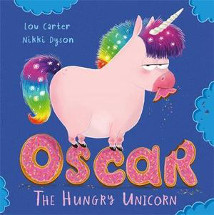
Oscar the hungry unicorn by Lou Carter
Ill. by Nikki Dyson. Orchard, 2018. ISBN 9781408355756
(Age: 3+) Recommended. Themes: Unicorns. Fairy tales. Food. Home.
Humour. Oscar loves to eat and despite what he eats, he is still
hungry. He eats his stable, the gingerbread house, the pirate ship,
the toadstools which house the fairies and the dragon's pizza. The
dragon points out that the pizza is to share, but Oscar takes no
notice. But at the giant's table, he finds that he is part of the
food going into the giant's mouth so runs away, despairing that he
will never find a home. He crosses the troll bridge eating it as he
goes, and just as the trolls begin to exact their revenge, Princess
Oola comes by with her boat. She scoops him up, telling how she
loves unicorns and takes him to her castle, where food is never
ending and Oscar finds a home. But he still looks at the moon with
avaricious eyes.
This lovely story about eating reflects many fairy tales which
readers will be familiar with. They will love the references to
these stories, spying the illustrations to see what parts of the
fairy story is mentioned. The fun illustrations suit the tone of the
story well, and younger readers will love peering into each picture
to see the details.
Teachers and parents will be able to use the story to talk about the
place of food in our lives, and the appropriateness of some of the
food available against a funny and inviting story.
Fran Knight
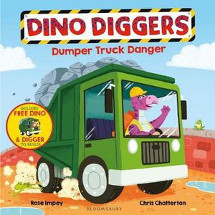
Dino diggers: Dumper truck danger by Rose Impey
Ill. by Chris Chatterton. Bloomsbury, 2018. ISBN 9781408872482
(Age: 4+) Recommended. Dinosaurs, Technology, Accidents. In
Dino-Town, the Dino Diggers are all ready for action. Dressed in
their hard hats and fluoro jackets, they can take on any problem
which comes long, so when the town bridge collapses after a heavy
rain storm, they are ready with their machines to clear the path and
help rebuild the bridge.
Young readers will adore the five friends, Terri,Tyrone, Bruno, Ricky
and Stacey, working out just why each has that particular name,
their size and physical attributes eagerly recognised by dinosaur
hunters. The problem of the bridge and the baker's van stuck beneath
causes the team some headaches as Tyrone takes his digger down into
the river bed to get the van out. He does this successfully but they
both end up on the wrong side of the bridge. Another problem creates
another solution, and all ends happily, with the dinosaurs reopening
the bridge in time for traffic. The Dino Diggers have done their
work.
Young readers will love looking at the array of work done by each of
the trucks illustrated, recognising these implements from seeing
them on their streets. The illustrations give a streamlined image of
each of them allowing kids to point out the features of each.
Recognisable work safety measures are included, alluding to the
possible dangers of this work, and showing readers what needs to
happen to keep themselves safe. In the last few pages is a cardboard
cutout of Stacey's dump truck with instructions on how to put it
together, continuing the fun of the book.
Fran Knight
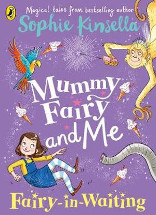
Mummy Fairy and me : Fairy in waiting by Sophie Kinsella
Penguin, 2018. ISBN 9780141377896
(Ages: 5 - 7) Recommended. Themes: Fairies. Humour. "Ella's
family has a big secret - her Mummy is a fairy. She can do amazing
spells with her computawand. Only, sometimes the spells go a bit
wrong, and that's when Ella steps in to the rescue.
In this brand-new book of magical adventures, there are very naughty
monkeys, a swimming pool filled with ice-cream, and the best
birthday party ever - complete with giant cakes and fairy dust."
(Publisher)
And after so much fun and adventure, will Ella get her wish and
become a magical fairy, just like her Mum?
The magic and mayhem in this young chapter book make it a sweet and
funny series for 5-7 year-old's. There are lots of messy adventures
and parents who do silly things.
Donna Isgar
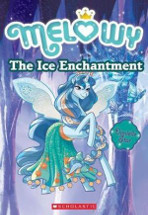
Melowy : The ice enchantment by Danielle Star
Ill. by Danielle Stern. Melowy series book 4. Scholastic,
2018, ISBN 9781338151800
(Age: 6-8) Themes: Unicorns, Fantasy, Friendship, Courage. In the
Castle of Destiny hidden by a sea of clouds, Melowies, winged horses
with gorgeous colourings, gather to be schooled in magic. Cleo,
Electra, Maya, Cora and Selena wake to a beautiful morning eager to
begin their classes in the Art of Powers. Cleo's destiny is unsure,
she hasn't received her place in a realm yet: will she be a Winter,
Spring, Day or Night? To find the nature of the young filly's power
she needs to attend all the classes with her friends. This proves to
be difficult for her, as she suffers sunburn in the Day Tower,
tangles herself up in plants in the Spring Tower, and has candle
problems in the Night Tower.
Cleo seeks advice from Theodora the friend who raised her after she
was left on the castle steps as a baby. She needs encouragement to
keep on with her lessons. Mysteries and problems abound, with a
stolen magic book, a classmate casting a forbidden spell and
problems in creating ice sculptures from the magic waterfall. Little
by little, Cleo learns the power of friendship and patience.
Bright colours, pretty embellishments and beautiful creatures adorn
the pages, making this junior novel sparkle. Danielle Star's magical
fantasy series are just right for newly independent readers.
Rhyllis Bignell
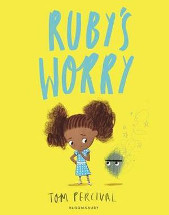
Ruby's worry by Tom Percival
Bloomsbury, 2018. ISBN 9781408892152
(Age: 3+) Recommended. Themes: Anxiety. Depression. Sharing.
Friendship. Ruby's life is carefree and happy, but one day a worry
finds her. At first it is a very small worry and can be hidden
behind her, or even ignored. But as time goes on the worry increases
in size, becoming a constant shadow next to her as she goes to bed
at night, eats her breakfast and catches the bus to school. She
tries to work at school, but the worry sits next to her, invading
her thoughts. The worry gets bigger, staring at her over the
breakfast table, sitting on the swing besides her. She realises that
no-one else can see her worry, until one day she sees a young boy
sitting in the park. He too has a worry and this time, Ruby can see
his worry. He is sad and reflects just how she feels, so she sits
down next to him and they talk about their worries. As they do this
their worries become smaller, and lift from their shoulders. They
are aware that by sharing their worries they become smaller, and
Ruby knows that although her shadow is still there, much smaller
than it was, she now has the skill to keep it under control.
This story, like Mr
Huff (Anna Walker, 2015) is most useful at a time where
mental ill health has become a problem amongst younger children.
Children will instantly recognise the background to the story, many
knowing someone who suffers from anxiety, and see that having a
worry is not unusual and there are steps they can take to help
themselves not be overwhelmed by the feeling.
Fran Knight
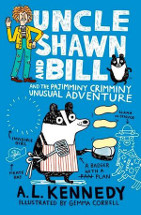
Uncle Shawn and Bill and the pajimminy-crimminy unusual adventure by A.L. Kennedy
Ill. by Gemma Correll. Walker Books Ltd, 2018. ISBN 9781406360509
(Ages: 6-9) Recommended. Themes: Friendship. Humour. Bonkers
story of friendship, llamas and total evil.
Uncle Shawn and Bill are back, and so are the llamas. In a book that
could stand alone or work as a sequel, they have settled into a
happy life at their llama farm in Scotland with their new llama
friends. But all is not right on the horizon as someone new to their
village is stirring up trouble, and encouraging anything 'unusual'
to be vilified and the perpetrators locked up...
This contains great hilarious posters, comic style illustrations and
informative chapter headings evoking old Victorian novels. It is a
very visual story, with plenty to read around the words themselves.
The theme of celebrating difference and not being afraid of who you
are, is well covered by a vast number of different habits and
hobbies of the people in Pandrumdroochit. They get involved in an
exciting adventure as Bill and the llamas (as well as some other
friends) work together to defeat the evil threatening them all.
The story is totally bonkers, but such good fun and has a lesson of
friendship at its heart.
This is a great series, with lovely short chapters, lots of action
and silliness and full of things to look at.
Donna Isgar
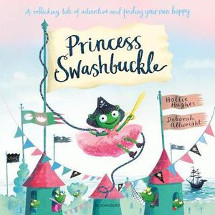
Princess Swashbuckle by Hollie Hughes
Ill. by Deborah Allwright. Bloomsbury, 2018. ISBN 9781408862803
(Age: 4+) Recommended. Themes: Princesses, Stereotypes, Adventure,
Frogs, Family, Verse, Humour. All Princess Swashbuckle wants to do
is be a pirate queen, to sail away on a pirate ship and be the ruler
of the waves. But her parents want her to marry a frog and settle
down. How can she marry Hubert who lives in a bog or Gerald who
lives beneath a log? She packs her bag and steals away one night,
boarding the Stinky Fish. Finding its crew is upset at seeing their
captain swim for shore, she is the perfect replacement.
Together the princess and the crew have incredible adventures,
sailing the seven seas, meeting a range of other people, helping out
where they can. They teach a mouse to be brave, and show a snake how
to make a cake, but once all their adventures are done, Princess
Swashbuckle feels a little out of sorts. She writes to her parents
and receives a reply which apologises for their insistence that she
marry, and invite her back to Frogland. Without hesitation she makes
her way back home, allowing her parents to retire while she takes
over ruling the kingdom, albeit with a pirate flavour.
This charming story full of whimsy and humour, will appeal to
younger readers, lapping up the allusions to fairy stories with a
reversal of the usual roles, and parallels to frogs which they will
perfectly understand.
The detailed illustrations attract the eyes drawing them into
perusing the things in the background, referencing things that
pirates do and adventures associated with this group of people.
Readers will thrill at the kingdom's seawall, shaped like a dragon's
body, or the watchful eye of the ship, or the pirate's flag. All
good fun.
Fran Knight
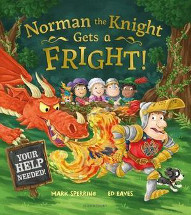
Norman the Knight gets a fright! by Mark Sperring
Ill. by Ed Eaves. Bloomsbury, 2108. ISBN 9781408873991
(Age: 4+) Recommended. Themes: Knights, Dragons, Employment. When
the four children and their cat apply for the job of helping Norman
the Brave, a knight of renown, they are surprised at what he expects
them to do. Their work involves darning his large pile of socks,
ironing his pants, cleaning his armour and scrubbing him in the bath
after fetching loads of hot water. They must then squeeze him into
his armour, and use a hoist to lift him into his horse's saddle,
after first catching the unresponsive animal. They are all ready to
go to the Royal Parade, Norman looking very brave and shiny after
all the efforts of his knaves, our four friends by contrast looking
shabby and weary. At the parade the knights are set upon by a group
of brigands and bandits, while trying to deal with a fire breathing
dragon. Norman and the other knights cower in the background while
the four knaves take charge, putting out the dragon's fire and
seeing off the brigands and thieves.
Norman then puts his knaves further off side by bragging about his
exploits at saving the day whereas the knaves know what really
happened, making the readers laugh at the knight's duplicity. The
work might not be the job for our four friends, and at the end of
the story, another workplace seems to be before them, making sure
the readers will want to see the next book when the four try out
working with a magician.
Told in rhyming pairs of lines, readers will love predicting the
rhyming word as each line is read, and be intrigued with some of the
new words offered: knave, brigand, bandit, which they may not have
come across before. There are hilarious illustrations with lots of
detail to look at, funny faces and situations to laugh at, as well
as a lesson to be discussed about humility, and information included
giving readers an insight into the lives of knights and knaves
during Medieval times.
Fran Knight
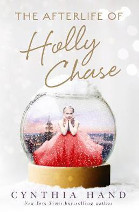
The afterlife of Holly Chase by Cynthia Hand
Harper Collins Publishers, 2017. ISBN 9781460754283
(Ages: 12+) Highly recommended. A heart-warming and emotional tale
of the importance of generosity, family, love and compassion. When
Holly Chase is visited on Christmas Eve by three spirits warning her
of the imminent consequences of her selfish actions, she elects to
ignore their advice, doing nothing to mend her ways. Six days later,
she dies. Awakening in an office, Holly learns that she will be
working for a top-secret company called 'Project Scrooge' to help
other 'Scrooges' like her change their behaviour before it's too
late. She is appointed to the position of the Ghost of Christmas
Past and accepts this as her fate; forced to redeem herself through
encouraging others to do what she could not - change for the better.
Five years after her death, however, she is faced with a Scrooge
that she feels a connection to: Ethan Winters III, a
seventeen-year-old who is similarly spoilt, materialistic and
grieving the loss of a parent. For the first time since her death,
Holly finds that she has something to be hopeful for.
Through her authentic and genuine characters, beautiful writing
style and valuable moral, New York Times bestselling author Cynthia
Hand provides a sweet, unforgettable and thought-provoking novel
that will touch the heart of its reader, and fill them with hope,
happiness and gratitude. A book that is impossible to put down, and
even harder to stop thinking about, "The Afterlife of Holly Chase"
is not a novel to miss and is a wonderful read all year round.
Daniella Chiarolli (university student)
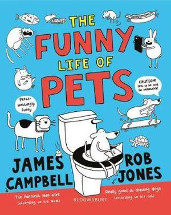
The Funny Life of Pets by James Campbell
Bloomsbury, 2018. ISBN 9781408889947
(Age: 8+) Recommended. A dog's nose is more than 1 000 times more
sensitive than our nose. That's why if you do a bottom burp in a
dog's face it will go cross-eyed and fall over. Imagine a sausage
dog's dilemma when it's eating sausages - the resemblance of this
tasty snack to their Granny is uncanny! Uncover top tips for feeding
goldfish and avoiding a mini tsunami in your house causing dinosaurs
to evolve from your carpets! Discover some of the rarest dog breeds
in the world, like the Jack Russell Sprout . . . but remember,
they're not just for Christmas.
This is truly one of the funniest books I have ever read. Campbell
have very cleverly mixed fact with fiction and will be a real hit
with the young readers (8 and up) - especially the advice that is
given to convince parents to allow them to get just the pet they
want. It has a mix of quirky illustrations, sign posts indicating
what directions you can choose and text. It is a little like a
choose your own adventure book, whereby you can choose what you want
to do. It is not a book that has to be read from cover to cover. I
sneakily gave it to one of my Year 6 reluctant readers and he could
not put it down - he was very keen to borrow it. I can also see
myself using it to fill in the odd five minutes - picking it up and
reading a couple of pages. A very lighthearted book that is a must
have.
Kathryn Schumacher
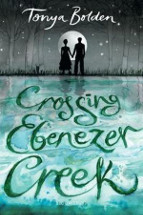
Crossing Ebenezer Creek by Tanya Bolden
Bloomsbury, 2018. ISBN 9781681196992
(Age: 13+) Recommended. In the latter months of 1864, during the
U.S. Civil War, General Sherman of the Union led a huge army through
Georgia, freeing slaves, plundering goods and destroying property of
the vanquished. Many ex-slaves chose to accompany the advancing army
on the march. Many would have seen the Northern soldiers as
saviours, some depended upon their rations and some undoubtedly
wanted to participate in and witness the defeat of the Confederate
South.
The Union army was glad to have the labour from thousands of willing
workers for transporting equipment, foraging food and building
pontoon bridges to replace those destroyed by the retreating
Confederates. Accompanying the principally male ex-slaves engaged in
military support were the women, children and elderly from their
families or dependants from their previous life of servitude.
This story centres upon Mariah, a young woman whose main focus after
being freed is the protection of her intellectually disabled young
brother by establishing a home on one acre of land, upon which she
can grow food. From her recollections, the reader comes to
appreciate some of the abject misery and brutal cruelty endured by
slaves in the American South. It is difficult to imagine conditions
in an era when those who considered themselves part of civilised
society might sell children away from traumatised mothers, would
inflict barbaric, degrading punishments for the slightest of
perceived misdeeds and could ultimately end a slave's life.
Liberated from tyranny, these ex-slaves rejoiced in freedom but
faced the fact that they were ill prepared for life ahead, having no
land or property and usually no education. When Mariah meets Caleb
(a skilled black man working for the Union Army) she recognises his
kind, gentle and decent nature and a romance develops which would
have been realistic under the circumstances.
The climax of this story involves an historically accurate event
which should be shamefully acknowledged and remembered, yet appears
to have been buried and forgotten in the mists of time.
Young readers may be confused by the opening sequences of this
story, especially if they have no knowledge of slavery in the
American South. It may be difficult for those unfamiliar with
plantation life and conditions to understand the various characters
who are introduced in the early passages, yet if they persist, they
will be better for learning about this profoundly important chapter
of history.
Recommended for readers 13 years+
Rob Welsh
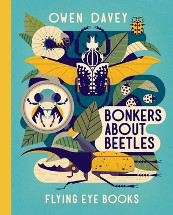
Bonkers about beetles by Owen Davey
Flying Eye Books, 2018. ISBN 9781911171485
(Ages: 6-adult) Highly recommended. Themes: Beetles. Non-fiction.
What a wonderful encyclopaedic book about beetles, I read it from
cover to cover, loving every piece of information given, observing
the pictures with glee, scanning the layout and clear design
features with admiration.
After a contents page, each double page fastens on one topic, well
illustrated with clearly defined drawings, using colours that
reflect the places the beetles dwell. Each page is covered with
highly arresting information, distinctive and finely detailed
illustrations which will enrapture the readers.
The first two double pages inform the reader about the basics of
being a beetle: what they are and where they live. Readers will find
that there are over 400,000 different beetles species, and that they
can be terrestrial or aquatic, and herbivore, omnivore, predator or
decomposer. While over the page is a magnificent drawing of a beetle
with body parts numbered so that the reader can easily see what part
is what, and read how each part is useful to a beetle. From there
each double page concentrates on one aspect of the beetle: wings,
food, disguise, defence, and camouflage while other pages
concentrate on one beetle, like the ladybird and the horned dung
beetle.
The last two double spreads show the beetles in mythology and
conservation being made on the beetles' behalf. It will surprise
readers to find out that although there are over 400,000 species of
beetle, some are under threat, and Davey explains just what these
beetles do and how we can help in their conservation.
All in all a sparkling look at beetles, and a book I will go back
to, as will many readers who love gathering bits of information or
who are potty about beetles, or just love the design of the book.
Flying Eye Books has published three other books by Owen Davey that
use the same entertaining style of both information and
presentation: Mad about monkeys, Smart
about sharks and Crazy
about cats. All four of these books will gather a wide
excited audience from primary people.
Fran Knight
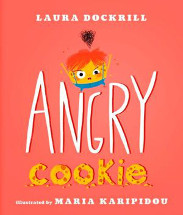
Angry Cookie by Laura Dockrill
Ill. by Maria Karipidou. Walker Books, 2018. ISBN 9781406383089
(Age: 4+) Recommended. Themes: Anger. Friendship. Confronted by an
angry Cookie from the start, the reader will be in no doubt about the
theme of this book. We are told in no uncertain terms, not to open
the book, not to turn the page, and not to try to do anything about
his anger. With that, Cookie escapes up the stairs to his bedroom.
But then he peeps around the door, apologetically, a little
chagrinned about his outburst. Over the next few pages we find out
why Cookie is angry. His best friend, the cactus, plays his recorder
badly, a pigeon tries to snack on him, he has had a bad hair cut,
his toothpaste runs out and he must use his parent's toothpaste
which is not to his liking, in fact, his whole day goes awry. But he
peeps again at the audience and realising that we are all still
there listening to him, deduces that things can't be that bad. He is
surprised that the reader keeps coming back despite his bad temper
and anger, and concludes that the reader is there because he is a
friend and that's what friends do. Young readers will readily
empathise with Cookie, recognising the bad events that can happen to
them all.
The humour behind the illustrations will have broad appeal to the
reader, the simple Cookie expressing his emotions with small changes
in the mouth, eyebrows, and eyes. I loved looking at the pictures
first to see just how Cookie is going to react on each page before
reading the story. Young readers will enjoy Cookie's exploration of
what makes him angry, and like him, realise that a friend can make
all the difference to how you feel. This is a perfect conduit to
class discussions about feelings, anger and friendship.
Fran Knight
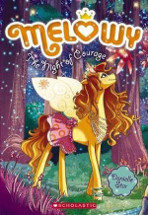
Melowy: The night of courage by Danielle Star
Scholastic, 2018. ISBN 9781338151787
(Age 7+) Recommended. The night of courage is book 3 in the
Melowy series and will be enjoyed by any pony lover aged 5+. In
this book, readers meet the Melowies, magical ponies who are
at school together. They come from a variety of Melowy worlds and
display skills and powers accordingly. The Melowies have been
challenged to spend a night in the woods. Their teacher expresses
the need to learn to not fear making mistakes as the fear stops you
from trying something new. The trip starts well despite another
Melowy being added to the group of friends, a Melowy who isn't
normally nice to the group of friends. The girls build a successful
shelter together but in the search for something to eat, Elektra
goes missing. Will they find Elektra? Will Eris ruin the chances of
the friends being reunited? The night of courage is a simple narrative built around the themes
of friendship and not being afraid. The storyline moves quickly and
it is easy to read and understand. It is a short novel, making it
ideal for younger readers moving into being independent readers. It
would also make a great read for before bed whether independently or
being read by an adult. Sections of the story could be linked to the
Child protection and Health curriculums when discussing teamwork,
problem solving and friendship. The night of courage is a fun read and is recommended for
independent readers aged 7+.
Kylie Kempster