Ill. by Laura Hughes. Bloomsbury, 2018. ISBN 9781408872413
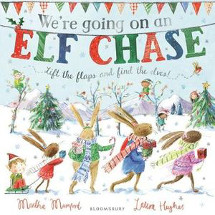
(Age: 4+) Recommended. Themes: Christmas, Elves, Hunt, Lift the flap
book, Verse. Fingers will just love lifting the flaps in this book
as the reader is asked to work with the bunnies on their wintry
quest to find the elves. Four very warmly wrapped bunnies walk
through the snow to find the elves hidden in various places on each
page. Sometimes lifting the flap reveals an elf, sometimes something
associated with Christmas: presents, a candy cane, a stocking.
Through the woods, passing penguins and polar bears, the bunnies
have their work cut out for them as they travel north. Through snow
and wintry weather, past gingerbread houses, and stables with
reindeer housed in them, they finally reach the place in the North
Pole where many elves are working, wrapping presents for Christmas
Eve. Then they must rush back home and be tucked up in bed for when
their turn comes for someone very familiar to land upon their roof.
A very cute introduction to the ideas around Christmas which we all
hold dear: stockings, elves, reindeer, gingerbread, fir trees, snow
and so on, this will have broad appeal at this time of the year, and
the rhyming lines encourage prediction of the next word, and
underline the ideas of poetry, as well as being good fun for kids
looking under the flaps.
Fran Knight
Santa Bruce by Ryan T. Higgins
Bruce book 4. Disney-Hyperion, 2018. ISBN 9781484782903
(Age: 7+) Recommended for its humour. Themes: Christmas, Santa
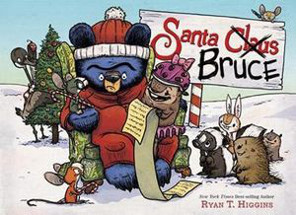
Claus, Humour. Santa Bruce is the fourth in a series about
Bruce, a very grumpy bear, who is often the victim of mistaken
identity, in this case Santa Claus. Bruce does not like holidays and
is not impressed when his friends the mice, drag in a huge Christmas
tree. All he wants to do is stay in bed, but his friends have other
ideas - they want 'to enjoy a cozy snow -filled Christmas together.'
Bruce didn't like fun or cheer or the cold, so he started to wear
long red underwear and a red hat leading to another mistaken
identity - a woodland creature asking him if he was Santa, everyone
else believing he is Santa and from then on he is enticed to finally
deliver Christmas presents to all the forest animals.
The contrast between the very large and very grumpy Bruce and the
very cute and very small mice and other woodland creatures makes for
a very funny experience for the reader as the wonderful
illustrations show the crossness of Bruce's face while the happiness
of all his little friends is very vividly portrayed. I particularly
liked the page showing the geese trying to pull Santa Bear on the
sled, and then the following page which shows Bear having to pull
the sled and carry the huge bag of presents himself. Cold wintery
scenery also brings the northern Christmas season to life.
Readers familiar with other books about Bruce the Bear will love
this one, while readers new to the characters will have an enjoyable
and humorous read to lighten their day. Not for younger readers who
might start to have questions about Santa's identity.
Pat Pledger
Princess Snowbelle and the Snow Games by Libby Frost
Bloomsbury, 2018. ISBN 9781408896853
(Age: 3+) Recommended for its themes of cooperation, sharing,
teamwork and being a good sport. Following Princess
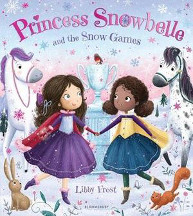
Snowbelle and the snowstorm this very cute picture book
features Princess Snowbelle competing at the snow games with her
family against the neighbouring kingdom of Snowland. Princess
Snowbelle hopes to win the Ice Trophy while her brother Noel is
convinced that he will win the sledging race and Nicholas has been
training for the running race. Meanwhile Snowbelle's mother and
father remind them:
'Remember, it's not about winning, it's about trying your best.' And
when the games begin the children from both families show their
competitive spirit and how to be a good sport when they don't win.
Sparkleshine helps Snowbelle when she gets into trouble in the horse
race, even though it means that she could have won the race and
instead of competing for the final event, making a snow sculpture,
the children all cooperate together in a wonderful display of
teamwork to make a magical snow sculpture.
Although rather didactic, small children will love the cute, diverse
main characters with their smiling faces, capes and sparkles and the
snowy landscape will attract much attention as the children compete
in the snow games. The themes of being a good sport, of helping
others and about doing your best in competitions would fit in well
in classrooms when these issues are being discussed and would also
be a talking point when reading the tale as a bedtime story.
The book would also be good for emerging readers to engage with,
especially those who are interested in little princesses who are
magical and helpful.
Pat Pledger
Feminists don't wear pink and other lies by Scarlett Curtis
Penguin, 2018. ISBN 9780241364451
(Age: 15+) Highly recommended. Scarlett Curtis assembles a
magnificent 'guide book' for the Girl-Up movement, with this
anthology of short essays, blogs, narratives, lists, poems, diaries,
interviews, anecdotes - including an Alphabet. The Girl-Up brand,
spanning over 2,000 clubs worldwide, is transparent but both the
foreword and further reading sections encourage any and every level
of feminism. Listing websites, books and everyday actions, Curtis is
expansive, including books like The
Hate U Give and The Bone Sparrow to reassure
girls that equality for women runs parallel to equality for all
people. Important quotes and truisms loom large covering entire
pages. 'Women's history is bigger than one person, so the way we
talk about the past needs to be as well.'
Kiera Knightly addresses her young daughter fiercely regarding the
lie of the weaker sex. Nothing is sacred as her co-contributors
gleefully discuss periods, bras, genital mutilation, masturbation,
man-hating, ableism, #MeToo, intersectionality and more.
This historical quest for equal rights across gender, age, race,
class, disability is pervading, although the history of the women's
movement is extolled in the very last 'Education' section. It's a
shrewd device because we have spent 300 pages being highly engaged
by comedians and actors with amusing perceptions and fascinating
experiences - from transgender girls to traditional Muslim girls.
The reader does not want for feminist definitions, but Scarlett
Curtis, while pinpointing the gender stereotyping of the patriarchy,
opens her feminist arms wide, 'The goal of the feminist movement
aims to give each person on the planet the freedom to live their
life the way they want to live it, unhindered by sexism or
oppression or aggression.'
One of the contributors warns against using the internet abounding
with confusing fallacies, encouraging girls to go right to the
source - the wealth of books written by historical and current
feminists. Perhaps drawing on those higher tier needs and habits of
humanist thinkers, Curtis encourages girls not to leave any girl
behind, rather support them with understanding and encouragement for
their own difficult struggles against aggression. Beanie Feldstein's
drama teacher encapsulates the books sentiment, 'Stuff your
pockets'.
Although females and males of all ages will devour this funny,
uplifting and sometimes shocking collection, school libraries are
likely to run into problems with the many colloquial referents for
female genitalia - thus an 'M' for mature sticker is mandatory.
There's not one picture in this verbal 'mash-up' but there's a
brilliant reason for the cover's particular shade of pink - finding
out is definitely worth it. Want more? Investigate the podcasts on
itunes found on the book's site.
Deborah Robins
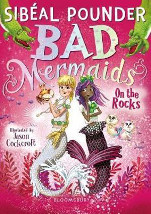
Bad Mermaids: On the rocks by Sibeal Pounder
Ill. by Jason Cockcroft. Bloomsbury, 2018. ISBN 9781408877142
(Age: 8-11) Recommended. Another hilarious, laugh out loud book
about mermaids, evil mothers, talking seahorses, fish, crocodiles
and more. Featuring magical mysteries and fabulous fashions, this
adventure brings a whole new twist to the underwater world of
mermaids.
We leave where we left the girls the previous time in Bad
Mermaids, stuck in a ship being flung to parts unknown. Steve
is getting shipsick/seasick? The girls are trying not to panic too
much. And on the other side of the story we see Paris. A girl we
already met in a fleeting way in the first book, is the one who
handles the ice cream cart. But she is also much more than that. She
also loves inventing and has put a tracker on the mermaids.
My favourite part of the book was the mermaids, seeing their
friendships, and seeing them discover new places, and try to, once
again, save the day.
I love that we found out more about the mermaid world. This time we
see about a kingdom with crocodiles. Mermaids with crocodiles'
tails, crocodiles for transport. And then the fact that there are
even more kingdoms/countries to explore, and I hope that we will be
going there as I want to see what mermaids live there and what their
life is like.
It was fun that we discover magic is real, and that there are
witches.
The book is delightfully illustrated.
Donna Isgar
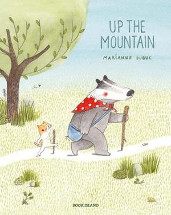
Up the mountain by Marianne Dubuc
Book Island, 2018. ISBN 9781911496090
(Age: 4+) Recommended. Themes: Friendship. Generosity. Outdoors.
Life skills. Mrs Badger lives at the bottom of a mountain and each
Sunday she takes a walk up the path to the top. She knows all the
creatures who live along the way, stopping to talk to them or help
them on their way. One day a cat called Leo stops her and she
convinces him to walk with her. He is easily tired and they need to
stop and rest, but she shows him all the other animals and plants on
their route, showing him which mushrooms are best to eat, and how to
avoid dangers. Leo tires quickly because of his short legs, but Mrs
Badger urges him on. Together they reach the top and the view of the
world is magnificent, worth the effort made. Together they climb the
mountain each Sunday, Mrs Badger teaching him the names of the
plants and animals, watching over him as he learns the way. But one
day Mrs Badger cannot climb the mountain as easily as she once
could, and it is up to Leo to help her. The situation is reversed
until there comes a time when Mrs Badger can no longer climb the
mountain at all. Leo brings back some of his findings for her and
eventually someone else climbs the mountain with him, Leo showing
the way.
Translated from French, this is a gentle story of the passing on of
knowledge, of leading younger people to being independent, as Mrs
Badger leads Leo up the mountain of life, and when she can no longer
help, he in turn helps another.
The trek through the path leading to the mountain displays a lot of
the outdoors to children, a turtle on its back needing help, a group
of baby hedgehogs crossing their path, keeping to the right path,
making a stick to help with walking and so on. Lots of discussion
points to pursue with a group of children, eager to be outdoors
themselves.
The charming illustrations invite closer inspection of the animals
that a child would find in the European outdoors, badger, hedgehog,
fox, a bunting bird and so on. I love the repetition of the
illustrations as Leo becomes the leader, changing roles with Mrs
Badger. The drawing of Leo helping Mrs Badger at the top of the
mountain is inspiring and children will easily understand the
message being shown.
Fran Knight
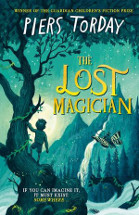
The Lost Magician by Piers Torday
Quercus, 2018. ISBN 9781786540515
(Age: 9-12) Themes: Good and Evil, Fantasy. The year is 1945 and
Simon, Patricia, Evelyn and Larry have survived the London Blitz and
experienced the destructive effects of the bombings on their schools
and housing. They are sent off to the countryside while their
parents search for a new residence. Secretly, they have been chosen
to participate in the classified 'Magician Project' to discover if
magic is real and can be used as a powerful force by the Government.
On arrival, young Larry disappears in the old country house and
discovers a secret carved wooden door leading into The Library. Here
there are three sections of books, Read, Unread and Never Read. Of
course, he's selects a book and is swept into a magical kingdom led
by a fairy knight flying on a tiger-winged butterfly. His siblings
do not believe his wild tales about the magical kingdom, preferring
to swim and explore the countryside around Barfield Hall. When
Evelyn discovers the secret portal, she chooses a different section
and is drawn into the Never Reads world - Folio, ruled by evil
secretary Jana and her silver robots. Evie makes a pact to return
with the rest of her siblings to assist in the evil plans to destroy
the fantasy characters and fantasy world.
Torday includes so many recognisable elements, blood drops revealing
hidden texts, giant talking trees, assistance by fairy tale
creatures, here the Three Bears help in their rescue. His central
theme differs from that of C. S. Lewis, the battle is fought between
knowledge and imagination: Jana believes in a factual world filled
with numbers. She delights in turning, giants, fairies and other
magical creatures into strings of data. There is the difficult and
dangerous quest to find the Magician. The author imbues the
characters with a deeper sense of self, Evelyn - Evie struggles with
her allegiances and her trouble memories of her school being bombed.
In The Lost Magician, Guardian children's fiction prize
winner Piers Torday's decision to pay homage to C. S. Lewis and his
Narnia Chronicles, delivers a very familiar format. He has
added Tolkien touches, included recognisable fantasy characters and
common fantasy tropes. This is an interesting junior novel, one for
fans of the genre.
Rhyllis Bignell
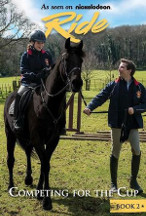
Competing for the Cup by Bobbi JG Weiss
Ride series, Book 2. Candlewick Entertainment, 2018. ISBN
9780763698553
(Age: Teenagers+) Recommended. Competing for the Cup is the
second book in the Ride series, and is based on a TV show
aired on Nickelodeon. Competing for the Cup follows Kit
Bridges after her arrival to Covington, an elite equestrian boarding
school in England. Thankfully her father is there with her, and
together they are helping each other deal with the death of Kit's
mother. In this second instalment, Kit has to prepare for the House
Cup competition, and she is raring to prove just how far herself and
her horse TK have come. But life isn't always that simple: Friends
and frenemies acting stranger than usual, someone leaving
encouraging sticky notes with tips for bonding with TK for her, and
lastly catching her Dad on a dinner date. Kit may have more problems
than she can handle. This story explores life issues and the
struggles one can have when moving to a new home, as well as other
teenage issues surrounding friendships and first loves. Kit is
strong minded but her emotions seem to get in the way of her
decision making at times. Still recovering from the events from the
first installment she tries her hardest to be normal at this new
school she now calls home. Kit's father Rudy is portrayed as a
strong father figure to not only Kit but some of the other students
as well. But he seems to be ready to move on in his romance life
sooner than Kit expected. Lastly, since there are a number of other
characters in the TV show that the story follows, the author does
well to balance the chapters between them all. Overall, I believe
this to be a good series for teenagers and would recommend the
series to teenagers and above.
Kayla Raphael
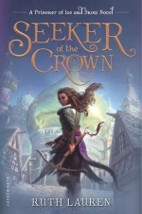
Seeker of the Crown by Ruth Lauren
Prisoner of Ice and Snow Book 2. Bloomsbury, 2018. ISBN
9781681191331
(Age: 10+) Highly recommended. Valor risks everything to protect her
friends in this second book in a thrilling fantasy series that's Percy
Jackson meets Frozen.
'One month has passed since Valor broke her twin sister Sasha out of
jail. But the girl who imprisoned her to begin with - Princess
Anastasia - has gone missing. The queen, desperate to find her
daughter, asks Valor and Sasha to track Anastasia down and bring her
home.
But just as the girls and their friends embark on the search, the
queen also vanishes, throwing the realm into utter chaos. If Valor
can't restore order, she risks getting sent back to prison . . . and
tearing her newly reunited family apart once again. She must rely on
people she can't quite trust, as well as her own instincts, to
protect the people she holds dear.' (Publisher)
I could not put down Prisoner
of ice and snow, the first book in the series and this
was no exception. I found myself going to bed early to read as much
of it as I could before I fell asleep. It is fast paced, and I loved
the descriptive language that Lauren so cleverly intertwines into
the story. Despite this book being a sequel, it could in fact be
read as a stand-alone.
It is a great read for fantasy readers starting from age 10 and up.
Valor is an incredibly strong lead character and I love the fact she
is female. The plot is complex and continually twists and turns.
There is certainly no sexism in this book with both male and female
characters taking on the roles of archery, guards, royalty and
hunters. This is a welcome companion to the first book and a must
read.
Kathryn Schumacher
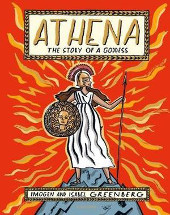
Athena the story of a Goddess by Imogen and Isobel Greenberg
Bloomsbury, 2018. ISBN 9781408892497
(Age: 8+) Greek myths, Athena, Gods and goddesses, Women. Athena the
story of a Goddess, is a collaboration between the Greenberg
sisters, with Imogen retelling the story and Isabel providing the
arresting images. The tale of the goddess Athena is retold in comic
style, part Graphic Novel, part text, while the pages are filled
with illustrations full of the fire of her life reflecting the
images presented on Greek antiquities. Some pages are presented in
full comic mode, with illustrations bound by frames, and
conversation given in bubbles in the air, while others are presented
in larger amounts of text with some illustrations, but all is easily
read, the text and drawings conveying to all readers the tenor of
her life.
From the story of her birth when she appeared out of Zeus's skull!,
Athena soon made her headstrong self known. She was a strong, wise
woman who showed distinct favour to humans, frowned upon by the
other gods watching from Mount Olympus.
In this publication, we see her outwit Poseidon to have a city named
after her (Athens), destroy the life of one more talented than her
(Arachne) changing her into a spider, challenge her sisters to charm
a shepherd by the name of Paris, and watch over Odysseus on his
return home from the Trojan Wars. The lives of gods and goddesses
intersect with humans in these stories, the gods and goddesses
having power of life and death over humans, and sometimes playing
with them like toys.
Athena's strength in dealing with others who cross her path is
captivating, and the retelling is accessible to all young readers,
who will enjoy the black outlined illustrations.
A double page at the start gives quick biographies of the main
protagonists in the tale of Athena, and the endpapers show the
illustrations seen on Greek vases, used as a reference for Isabel's
illustrations.
Fran Knight
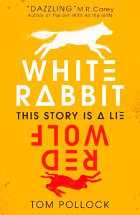
White Rabbit, Red Wolf by Tom Pollock
Walker Books, 2018. ISBN 9781406378177
(Age: 14+) Recommended. This book is brilliant, gripping and horrifying - all at
once! Right from the start we are gripped by the anxiety of the
narrator, and this does not let up at all. We are positioned to
wonder whom we can trust? Told episodically, this narrative has
chapters named for the thoughts and action that occur. Plunging us
into the lives of some members of one family, who are clearly very
clever people, albeit distracted and secretive, Pollock takes us on
a journey of fear, confusion, and a sense that terrible and
catastrophic events may happen at any time and they do.
Shocking, puzzling, and heartachingly sad, this story of a family
who are brilliant people, a family that does not seem like one,
however. This family of very, very intelligent people who can
explore, explain and expose what is happening to them and the world
around them, but fear the consequences, appear to be in trouble.
Two adolescents, a boy and a girl, we realize very quickly, possess
outstanding abilities to rationalize, explore, explain and
comprehend the situation in which they find themselves, a situation
that portends absolute disaster, that challenges them to trust
no-one, not their mother nor their sibling. His extraordinary
intellect enables seventeen-year old Peter Blankman to grasp the
threat that he faces, and the threat is his life. As the novel
focuses mostly on the way in which his use of mathematical logic and
computer-like reasoning enables him to slowly piece together the
events that have occurred both in the past and in the present, which
is the narrative structure of interwoven chapters, except for the
opening chapter, named ENCRYPT, with these letters encrypted to read
YICMXKQ. Already we are alerted to the model of thought that imbues
this novel with cleverness, fear, betrayal, murder and a seeming
lack of love and loyalty within one family.
Ultimately, this is a story of the failure of a family to be what
families should be, that is, to protect, nurture and guide the
children to live good lives, not selfish lives, but lives that
enable them to be honourable, to help others, to be part of a social
web that protects and nurtures children. The children in this story
are sacrificed for the state, or at least that appears to be so.
The narrative delivers a hard and fear-filled world for one fearful
child, albeit a brilliant one, whose actions reflect his isolation
when things go amiss and his family are not there. He and his twin
sister appear to have been abandoned, the adults in their lives
missing, and they themselves endangered. After a series of murders,
this family is catapaulted into terror. Using their brilliant minds
to decode the events and the messages they perceive, the twins work
to decode the events so that they can survive.
This powerful new novel will disturb, intrigue, fascinate and
unsettle the reader. Tom Pollock's work on the perils of espionage,
and the threat of death for anyone who reveals what is happening, is
situated in the centre of a modern world where fear of exposure and
death looms for those who work in government, and correspondingly
threatens the lives of their children.
Elizabeth Bondar
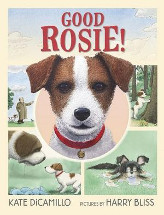
Good Rosie by Kate DiCamillo
Ill. by Harry Bliss. Walker Books, 2018. ISBN 9781406383577
(Age: 4+) Highly recommended. Themes: Dogs. Responsibility. Family.
Companionship. Divided into nine chapters, this comic styled story
tells of Rosie the dog who lives with George. Each morning, George
cooks himself two eggs and gives Rosie her food in her silver bowl.
But once finished Rosie can see another dog at the bottom of the
bowl, and realises that she is lonely. In chapter two George and
Rosie go for their usual walk in the woods, watching the shapes made
by the clouds. When George points out a dog-like shape, Rosie
becomes excited and George has an idea. The next chapter sees George
take Rosie to a dog park. Here Rosie is somewhat overwhelmed with
the number of dogs and one in particular who comes up to her is much
larger and has a toy in its mouth which it shakes with gusto. In
chapter four a smaller dog drops by, but this dog is a livewire and
jumps rapidly from one spot to another, so putting Rosie off. The
next chapter sees the larger dog shaking the smaller one in its
mouth and in chapter six, Rosie tackles the larger dog, warning it
to drop the little dog, which it does in chapter seven, and the last
two chapters see the problem resolved and the three meet regularly
at the dog park for companionship and play. Even George gets to make
new friends.
A seemingly simple tale of friendship, the story has the trio not
liking each other at first, but when an incident occurs from a
misunderstanding, Rosie stands up for the little dog, resolving the
issue and so making friends. It resonates with the problems of young
children making friends, of being understanding, of resolving issues
with other children and coming to a mutual understanding. The
positive flow of the story will appeal to younger readers who will
see it as a dog story but with overtones of their own attempts to
make friends.
The illustrations are simply adorable and highly appealing to any
reader who picks up the book, while the expressions on the dogs'
faces are wonderful.
Fran Knight
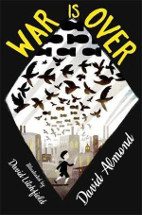
War is over by David Almond
Ill. by David Litchfield. Hodder, 2018. ISBN 9781444946574
(Age: 8+) Highly recommended. Themes: War, Peace, Conscientious
objectors. As one would expect from an author of the calibre of
David Almond, War is over is a lyrical and confronting story set in
1918. On the back cover it states 'This beautifully illustrated,
moving story commemorates the hundred-year anniversary of the end of
the First World War.' Although the reader might expect a story
glorifying war, Almond has instead melded together many complex
issues about the nature of war, with the dream of peace being the
over-riding theme.
'I am just a child,' says John. 'How can I be at war?' John's mother
works in a munitions factory putting shrapnel into shells; his
father is fighting in the trenches in France and his teacher, a most
unpleasant character, insists that the children too are fighting a
war. But there is a man, Dorothy's Uncle Gordon, who has been forced
to live in the woods and who doesn't believe in the war and insists
that the children in Germany are just like the children where John
lives. John has a strange moment when he glimpses a German boy, Jan,
from Dusseldorf and begins to realise that the German children are
not his enemy.
Beautifully illustrated in black and white and tones of grey, the
munitions factory rears out against a stark background, shells stand
in dangerous rows and then are exploded sending soldiers skywards
with the blast. The white feather from Uncle Gordon stands out,
white against a black page, and in the final pages the reader is
given a sense of hope with a light grey background as seeds of peace
are scattered by John across the German earth.
Although at first glance this short (117 pages) illustrated book may
appear to be for a young audience, the complexity of the themes and
message make it a book that a teacher or caregiver may need to read
with children. It will certainly engender much conversation about
the nature of war, nationalism and hate.
Pat Pledger
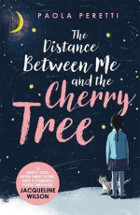
The distance between me and the cherry tree by Paola Peretti
Hot Key Books, 2018. ISBN 9781471407550
(Age: 10+) Highly recommended. Themes: Macular Degeneration,
Blindness, Family, Friendship. This poignant tale has Mafalda
charting her loss of sight as her eyes deteriorate. She begins with
her beloved cherry tree, counting the steps as she comes to school,
noting how close she needs to be before she can really see it. She
loves this tree and often climbs into its comforting branches. One
day her glasses fall and she cannot see her way down, but the new
caretaker, Estelle, retrieves her glasses and helps her come back
down. After that Estelle waits for her every day.
Juvenile Macular Degeneration leads to blindness as the macular
develops spots which impairs vision. Initially told she may have
some time before the black spots cover most of her sight, she is
told that it is imminent. She resolves to go and live in the tree
where she feels close to her late Grandmother and Cosimo, a
character from one of her father's favourite novels, to whom she
speaks, using him as a sounding board for her ideas.
But she is beset by problems. Her parents want to move closer to the
school, into an apartment with no stairs, but in doing she will lose
the one thing that Mafalda loves, the view from her window to her
Grandmother's old house across the way.
And Fillipi, a boy in her school wants to be friends, but she cannot
work him out. Mafalda pens a list of things she deems important, and
along the way learns to cross out the ones she finds less so, making
sure that her list is up to date. When she has had enough she
retreats to her tree, determined to live there with her cat, safe in
the arms of her gran and Cosimo, but Estelle's voice helps her
realise what is important, helping her out of the tree and to her
new life.
A most unusual book about losing your sight Mafalda is an engaging
character, full of grit and determination, learning that family and
friends are the best things to have around
you.
Fran Knight
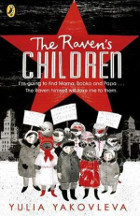
The Raven's Children by Yulia Yakovleva
Puffin, 2018. ISBN 9780241330777
(Age: 11-15+) Recommended. Stalin's Russia is a dark and foreboding
place, where the walls literally have ears and eyes. The imagery is
all about the secret police and the threat of the 'Ravens' taking
the 'enemy' away is always present. People are watching, no one can
be trusted.
Shura lives blissfully unaware in this world with his parents, older
sister Tanya and baby brother Bobka until both his father, mother
and brother are taken away.
Shura decides to find his missing family with his sister and
confront the 'Raven'.
This book combines both historical events and fantasy to tell
Shura's story. It is a harsh and uncaring world seven-year-old Shura
tries to survive and the adults are only there to punish and
incarcerate him.
This is a dark story based on the family experiences of the author.
At times there seems to be no kindness or love in the world and the
reader despairs for Shura and his family. The use of fantasy softens
the story and birds are a constant imagery, often talking to Shura.
At times I found this a difficult book to read and needed breaks
from Shura's world. I feel children will understand that Shura is on
a quest and that he experiences a dark and unfriendly world but they
will not have a historical perspective of this time. The real world
is mixed with fantasy giving the story a dreamlike quality. The
ending offers hope for the future but does not answer all the
questions the book poses.
I recommend this book to 11 to 15+ year olds, especially to students
who have read The Boy in the Striped Pyjamas.
Jane Moore