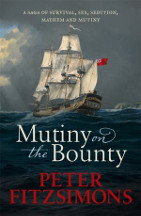
Hachette, 2018. ISBN 9780733634116
(Age: Senior students - Adult) Recommended. Mutiny on the Bounty
tells the amazing story of strong personalities, intrigue and high
adventure in the South Pacific.
Captain William Bligh was appointed to take his ship and crew, to
the island paradise, Tahiti, where they were to collect breadfruit
for transplanting in the West Indies. After five months of carefree
living the crew was reluctant to leave. William Bligh's changed
behaviour towards and eventual persecution of his protege, the
popular leader, Fletcher Christian, resulted in the crew mutiny and
the banishment of Bligh and 18 others to an open boat. In a
remarkable feat of navigation and endurance the small boat was
navigated to Timor. Meanwhile, Fletcher Christian sailed back to
Tahiti. The mutineers were well aware that they would be wanted men.
Most remained on Tahiti but Christian and eight compatriots along
with Tahitian men and women sailed off in search of a secret hiding
place. Eventually they discovered Pitcairn Island, where they
proceeded to settle, populate, quarrel and murder.
Peter Fitzsimmonds has based his book (613 pages) on the work of
earlier researchers, and detailed quotes from primary sources such
as Bligh's logbook. Incidents are flavoured through diary notes
converted to conversation and assumed thoughts or motivations
discussed during the main developments. The ship and settings are
described in detail with drawings, pictures and maps to support the
narrative. Suspense is maintained through simultaneous accounts of
the actions by both factions in different parts of the world. Some
readers might take issue with the accuracy of the accounts of the
mayhem on Pitcairn Island. However, the author gives a strong
flavour of how events probably occurred. An amazing story that is
still gripping over two hundred years later.
Paul Pledger
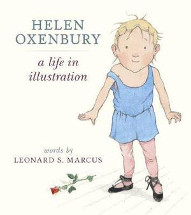
Helen Oxenbury: A life in illustration by Leonard S. Marcus
Walker Books, 2018. ISBN 9781406357943
(Age: 11-Adult) Highly recommended. What a joy it was to discover
this fascinating account of the life of Helen Oxenbury, written in
an easy to read manner by Marcus, a distinguished children's
literature critic. From the very beginning when the reader glimpses
a rich brown red door at the top of the stairs, then is shown all
the accoutrements of an artist, brushes, pens and crayons, it is
evident that this is a book to be savoured and treasured, one to
share with other people who love art and with children who have
adored the illustrations in many of Helen Oxenbury's books.
The book is divided into spans of years, giving information about
Helen's childhood and early training as an artist in the period from
1938-1957, then the book is divided into decades following the
important events of her life. It is illustrated with beautiful
photographs that bring Helen to life for the reader as well as
containing many gorgeous illustrations from her books. Anyone who
has been involved with reading to young children will recognise the
wonderful pictures from We are going on a bear hunt, to Ten
little fingers ten little toes and will be filled with
nostalgia for the lovely times of reading aloud and sharing these
books. Helen's understanding and love for children is evident in her
delightful drawings of toddlers and babies and her empathy for young
mothers is also very obvious.
It is easy to read the book from cover to cover as Helen's life and
the growth of the publishing industry is described. And it is also
wonderful to let the pages just drop open to see what gorgeous
illustration might appear.
This beautifully designed book is a fascinating biography of a very
warm and talented illustrator and one that could grace any home
where art is valued, while being a valuable addition to any library.
A video is available.
Pat Pledger
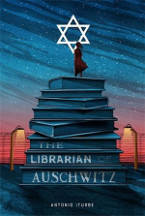
The librarian of Auschwitz by Antonio Iturbe
Translated by Lilit Zekulin Thwaites. Pan Macmillan, 2018. ISBN
9781250217677
(Age: 14+) Recommended. Historical fiction. Based on a true story,
this novel recounts the life of Dita, a 14 year old Jewish Czech
girl, sent with her mother and father by the Nazis in Prague, first
to the Jewish ghetto of Terezin, and then to the Auschwitz
extermination camp. There, in Block 31, she becomes the librarian,
guardian of a secret library of eight books, a strange assortment
that has been secreted into the camp one by one: there is an atlas,
a book of geometry, H. G. Wells' history of the world, a Russian
grammar, a French novel, a Russian novel, Freud's treatise on
psychoanalytic therapy and a disreputable Czech publication The
adventures of the good soldier Svejk. The books are forbidden,
and they become the most valuable link with another world, the world
of literature and education. Dita literally guards them with her
life.
Life in Auschwitz is miserable and fearful. The school that their
inspirational leader Fredy Hirsch has set up in Block 31 is
threatened at any moment by discovery by the Nazis. The cruel and
heartless Dr Josef Mengele has Dita in his sights, he is tracking
her every move. Afraid, Dita doesn't know who to trust - is it truly
as the eccentric Professor Morgenstern says, your best friend is
only yourself?
Despite all the horrors she experiences, Dita is a survivor, and in
this story Iturbe captures her unique spirit, her courage in the
face of the worst evils, and her determination not to be beaten. The
book includes other truly brave people, a reminder of the strengths
of ordinary people living in the worst of times.
In the end this is an uplifting book, a reminder of the importance
of literature and ideas, and of empathy and shared human experience.
Young readers and adults would equally enjoy it.
Helen Eddy
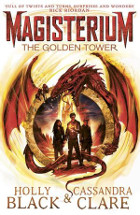
The golden tower by Holly Black and Cassandra Clare
Magisterium book 5. Scholastic, 2018. ISBN 9780552567756
(Age: 10-12) Recommended. Themes: Fantasy. Coming of age. Magic. The
final book in the series, The golden tower brings to an end
the adventures of Callum Hunt as he navigates his way through the
corridors of his school, the Magisterium. Callum has had a hard time
battling chaos, evil and the mage Constantine Madden and in this
book he is faced with the even more difficult task of stopping Alex
from manipulating the Magisterium for his own evil ends.
This book is a satisfying conclusion to the series. Callum is still
battling the distrust of his fellow school mates, but he resists the
urge to take off with Alistair, his father, and hide. Instead he
works with Tamara and Aaron to bring down Alex and make his world a
better place. Callum and his friends have to work together as a team
and share problem solving techniques for the good of the community.
The growth of his maturity and that of his colleagues is evident as
events that are difficult to control take over the life of the
school.
This was a fast paced story with enough action to keep the reader
engrossed. It is a series that primary school children who like
fantasy are likely to enjoy.
Pat Pledger
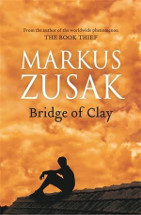
Bridge of Clay by Markus Zusak
Pan Macmillan, 2018. ISBN 9781760559922
(Age: Adolescent - Adult) Recommended. With a story that is based on
the deep and abiding love of a family, this book plunges us deeply
into the world of the Carey family in a Melbourne suburb near one of
the great horse racing tracks. The five sons are educated at the
local school, but their home education is deeply embedded in the
Greek classics, with even their pets being named after the great
Greek heroic figures. This is a story that packs an enormous punch,
just as the boys do so often in their home, even though they are
surrounded by love and care. The book is suitable for older
adolescents, and certainly is a great read for adults.
Zusak has chosen a storyline that takes the reader through the years
of the boys youth, through the loss of their mother to illness,
their father's occasional abandonment, their loving care of their
somewhat unusual pets, and the animals that are ever-present in
their lives, especially the mule. All the names of the animals
represent the qualities that the boys attribute to their furry
friends, and this is the key to their shared set of values and
beliefs that holds them together when their mother dies and their
father appears to abandon them.
Choosing to weave his story deep in the suburbs of Melbourne, Zusak
takes us back and forth in time so that we have to construct the
storyline as we work to place each chapter in its right time. When
their father leaves them, after his wife's death, the boys fight and
play, read and build, but never stop supporting each other and find
ways to cope, in their inimitable style. The father is not a bad
figure but is grieving so deeply that he cannot stay with his sons.
Yet they forgive him!
Place matters in this text, and the story is set in different places
that re-appear throughout the narrative. We get to know The
surrounds, the bridge over the deep valley that they work to
construct, the racetrack and the racing horses, and the animals'
shelters at home. Clay's bridge, the shelters for the animals, their
home, the race track and local area are all deeply reflective of
this family. The mixing-up of the timeline appears to be reflective
of the more important issue of the deep and abiding love they share,
and of their memory of a loving mother who educated them in the best
of the ancient Greek values, of loyalty, goodness, and generosity,
all in the face of almost constant threats of disaster. This is a
long story, and is one that needs concentration to build its place
in time, and yet it is utterly captivating. It is hard to put down,
to let the boys go when the end comes, but we leave them with a deep
feeling of gratitude that although we have spent so much time with
them, we are sad that the narrative has ended. It is hard to believe
that this is not a true story, and it is likely that we might well
posit its essential truths as pertinent to our being human, and be
all the better as people for having read this wonderful novel. Bridge of Clay is suitable for adolescent and adult reading.
Elizabeth Bondar
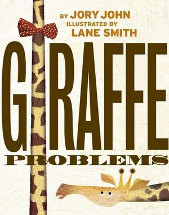
Giraffe problems by Jory John
Ill. by Lane Smith. Walker Books, 2018. ISBN 9781406383164
(Age: 5-8) Themes: Differences, Individual Characteristics. The book
begins with Edward the giraffe telling us his problem: 'I feel bad
about my neck. I do. I can't help it. It's too long. Too bendy . . .
Too . . . necky.' He tell us all the ways he has tried to hide it or
dress it up. All the other animals seem to have glorious, perfect
necks. But his makes him want to hide until the sun sets. His tirade
of self-loathing is just ending when he accidentally rests his
cumbersome neck on a turtle. Cyrus the turtle then begins telling
Edward about his own neck problems: 'I've been admiring your neck
from afar. Oh, how I wish my neck looked like yours! I'd get so much
done in a day'. And so he continues on his own little tirade. The
story is told with dry humour, making fun of their extreme vanity
and how focused they are on their own problem. The funniest part of
the book is when turtle tells us, using very descriptive
story-telling, of how he has waited for a week under a banana tree
for a piece of fruit to fall to the ground so he could 'sample its
sweetness and nourish myself in the process'. 'You want a banana
from a tree?' says Edward. 'That's what I said, yes'. Plunk, down
one comes. So, Cyrus praises Edward's neck and Edward waxes lyrical
about Cyrus's neck and they dress themselves up with bowties. 'I
feel good about our necks, Edward'. 'Thank you, Cyrus. For once, so
do I. Yes, for once, so do I . . . '
Lane Smith (It's a Book, The Stinky Cheese Man) has
used textured illustrations which are perfectly suited to the
animals and natural setting within this story and the
character-driven narrative. The colours used are mostly earthy
browns, yellows and greens. The reader can tell which animal is
speaking because of their individualised text style and colour; this
is a clever technique and it is always clear who is speaking, if not
from the content or placement within the picture then from the
typeface. This has a nice moral about accepting ourselves as we are
and celebrating what makes us unique. It is also about recognising
difference and how we can make use of those differences to work
together.
Nicole Nelson
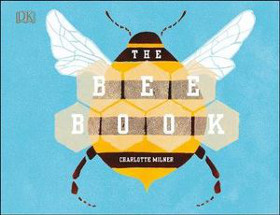
The bee book Charlotte Milner
DK, 2018. ISBN 9780241305188
Recommended. Bees have been an essential and integral part of life on the planet
for over 100 million years - even pre-dating the dinosaurs - and
about 20 000 different species can be found all around the world.
While some bees are large, others small, some can cook and the
original name of the much-loved bumblebee was 'dumbledore', the most
famous is the honey bee and this amazing new book focuses on this
species as it explores all aspects of its life and why it is so
important to the survival of humans.
Packed with easily accessible information and eye-catching
illustrations, this is the ideal book to show young children how
critical bees are within the environment as they, along with other
insects, are responsible for about a third of everything we eat! As
well as emphasising their importance, there is also a warning about
their decline in numbers and the potential for catastrophe if that
happens. There are suggestions for how we can assist their
longevity, including building a simple bee motel (although I cheated
and bought one) with more detailed instructions available here.
With Christmas approaching, and Miss 12 and Miss 7 growing beyond
toys and stuff, this book, and a copy of this year's winner of the
CBCA Book of the Year for Younger Readers, How
to bee because they seem like natural companions, as
well as the bee motel will make a somewhat different gift, but one
which will inspire them!
A must for school libraries and fascinating and informative for
those with an interest in the environment.
Barbara Braxton
Guinness World Records: Wild Things ed. by Craig Glenday
Guinness World Records, 2018. ISBN 9781912286485
(Age: 8+) Recommended. Subjects: Animals, Records, Zoology, Mammals,
Reptiles, Insects. Wild Things is jam-packed with an array
of amazing animal facts, records, achievements, oddities and
dangerous creatures. Split into 9 chapters, the book includes
information about Odd Bods, The Cute Factor, Creepy Crawlies and
Zootopia. Catchy titles, fun facts and figures, close-up photos,
bold visually appealing double page spreads make this a fun book to
share with animal lovers from eight to eighty!
Beginning with Booty and the Beast, it is filled with fun facts and
photos. Discover the female mandrill who displays her
rainbow-coloured butt as a sign of status, the trapdoor spider's
manhole butt and the manatees that use their digestive gas as a
flotation device! Compare mammal statistics, while the blue whale
weighs in around 190 tonnes, the tiny bumblebee bat from Burma and
Myanmar weighs up to two grams. In Little and Large a life-size
Indian rusty-potted cat leaps out, growling with pointed teeth. A
new wild cat species, the southern Brazilian oncilla, was only
recognised in 2013.
Australasia is On the Map; test your knowledge with thirty-three
unusual animals to identify and fun facts to discover. Did you know
the New Zealand tuatara is the fastest-evolving animal in the world?
Conservationists, including Dr Jane Goodall, Bindi and Rob Irwin and
Nisha Owen, provide interesting insights into their passions, work
and environmental messages.
Trading cards filled with animal facts, charts for animal height and
weight and short quiz questions across the bottom of some pages
capture interest and make for interesting conversations. An
augmented reality app in Creepy Crawlies adds an animated insect
screen to a phone. Guinness World Records: Wild Things is an
excellent resource for STEM classes, a fabulous addition to a
classroom or school library and for a scientifically minded reader
from eight to eighty.
Rhyllis Bignell
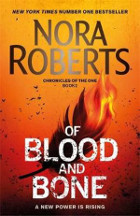
Of blood and bone by Nora Roberts
Chronicles of The One book 2. Piatkus, 2018. ISBN
9780349414980
(Age: Adult - 16+) Dystopian fiction. Pandemics. Coming of age.
Roberts continues with her compulsive series, writing as always in a
very readable style with great characters. The first book Year
One introduced many characters and the second in the series
carries on with the story of Lana's daughter, Fallon Swift, who has
reached the age of 13 on the farm where her mother had taken refuge
with Simon, an ex-soldier turned farmer. With her gifts beginning to
mature it is time to learn how to fight for good. She is taken away
from the family farm by Mallick to be trained as a warrior and
gifted healer as she has been identified as The One, the girl of
Light who would fight against the forces of the Dark and lead her
peoples to victory.
Fallon is an engaging character, showing all the signs of a young
adolescent, but under the guidance of Mallick, she takes up the
heavy burden that has been given to her and trains very hard and
studies intensively, to be worthy of the gifts that she has been
given.
Readers will follow her coming of age with interest and will be
happy to return to the community of New Hope and find out what
happened to characters first introduced in Year One. Roberts always
has strong family ties and relationships underpinning her stories
and Fallon's feelings for her family and her dead family are handled
deftly and sympathetically. There is a hint of romance to come with
growing feelings between her and Duncan, who has appeared to her in
dreams as a grown man, and the love between Lana and Simon is a
highlight of the story.
Battle scenes and devastated countryside bring the dystopian world
to life and Roberts manages to combine a world devastated by a virus
with elves, fairies and people who have extraordinary paranormal
gifts in an unusual and believable way. There is a surprise twist at
the end and the reader is left hoping for the next book in the
series to find out how Fallon and her compatriots deal with the
forces of evil.
Pat Pledger
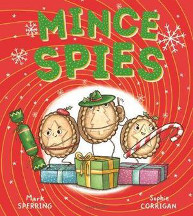
Mince spies by Mark Sperring
Ill. by Sophie Corrigan. Bloomsbury, 2018. ISBN 9781408893463
(Age: 3+) Highly recommended. Themes: Christmas, Competition. When
all the Christmas goodies: gingerbread men, Christmas sticks,
puddings, yule logs and so on, fall to the floor in the supermarket,
something must be done. The super spies, Mince Spies come jetting in
to unravel the mystery.
Told in verses, children will love predicting the next word in each
line, as the Mince Spies do some sleuthing around the supermarket to
find the culprit. With their flaky pastry jetpacks they hide within
the shelves, waiting. But time moves slowly until their walkie
talkies come to life, and they fall to the floor with their cheesy
breadsticks and whipped cream cans at the ready. Imagine their
surprise when they find that the Brussel Sprouts are working
together to rid the shelves of all the Christmas goodies, throwing
them to the floor with abandon. Readers will laugh out loud at the
antics of the Sprouts and sympathise with their reasoning. But
someone else must come and help with a solution, and Santa himself
appears. All is neatly resolved, and the readers will be happy at
the way the sprouts are appeased.
Told in verse form, supported with funny, detailed illustrations the
story will have readers laughing out loud at the antics of the Mince
Spies and Sprouts, as they almost come to blows over what is eaten
at Christmas. Children will love reprising the sorts of goodies they
have at this time of the year, and wonder at a winter Christmas
where Sprouts are served.
Fran Knight
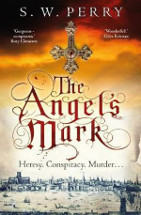
The angel's mark by S. W. Perry
Atlantic Books, 2018. ISBN 9781786494955
(Age: senior secondary to adult) Crime, Elizabethan England,
Medicine, Superstition, Childbirth, Women, London. Steeped in the
life and times of the later years of Elizabethan England, this story
of the investigation into bodies found with an upside crucifix
carved into them will have the readers enthralled. Nicholas Shelby,
an aspiring physician at a time when doctors used medicinal herbs to
deal with the most advanced of diseases, and where surgery was
undertaken by the local butcher, loses his faith when his wife dies
in childbirth. Unable to cope with a god that allows this to happen,
and made very aware of the limits of his knowledge, he falls into a
stunning decline, to the point where he throws himself into the
Thames. Saved by a young woman, a tavern owner called Bianca, he
realises after a few weeks that she has been using medicines that he
has only read about. Eventually the two are able to share
information, Bianca having a vast knowledge from her time spent as a
child in Padua, where both men and women practise medicine. But here
in London she must take care, women such as she are burnt as
witches, any fool wanting to cause trouble able to make an
accusation.
But Nicholas saw the body of a child dragged from the river,
emblazoned with the carving and he knows that it was not a drowning,
as certified by the coroner.
When he sees another with the same disfigurement, he and Bianca set
out to find an answer. But their lives are interrupted by Robert
Cecil, a master spy, doing the Queen's business rooting out Catholic
conspiracies, and when Shelby plans a visit to the house of John
Lumley, Cecil forces him to spy.
With Spain meddling in England's affairs, and the queen not as
strong as she once was, plots abound as people vie for power, making
this is a riveting historical read. Descriptions of London's streets
form an amazing backdrop, the descriptions of palaces and luxury
just as beguiling, while the two main characters set against these
impossible times evoke our sympathies as they rail against injustice
and coercion. The stunning conclusion brings all of these themes
together in a most intriguing way, making sure the second in the
series, The serpent's mark to be released in June 2019, is
watched for.
Fran Knight
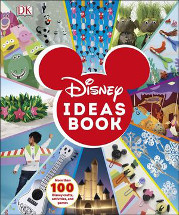
Disney ideas book by Elizabeth Dowsett
DK, 2018. ISBN 9780241314210
Whether it's 101 Dalmatians, Coco, The Little
Mermaid, Mickey Mouse or Tangled, every child
has a favourite Disney movie, and in this super-sized activity book
there are projects to accompany more than 50 of them!
Listed firstly by the type of project and then by the movie, young
readers can easily find their favourite and soon find themselves
making Elsa's sparkly cape, Buzz Lightyear's Wings, Cinderella's
pumpkin carriage, Belle's book garland or even doing the boogie with
Baloo. Each activity is related to a character from the movie, has a
list of the equipment needed, if any, and clear step-by-step
instructions so that young readers can follow the steps
independently. There are templates, tips, tricks and explanations
and the typical DK layout makes it accessible to all ages and
abilities, although some may need adult assistance.
Each activity provides a procedural text to follow, which could be
used as a model for students to create their own, while others like
the parachuting soldiers from Toy Story offer science to be explored
and explained.
With so many activities, this one book could form the basis of your
STEM and craft curriculum for the year, while being the perfect
addition to the family entertainment library as the long summer
holidays loom. No computer screens required!
Barbara Braxton
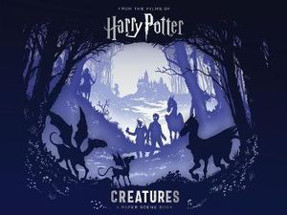
Harry Potter - Creatures: A Paper Scene Book by Warner Bros
Bloomsbury Children's Books, 2018. ISBN 9781526605849
(Age: 6+) Recommended. Themes: Fantasy, Art. Fans of the Harry
Potter world will be thrilled with this very handsome volume
featuring the fantasy world and dark creatures of the Black Lake,
the Forbidden Forest and the dragons of the Triwizard Tournament.
There are four fascinating paper cut-out dioramas showing the
strange creatures from the films that readers will be find
themselves poring over. Some will be a tad frightening like the
strange merpeople in the Black Lake all coloured in blue black with
a slightly paler blue or the dementors in Dark Creatures, coloured
in paper of the deepest purple. All have Harry Potter lurking
somewhere, his distinctive glasses giving a clue to his whereabouts.
The artistry of the dioramas is incredible. The paper cut-out works
are intricate and beautifully produced in deep, dark, rich colours
and each begs to be inspected closely.
The introduction gives an outline of what is in the book and
interspersed between the dioramas is a double page spread describing
the creatures, some of the films' productions and how the creatures
were designed and filmed, all with illustrations and photographs to
stimulate the imagination. The descriptions of how the creatures
were created for the films, using well known myths for some like the
centaurs and the magnificent red dragons or J.K. Rowling's
imagination for the unknown creatures give the readers an in-depth
idea of the creativity of the film-makers.
This will be a delight for all art lovers who will be intrigued by
the intricate work of the dioramas, while fans of the Harry Potter
world will want to have this in their collection.
Pat Pledger
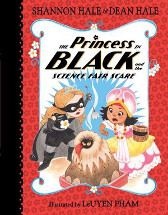
The Princess in black and the science fair scare by Shannon Hale and Dean Hale
Ill. by LeUyen Pham. Candlewick Press, 2018. ISBN 9780763688271
(Age: 5-8.) Recommended. Who says feminists can't be princesses or
wear pink? In this fantasy, Princess Magnolia and her multicultural
sorority of Princesses, have entered the science fair. All of the
impressive science projects seem to have outshone her own project -
a poster titled, 'How Seeds Grow into Plants'. But the source of
Magnolia's anxiety is Tommy Wigtower's talking volcano. Tommy has
inadvertently created a potentially dangerous goo monster, which
eats Magnolia's poster and proceeds to disrupt the science fair.
Princess Magnolia and Princess Sneezewort, in the guises of Princess
in Black and Princess in Blankets, are joined by Princesses
Honeysuckle, Orchid, and Snapdragon who help control the monster by
relocating him to a bigger home. By the end of their adventure, all
of the Princesses want alter-egos.
It's a struggle to contain the monster finally, but these burgeoning
multiracial feminists are gracious in defeat and genuine in their
praise of the Science Fair winner, vowing to try harder next time.
Both mums and daughters will find that despite cute, Disney styled
illustrations, Volume 6 of the Princess in Black series
continues to place valour ahead of vanity and smarts ahead of glass
slippers.
Deborah Robins
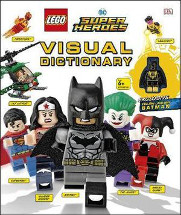
LEGO Super Heroes Visual Dictionary by Elizabeth Dowsett and Arie Kaplan
DK, 2018. ISBN 9780241320037
Since 2006 when it first released its Batman-themed sets, LEGO, a
contraction of leg godt which means 'play well' in Danish, have
offered fans construction sets related to the popular superheroes so
they can learn to read and follow instructions and develop their
fine motor skills as they make the intricate models from the movies,
then use their imagination to build new stories and adventures with
their creations.
This visual guide to the minifigures, vehicles and sets of the
Superhero world offers lots of background information about the
characters culminating in a behind-the-scenes chapter which features
concept art and an interview with the LEGO DC Super Heroes creative
team.
Like its predecessors that have been linked to popular movies and
characters, this is a book that will have young fans poring over it,
talking about what they are discovering, wanting to learn more and
reading to do so - engaging in all those behaviours that show that
print offers them something and that reading for pleasure is a
worthwhile thing to do. Guaranteed to hook young reluctant readers,
appeal to more independent fans and even offer suggestions for the
Christmas stocking as each model has details of its release date,
set number, and the number of pieces and minifigures that come with
it. There is even a Yellow Lantern Batman included!
Barbara Braxton