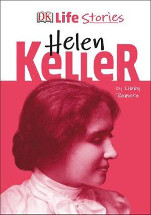
Ill. by Charlotte Ager. DK Life Stories. DK, 2019. ISBN
9780241322932.
(Age: 8-12) Highly recommended. Themes: Helen Keller. Biography.
Disability. Blindness. Deafness. Helen Keller's life is revealed in
this accessible biography for younger readers. Helen's disability
and her relationship with her teacher Annie Sullivan are described
with simple detail. Her later life is also explained, along with her
opinions and service for others, all demonstrating her amazing
capacity; she was never limited by her disabilities but used her
talent for overcoming obstacles to inspire others.
The presentation of this book is delightfully appealing for readers
aged 8-12. The cartoon style illustrations are interspersed with
photographs, and decorated text boxes are used to explain
terminology and ideas for the benefit of the younger audience. With
colourful chapter headings, a family tree, a summary timeline of
Helen's life, a quiz, and a glossary the book is a wonderful,
appealing non-fiction book. The text is not complex and this book
would make an excellent addition to a biographical collection in a
primary school library.
Highly recommended. Ages 8-12
Carolyn Hull
Playing Atari with Saddam Hussein: Based on a true story by Jennifer Roy with Ali Fadhil
Oneworld Publications, 2018. ISBN 9781786074669.
(Age: Upper primary, Lower secondary) Recommended. An intriguing
title, combining two seemingly unconnected topics. Ali is an
eleven-year boy who lives in Iraq during 1991, a time when the
country was bombed by the Americans. President Saddam Hussein has
invaded Kuwait and the US and allies launch Operation Desert Storm
to force him out. That means the people of Kuwait must experience
the onslaught of the bombing raids, starvation and death.
All of this is seen and described through the eyes of Ali who lives
with his brothers, sister and mother while his father is away
serving as a medic.
Mixed up with the horrors of war, are the day to day survival
strategies his family must practise such as taking shelter and
surviving on meagre food supplies. He deals with problems with his
brothers, bullies in the street as well as witnessing the horror of
a public execution.
Ali loves his Superman comics, his Atari game, soccer and American
shows (from which he has learnt English) and wants nothing more than
his father to return safely and life to go back to normal.
This novel is based on a true story and Ali Fadhil, the joint author
and protagonist of the story, eventually migrates to the USA after
participating in the trial of Saddam Hussein as a young man.
This is a time in history that the young readers of this book may
not know but it gives a child's eye look into the experiences of
real people on the ground surviving war.
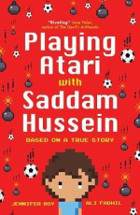
The cover has a pixelated Atari screen style of illustration showing
Ali surrounded by bombs and soccer balls, wryly mimicking the
comments made by Americans, calling the nightly bombings 'the video
game war'.
I recommend this book to upper primary, lower secondary students.
Jane Moore
Zenobia by Morten Durr and Lars Horneman
UQP, 2018. ISBN: 9780702260254.
(Age: All) Recommended for all ages, a useful stimulus to discussion
of refugee issues. Could worry younger readers.Themes: Refugees,
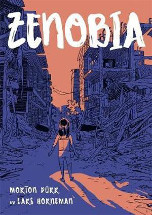
Children in war, boat people, migration. The opening page of this
graphic novel is divided into three uneven frames; in the middle we
see the gently curving horizon with the sky above. Below, alone in
the ocean is an overloaded boat, every inch occupied by people. The
following pages zoom in on the people, so tightly packed that the
deck is not visible. We see a little girl, alone, surrounded by
adult men. Then the sea gets rough and the people are thrown from
the boat, clutching babies and meagre possessions and our little
girl is thrown into the sea. The first words come as she sinks, 'it
is big and empty here'. 'No-one can find me here.' We find out her
name is Amina and we enter her memories of happier times, playing
hide and seek with her mother and cooking before they one day went
to town and never came back. She had to be brave like Zenobia, a
beautiful warrior Queen of Syria who never gave up. An uncle takes
her to try and escape the war torn country but there is not enough
money for them both so she is alone when the boat sinks.
Beautifully produced and powerfully composed the colours instantly
transport us into the blue of the ocean or the brown of the ruined
Syrian villages. The impact of the deceptively simple story is
graphic and should worry us all. Like the Child Soldiers of Africa,
the tragic plight of children in conflict told through books like
this will reach into our hearts unmediated by words. We anticipate a
last minute rescue but that ending is withheld.
Sue Speck
That's not what happened by Kody Keplinger
Hodder Children's Books, 2018. ISBN: 9781444933628.
Recommended for older students but with a warning about post
traumatic sensitivities. Themes: gun violence, trauma and anxiety,
post-traumatic stress, faith, loss, personal accounts. It is three
years since a shooter at the small, strongly Christian, Virgil
County High School killed nine; Leanne (Lee) Bauer is one of the six
witnesses who survived the shooting. Lee's best friend Sarah was
shot while they were hiding in a toilet cubicle and died holding her
hand. Lee, like the others was traumatised by the event and its
aftermath of media frenzy and their stories have become 'tangled
into a knot of fact and fiction' p2. She is troubled by the false
story attached to Sarah about a cross necklace and her refusal to
deny her faith when questioned about it by the shooter. When Sarah's
parents announce they are going to publish a book about their
daughter's brave sacrifice, Lee realises she must tell the true
story even if it is not one people want to hear. As a tribute to the
nine victims she asks the other five survivors to write their true
recollections of each victim and how they died that day. She makes a
considered choice to keep the shooter's name out of it. 'This was
the one thing that wasn't about him or why he did it. This was about
everyone else and the damage he had done.' p 19. Four of the
survivors meet and communicate regularly, the only people who truly
understand the traumatising effect of the shooting, but one, Kellie
Gaynor left the district. Lee finds it difficult to trace her and
discovers that while she was recovering from the trauma Kellie was
bullied and called a liar after claiming the necklace as her own.
Even though it means revisiting the event Lee is determined to tell
the truth and in doing so put the record straight before the
survivors leave the school taking their stories with them. In asking
for their stories Lee discovers more about each of the survivors and
how they have coped, ranging from reinforcing Christian belief to
advocating for gun control and she gains strength from them.
We all have a right to tell our own story, except when we are not
here to tell it. The stories told by the survivors about the victims
allow different points of view and appear on pages edged in black.
Their own stories are about struggling to survive as damaged victims
after an unthinkable event that seems to be happening too often in
America.
Sue Speck
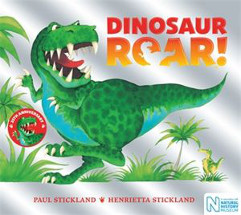
Dinosaur roar! by Paul Strickland
Ill. by Henrietta Strickland. 25th Anniversary edition. Macmillan
Children's Books, 2019. ISBN: 9781509885398.
(Age: 4+) Recommended. Themes: Dinosaurs, Humour, Verse, Rhyme,
Prediction, Comparisons. Celebrating twenty five years since its
first publication, Dinosaur roar! continues to intrigue, delight and
scare those small children who pick it up to read. All children
thrill at the idea of dinosaurs, and learn their names quickly and
easily, recognising their size, shape, colours and behaviour with
accuracy.
In this book, each double page has several different dinosaurs
pictured with the simplest text across the bottom of each page,
telling the reader something about the animal. The opening pages,
dinosaur roar and dinosaur squeak show a large toothed animal
filling most of the left hand side page, while the next page has a
much smaller animal. Each animal depicted will have the audience
enthralled as they look at its fierce mouth and teeth, its scaly
skin, long legs and clawed feet, prompting them to recognise the
animal shown. They will also readily understand the differences
between each animal and the words used to describe them. Turning the
page is another noisy dinosaur with dinosaur fierce across the page
and on the next a larger animal cowers, with the words, dinosaur
meek. Children will love seeing the difference between the size of
the animals and their fierceness, and understand the difference
between the two opposing words presented on each page, while having
fun predicting the rhyming word.
The images will delight younger readers, enjoying the humour,
predicting the rhymes, and reprising all the animals on the last two
double pages where their dietary needs are shown. Included in the
endpaper is a fold out poster of the whole book which when put up
will further extend the wonder of the book.
The illustrations are wonderful, full of fun, filling the pages with
colour and movement, depicting these amazing animals with gusto. I
love the slimy dinosaur, its hide dripping with slime and goo from
its environment, prompting readers to ask where it lives. This is a
wonderful book, subtly revealing information about dinosaurs and
prompting discussion and research. Republished in conjunction with
the Natural History Museum, London.
Fran Knight
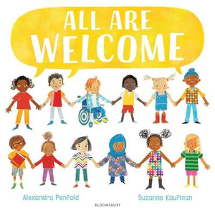
All are welcome by Alexandra Penfold
Ill. by Suzanne Kaufman. Bloomsbury, 2019. ISBN 9781526604071
(Age: 3+) Highly recommended. Themes: Diversity. Schools. Families.
Community. Told in four line stanzas where the first three lines
rhyme, the verse rolls easily off the tongue and the repeated last
line ensure children will catch on quickly and repeat the last line
together with the reader. That last line, 'All are welcome', sets
the tone for the book as it shows in both text and illustrations the
variety of children, families and adults that are involved in our
schools. The author based this story on her daughter's school in
Seattle, USA, where diversity and community are celebrated, and she
designed a poster to celebrate just that, taking it further with
this book.
Each page brims with inclusiveness and being involved, no matter
where you come from, or what you eat, how you dress or pray. The
classroom is shown with a large number of flags across the
blackboard and a world map to indicate the origins of many of the
students, but it matters not: they all play and eat together, go
home at night with their families, sleep in a bed then return to
school the next day. The diversity of families too is included, the
illustrations making it clear that everyone is the same, they are
all in a family caring for their kids.
The illustrations reinforce the similarities of us all: the
classroom routines, the playtime, going home after school, eating
dinner then getting ready for bed. The illustrations serve to link
all children together, and students will love spying out the
similarities and smattering of differences between their schools and
those in the USA, and have a go at saying all the versions of
'welcome' in other languages on the last double page in the book.
Fran Knight
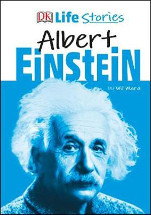
Albert Einstein by Wil Mara
Ill. by Charlotte Agar. Penguin Random House, 2019. ISBN
9780241322918.
(Age: 10+) Recommended. Albert Einstein is perhaps best known as a
remarkable scientist, but he was also a complex human being. He was
a brilliant but rebellious student, a patent clerk whose theories
about physics and cosmology transformed our understanding of the
universe, a Nobel Prize winner, an activist for peace and a refugee
from Fascism. Einstein was a pacifist but his warning about Hitler's
plan to develop an atomic bomb contributed to the American
government's decision to create nuclear weapons.
Wil Mara has incorporated the elements of Einstein' life into an
engaging and informative narrative that interweaves the scientist's
personal life and experiences with explanations of scientific
concepts and political turmoil. Mara's writing is particularly
effective when providing insights into Einstein's state of mind,
whether it was his childhood loneliness, his lifelong curiosity, his
passion for music or his determined opposition to racism and armed
conflict. The breakdown of Einstein's first marriage and the regret
he felt after atomic bombs were dropped on Japan are described with
directness and sensitivity.
Short, well-constructed sentences and a large font facilitate
reading by a younger audience. Text boxes which explain scientific
theories and historical events, photographs and hand-drawn
illustrations add to the reader's understanding without intruding on
the narrative. The family tree, timeline, list of characters,
glossary and index are useful keys to the text. However, a list of
selected references or a brief explanation of the author's research
process might have enhanced the book's credibility.
The mark of an effective biography may be its ability to reveal that
someone who is celebrated for his extraordinary achievements can
also experience doubts and setbacks. If so, then Wil Mara's
biography of Albert Einstein has succeeded in explaining the complex
man behind the famous name.
Elizabeth Bor
The chaos of now by Erin Lange
Faber and Faber, 2018. ISBN: 9780571317479.
(Age: 13+) Highly recommended. Themes: Suicide, Bullying,
Cyberbullying, Schools, Power, Monitoring. A disturbing opening page
will ensure young adults read to the last page, so incensed at the
suicide that they will want to see the bullies brought to justice.
That Jordan was being bullied was not a secret, but his response
shocked the school into placing cybermonitors on the computing
system to stop such things happening again. Eli is amazed at this
response by the school; all done without consultation or getting to
the main problem. Lip service is given to making people aware,
having anti bullying signs around the school and a gratuitous
memorial service for Jordan after 12 months has elapsed. It makes
Eli sick, but he has problems of his own with his father bringing
home a woman to live in the house, and a nasty run in with one of
the school bullies, Malcolm.
A computer nerd, Eli is a coder, one of a small group of people for
whom the binary system is a language he can speak without fear, able
to hack into the school's computer system with ease, at one stage
hacking into the local police system, with disastrous consequences.
Two other geeks seek him out. They were friends of Jordan and had
planned to enter and win a computer hacking competition which would
bring them to the attention of corporations and the possibility of
work in an area they know well. With Jordan gone, Eli is their next
choice. But they are not just interested in winning a competition.
They want to heap revenge upon those students who bullied Jordan,
and they use their computer skills to achieve this.
This is an up to the minute look at the skills of the millenials,
able to use computers for their own ends, stretching the notions of
morality confining earlier users of technology, seeing possibilities
and uses beyond those proposed by their teachers. This is a most
unsettling look at the problem of cyber bullying, where the skills
of those perpetrators outstrip those of the monitors and Eli and his
friends represent those who are willing to use their skills to bring
down those who would bully. But have they turned into bullies
themselves? In posting some of the videos they illegally access
online, exposing one as a drug cheat, another as a racist another
dressing in his mother's clothes for a video, the question arises
about who is bullying who? Eli at first sees himself as exposing
wrong, but in doing this he becomes a vigilante, one who is outside
the law, taking the law into his own hands.
The line between right and wrong, black and white becomes very
blurred and makes for a read which will make people think about the
consequences of cyber bullying and how to deal with it. Readers will
want to know how Eli comes out of this, after all he and the others
have committed criminal acts.
Fran Knight
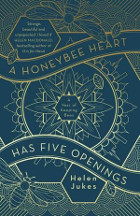
A honeybee heart has five openings by Helen Jukes
Simon and Schuster, 2018. ISBN: 9781471167713.
(Age: Senior secondary - Adult) Highly recommended. Subtitled A
year of keeping bees, Helen Jukes' book is a mix of memoir and
research project. Set in Oxford, England, it tells of her decision
following her move into a shared house with her friend Becky, to set
up a beehive down the bottom of the garden. Jukes had previously
learnt about beekeeping from her bee-enthusiast friend Luke who has
hives set up all around London. Now Jukes has just started a new job
which was turning out to be very stressful, and it is while she is
attempting to destress in the garden that the idea occurs to her
that she has the perfect spot to set up her own beehive. That
thought sets in train Jukes' research into bees, because she doesn't
just want a hive, she wants to learn absolutely everything she can
about bees. Her curiosity has her researching ancient texts about
bees, hive designs and the art of beekeeping; she joins the
Oxfordshire Natural Beekeeping Group; and she visits the
entomologist archives of Oxford's natural history museum. She
follows up all sorts of interesting questions such as whether you
can 'know' all your bees, whether they are changed by being watched,
and whether they sense your mood.
The book isn't just a research project though, in the process we
learn about Jukes herself, her unusual mix of friends, and her
struggles with how to manage her job and whether she should stick at
it or not. And interestingly many of the questions she unravels
about bees are reflected in the nuances of what is happening in her
own life. In caring for bees, she is also learning about
relationships and sense of community. Maybe that is something that
happens if you become seriously involved in beekeeping - you can't
keep at a distance, there is a deeper connection that develops. We
can all learn from bees.
There have been some excellent books in recent years about bees and
beekeeping: the fictional The
history of bees by Maja Lunde (2017) and the non-fiction The
honey factory by Jurgen Tautz and Diedrich Steen (2018). With
her absorbing and original approach, Jukes provides yet another
perspective on their fascinating world.
Helen Eddy
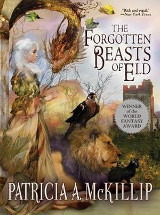
The forgotten beasts of Eld by Patricia A. McKillip
Fantasy Masterworks. Orion, 2017. ISBN: 9781616962777.
(Age: 14+) Highly recommended. Winner of the inaugural World Fantasy
Award 1975. In my quest to read some of the award winning books that
I have missed over the years, I was very fortunate to pick up this
outstanding story by Patricia A. McKillop. First published in 1974,
the fact that it is still in print after so many years is a
testament to its lyrical writing and timeless story.
Sybel is a young wizard who needs only her magical animals, Gules
the Lyon, Gyld the dragon who yearns for gold, Cyrin the boar who is
a master of riddles, Ter the fierce falcon and Moriah, Lady of the
Night. When she is given a baby, Tamlorn, to care for, she becomes
embroiled in the politics of the kingdom and the world of revenge.
It was a joy to become immersed in Sybel's world which is vividly
imagined in a sparse 208 pages, unlike many of the fantasy books
written today which often are over long. Memories of McKillip's
dangerous world, her fantastic beasts and the love story between her
and Coren and the awful taint of captivity and revenge will stay
with the reader long after finishing this book.
Readers who enjoy stories by Juliet Marillier and Robin McKinley
will be thrilled to discover another author whose tales delve into
fantasy worlds. I will be pursuing other books written by McKillip,
who also won a World Fantasy award for Ombria in shadow,
which I have put on my to-read list.
Pat Pledger
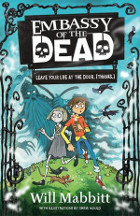
Embassy of the Dead by Will Mabbitt
Ill. by Chris Mould. Orion Children's Books, 2018. ISBN: 9781510104556.
(Age: 8-10 ) Recommended. Themes: Fantasy. Opening a strange box is
the starting point of this amazing adventure for Jake Green as it
contains a severed finger, summoning the Grim Reaper which takes him
into the Eternal Void, a place to be avoided. In this place he
must run for his life, but finds he can communicate with the other
inhabitants: the ghosts. In this appalling place, Jake teams up with
several other creatures, Cora who uses a hockey stick for
protection, Stiffley the undertaker and Zorro the ghost fox, all of
whom, like Jake are searching for the Embassy of the Dead, a place
where they will find refuge.
In the background of this tale, in the only too real world, Jake's
life is being torn apart with his parent's decision to split,
bringing to an end all that Jake knows. It is an issue he must deal
with. Mabbitt, the author of the Mabel Jones series for slightly
younger readers, lives in England and enjoys wandering through
graveyards, which seems to me where he gets his great ideas. Full of
humour and adventure, this story is full of laugh out loud lines,
the strangest situations anyone can get themselves into and a nod to
the lives of modern children, alluding to some of the things they
must deal with.
The illustrations by Chris Mould add to the zany adventures of Jake
Green.
Fran Knight
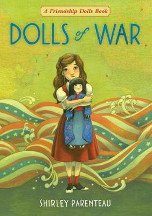
Dolls of war by Shirley Parenteau
Candlewick Press, 2017. ISBN: 9780763690694.
(Age: 10+) Highly recommended. Themes: World War Two, Japan, Dolls,
Prejudice, Museums. In 1941, eleven-year-old Macy James lives near
the Oregon coast with her father, the director of a small museum.
Miss Tokyo, one of fifty-eight exquisite friendship dolls given to
America by Japan in 1926 (https://en.wikipedia.org/wiki/Japanese_friendship_dolls)
is part of the museum's collection. This doll represents more than
the place of her mother's birth; it links Macy to her mother who has
recently died. It is a doll they spoke of together often, Mrs James
wanting to take Macy to Japan to meet the people she grew up with
and it was her dearest wish that she meet the maker of the doll,
Miss Tokyo. When the Japanese bomb Pearl Harbor, many of Macy's
neighbours demand that Miss Tokyo be destroyed. From Macy's friend,
Lily who thinks it should be put away to those who want it
destroyed, Macy has to stand firm.
She decides to hide this doll which reminds her of her mother, and
keep it hidden until people's discomfort with the doll dies down.
But as the war progresses, Macy begins to have persistent doubts
about her actions, and begins to think that perhaps her neighbours
were right in their push to destroy the doll.
An engrossing story of conflicting loyalties, of prejudice and
judging people, this is one of a trilogy called Friendship Dolls,
the first two being Ship of Dolls (2018) and Dolls
of Hope (2016). The story of these dolls can be found in
the Wikipedia site above, which details what happened to the 58
dolls sent to the USA. The background of the story is riveting,
bringing up small details of life lived during the war for many
people, and of the prejudice shown to people who have been friends
and neighbours for years.
Fran Knight
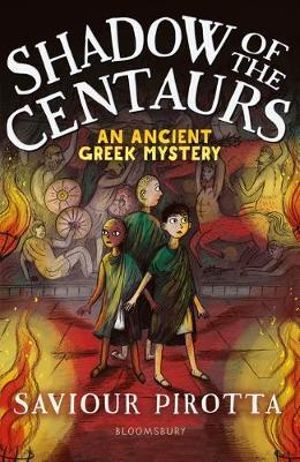
Shadow of the centaurs: an Ancient Greek mystery by Saviour Pirotta
Ill. by Freya Hartas. Bloomsbury, 2018. ISBN: 9781472940254.
(Age: 8-12) Recommended. Themes: Ancient Greece, Mystery. Saviour
Pirotta's fourth book in the Ancient Greek Mysteries series is a
lively tale of mystery and celebration. In Shadow of the
Centaurs the citizens of Athens are preparing for the festival
of Anthesteria to honour Dionysus the god of wine and to celebrate
the beginning of spring. Pirotta's attention to detail from
clothing, architecture, food, daily life, even conversations about
politics, class structure and religion bring the Ancient Greek world
alive.
Told through young Nico's eyes, a free man who scribes for Master
Ariston the travelling poet, he and his friend Thrax who is the
poet's personal slave quickly become involved in a small mystery.
Thrax's deductive powers and his careful observations have assisted
in solving of other mysteries and he's asked by Master Zeno the gym
master to unravel the problem of his stolen dog. When the boys visit
his house, Thrax comments on the gruesome floor mosaic depicting a
battle between soldiers and centaurs. When the boys return late at
night to investigate why the little dog who always barks at
strangers was stolen then returned, they discover a hidden secret
under the mosaic floor. Soon they come upon a plot to assassinate
Pericles the general of Athens and they become deeply embroiled in
searching for the evil people behind this. Thrax mysteriously
disappears, his cloak found supposedly torn by a lion and Nico even
succumbs to an extreme bout of food poisoning. With the help of
street urchins and other members of their secret Medusa League Thrax
and Nico sneak into the festival at the Acropolis and perform one of
their greatest feats. Shadow of the Centaur is a wonderful historical
representation of ancient Athens, filled with recognisable figures
like Socrates and Pericles. Pirotta addresses the role of women in
society, the structure of the classes and opens the reader's eyes to
a new world. Readers who love historical mysteries will enjoy these
junior novels and can quickly refer to the glossary and learn about
everything from agoras - meeting places to tympanums - tambourines.
What a valuable resource for teaching Upper Primary History
researching the roles of key groups in Athenian society!
Rhyllis Bignell
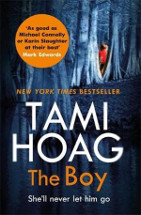
The Boy by Tami Hoag
Broussard and Fourcade book 2. Trapeze, 2018. ISBN:
9781409169635.
(Age: Adult - senior secondary) Recommended. Themes: Mystery and
suspense, Detectives, Death, Domestic violence, Children at risk,
Bullying. As a fan of Tami Hoag, I grabbed The boy as soon
as it arrived on my desk and found myself totally involved in the
characters and even better for me, the murderer remained unknown
right until the gripping conclusion. Hoag returned to Louisiana and
her two detectives Broussard and Forcade in this story which can be
read as a stand-alone. It opens with a horrifying scene of a woman
covered in blood, fleeing for help for her son who has been
attacked. Detective Nick Fourcade is first on the scene and finds
Genevieve's 7 year old son, P.J., dead and no clues as to why he was
killed and why his mother was allowed to run for help. Meanwhile
Annie Broussard is with the grieving mother who cannot help her with
the crime.
As the two investigate, each using their particular skills, Annie's
understanding of the emotions of the people involved and Nick's
dogged determination to find the murderer regardless of the cost,
the question still remains - why was the only witness left alive?
Then the boy's babysitter, thirteen-year-old Nora Florette, is
discovered to be missing and the mystery deepens.
Hoag is a master at building up suspense and is also very clever in
her portrayal of the main characters. The marriage between Annie and
Nick survives through the problems of their work, Nick's temper
about injustice and a boss who is not helpful. The difficulties of
single mothers are highlighted, not only with Genevieve and her boy
but with the relationship between the police chief, his fiancee and
fiancee's teen son, and the problems with supervising her family
that Nora Florette's mother has while her husband works far away.
This is a tense, dark, emotional murder mystery, which will leave
many readers wanting to read more of Tami Hoag's stories.
Pat Pledger
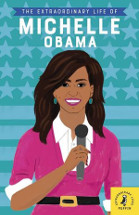
The extraordinary life of Michelle Obama by Sheila Kanani
Ill. by Sarah Walsh. Penguin Random House, 2019. ISBN:
9780241372739.
(Age: 8+) Michelle La Vaughn Robinson, the descendant of a slave,
was raised in a small apartment in Chicago. At the age of forty-four
she became the First Lady of the United States. Sheila Kanani's
biography explains why being the President's wife was only one of
the reasons why Michelle Obama's life has been extraordinary.
The chronological narrative emphasises how Michelle has overcome
economic and social challenges with determination and education. She
used her position as First Lady to promote healthy eating, and
campaigned for improvements in education, housing, and conditions
for veterans. While the author emphasises Michelle's self-belief,
she also acknowledges her competitive nature, and the difficulties
she has faced. These difficulties have included racism, economic
inequality, her father's multiple sclerosis, and the demands of
balancing motherhood with her legal career and her husband's
political ambitions. Kanani has also noted Michelle's gratitude for
the encouragement she received from a caring family, and from
lecturers who recognised her potential. These insights into the
sources of Michelle's insecurities as well as her strength of
character increase the book's credibility as a short but
well-rounded biography. The author's writing style, choice of
vocabulary and provision of definitions in text boxes, demonstrate
that she is mindful of the needs of her young audience. A brief
overview of the United States system of government is helpful for
non-American readers, while monochrome drawings, a timeline and an
index facilitate an understanding of the text. A list of sources for
quotations helps to reveal the author's research process.
Michelle Obama's life demonstrates how a supposedly ordinary
upbringing can foster a desire to achieve extraordinary goals.
Readers can learn from Sheila Kanani's biography not only what the
former First Lady has achieved, but also how she has used her
education and influence to help others.
Elizabeth Bor