Hachette, 2019. ISBN 9781474610049
(Age: 12+) Highly recommended. Non-fiction.
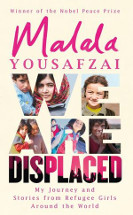
Nobel Prize winner and campaigner for every girl's right to complete
12 years of free, safe and quality education, Malala Yousafzai
presents not only a short version of her own story in this new
publication, but has gathered together the stories of many brave
refugee girls she has met in the years following the attack on her
by the Taliban. Her aim is to help people understand the enormity of
the current refugee crisis, the biggest refugee crisis in history,
and to hear the stories of the people caught in it, ordinary people
caught in conflict and forced to leave their homes, choosing life
over death.
The refugee stories are gathered from around the world: Yemen,
Syria, Iraq, Colombia, Guatemala, the Congo, Myanmar, Uganda. The
stories are quite short but oh so powerful! The first tells of
Zaynab and Sabreen, two teenage sisters, who fled the bombs in Yemen
and travelled to Egypt to apply through the US Embassy to be
reunited with their mother who had already reached safety in the
United States. Zaynab, the eighteen year old, was granted refugee
status. Her sister, sixteen, was inexplicably, senselessly,
rejected, and left on her own. Zaynab was able to fly to Minneapolis
and undertake college education. Sabreen was left to risk her life
on a boat with other refugees crossing the Mediterranean to Italy.
The different fates of the two girls were cast by a careless and
cruel administrative decision.
Marie Claire's family fled the Congo, running from wild militia
groups terrorising the country. Marie Claire saw her father stabbed
in the head, and her mother brutally murdered, sacrificing herself
to save her children. Marie Claire and her extended family were
lucky to be approved by UNHCR to go to Pennsylvania, and be welcomed
by Jennifer, a warm-hearted volunteer with a refugee support
organisation.
There are other stories, of young girls in desperate situations,
seeking refuge and determined, like Malala, to build a better
future. They are sad but also inspiring stories, of people who if
just given a chance, are able to rise up to achieve their dreams.
The coloured photographs of each of the girls reinforce that these
are real people, who just by the chance of the place they were born,
have had to deal with the most terrible life circumstances. Their
stories reveal that they are also very strong, independent and
determined people deserving of our admiration.
Proceeds from We are displaced go to the Malala Fund for girls'
education. But the message of the book is that we can all help, not
only by donating money, but by educating ourselves about the refugee
situation, giving time and attention, having empathy, and being kind
to someone who has been displaced.
Helen Eddy
The little grey girl by Celine Kiernan
The Wild Magic Trilogy book 2. Walker Books, 2019. ISBN
9781406373929.
(Age: 9-13) Recommended. Themes: Fantasy. Ghosts. Witches. Scary
books. In the second book in The Wild Magic Trilogy, following Begone
the raggedy witches, Mup and her family travel to the castle,
where Mam is greeted, to her dismay, as the new queen. But the old
queen is still powerful and the kingdom is in danger. Mup sees a
little grey girl, a ghost who has extraordinary powers, and
discovers that she can make anyone exceptionally sad as she haunts
them with terrible memories from the past. What can she do to help
heal the kingdom?
This is a book that will appeal to children and young adults who
like ghost stories with brave protagonists who try to fight evil.
The little grey girl has frightening powers and children with vivid
imaginations will be able to see the terrible things that she
remembers from the dungeons under the castle. (It is not a story for
the faint-hearted to read at night.) However many readers will be
able to concentrate on the closeness of Mup's family, her friendship
with Crow, and her determination to help everyone, including the
little grey girl.
Mup is a very strong character who can stand up to witches and
ghosts, while acknowledging when she is wrong and being able to
apologise when her actions hurt someone. Throughout the story she
gradually learns about her powers as a witch and uses them to do the
right thing.
Kiernan's prose is vivid, sparse and easy to read and it takes the
reader on an adventure with Mup soaring through the air, sitting on
the castle roof with Crow, and using her witch light to explore the
tunnels and dungeons that are hidden under the castle floors.
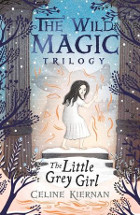
Tiny illustrations throughout the book add atmosphere and add to the
tension. Readers who examine the front cover, too, will get a shiver
down their spines when looking at the shadow of the fierce dog
depicted there.
Older readers might like to continue reading about ghosts with City of
ghosts by Victoria Schwab, and younger readers might like the
style of books by Katherine Rundell.
Pat Pledger
There are fish everywhere by Britta Teckentrup
Big Picture Press, 2018. ISBN 9781787410763.
As summer draws on, it is likely that many of our young readers will
have either been fishing or will have eaten fish or perhaps seen
them 'in the flesh' over the past few months. While those who have
caught them in rivers, lakes or the sea may be able to identify the
species of their catch, with over 33,600 described species in the
world, fish are the most diverse creatures than any other group of
vertebrates found in aquatic environments all over the world.
'Big or small, spiny or flat, spiky or blobby, bright or exactly the
same colour as the sand', fish have inhabited the planet for about
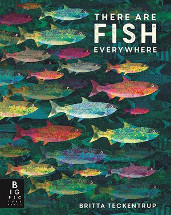
420 million years, and in this richly illustrated, informative book
from Britta Teckentrup, young readers can investigate all things
fishy, from the biological characteristics of fish to their evolution
to what lives where. Focused on providing initial answers to a
variety of questions it is a broad-ranging text that will satisfy
the reader's curiosity and perhaps inspire them to investigate
further. With information in manageable chunks and accessible
language it is an ideal starter text for the independent reader, and
with invitations to search for things, including the rarely seen but
most common fish on the planet, the bristlemouth, they are
encouraged to read and look carefully. Ideal for those with an
interest in these amazing creatures.
Barbara Braxton
Where happiness lives by Barry Timms
Ill. by Greg Abbott. Little Tiger, 2018. ISBN 9781848699519.
In the beginning Grey Mouse is very happy and satisfied with his
sweet little house which has enough room for each mouse to have fun,
plenty of windows to let in the sun where he is safe and never
alone. But one day while he is out walking he spots a much larger
house that is hard to ignore, the home of White Mouse who invites
him up to the balcony to view an even more impressive house high on
a hill. Together they set out to visit it, so focused on reaching
their destination they are oblivious to all the sights, sounds and
smells that surround them on their journey.
When they get there, it is indeed a house like no other, and they
are welcomed in by Brown Mouse who delights in showing them round
her magnificent mansion. Grey Mouse and White Mouse feel more and
more inadequate as its features are revealed until they come to a
room that has a large telescope and they peek through it.
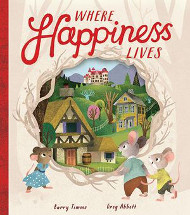
Told in rhyme and illustrated with clever cutouts and flaps to be
lifted, this is a charming story for young readers who will learn a
lesson about bigger not always being better, and the difference
between wants and needs, as well as being encouraged to reflect on
what makes them happy. Is it things? Or something else? Is the grass
always greener?
Both the story and the presentation have a very traditional feel
about them, making it perfect for young readers who relish the
places books can take them. And with the aid of boxes, rolls and
other everyday items they can have much fun creating their ideal
home!
Barbara Braxton
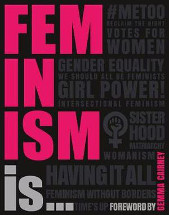
Feminism is... by A. Black et al.
DK, 2019. ISBN 9780241228029.
(Age: 14+) Highly Recommended. Non fiction. Feminism is...
follows on the heels of the recently published Feminists
don't wear pink and other lies - a collection of feminist
essays edited by Scarlett Curtis. Both books consolidate the concept
of intersectionality but Feminism is...takes the form of a
lively reference book. It might be a contradiction in terms, but
familiar frames for lucid explanations reward every page turned. The
thought-provoking topics form double page spreads within each
section, including a handful featuring key historical identities.
Each topic fans out across the gutter to engage with stylized
diagrams, bold boxed headings and a monochrome photo.
It's a ready reference with all the accessible features plus a
directory, glossary and index. Textbook sized, the topics are
classified into broad sections: A political and social movement,
Body and identity, Relationships and families, Education and work
and Culture and society. The simple language explains complicated
academic concepts and the spectrum of topics range from 'No Means
No' to 'Feminism and Sex Work.' A further delight is that every
topic gives equal weight to the opposing views of different schools
of feminist thought.
Like its counterpart, the gambit of feminism is linked by a central
idea - that intersectionality is at the heart of feminism. Feminism
cannot exist in a vacuum. The majority of humankind identify with or
belong to more than one marginalized and exploited group. Feminism
champions equal rights for everyone who is a victim of patriarchal
institutions - in reality that means fighting for as many men (of
character) as women. The media, legal system, education and religion
are the pillars supporting tyranny of a privileged system that
filters through family, language, work, politics, culture and
sexuality.
Feminism has evolved. The book may be aimed at youth, but it
provides everyone with access and clear understandings of hitherto
complex academic theories. Secondary schools should stock a feminist
reference book so thoroughly executed, if only for the simplest
definition proposed by Gemma Cairney in the foreword: 'It's a
hopeful term to associate ourselves with - it means you believe in
human rights'. As a result, Cairney was invited to take part in the
'My Life in Objects' series for The Pool. Meet her online on YouTube.
Deborah Robins
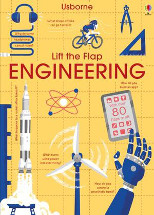
Lift-the-flap Engineering by Rose Hall
Ill. by Lee Cosgrove. Usborne, 2018. ISBN 9781474943659.
Highly recommended for your STEM collection. "Engineering is not
just about engines. Engineering means designing, testing and making
all kinds of useful things. To do this, engineers use mathematics,
science, and - above all - their imaginations." Engineers work in
teams to solve puzzles, whether the puzzle is big or small. They
follow a series of steps including:
asking questions to ensure they understand the problem
imagining possible solutions by letting their brains go wild
making detailed designs of their ideas
making models to test their ideas
having the final version built and checking it carefully.
Not so long ago primary students had 'art and craft' lessons in
which they usually followed a set of instructions to create a
cookie-cutter model of something their teacher had decided would be
appropriate for the current theme or unit of work. Then, in the 80s
with the launch of the National Profiles, technology became a
recognised key learning area and the strand of 'design, make and
appraise' gave students more freedom to imagine solutions to set
problems and actually trial their thoughts. In those days,
engineering was still viewed as a subject for university level. But
with the advance of computers and computing and inventions like the
Internet came a realisation that university was too late to start
that sort of thinking and now we have a real focus on 'STEM
subjects' - science, maths, engineering and technology - and with
it, a growing understanding of how integrated all the disciplines
are. There are no and can not be stand-alone slots in a timetable.
And now, with the rise of 'makerspaces', even our youngest children
are involved in engineering on a daily basis.
While this is a 'lift-the-flap' book it is a sophisticated one like
others in the Usborne collection, providing explanations and answers
in an interactive format that engages the reader and offers easy-to-
understand text within a myriad of diagrams. Things typically
associated with engineering like aircraft, rockets and robots are
explored but so are more everyday things like bicycles, solar panels
and sounds.
Barbara Braxton
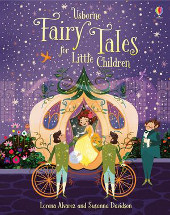
Fairy stories for little children by Lorena Alvarez and Susanna Davidson
Usborne, 2018. ISBN 9781474951784.
This selection of five well-loved fairytales - Cinderella, Goldilocks
and the Three Bears, Jack and the Beanstalk, Little
Red Riding Hood and The Princess and the Pea - has
been lovingly recreated in words and pictures to appeal to the young
reader, either as a read-along or one who is verging on independence
and knows the stories well enough to predict the text.
Fairytales never go out of fashion and there is always a new
generation of children coming through to enjoy these age-old tales
so a new, revamped version is just the thing for sharing with them.
The illustrations in this edition are very modern although still
retaining the charm of the past, making this a suitable book for
those children who are older but who are learning English as another
language, and who are expected to be au fait with these traditional
tales. They may even have similar tales in their own language that
they can compare and contrast these with. Cinderella,
for example, has a version in many different cultures. Similarly,
the stories could be used to compare other versions of the same
story or even the movie versions so their appeal is not limited to
just emerging readers.
Barbara Braxton
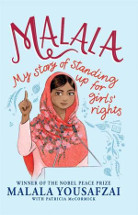
Malala, my story of standing up for girls' rights by Malala Yousafzai with Patricia McCormick
Wren and Rook. ISBN 9781526361592.
(Age: 7-10) Highly recommended. Auto-biography. The
extraordinary true story of the Pakistani girl who stood up for
girls' rights to education and was shot by the Taliban is now
available in a new publication for a younger audience, so that they
too can learn about the young girl who refused to give in to
terrorism and believed that truth must prevail.
Malala was fortunate to have a father who encouraged her
independence of thought and her aspirations for education,
allowing her to participate in a BBC website on the daily life of a
girl in Pakistan under the rule of the Taliban, highlighting to the
wider world the issue of girls' rights to education. Hoping to
silence her, Taliban supporters stopped her school bus, and fired
shots to her head. The ensuing airlift to medical services, first in
Pakistan then to Britain as the seriousness of her injury became
apparent, brought her once again to the attention of the world. When
Malala's bravery is recognised with the award of the Nobel Peace
Prize in 2014, the youngest person to ever receive it, it means that
instead of being silenced Malala's message will continue to be
heard.
This version of Malala's life is written simply with short chapters
and large font. There are explainer boxes on some pages to explain
topics such as the celebration of Ramadan, the shalwar kamiz
clothing, the difference between an internally displaced person and
a refugee, the Malala Fund charity etc. And simple black and white
drawings by Joanie Stone further enhance understanding of the text.
At the end there is also a glossary of terms, a guide to
pronunciation of some words, and a timeline of significant events in
Malala's life.
All in all, this is a very accessible book, and would make a
worthwhile addition to every school library. The story of standing
up for one's beliefs and refusing to give in to bullies, is one that
will continue to be relevant to young readers.
Helen Eddy
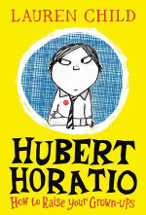
How to raise your grown-ups by Lauren Child
Hubert Horatio, Book 1. HarperCollins Children's, 2018. ISBN
9780008264086.
'These stories are about the days when the Bobton-Trents had it
cushy, very cushy indeed.' The Bobton-Trent seniors certainly know
how to make the most of their extravagant wealth - socialising,
doing things, buying things and generally being more than a little
bit irresponsible. Luckily for them, their son Hubert Horatio
Bartle Bobton-Trent is an exceptionally intelligent, talented and
sensible child. Unluckily for Hubert, this tends to mean that a lot
of his spare time is spent steering his rather unruly set of
grown-ups out of trouble. So oblivious are they, they don't realise
that their lavish lifestyle means that their money has run out even
when the Bobton-Trents and their guests sit at a bare dinner table,
waiting for an hour and 22 minutes for the maid to serve them,
unaware that the staff has left. They are also unaware of
their only child's immense talents - he phones his parents at
the age of one, reads at two and, when he tumbles into the pool at
age three, discovers that he is "a natural swimmer" - and when their
financial situation becomes clear to him, he tries ways to raise
money through schemes like hosting board game sessions and opening
the mansion up for tours, but all his schemes fail because his
parents just spend the proceeds. It even becomes his decision to
sell the mansion and downsize to an apartment!
Lauren Child brings her unique combination of story-telling,
illustration and humour to this new series of books for the
newly independent reader. Even though the message about money not
necessarily being the happiness-bringer it is reputed to be may be
lost on the target audience, nevertheless young readers will delight
in the outrageous lifestyle and Hubert's constant vigilance and
tactics to keep the family afloat. Those who are a little older
might like to think about how income is derived and disbursed and
the sorts of decisions that must be made.
With the second episode Alien beings due later this year,
this is a series that will become very popular as the word spreads
among your students.
Barbara Braxton
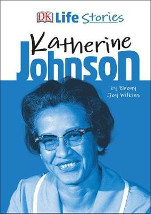
Katherine Johnson by Ebony Joy Wilkins
Ill. by Charlotte Ager. DK Life Stories. DK; Penguin Random
House, 2019. ISBN: 9780241358580.
(Age: 8 - 13) Highly recommended. Themes: Biography; Katherine
Johnson; Mathematicians; Space; NASA; STEM; Discrimination.
Katherine Johnson may not be well known to Australian readers, but
her story has now been told in the movie Hidden Figures.
This amazing Afro-American woman was born in the era of segregation
in USA in 1918. Her family though were determined that their
children would explore every opportunity for education and it was
obvious from very early in Katherine's life that she had
considerable talent with numbers. No human restriction was going to
stand in the way of her inquiring mind and determination to let
numbers and their ability to describe the world to be understood and
communicated. Working eventually as a 'human computer' and
Mathematical analyst within NASA, she defied both discrimination of
her race and gender to become an elite force to be reckoned with,
originally in the Academic world and eventually within NASA. During
the incredible era of the Space Race and the first Moon Landing, it
was Katherine's role to create mathematical certainty for the
astronauts. At the age of 97, Katherine was presented with the
Presidential Medal of Freedom by President Barack Obama, an
incredible honour for a long and incredible life. For someone who
loves counting, she certainly has a lot of years of a rich life to
count!
This is a book that should be read! Katherine Johnson is such an
inspiring advocate for STEM learning and is also just an amazing
person, not letting social obstructions be a barrier to learning and
success. Her resilience and determination are also worthy of being
shared with a younger generation. The presentation of this biography
in the DK Life Stories series is simple with plenty of
illustrations in a cartoon style, and with photographs dotted
through the simple text. With some text boxes and bubbles explaining
unfamiliar terms this is a book easily accessible for young readers
and visually 'youthful'. The family tree and timeline of Katherine's
life appears at the end of the biographical detail.
Carolyn Hull
Believe me by JP Delaney
Quercus, 2018. ISBN: 9781787472419.
(Age: Adult, 18+) Highly recommended. An enthralling and turbulent
psychological thriller, JP Delaney's re-written and re-published
version of his 2001 novel The Decoy grasps the reader's
attention and interest and never relents. Claire Wright, a British
drama student living in New York without a green card, begins work
with a firm of divorce lawyers, acting as an easy pick-up in hotel
bars in order to entrap unfaithful husbands. Usually excellent at
her job, it is surprising when her newest target, Patrick Fogler,
remains faithful to his wife. While Claire dismisses this as merely
a rare decent husband, suspicions arise when his wife is murdered
later that very night. Requested by the police to make use of her
acting skills to lure a confession out of Patrick, the prime suspect
in his wife's murder, Claire gets to work. But from the beginning,
Claire has doubts about the part she is to play, and about whether
Patrick really could be a murderer. As she progresses with the
investigation, and wonders whether there could be more to this that
she was told, she learns that she never really knows who she can
trust, and that this might just be the deadliest role of her life.
JP Delaney provides a vivid and realistic world, with authentic
characters that make the reader question just how complex human
nature is. The storyline is engaging and keeps the reader on their
toes and constantly re-evaluating the motives of each character.
With each new twist and turn, the reader is sucked into Delaney's
world, and eager to uncover the mystery it revolves around. Note:
themes of violence, sex, murder, psychological torture, domestic
violence, necrophilia, BDSM and crime. Not suitable for younger
readers.
Daniella Chiarolli
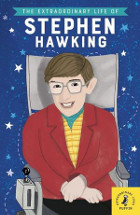
The extraordinary life of Stephen Hawking by Kate Scott
Ill. by Esther Mols. Extraordinary lives series. Puffin
Books, 2019. ISBN: 9780241373927.
(Age: 7-10) Highly recommended. Themes: Biography; Stephen Hawking;
Scientists; Science; Cosmology. In a very unpretentious format, with
simple language and naive illustrations, this biography of Stephen
Hawking introduces this amazing man of Science to youthful readers.
Explanations of his journey as a scientist and cosmologist, while
coping with the difficulties of his diagnosis and life with MND, are
described with side notes to explain any complex terms. Basic family
history and Hawking's appearance or influence in popular media and
film are also included. Obviously, the science of cosmology needs to
be explained at a fundamental level for the target audience, and
this is done well. Disability and the resilience of Stephen Hawking
is described with sensitivity. A time line of his life completes the
biography.
This series makes biography a great alternative to a fiction text
for youthful readers. This is certainly easy enough for readers aged
7-10 to manage. The use of green text and illustrations also will
appeal to the visual generation. The book also includes excerpts
from two other biographies in the series: Malala Yousafzai and
Michelle Obama. With more biographies planned to be released, this
will be a great series to collect for school libraries or to add to
a reading program.
Carolyn Hull
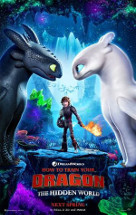
How to train your dragon written and ill. by Cressida Cowell
Hodder Children's Books, 2019 (c2003). ISBN: 9781444950380.
(Age: 8-12) Recommended. To become a Viking hero it was a tradition
of the Hooligan Tribe to undertake the dreaded Dragon Initiation
Programme. Failure meant banishment from the tribe forever.
The unremarkable Hiccup, the son of Viking Chieftain Stoic the Vast,
and a member of the Hairy Hooligans, must capture a sleeping baby
dragon from the cave in Wild Dragon Cliff, preferably without
awakening the mass, take it back to the village and train it to obey
and catch fish for him. No easy task.
Hiccup and his little dragon, Toothless, are scorned and bullied by
other members of the gang. He has great difficulty training his
reluctant dragon, but patience pays off and Toothless eventually
proves to be very heroic when most needed.
All the characters have unbecoming names such as Snotlout, Thuggery,
Baggybum and Gobber, who is a six-and-a-half foot giant with a mad
glint in his one working eye and a beard like exploding fireworks.
The teenage Hooligans and their counterparts, the Meatheads,
initially clash in fierce rivalry. A dreadful crisis threatens the
entire village and the 'Big Drums' summon the two teams of boys, who
must work together to overcome two humungous dragons, causing
spectacular havoc.
Brave Hiccup, the only person who can converse with dragons, devises
a remarkably clever plan and endures a mindboggling experience with
Green Death and, with Toothless helping, struggles to outwit the
monsters, to avert a catastrophe.
Joan Kerr-Smith
Editor's note: Review from earlier edition.
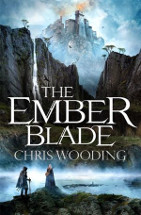
The ember blade by Chris Wooding
Gollancz, 2018. 824 pages. Paperback. ISBN 9781473214859.
(Age: 15+) Recommended for advanced young adult readers. Two young boys
living in an occupied Kingdom, are fighting to recover a stolen
treasure of their people. The ember blade follows Aren and
Cade, two young boys who are swept from their home village and sent
to work as slaves in the prison mine. In a moment, their entire
world is brought crashing down around them. Still, it isn't until
they escape into the world beyond the prison walls that their epic
adventure truly begins.
The strongest theme of this story is that of the brotherly bond
between the two friends, shown through their lively banter and the
actions that they take to protect one another. There is a strong
sense of disbelief portrayed by Aren. Aren has always seen himself
as the hero of the story and struggles to come to terms with how he can
be wronged, even when he believes that he has done everything right.
Cade has always been resentful of the Krodan people, but it is Aren
who is affected most.
Wooding's writing is suspenseful and detailed, constructing
beautiful mountainous landscapes, filled with medieval terrors and
the cruel and unjust rulers of the occupying Krodan people. The
story is filled with edge-of-your-seat action, and excellent,
humorous dialogue between the characters. The magic in the story was
the use of druidic arts, founded on faith in the Aspects (the Gods
of the Ossian people) and an understanding of nature. It was an
interesting twist on magic, and one that I found to be well
constructed. The ember blade reads like an Arthurian
classic, which as huge fan of Arthurian legend, I certainly enjoyed.
A brilliant start to the trilogy.
Jake Morgan, Unley Libraries
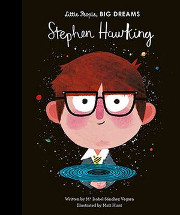
Stephen Hawking by Maria Isabel Sanchez Vagara
Ill. by Matt Hunt. Little people, big dreams series.
Frances Lincoln, 2019. ISBN 9781786037329.
(Ages: 6-10) Recommended. Themes: Physicists. Biographies. 'However
difficult life may, there is always something that you can do and
succeed at.' Stephen Hawking's life was truly amazing and this Little
people, big dreams biography opens up his life and scientific
endeavours to a younger generation. Vagara presents the key facts,
milestones, accomplishments and personal struggles in an enjoyable
and relatable style. 'Children are sponges absorbing the world
around them,' is her impetus for writing these biographies.
Hawking's life is pleasingly portrayed by Matt Hunt's crisp, linear
digital illustrations where dark skies shimmer with stars, dark and
lighter tones shape the setting and simple stylised characters show
stages of life.
Young Stephen was born during World Ward II in Oxford, England, to a
family who loved science and encouraged education. His nickname at
school was Einstein, he even built a computer from clock workings
and an old telephone. His passion was studying the universe and he
studied cosmology at Oxford University. When diagnosed with ALS, a
neurodegenerative disease he determined to study the stars rather
than be limited by his condition. Vagara presents this information
with a simplicity suited to younger readers.
Hawking's brilliant mind turned to the study of black holes, where
he discovered tiny lights escaping from them, named 'Hawking
radiation' in his honour. Utilising a robotic voice, he dictated his
scientific books and helped the world understand the universe. A
comprehensive biography concludes this picture book, just right for
students to begin researching. Vagara's Little people, big
dreams series opens up children's eyes to inspirational,
authentic and unique world changers.
Rhyllis Bignell