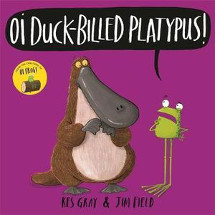
Oi duck-billed platypus! by Kes Gray
Illus. by Jeff Field. Hodder Children's Books, 2019. ISBN:
9781444937336. pbk.
(Age: 4+) Highly recommended. Themes: Animals, Verse, Word play,
Alliteration, Humour. Following on from the success of the zany fun
filled humour of the "Oi" books (Oi Frog
(2014) Oi Dog
(2016), and Oi Cat
(2017)) this paperback version follows a slightly different
variation as the frog finds it difficult to find a rhyme for some of
the animals that appear before him, waiting to be seated. What do
you rhyme with a duck billed platypus or a hippopotamus, an ostrich
or a meerkat. Frog, cat and dog are puzzled and platypus is not very
patient, reminding the trio that he is waiting, as he points out the
queue behind him of other animals also waiting for their rhyme
before being seated.
Eventually the Frog asks for their first names and they find it much
easier to use their first names rather than their second to find a
rhyme that fits. So Dolly the duck-billed platypus sits on a brolly,
Kate kookaburra sits on a gate and Lemony lobster sits on an
anemone. Everyone is satisfied, the alliterative names of the
animals used to make a nice rhyming seat until a kangaroo happens to
come along, with the fearful name, Amelia Esmerelda Honeydew
HigginbottomPinkleponk-Johnson. The resolution will have children
trying vainly to find a rhyme and like frog, telling the kangaroo to
sit where she likes.
Full of humour, reflected in the appealing illustrations, the tale
will bring laughter from all readers, recognising the alliteration
and how it teams with the animal's name, seeing the rhyme that frog
comes up with, perhaps offering an alternative, all the while
looking closely at the expressions on the faces to see what a
quandary frog is in. In a class emphasis could be the word play,
rhyme and alliteration, while discussion with younger readers about
first and last names would be appropriate.
All readers will love looking out for the seat of each of the
animals and delight in the end papers with Field's platypus
panorama.
Fran Knight
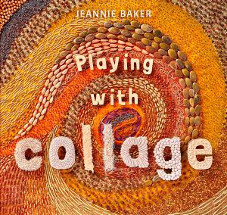
Playing with collage by Jeannie Baker
Walker Books, 2019. ISBN: 9781406378665.
(Age: 6+) Highly recommended. Themes: Collage, Arts and crafts,
Invention, Recycled materials. The front cover invites the readers
to look more closely at the image, working out what it is made of
and what it could be. For those who know Jeannie Baker's work, the
background knowledge that she plays with collected items from nature
will stand them in good stead as they scan the cover. But those who
do not know her work, and there can be only be a handful, then this
will be an eye popping read.
Aimed at a younger audience, but with enough information and
instructional images to appeal to anyone with an interest in art,
Playing with Collage is a joy to read.
Each chapter involves a double page of information with illustrative
photographs, allowing the reader to see just how her work is done,
as she gives the most basic of instructions that will make every
reader believe that they can do it too, even someone new to the
field.
After the introduction, three more double pages talk about Tools,
Tips and Playing with Materials. After these the book is divided
into four parts, each dealing with a different aspect of collecting
materials. The first is Paper which encourages readers to collect
all sorts of paper, then play around with it, making different
shapes and images. This is followed by Out in Nature, where she
shows the readers the sorts of things they can collect when out in
the field. Again, On the beach shows a range of things that can be
collected while beach walking, and the last section, In the Kitchen
showcases the sorts of things that are right under our noses.
Baker goes on to discuss Translucency encouraging the reader, as
always, to try it out for themselves, and the last section shows a
variety of found materials and asks the reader to guess what
materials she has used in her egg box collage.
And this then is the aim of this beautiful book. Readers will be so
entranced that they will go out and try her techniques for
themselves, marvelling at her work, seeing her work with fresh eyes.
Readers familiar with her work will be astounded at the range of
materials she collects to use in her collages and look more closely
at the books when they come across them. For others this book will
initiate collection and storage then experimentation as they try out
some of the techniques she espouses.
This is a beautiful read from every point of view: an instruction
manual, an art book, a book espousing the art of collage, a peep
into Baker's talents, an inducement to re-look at Baker's other
books.
Fran Knight
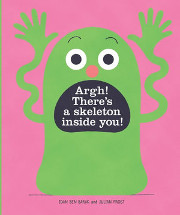
Argh! There's a skeleton inside you! by Idan Ben-Barak and Julian Frost
Allen and Unwin, 2019. ISBN: 9781760631635.
(Ages 4-8) Highly recommended. Themes: Human Anatomy, Skeleton,
Hands. This simple, interactive and very enjoyable picture book
seeks to give young children a look inside their hands to discover
what makes them work. The aliens Quog and Oort need to get to a
party but their spaceship needs repairs. Neither of them has hands,
which makes it more difficult to make their repairs. Through some
clever interaction Quog grows what he needs to make the repairs and
in the process the reader comes to understand how their skeleton,
muscles and nerves work together to make their hands the useful
things they can be.
The bright, simple but informative illustrations make this an
extraordinary introduction to human anatomy for young children. The
interactive parts of the story were particularly popular with the
children who heard this book read aloud; putting their hands onto
the page so that Quog could see inside made the book come alive for
the young audience.
At the end of the entertaining story the authors give us more detail
about what is inside our hand and how it works, just in case we
would like to grow another hand. Very well thought out and
informative for all who read it.
The duo that produced this book also gave us Do not lick this
book, (it's full of germs) and this one will be just as
popular with young readers. Great addition to every primary school
library.
Gabrielle Anderson
Sweet sorrow by David Nicholls
Hodder and Stoughton 2019. ISBN: 9781444715415.
(Age: 12+) Highly recommended. Sweet sorrow is a lament to the
end of childhood and to first love. A bildungsroman, the novel
follows Charlie Lewis on his quest to get to know the lovely Fran
Fisher, amateur actor and Shakespeare aficionado. In an attempt to
impress, or get her number, Charlie agrees to join a production of
Romeo and Juliet that the Full Fathom Five Theatre Co-operative are
organising over the Summer. Without his mates to join him in his
scorn, Charlie finds himself intrigued with the players and the
drama students.
While he scoffs at theatre sports, Charlie finds himself with
friendships completely different to the friendly scuffles and
drunken antics of those he's known before. Being part of the play
allows Charlie not only to get close to Fran, but also to grow as a
person independent of the politics of the boys and rebelling against
his parents' expectations. But the pressure of looking out for his
father and navigating the ditch between his parents and him and his
sister is almost too much. When the walls Charlie built to keep
himself and his dad safe start to crumble, everything quickly comes
crashing down.
Told both in the present and retrospect, Sweet sorrow
follows the summer Charlie threw off social expectations he'd come
to respect in school, he starts to work to pull his life together
after the stress of his father's erratic behaviour, bankruptcy, and
divorce sends him down a dark and spiralling path of failure. I
would highly recommend this novel to boys twelve and up who struggle
to fit in and achieve at school as they might find some parallels
with Charlie.
Kayla Gaskell
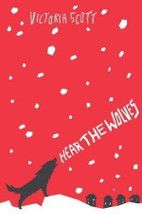
Hear the wolves by Victoria Scott
Scholastic, 2017. ISBN: 9781338043587.
(Age: 11+) Highly recommended. Themes: Alaska, Wolves, Survival,
Bullying, Abuse. Sloan, partly deaf and still suffering the loss of
her mother who left two years before, is left alone in her house by
her father and older sister, when they trek to the neighbouring
village for a meeting. Sloan finds several other people still in the
village: Ms Wade who has injured herself and needs medical
attention, Pilot and his abusive father, Nash, a young boy and their
teacher, Mr Foster. Together they pack some supplies and head for
the moored boat to go down river to the next town to get Mrs Wade to
a doctor.
But the community has cleared the land, denuding the place of
rabbits and hares the main source of food for the wolves, and
Sloan's father, in building a fence has stopped the elk coming near
the town. Wolves are now hungry, unable to keep themselves fed and
so track the six people as they make their way towards the river.
The trek should only take a day but is hampered by the injured woman
and an alcoholic Nash trying to control the group, so the search for
shelter becomes obvious as each night the cold and fear sets in.
This is a chilling read. A blizzard has blown in unexpectedly, the
wolves are a constant threat in the background, the hatred between
Pilot and his father is overwhelming and the ammunition is running
out.
The book reminded me of many other stories set in the Alaskan
wilderness, the Hatchet series of books (Paulsen) Call of
the Wild (London) and The Great Death (Smelger), but
in this one the wolves track and hunt their quarry, Ms Wade and
Sloan all the while telling the reader of the behaviour of these
animals, pushed to the brink by the destruction of their habitat.
Sloan has been afraid of being alone since her mother left and the
extraordinary decision by her father to leave her to force her to
survive is akin to a child being thrown into water to teach it to
swim. But Nash's cruelty to his son is mind numbing. In this harsh
landscape some people's humanity has deserted them and reading this
book reminds us over again of the need for people to understand each
other and work together to survive. And no where more so than in the
Alaskan wilds.
Fran Knight
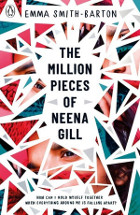
The million pieces of Neena Gill by Emma Smith-Barton
Penguin, 2019. ISBN: 9780241363317.
(Ages: 15+) Recommended.
Themes: Mental health, Contemporary. Emma Smith-Barton's debut novel
draws on her own experience as a Pakistani child growing up in the
UK.
Not only does Neena have to deal with the usual teenage search for
identity but ten months of grief since the mysterious disappearance
of her older brother Akash, whom she obviously adored. Her parent's
grief exacerbates their cultural expectations of Neena and she
begins to 'act out'. When they announce a new pregnancy, Neena
really flips out.
Neena seeks solace in the company of Fi, her brother's ex-girlfriend
- perhaps to feel close to him again or maybe to solve the mystery
that is consuming her. She juggles the demands of school, work and
home with her need to feel numb with Fi. A clandestine romance with
gentle Josh, only adds to her pressures. Neena's confusion persists
and she puts herself in danger visiting an older drug addict who may
or may not know something about Akash's disappearance. Neena's
childhood friend, Raheela, reaches out to her but is pushed away.
While we wonder what happened to Akash, the story is more about our
increasingly unreliable protagonist and our concern for her mental
state and destructive behaviour. Smith-Barton uses very mature
themes and language to explore the consequences of not talking to
someone about your feelings of loss and anxiety - feelings which
potentially can spiral into psychosis.
We don't know who to believe in this story, perhaps not Neena. The
fast pace and insightful writing teaches us far more about the
complexity of grief and trauma than any hopes we harbour that Josh's
love has the power to salve Neena's troubled mind. The million
pieces of Neena Gill is riveting because it is a credible
exploration of a family under pressure and fascinating because we
wonder if the pressure came before or after the bad stuff? Emma
Smith-Barton may have grown up between two cultures, but she is
definitely a very astute observer of the inner life.
Deb Robins
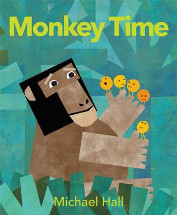
Monkey time by Michael Hall
Greenwillow Books, 2019. ISBN: 9780062383020. 48pp., hbk. Monkey is trying to catch time.
Up, down, and all around Monkey goes.
Can Monkey catch a minute
Can you?
From the creator of both Little
iand Red,
a crayon's story comes a new story that explores time,
this time. Asleep in a tree with branches remarkably like a clock
face, Monkey is taunted by Minute who challenges him to catch him as
he races around the 'clock'. And when, despite Monkey's frantic
effort, Minute beats him another Minute pops up with the same
challenge.
'We are lightning fast, and you are a slowpoke, Monkey.'
Fifty-nine times, Monkey chases the minutes until . . .
Time is a very abstract concept for young children and while they
constantly hear about 'Just a minute' and 'Wait a minute' and so on,
it is hard for them to know just how long a minute is. For anyone,
even an adult, who is watching the clock a minute can whiz by or it
can drag like a gammy leg, so it's no wonder it's a tricky concept
for a little one to grasp. However, by having fun with the book and
challenging the child to see what can be accomplished in a minute
using a one-minute egg-timer as a visual reference, it will start
them on the journey towards understanding. The addition of the
strategy for breaking an hour up into blocks and the counting
endpapers enhance the power of the book, as do the descriptions of
the rainforest creatures that appear in Monkey's story.
Barbara Braxton
The little mermaid by Geraldine McCaughrean
Illus. by Laura Barrett. Orchard, 2019. ISBN: 9781408357231.
(Age: 7+) Highly recommended. Themes: Fairy tales, Hans Christian
Anderson, Mermaids, Cautionary tales. When a little mermaid gives up
her tail, voice and her home in the sea because she loves a prince,
it is to be hoped that she receives his love in return, after all
she saved his life when he was drowning at sea. But no, she cannot
tell him, she has given up her voice, and he marries the princess
from the country next door. This Hans Christian Anderson tale always
intrigued me, and even more so when it was modernised so that true
love came out trumps in the end. I preferred the one where she went
back to sea a wiser and happier mermaid, although Anderson's tale
has a religious ending that surprised me when checking the original
story for the review.
This wonderful retelling by McCaughrean comes from the original
Anderson fairy tale and will be a pleasant surprise for all readers.
Mermaid Delphine falls for the prince, and despite warnings from her
five golden haired sisters, takes the potion from the sea witch who,
in exchange, swallows her voice like an oyster. Delphine stays with
the prince in his palace, a companion who dances for him but must
wash her feet each night to wash off the blood. But the prince does
not know that she loves him and marries the princess from another
land, and with that the witch's curse says that Delphine's heart
must break and she return to the sea as sea foam.
Her sisters sell their hair to the sea witch in return for a knife
with which Delphine must kill the prince in order for her to return
home, the magic spell broken. But Delphine cannot do this and so
jumps into the sea where a greater magic than that of the sea witch
restores her to her family.
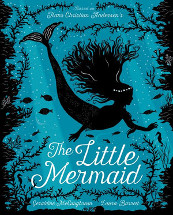
This beautiful retelling is accompanied by the most engaging of
illustrations: against a sea of blue, black silhouettes appear,
mermaids and sea creatures wind their way across the pages, the
mermaids' hair spilling out behind their tailed bodies, the weeds,
small fish and different blues contrasting with the world on land
with women in their large ornate dresses, along with castles, horses
and the prince.
This would be a wonderful read aloud as well as an engaging series
of lessons in comparing fairy tales, or comparing this with the film
or asking people to retell the story of The little mermaid
before reading one of the versions. And of course there is the statue
in Copenhagen to wonder at.
Fran Knight
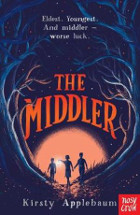
The middler by Kirsty Applebaum
Nosy Crow books, 2019. ISBN: 9781788003452.
(Age: 12-14) Recommended. Themes: Dystopian fiction, Future society,
Friendship, Loyalty, Siblings, Betrayal. Maggie is looking for a way
to make herself noticed. She is a middle child, not a heroic eldest,
who will help to fight in the silent war to help her society. When
you turn 14 you go to camp and then to fight, it is a tradition that
no-one questions. But Maggie is not an eldest and laments the fact
that she is often forgotten even by her own family, so finding and
catching a Wanderer seems the best and most noble thing she can
manage to change that. Maggie and all the other townsfolk are
indoctrinated during their schooling to believe that the boundary of
the town is there to keep them safe from the outside world and the
wanderers - dirty, deceitful, dangerous people that don't have a
town to call home. So why does the one that Maggie has met seem so
nice and friendly? Una and her father are certainly dirty but are
they dangerous? She has connected with them and she feels compelled
to help. Una's father is badly injured, her mother is dead, so
Maggie gets the medicine they need and gives them food. She tells
herself that she will turn them in but when this happens facts are
revealed that make her question everything she has ever been told
about her society.
Maggie narrates the story, telling us about her family in such
detail that we get to know them well: her eldest brother Jed, about
to leave for Camp; her youngest brother Trig, who is special and
needs extra care; her hard-working mother and father; a family
living in the 20th century but at a time when the war has meant life
is a struggle and they don't always have the things they need to
live an easy life.
This book allows us to see that everyone has a different point of
view and putting yourself in another's shoes often reveals the truth
about life instead of the beliefs and prejudices that surround us.
The story could link with discussions about refugees and how their
lives are affected by the way society views their situation and life
choices.
Gabrielle Anderson
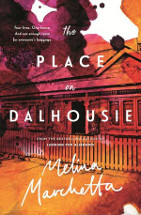
The place on Dalhousie by Melina Marchetta
Viking, 2019. ISBN: 9780143793533.
(Age: Adult - Mature senior secondary) Highly recommended. Themes:
Pregnancy, Blended families, Inheritance, Houses. Fans of
Marchetta's writing will be overjoyed to read this story of Rosie
Gennaro who has walked away from the place on Dalhousie that her
father had renovated for his family. Devastated that he has married
Martha less than a year after her mother's death, it takes her two
years before she can return to the house where Martha now lives and
face not only her new responsibilities but her memories of her
mother and father.
Fans of Saving Francesca and The piper's son, will
meet again the characters from these two novels and learn about what
has happened to Jimmy over the years. He has met up with Rosie
during a devastating flood in Queensland and after a brief affair,
both have gone their separate ways trying to sort out where they
belong. Jimmy desperately wants to be part of a family, and
Marchetta with compassion and empathy, traces the story of these two
young people as they learn about the nature of love and family.
Jimmy comes back to Sydney and after searching so hard for a family
of his own, may find one in the house on Dalhousie. He is so
uncertain about his ability to love his son and to do the right
things by Rosie, but surrounded by his friends, gradually comes to
accept his responsibilities.
Marchetta also describes the netball team that empowers some of
Martha's friends, her growing relationship with the netball coach,
the neighbours who all try to help Rosie and then the house on
Dalhousie which seems to have a life of its own. The stand-off
between Rosie and Martha about the sale of the house is also central
to the story and Marchetta discusses this here.
After finishing The place on Dalhousie, I felt compelled to
go back to the two companion novels, Saving Francesca and The
piper's son, savouring the warmth of Marchetta's writing, her
depiction of love and loneliness and the strength of friendships
over the years.
Pat Pledger
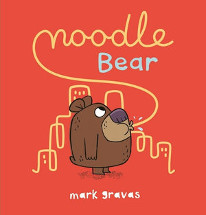
Noodle bear by Mark Gravas
Walker Books, 2019. ISBN: 9781760651022.
(Age: 4+) Recommended. Themes: Bears, Noodles, Food, Seasons,
Friendship. One the first day of spring, Fox holds a party and
invites all the other animals. But Bear does not come. Fox goes to
his cave to see if he is alright and finds him snoring loudly, his
cave littered with empty noodle bowls and packets. He has spent the
whole winter bingeing on Noodle Knockout, a weird TV show, and
eating noodles. He has eaten all the noodles he could find and now
waking wants more. He searches but cannot find any and the other
animals offer him their food. Each is rejected as being too crunchy
or too flowery or too splintery. He cannot find anything to eat so
decides to go to the city and become a contestant on the show where
he can eat all the noodles he could wish for.
The digital illustrations will provoke laughter from the readers as
they see the bear in his messy cave, watching TV incessantly, and
rejecting the food from the other animals. Readers will recognise
themselves in the bear, and empathise with his longing for noodles.
Of course, once in the city he is invited to be a contestant and
wins easily, becoming a TV star with his own TV show. As good as
this is, he begins to remember his friends in the forest and the
good things they did together, and decides to return home. Once
there he has enough noodles for everyone, and they find that they
are just to their liking.
Fran Knight
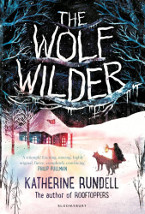
The wolf wilder by Katherine Rundell
Bloomsbury, 2015. ISBN: 9781408872352.
(Age: 9-13) Highly recommended. Themes: Wolves, Russia, Nineteenth
century, Animals, Survival. A totally engrossing adventure story
about Feo and her wolves, seeking to survive in the harsh Russian
winter while being pursued by those who see wolves as a threat,
something to be hunted down and killed.
While a wolf wilder, someone who helps wolves survive in the wild
after years of living with humans, may be a fiction, there are many
people around the world helping partially domesticated animals
return to the wild. Rescue parks exist to return animals to the
wild, their natural place rather than be dependent upon humans.
In Russia, the wolf is seen as a sign of strength and power and pups
are stolen shortly after birth to be sold for large profits to the
idle rich, in whose grand houses the wolves are trained to beg and
sit, fed inappropriate food, discarded when they grow too big or
become aggressive.
Feo and her mother take these abandoned wolves and show them how to
survive in the cold snow covered wilds 1000 miles from St
Petersburg, but into their area comes General Rakov, a man obsessed
with ridding the woods of these wolves and their benefactors. Feo
befriends one of the garrison, a boy her age entranced when he sees
a pup born, Ilya, slipping away from his work to help Feo raise the
pup.
But one breathless night he comes to warn the women: a cow has been
killed and the general is on the rampage, death in his heart.
After seeing her mother bound and taken away by the soldiers, Feo
flees, determined to find her and free her.
So she, Ilya, the three wolves and new pup set out on the journey to
St Petersburg. They have the most extraordinary of adventures,
meeting others, slipping past the soldiers, helping villages with
their own survival as the soldiers move against anyone who helps
Feo. Staying with others gives her the opportunity to educate them
and the readers about wolves, their habits, habitat and lifestyles,
and I can assure all readers that they too will come away from this
book with a wolf sighting added to their to do list.
Rundell writes with incredible sympathy, engaging the reader in a
story so real, you feel the need to brush the snow from your
eyelashes, duck beneath the overhanging fir tree boughs and nestle
your face in the warm fur of the new pup.
It is the last days of Tsarist Russia, and glimpses of that failed
system of government can be seen throughout this amazing story. Teacher's
notes are available.
Fran Knight
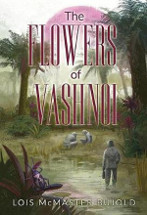
The flowers of Vashnoi by Lois McMaster Bujold
Subterranean, 2019. ISBN 9781596068926. 96pg.
(Age: 15+) Highly recommended. Themes: Science fiction. Lovers of
Bujold's Hugo Award winning Miles Vorkosigan series will
rejoice to discover a short stand-alone novel starring Ekaterin,
Miles' clever wife who is determined to help Vashnoi exclusion zone
that was been devastated by radiation when the Centagandans attacked
the planet. With the help of scientist Enrique Borgos, she has
attempted to use bioengineered insects to regenerate a region but
when checking on the experiment finds that some have been stolen.
Further investigation from the air uncovers the fact that there are
four individuals living in the area. It is up to her to help them
leave Vashnoi for medical treatment.
Ekaterin is clever and empathetic and readers will enjoy getting to
know her character and her abilities in this short work. She emerges
a formidable woman who is equally as compassionate and intelligent
as her husband and is very good at problem solving. The unique
science behind the bioengineered insects is also fascinating.
Fans who want to know more about the planet Barrayar and Miles' wife
will not be disappointed and readers new to Bujold's work will
discover a satisfying short stand-alone read that will have them
searching for the Miles Vorkosigan series.
Pat Pledger
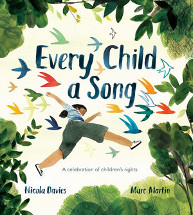
Every child a song by Nicola Davies
Illus. by Marc Martin. Wren and Rook, 2019. ISBN: 9781526361417.
(Age: 5+) Recommended. Themes: Universal rights of the child, Human
rights. A unique and moving picture book combines a tender story
with information about the rights that children are entitled to
under the United Nations Convention on the Rights of the Child. It
begins with the birth of a child: 'When you were born, a song
began...' and goes on to show that the child needs to be 'nourished,
cherished, celebrated.' Using a song as metaphor, the reader sees
the child soaring and exploring and meeting other children 'unique
and special', but the short lyrical text also shows what it is like
to be exploited, imprisoned or part of war and needing refuge. It
exhorts everyone to raise their 'voices for the right of every song
to sing out loud, bold and unafraid'. In conclusion Davies has
chosen some of the rights of the child to emphasise.
Marc Martin's watercolour illustrations complement the text and give
the reader extra information to help understand the needs of the
child. Dark colours show the tribulations of child labour and boat
people, while bright colours portray the happiness of children when
their rights are maintained.
This would be a wonderful book to use to celebrate the 30th
Anniversary of the UN Convention on the Rights of the Child (30
November) and could be used at any time when discussing human rights
and the needs of children everywhere. It is a book that would help
children to show compassion and kindness and to stand up for human
rights.
Pat Pledger
Inland by Tea Obreht
Hachette, 2019. ISBN: 9780297867074.
(Age: 16+) Highly recommended. Themes: Historical fiction, Survival,
Drought, Cameleers, Ghosts, Trust, Relationships. Set in the harsh
drought ridden country of 1890's southwest America, Obrecht's Inland
tells two stories that gradually draw closer together, both set in
harsh inhospitable environments, with people struggling to make an
existence, dealing with loneliness and ghosts of people dead.
Outlaw, Lurie, described as a 'hirsute Levantine' on the wanted
posters, travels for a while with a band of cameleers attached to a
US military expedition into the desert but pursuit by the relentless
Marshal Berger sees him once again finding his own way, but this
time with a strange companion for whom he feels a growing
attachment.
The other story is one day in the life of homesteader Nora. With her
husband gone to find water, and her two adult sons disappearing
early in the morning, she is left with her anxious child Toby, a
wheelchair-bound mother-in-law, and young helpmate, Josie, who
communicates with the spirit world. With only the last dregs of
water to contend with the scorching heat, Nora has to stand guard
against hostile outsiders, and now, a phantom wild beast that has
put fear into Josie and Toby.
Both Lurie and Nora are tough individuals each dealing with ghosts
of the past. For Lurie it is past companions he continues to see and
who infect him with their needs; for Nora it is the ghost of her
daughter, dead from heat stroke many years ago. Both have to contend
with loneliness, hardship, and distrust of others. Their stories are
a journey of self-enlightenment and exploration of the human need
for trust and companionship. The reader is drawn into the two
stories, wondering how they will eventually come together. The twist
at the end makes for an unforgettable ending.
It is a panoramic novel, each chapter written with a different
voice, the language rich and poetic, evoking another time and place.
It has many of the elements of the American western but is highly
original in weaving in the little known history of the U.S. Camel
Cavalry Corp, and the mix of Middle Eastern migrants, Mexicans, and
Indians. It is a good reminder that America, like Australia, has
always been a multicultural mix of people.
Helen Eddy