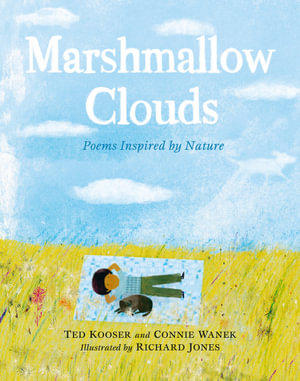
Marshmallow clouds: Poems inspired by nature by Ted Kooser & Connie Wanek
Walker Books, 2022. ISBN: 9781529507072.
There have been a number of books over the last couple of years like that have encouraged young readers to explore their immediate environment with critical, sensitive eyes to discover the detail hiding in the big picture.
But what if, as well as their senses and science brain, they also took their imagination out to play? And what they saw really did become a clown on the top of the hill, up on one leg, juggling a pie, rather than just a winter tree with a long-vacated squirrel's nest on the end of a branch?
The subtitle of the US version of this book by former US poet laureate Ted Kooser and and poet Connie Wanek is "Two Poets at Play Among Figures of Speech" and while a bit dull, nevertheless, it sums up this stunning collection of blank verse poems perfectly. By letting their imaginations out to play, and using similes and metaphors and other literary devices beloved of English teachers, a thunderstorm becomes something that has become lost in the dark of the house, not wanting to wake us but crashing into walls as they stumble about, occasionally striking a match to see their way; tadpoles become commas making them "the liveliest of all punctuation;" and a book is transformed into a sandwich with all sorts of goodness between its folded pitta covers!
Organized by the elements of Fire, Water, Air and Earth and accompanied by distinctive, sparse illustrations that interpret the words but which don't interfere with the picture created by the reader this is an intriguing anthology to dip and delve into, for letting the imagination roam free, wander, and stay healthy. So while we understand that a fire has no stomach, is "never full, never satisfied" and thus must never be set free, it is an entirely different story for our imaginations.
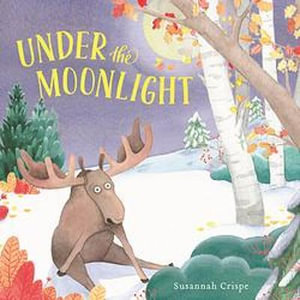
A bedtime story in verse this charming tale of a frightened moose will give hope to all who fear things that go bump in the night. Moose settles down in the snow for his night time sleep. Surrounded by the cold winter, other animals forage for their food in the snow drifts. But something disturbs moose and he wakes, a little disoriented and frightened. He spies a pack of wolves in the hill nearby, he imagines a creature lurking in the forest, a barn owl screeches over his head. He sees the bush quivering and investigating scares a rabbit. He enters a dark cave only to find a sleeping bear. He runs back to his spot in the forest and there finds a little mouse just as fearful as moose. Together they find peace and sleep through the night with each other as company.
A charming and uplifting tale of companionship, of friendship, of the power of togetherness to overcome fears and moments of anxiety, this story will have children empathising with the fearful moose and feeling relaxed as he finds a friend to share the night with.
Soft illustrations cover each page, giving a good impression of the environment in which Moose lives, and also radiating with the cold of the background. Kids will shiver reading the story and point out the many aspects which make Moose’s habitat cold. Many children will marvel at the flora and fauna spotted in the pages, adding to their knowledge of the place where Moose lives.
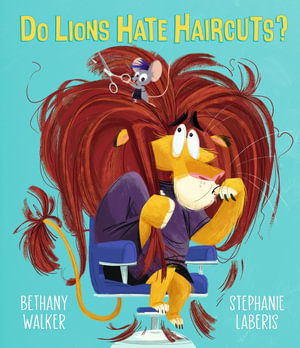
Do lions hate haircuts? by Bethany Walker and Stephanie Laberis
Walker Books, 2022. ISBN: 9781406388411.
Leonard the Lion is king of the beasts, master of the Savannah, leader of his pride and a great big baby when it's time for a haircut!
Nobody, NOBODY, can cut Leonard's hair to his liking. That is, until he meets a little mouse called Marvin. Despite his scepticism that a mouse could help a lion, Leonard gives him a try and is so impressed by the wild and whacky styles Marvin creates with his teeny-tiny comb and scissors that soon they are best buddies.
However Leonard wants Marvin to cut his hair and HIS HAIR ONLY. So when Leonard sees Marvin giving Zebra a new hairdo, Leonard is jealous and refuses to have his hair cut at all. But the folly of that plays out when he hears Marvin in trouble and he rushes to his rescue...
This is a fast-paced story that has several twists and turns, including the ending, and which will engage young readers, especially those who are not keen about getting their hair cut. Perhaps they will suffer the same fate as Leonard! Hilarious illustrations that are bright and bold really enhance the text and the creatures' faces are so expressive that discussing how each is feeling and why is a must.
Apart from a subtle message about finding friendship in unexpected places, this is a story that will be enjoyed just for the fun of it.
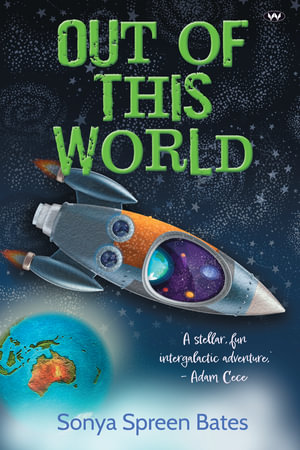
Out of this world: Star-studded haiku by Sally M. Walker and Matthew Trueman
Walker Books, 2022. ISBN: 9781536203561.
one minuscule speck grows into the universe a mind-boggling birth
Defined as a traditional Japanese three-line poem with seventeen syllables, written in a 5/7/5 syllable count which often focuses on images from nature, haiku emphasises simplicity, intensity, and directness of expression making it an effective way to get students to focus on the essence of an object and then use succinct, descriptive vocabulary to portray it so every word has to work hard.
In this stunning union of poetry, art and science, haiku is used to explore the universe through a lunar eclipse, beyond the orbiting planets, and into glowing galaxies and twinkling constellations out to Ultima Thule, the most extreme limit of the journey which "longs for a visitor with coal and a carrot", and all accompanied by the most imaginative illustrations that are almost photo-like so that not only does the reader learn about the vast beauty of space but they are left in wonder and awe of its magnificence. The minimal text structure of haiku means just the nucleus of the phenomenon is offered as a teaser, leaving the reader with a tempting taste to learn more...
the Eagle landed one giant leap for mankind footprints in the dust
Some of this is offered in the comprehensive, well-researched final pages which explore such topics as constellations and astronomers, the birth of the universe, stars, the solar system, moons and eclipses, asteroids, meteors, and comets, but the whole offers an opportunity for students to engage in their own interest-driven investigation with the challenge of summarising their findings in their own haiku and artwork.
Barbara Braxton
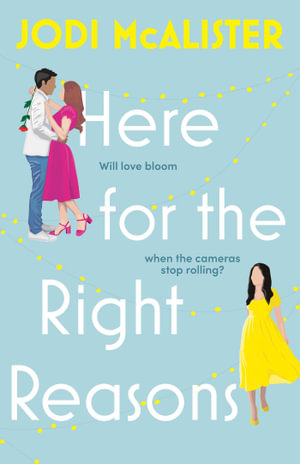
Here for the right reasons by Jodi McAlister
Simon & Schuster, 2022. ISBN: 9781761104961. (Age:Adult) Recommended.
As a fan of the YA Valentine series by Jodi McAlister I was keen to read an adult novel by her and I was not disappointed. The setting of a TV show, Marry Me, Juliet, is sure to engage anyone who is a fan of the TV show Bachelor, while people like me who do not watch reality TV will enjoy learning about how such shows are set up and filmed. Cece James and Olympic gold medallist Dylan Jayasinghe Mellor are both characters that readers can emphasise with. Cece has been brought up in foster homes and has trouble believing anyone can stay with her, while Dylan is plagued with anxiety attacks. Both have their own reasons for being on the show – Cece is an unemployed student and really needs the money, while Dylan wants to promote his men’s mental health charity. When Cece gets eliminated on the first night of the show, she thinks that everything is over for her, but the director of the show is persuaded to film a developing friendship between Dylan and Cece.
The other Juliets on the show are all accomplished and clever women and could become Juliet to Dylan’s Romeo and tension is built up amongst them. The global pandemic and lockdowns also mean that the women must stay in a bubble, and this gives McAlister the opportunity for the reader to get to know many of them.
This is a feel-good romantic comedy with some great dialogue. It is enjoyable to read about the antics of the Juliets to win over Romeo while the slow growth of friendship and attraction between Cece and Dylan is a delight to read.
Themes Romantic comedy, Love, Anxiety.
Pat Pledger
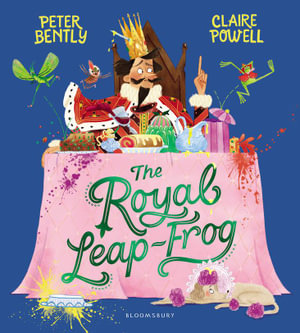
The royal leap-frog by Peter Bently and Claire Powell
Bloomsbury, 2022. ISBN: 9781408860113.
Peter Bently (The Great Dog Bottom Swap) has written a rollicking story that is great fun to read aloud. Claire Powell's illustrations are exuberant, brimming with personality-filled characters and intricate and amusing details. Her work is similar in style to that of Alex T. Smith (Mr Penguin series, The Adventures of Egg-Box Dragon). This is the pair's second retelling of a Hans Christian Andersen story (The King's Birthday Suit based on The Emperor's New Clothes is also available).
The Royal Leap-Frog is a witty take on the classic tale The Leaping Match, telling the story of a flea and a grasshopper who head to the castle to get the King to decide who can jump the highest. When a frog decides to join them they aren't enthused but they also don't feel threatened. 'Fine,' said the grasshopper. 'Sure,' said the flea. 'But you don't stand a chance. And the frog thought, We'll see!'. The competition itself is a domino effect of chaos: there's food being flung, fleas in collars and a flurry of pepper sneezes. The King and his people are completely underwhelmed by the whole messy affair. Can the frog impress him with smart thinking and be declared the winner?
The colourful, patterned Elizabethan dress worn by the royals as well as the outfits of the bugs are delightful, while the frog is clearly part of the bourgeoisie, with his raggedy buttoned shirt and necktie. Children will be ensconced in these vibrant pages and the fun story they tell. The takeaway message is that it is more effective to gain admiration by appealing to one's sense of self, rather than with your own prowess, but perhaps it would have been nice if the story was modernised slightly more (do we really need to be talking about the King being 'higher' than everyone else? And having princesses kissing frogs in the hope of finding a prince?).
Themes Fables, Rhyming Stories, Humorous Stories.
Nicole Nelson
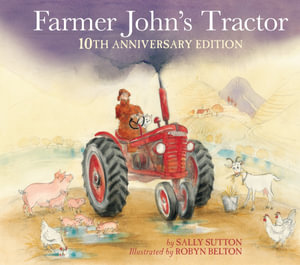
Farmer John's tractor by Sally Sutton. Illus. by Robyn Belton
An orangey-red old tractors sits in a shed, seemingly rusting and unused, until there is a flood. A car with two little girls gets stuck in the rising floodwaters. The jeep that tries to rescue them rolls on its side; a tow truck gets stuck and the fire-engine slams to a halt on a slip. Then Farmer John comes up with an idea. Unlocking the door to the shed, he brings the trusty tractor to the rescue.
Teachers doing a unit with young children about disasters and in particular floods, will find this beautiful picture book very useful. The illustrations in watercolours by Robyn Belton bring the wet weather to life. The swirling murky waters of the flooding river, the brown mud and the oppressive sky tell vividly what can happen during a flood. The oppressive atmosphere is lightened with humorous touches like the chickens nesting on the tractor and the little dog following the farmer around. There is a plethora of detail in each of the pictures for inquisitive children to pore over and talk about.
The story of the tractor, which is rusty but trusty, will appeal to young children as will the rhyming language that makes it a good read aloud. The fact that this is the 10th anniversary of Farmer John's tractor is testament to its lasting appeal.
Themes Tractors, Floods, Tractors, Weather.
Pat Pledger
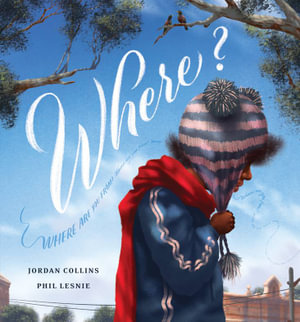
Where? by Jordan Collins and Phil Lesnie
Allen & Unwin, 2022. ISBN: 9781760526382. (Age:8+) Recommended.
Author Jordan Collins identifies as African-American-Greek-Australian and dark skin and curly hair mean that people are always asking 'Where are you from?'. This book, based on a slam poem Collins wrote as a young teen, is a direct response to that question. It asserts that we are all products of this solar system and this planet that we share. It celebrates our sameness and our shared humanity and ancestors. 'I'm from the interiors of collapsing stars, From the explosion that made the big bang and the iridescent glow of a nebula'. The language used by Collins, and Lesnie's (Feathers) illustrations, are atmospheric and remind us how tiny and insignificant we are compared to the vastness of this world and its origins. 'I came from the same ancestor as you, The primate who decided to walk upon two legs for the first time'. It's a lesson in perspective and significance. It's about focussing on the big questions and looking at the big picture. For many people the question 'Where do you come from?' is a complex one and there is no easy way to answer. Collins says in a note at the back of the book that this was written to give hope to other kids and let them know they aren't alone in feeling othered, but it also gives those same kids a way to answer the question as well as hopefully showing everyone why it's not a welcome or meaningful way to get to know someone. As Phil Leslie's note says 'Instead, ask me what I'm reading at the moment. You'll see my face light up. That's where I'm really from.' This is a powerful book with an overt yet important message.
Themes Belonging, Identity.
Nicole Nelson
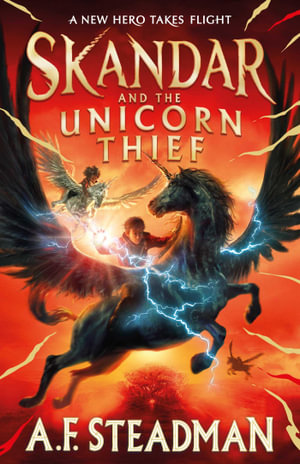
Skandar and the unicorn thief by A.F. Steadman
Simon & Schuster, 2022. ISBN: 9781398512429. (Age:9+) Highly recommended.
This book had some fantastic reviews from tweens who read it and I understand why. It’s exciting, original, funny and heart-warming. Cross Percy Jackson with Harry Potter add in a touch of Anne McCaffrey’s dragon books and you have a great start to a series kids will love. At least I hope it’s a series because I am really looking forward to book 2.
Skandar is dreaming of being a unicorn rider so when he’s stopped from taking the test, he’s heartbroken. Then a mysterious woman flies him to the Island to smuggle him in with the other candidates. When he bonds with Scoundrel’s Luck, his own unicorn, he understands why. Skandar is a spirit wielder, the forbidden element and if he’s discovered Scoundrel will be killed.
Skandar needs the help of three new friends to keep his ability a secret, but the danger is real. Especially as the Weaver is back, an arch villain and spirit wielder who can break unicorn bonds and control the vicious wild unicorns. And what’s their connection to Skandar?
Steadman has created a solid story line with an excellent balance of adventure and friendship in a setting that is interesting, unique, and delivered with the perfect amount of detail for its audience. This book will appeal to any fantasy reader. The style is both easy to read and compelling and the idea of fighting unicorns and a unicorn cup could bridge the gap for readers who prefer contemporary settings.
What set the book apart for me was what Steadman did with her characters. Michael, the posh boy, Flo, the girl with the powerful unicorn, Bobby the aggressive, competitive girl and Skandar, the brave underdog hero: we’ve seen them all before but not quite like this. Michael copes with his overbearing father by obsessively organising, almost OCD is his need to have a plan. Flo fears the power her unicorn holds and needs to discover her own strength. Skandar has no friends because he must look after a clinically depressed father and Bobby, Bobby has panic attacks. They are all the heroes we have come to expect but they also have real problems like their readers.
This mix of high fantasy with real life issues makes Skandar and the Unicorn Thief a perfect book for study in schools. Both kids and educators will love it. Highly recommended.
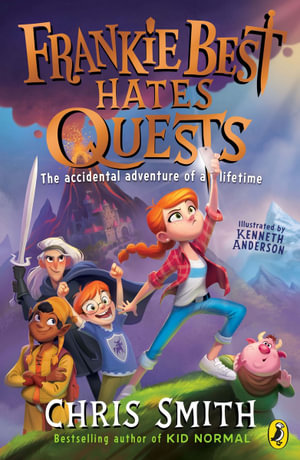
Chris Smith, English radio newsreader and co-author of the Kid Normal series, has gone solo and produced another funny, action-packed adventure book Frankie Best hates quests.
The third person omniscient narrator tells the story of Frankie Best hates quests in the manner of many energetic, chatty style authors by engaging the reader personally with comments such as "If you were thinking that..." Frankie, our central character, addresses the reader right at the start by saying, "I just want to make one thing totally clear...this is not a story about some mystical quest through a magical land...about fantastical creatures, or elves, or witches...or about a princess..." Ofcourse it turns out to be all those things and more.
This is the main message of the story - that grumpy, too cool for school teenagers, addicted to their phones and trying so hard to be cool in the eyes of their peers can actually chill out and enjoy childish fun, quests, adventures, the outdoors, finding new and interesting even "nerdy" friends and their true identity. Once Frankie, her little brother Joel and Garyn (a strange knelf companion) go through the mirror portal in her grandfather's house, somewhat like in The Lion,The Witch and The Wardrobe, they find themselves in the fantasy land of Parallelia. As in The Hobbit, a map of the land is provided at the front of the book and it is a good idea for the reader to refer to it as too cool Frankie and her nerdie companions go on a quest to save Grandfather and be back in time for their parents' return in the real world.
Parallelia is an interesting study of a different effective form of government. Interestingly, coming from the perspective of an English author, Parallelia has no monarch. Five custodians, each keeping five talismans safe, rule the land by turn; each ruling for a term of five years. However, the quest has to happen because one of the talismans has been stolen by the baddies in the book and one custodian has been kidnapped. When the puzzle of governance is solved, it can be vaguely seen on the map how the talismans work. In any future publications of Frankie Best hates quests, one hopes that the map could be clearer- particularly the five pointed star.
Many aspects of the fantasy land are superior to the real world. When Frankie talks with Garyn about aspects of her world, eg mobile phones, pop music, clean water, he is able to trump her every time with Parallelia's pure offerings. When she mentions social media he replies, "You're not serious...give me a break!" Frankie has her reality checked and in the end finds the real world that was so cool and exhausting a poor substitute for Parallelia.The friends who she had previously denigrated as nerdy turn out to be stalwart, capable and loyal and Frankie emerges with a new identity and new attitudes.
Frankie Best hates quests is a playful happy romp of a fantasy story. The characters are likeable and the stages of the quest are easy enough for the young reader to follow. All ends extremely well. Good lessons are learnt through the company of very good friends, a bit of magic and the help of a moral compass!
Themes Fantasy lands and rulers, Identity, Friendship, Social media.
Wendy Jeffrey
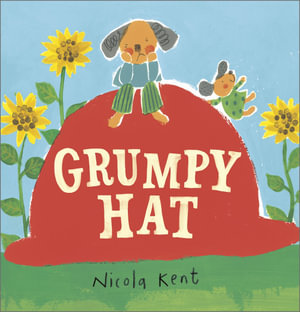
Grumpy Hat by Nicola Kent
Andersen Press, 2022. ISBN: 9781839130373.
Everyone knows that little sisters can be an-noy-ing! So when Ravi gets annoyed with Ruby and breaks her toy car in a rage, everyone goes to bed upset. Ravi wakes up the next morning with a bright red grumpy hat stuck fast on his head! And he can't get rid of it, no matter how hard he tries. Ravi learns how to swap his grumpy hat for happy socks in this uplifting story about siblings, family life and controlling bad moods.
Everyone has woken up with their grumpy hat on and so this story will resonate with our youngest readers, but portraying a bad mood as an animate object brings well into their world of the concrete and the here and now. Hats can be seen and touched and described whereas moods are more elusive, and little people don't have the vocabulary or the skill to articulate them. So having an ugly, uncomfortable red hat that is "heavy like a log", "itchy as a spider's dance class", "sticky as dough" and "tight like too-small-shoes" not only creates a visual image of the feeling but starts to build their words to describe it.
And while each will have a story to add about a time their grumpy hat was stuck on, they will also be able to talk about a time that, like Ravi, they were able to swap it for happy socks.
Barbara Braxton
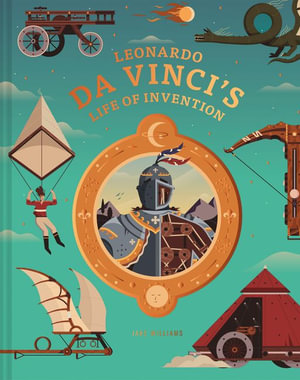
Leonardo Da Vinci's life of invention by Jake Williams
Pavilion, 2022. ISBN: 9781843654988.
Whether you're looking into art, architecture, engineering, mathematics, music or just about anything else, the name of Leonardo da Vinci keeps cropping up. Born in 1452 in a small town in Tuscany Italy, more than 550 years later his inventions and discoveries live on being the foundations of many of the things we take for granted. Known now as a polymath - someone whose knowledge spans many different areas and subjects - he was responsible for so much more than the Mona Lisa.
This new book written to introduce the man, his talent, skill and world to young readers who are as curious as he was, is a fascinating read that follows his life, his discoveries and their continuing impact in a way that is easily accessible and full of illustrations. Through his passion for sketching and note-taking that left a legacy of 'wild ideas, futuristic inventions, fearsome creatures and beautiful works of art', the author has pulled together an authoritative, engaging biography not just of the man but his contribution to his society and ours.
Themes Leonardo Da Vinci, Inventions.
Barbara Braxton
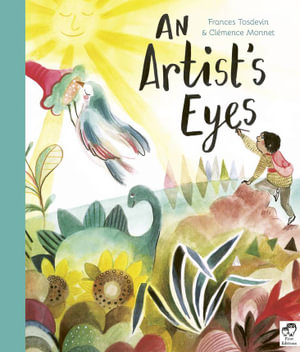
An artist's eyes by Frances Tosdevin. Illus. by Clemence Monnet
Frances Lincoln Children's, 2022. ISBN: 9780711264830.
When Mo looks at the sea, she sees "dazzling duck-egg blue, a swirl of peacocks and the inky indigo of evening" but all Jo sees is blue.
When Mo looks at the forest, she sees "shiny apple-green, the lime of gooseberries and the springy zinginess of moss" and shadows that make the green go darker. But all Jo sees is green, making him more and more frustrated because he can't see what Mo does. But Mo is patient and gradually Jo begins to use his imagination although instead of seeing the shades and hues that Mo does, he starts to see something different...
This is a powerful yet gentle story that reminds the reader that two people can look at exactly the same thing and see it differently- that each of us has artist's eyes that are shaped by our imagination, experience and perceptions and it can take us a while to align them. Monnet's watercolour interpretation of Tosdevin's lyrical text is enchanting and with their shapes, lines and colour choices the reader will view them through Mo's eyes or Jo's eyes or their own eyes...
At the age where our children are exploring a new independence and making a wider friendship group, they look at those around them and think that being like them is the key to "success:" and they try to change who they are to be like those they admire. So this familiar message of being comfortable in your own skin, being the unique individual you are, perhaps even being the 'you' that others admire and seek to emulate is important and cannot be shared too often. So this iteration of that truth is not only important but being a completely different interpretation gives it added reach and recognition. Whether our eyes kiss in the corners or speak to the stars, sees shapes or colours or sparkles, what we see is unique to us and is as valid as what our neighbour sees.
Barbara Braxton
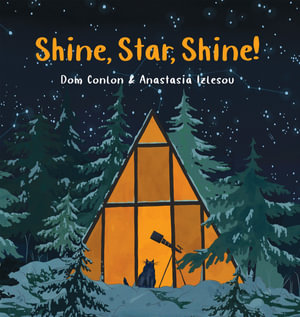
Shine, Star, Shine! by Dom Conlon. Illus. by Anastasia Izlesou
From the author of Swim, Shark, Swim! comes the book Shine, Star, Shine! once again written in the complex poetic language style which sets these books apart from others in the factual narrative range. Our biggest star is the sun, and this story shares how it is so very important in our lives. From where it rises in the east, to night and day, how it ‘ripens the wheat in Idaho, adds fire to spice in Punjab’ and provides a source of growth for flowers and forests from China to Brazil. The sun visits Australia and shares with the reader how it can burn and cause harm. It then travels west, through deserts, and to the North and South Poles where it stays low.
The striking illustrations are presented in a dark pallet of colour with the orange orb of the sun the focal point. There is a great deal of detail in each of the drawings to engage the readers and promote discussion. In particular, the images of the constellations are striking. The author has included Star Facts in the final pages which provide helpful explanations of more difficult words and concepts. This is a book which benefits from being read more than once and discussed with younger children.
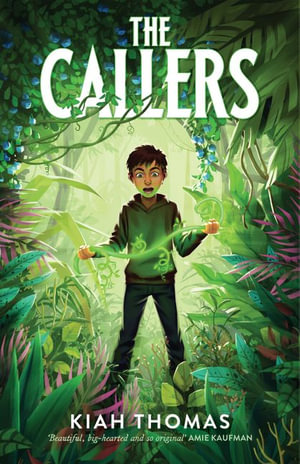
Quin Octavius is an 11-year-old boy who lives in dread of a test he must sit to prove he is a Caller. Calling is a special ability you are born with where you summon things by saying the word and that object appears. There’s no need to grow your own food or buy anything if you are a Caller. His intimidating and powerful mother is Chief Councilor in this world of Elipsom. His sister Davinia, and best friend Cassius, are accomplished Callers. Quin knows he doesn’t have this ability and is mortified that his mother and sister cheat in order for him to pass the test and therefore uphold family honour and dominance. Quin realizes there are people who don’t rely on Calling and live much simpler, happier lives and he questions the way things work in Elipsom. Suddenly he finds himself in another world, Evantra, where he meets and befriends Allie. He discovers the truth about Calling and how Elipsom is abusing the people of Evantra and stealing from them. Quin also learns the truth about himself and his own important gift which may help revive a deteriorating natural world.
The Callers is a very well-paced and readable sci-fi parable about our own world. Currently powerful governments and greedy businesses exploit people and resources and destroy lives and the environment. These are important topics to ponder and I think this novel will work well as a class novel for 11/12-year-olds. There are also ethical issues of honesty, betrayal and questions of loyalty to family. Although The Callers deals with serious stuff this is balanced out with a creative and rich world of maengoberries and rhinodrites. The inhabitants of Evantra have ingenuity and care for each other. Then there are also the heroic characters of Quin and Allie who have hope and principles. The story ended quite positively but abruptly and I think there will probably be a sequel.