The book of dust vol. 3: The rose field by Philip Pullman
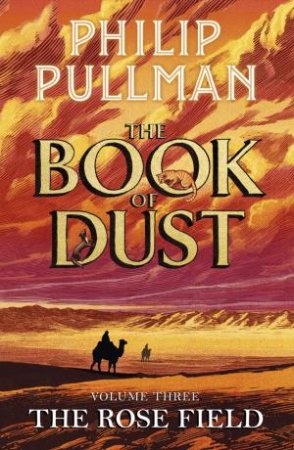
The rose field is Volume Three of Philip Pullman's epic trilogy The book of dust. It is possible to read The rose field as a stand alone but due to the multi-layered complexity of the plot and the multiplicity of characters it is recommended that The book of dust trilogy is read in order: La Belle Sauvage, The secret commonwealth... and then The rose field. Pullman though, being a skilled writer, leaves enough markers to assist the reader if they choose to read just The rose field (but once hooked on the story that might be unsatisfactory!) Thus, preceding The book of dust is a short precis which informs the reader that Lyra (the central character of the trilogy) has reached the deserted city of al-Khan al-Azraq in search of her daemon, Pan. She goes into the ruins and meets a girl of North African appearance who is also without a daemon (a guiding spiritual being, manifestation of a person's soul in the shape of an animal) who has been waiting for her... Pullman's work is aimed at competent readers and is usually first discovered by able students in upper primary levels and marketed at a teenage + readership in good bookshops. It is both "sophisticated fantasy" and "philosophical fiction" so it pleases a wide readership. Pullman's books quickly become an "addiction". Readers (this one included) soon want to read the entire collection. Adult readers can appreciate the clever mirroring of Pullman's characters, politics, philosophy and theology with what goes on in the real world.
Pullman is known for the dazzling, exotic settings of his books. It is recommended that readers keep an atlas beside them as Pullman mixes real with fictitious settings. Lovers of geography will find themselves in far-flung locations of great interest. In The book of dust, Lyra is heading towards Aleppo in search of her daemon. The setting stretches from dystopian, Brytain - (Britain thinly veiled) across the Middle East to Central Asia and includes such places as the Karamakan Desert which is the Pullman parallel universe counterpart to the real-world Taklamakan desert in NW China and was the desert where Lyra had to find the botanical research station. The Karamakan is tied to the dangerous shifting lakes of the real world Lop Nor which was known as "the Wandering Lake" with this area now highly restricted, a potash mining hub and site of China's former nuclear testing facility. The "potash" company logo is a sinister component of the story and another example of the blending of real world and fictitious counterpart. This journey is so dangerous that in Pullman's story, humans must separate from their daemons and that is a terrible, terrible wrench. Crucial to the story, it points to the separation of man from his soul or his imagination or his consciousness.
Malcolm Polstead, loyal and from Lyra's past, races simultaneously across the world trying to get to the red building in the desert to discover the meaning of Dust and the roses. Powerful enemies called the Magisterium threaten. Alliances are formed with gryphons and witches.
Pullman's descriptive powers are on full display; scenes and characters are perceptively wrought. The description of King Edward the Twelfth's character and the wily manipulation of him be the Magisterium and the War Office is an example... "in his late eighties...it was felt better to spare him the burden of what was being planned in his name...his penmanship was shaky, his memory was tenuous, but his courtesy was unfailing."(p. 60) That passage alone, being indicative of the rest of Pullman's writing, gives the uninitiated Pullman reader an idea of the power of his writing.
The book of dust is a breathtaking and emotional read!
Themes: Politics, Theology, Fantasy, Philosophy, Imagination vs dogma, Freedom vs control, Love and reunion.
Wendy Jeffrey