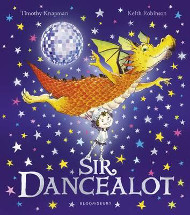
Ill. by Keith Robinson. Bloomsbury, 2016. ISBN 9781408846995
(Age: 4+) Recommended. Themes: Dancing, Humour, Alliteration/Rhyme,
Monsters, Reconciliation. Sir Dancealot lives in times of old and
his great skill as a dancer makes him a winner against all opponents
(including bogglesnots, beasties and monsters). That is until he
meets his match in the light footed and daring Dragon who has
mastered the fearsome art of Dance! The Dragon is a formidable
competitor and a dance-off . . . on ICE . . . is proposed to find a
winner. Who will survive as the winner?
This is a lovely tale with alliteration, rhyme and wonderful
illustrations with warts, fangs and dance moves. Friendship is the
winner after a dangerous move on the ice creates a sinking feeling
for the pirouetting pair. The illustrations are bright, and
endearing and bold colours and the silver mirror ball and stars on
the cover will cause this to leap from shelves into the waiting
hands of young readers.
Carolyn Hull
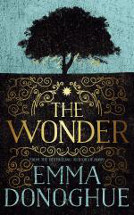
The wonder by Emma Donoghue
Picador, 2016. ISBN 9781509818396
(Age: 16+) Highly recommended.
Emma Donoghue is the bestselling author of Room, shortlisted for the
Man Booker Prize in 2010, now an award winning film. That book was
about a young boy and his mother held captive in a room by a child
abductor. With this latest book, The wonder, Donoghue ventures into
the world of historical fiction - it is set in the Irish Midlands in
the 1850s, a time of fervent religion mixed with superstition, and
bog marshes that could easily sink a body. In this story also, the
child is like a prisoner under constant watchful guard, and there is
an undercurrent of suspicion of abuse.
Anna, the child, has been extolled as a wonder, a miracle from God,
she has not eaten for months but seems healthy nonetheless. She is a
'fasting girl' - one of a number of recorded cases of girls and
women hailed for surviving for long periods without food, in
the sixteenth to twentieth centuries. Lib, a nurse trained in the
latest medical approaches by none other than Florence Nightingale
herself, is hired by a local committee to observe the child and make
a report at the end of her two weeks of observation. A no-nonsense
believer in science, Lib is determined to expose any trickery, and
she sets about ensuring there is no secret smuggling of food.
However, as her observations record the gradual deterioration in
Anna's health and she is shocked into realising she is also
complicit in starving the child, Lib has to decide what action she
should take.
At the heart of the story is an analogy with the fairy story of
Rumpelstiltskin, where a young girl is compelled to weave straw into
to gold because of her parent's boastings. Her debt to the strange
little man who comes to her aid can only be broken by guessing his
name. So there is the play between Anna and Lib, of guessing games
and riddles, which creates a kind of friendship between the two. But
Lib gradually comes to realise that she has to do more than just be
a friend, she has to take action.
This book is an intriguing mix of fairy story, science and religion,
each contributing to the puzzle that Lib has to solve. In addition
there is a thread of romance as she is befriended but also
confronted by the charming yet astute young journalist William
Byrne. The tension builds as Lib comes closer to working out the
truth and realises that she alone can save the child. Is she clever
enough and brave enough to do what is needed? I found I couldn't put
this book down in the last chapters - it is a gripping yet very
satisfying story because it is clearly written from a real
understanding of the world of the child, of parent-child
relationships, the complexities of child abuse, the power of
religious and superstitious beliefs, and the individual struggle
with conscience and finding the courage to take a stand against the
prevailing group. It's a fascinating and thought-provoking book -
highly recommended, and has my vote for best book for 2016.
Helen Eddy
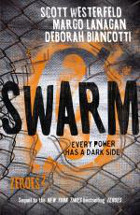
Swarm by Scott Westerfeld, Margo Lanagan and Deborah Biancotti
Zeroes bk 2. Allen and Unwin, 2016. ISBN 9781925267242
(Age: 14+) Recommended. Thriller. Super heroes. 'Every power has a
dark side'. Reading the second in the Zeroes series takes
the reader on a dark, scary and unexpected trip on the wild side.
The Zeroes - Ethan (Scam), Nate (Bellwether), Thibault (Anonymous),
Kelsie (Mob), Riley (Flicker) and Chizara (Crash) have made
themselves an underground nightclub where they are experimenting
with crowds and controlling their powers. One night two other
Zeroes, Coin and Glitch, take to the dance floor and the Zeroes find
that not only are there more people out there who have super powers,
but a powerful person, Swarm, is out to harm them. On the track of
Swarm, the friends find themselves in deadly danger, and Swarm's
actions make them face some issues. Bellwether's confidence is
severely challenged; Mob has to face the dark side of her power;
Anon realises that he doesn't belong anywhere; Crash has to question
the morality of her actions while Ethan faces trying to fit in.
An exciting second novel, this finds the characters growing and
working out the limits to their powers. There are lots of unexpected
moments and it is difficult to predict just what is going to happen
next. Lots of action and suspense kept me glued to the page but the
personal conflicts that each character faced brought plenty of heart
wrenching moments as well.
This is one dark, frightening and thrilling ride. There are some
rather horrific deaths that are not for the faint hearted and the
conclusion leaves the reader reeling from the shock of it, and
desperate for the next instalment.
Pat Pledger
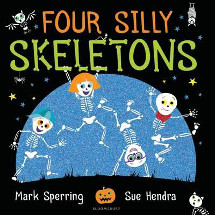
Four silly skeletons by Mark Sperring
Ill. by Sue Hendra and Paul Linnet. Bloomsbury, 2016. ISBN
9781408867143
(Age: 5+) Recommended. Humour. Skeletons. Bodies. Verse. Four silly
skeletons named Fred, Sid, Belle and Bill live at the top of a very
steep hill. Lucky for them their dear old Aunt June lives near the
bottom of the hill and she is very sensible. The four do some very
silly things, slipping on a banana skin, overfilling the bath,
hitting a ball with the tennis racket and smashing a vase. But sweet
Auntie June is there to put things right. One night they become
entranced with the music that they hear. They dance and jive, leap
and swish, all over the top of their hill. Auntie June calls out
very sensibly to take a torch but they do not listen, and fall over
the cliff. They become a jumble of bones at the bottom of the cliff,
and Auntie June must try to put them together again. She gets out
her sticky glue and attaches the bones together. But she does not do
it at all correctly and the four silly skeletons are arranged a
little differently.
This is a very cute rhyming cautionary tale. It reminds readers
through a fun story, of taking note of your elders, of taking
precautions when out at night, of watching where you are going. It
will raise gales of laughter from the intended audience and readers
will want to write their own 'Four silly skeletons' verse. The
luminous illustrations add to the fun of the story and an astute
teacher will have skeletons ready to be cut out and danced across
the pin up board, and use the tale to introduce work on the body.
Fran Knight
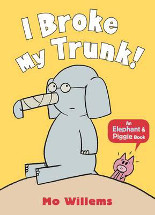
I broke my trunk! by Mo Willems
An Elephant and Piggie book. Walker Books, 2011. ISBN
9781406373592
(Age: 3-6) Recommended. Humour. Injury. Picture book. Animal
characters. Friendship. Mo Willems manages to entertain with few
words and simplified illustrations (and all text in speech bubbles);
and young children will love this! With few colours and few words,
Elephant tells the convoluted reason for his injured trunk. This
begins as a recount of the events leading to his injury (akin in
style to the fable, The giant turnip), but leads to a twist
connected to his friendship with Piggie. The simple explanation is
the basis of the humour, but this is then compounded and magnified
when Piggie also gets his own 'broken body part'!
It is a crazy story with silly illustrations, but very appealing for
a young audience aged 3-6.
Carolyn Hull
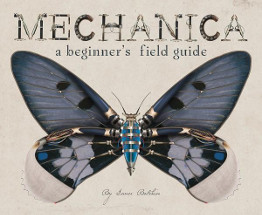
Mechanica by Lance Balchin
Five Mile Press, 2016. ISBN 9781760401085
(Age: All) Highly recommended. Picture book for older readers,
Technology, Machines, Environmental destruction, Extinction, Science
fiction, Dystopia. Machines have taken over the role of animals in
this dark view of our future, where the continued use of fossil
fuels has caused the environment to collapse, species have become
extinct and large areas of the world uninhabitable. Built to replace
the work done by animals (for example, a mechanical bee was
developed to propagate the crops) these interbred with drones built
for surveillance purposes when the world descended into war. Their
offspring are presented in this highly imaginative and compulsive
picture book, set out like a scientific catalogue of a new species.
What began as drones escaped into areas beyond human reach and
meeting the mechanica, designed by man to replace the animals lost,
their offspring become the most intricate and beautiful of
creatures, darkly mechanical, steam punk in their design and
absorbing in their detail.
Each verso page has the most imaginative of illustrations, depicting
one of these mechanica. One I particularly like is on page 23:
Interfectorem Apis (scientific name) or Killer Bee, and beneath is
given information about where it is found, how it was developed and
why it is called a killer bee. An example of its power is given and
then facts about the mechanica: its weight, length, speed, power
source, sensors and origin. Each fact adds to the knowledge of this
bee, giving hints about why it was created in the first place and
how dangerous it now can be. It is a formidable bee, and the
illustration is staggeringly beautiful. Readers will be enthralled
at the detail given, the mechanical elements of the creature and its
possibilities. And this is only one of a dozen or so creatures,
which aided by a useful index will be enjoyed by readers of all
ages. An afterword tells how the person who complied this catalogue
has found a real butterfly, so adding a note of optimism to this
bleakly dystopian story.
Readers from a young age to adult will pour over these pages,
looking at every detail of these creatures.
This powerful image of our future will resonate with many readers,
stunned by the destruction of our global environment and concerned
at the advance of war technology.
Fran Knight
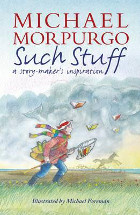
Such stuff: A story-maker's inspiration by Michael Morpurgo
Ill. by Michael Foreman. Walker Books, 2016. ISBN 9781406364576
What a master storyteller Michael Morpurgo is! His body of work and
his reputation are both completely awe-inspiring. This unparalleled
weaver of dreams who was the UK Children's Laureate from 2003-2005,
with over 100 books to his credit (many translated into other
languages) and numerous awards, has provided those of us who are such
admirers of this work with an unprecedented insight into his
writing. This is truly a joint production. When Michael's brother
suggested that so many people always ask about how the stories come
to life it would be a good idea to write about it, Michael took up
the idea with enthusiasm. It was natural to involve his long-time
illustrator and collaborator, Michael Foreman, who has often
provided him with the germ of an idea for a story. And along with
his wife, Clare, he began the task of collating anecdotes, excerpts and
background information for the brilliant format of this book.
The story of each book begin with Michael's recount of the first
idea, sometimes a real life incident, a media story, an historical
fact or a yarn from someone met in a pub. He discusses how the
pieces of each story then come together, to be woven into one
narrative. At times, many such singular ideas all combined into the
one book. Then follows an excerpt from the book in question, these
selected by Clare and lastly, a few pages of information that
provide back story to the particular theme of each all fascinating
and interesting aspects of the relevant title.
As an indulgence I must share this from the chapter on 'I believe
in unicorns': We know the best parents and the best teachers do this, change
lives. So often forgotten are the best librarians, dedicated
people who go quietly about their business of trying to encourage
reading. For many children who are not read to at home, or who
have been frightened of books, or bored by them, at school, a good
library and good librarian can change the life of a child, by
judicious and sensitive recommendations, by arranging book groups,
by readings, by inviting authors in to talk to children.
Thank you Michael both for that positive affirmation of our
profession but also for the joy you bring to our lives with your
superb writing.
I highly recommend this to you for students who are interested in
the process of creative writing, for lovers of Michael's work and
for your own professional reading. This one stays firmly on my own
shelf!
Sue Warren
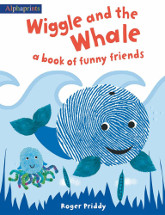
Wiggle and the whale: A book of funny friends by Roger Priddy
Ill. by Lindsey Sagar. Priddy Books, 2016. ISBN 9781783413522
(Ages: 2-5) Rhyming. Animals. Friendship. Collage. This simple book
in the Alphaprints series is explicit in its purpose, initially
asking 'What makes a perfect animal pair?', and then explaining that
even though friends can be different colours and sizes, all
friendships are special. Then follows shorts rhymes about each of
the pairs of animal friends: what makes them special and how they
are different. The animal pairs are fantastical (including a pink
baby bear and a hedgehog), but the drastic differences between them
make the message even clearer. While the lower end of the target age
may not fully appreciate the message of the story, they will enjoy
the simple rhyming text and the fantastic illustrations, which use
different objects (as well as many fingerprints) to create the
animals and the brightly coloured worlds around them. Photographs of
iced donuts create the bear and his lair, the hedgehog's body is a
pinecone, and the flamingo's neck is a pink feather boa. Children
will love identifying these objects and will enjoy the visual
textures they create on each page. The rhymes about each animal,
while not always masterful, are mostly pleasing when read aloud and
relate accurate information about animal behaviours and habitats.
Preschool and early childhood teachers will find this book useful to
get children thinking about how they are different to their friends
and to discuss diversity. It could also springboard art activities
involving collage and fingerprint printing.
Nicole Nelson
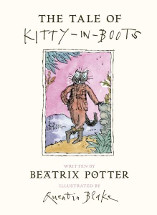
The tale of Kitty-in-Boots by Beatrix Potter
Ill. by Quentin Blake. Frederick Warne, 2016. ISBN 9780241247594
By day, Miss Catherine St Quintin appeared to be a very serious,
well-behaved black cat who answered to 'Kitty' whenever the kind old
lady who owned her called her. The old lady saw a 'Kitty' with all
the pleasant connotations that that name brings to mind but Miss
Catherine St Quintin led a double life.
Because by night, when she was supposedly locked in the wash-house,
Kitty was not curled up in her basket dreaming sweet dreams until
morning. She was not the purring, nuzzling, gentle cat her owner
believed her to be. Known to her more common cat friends as 'Q' and
'Squintums', she would leap out the laundry window to be replaced by
Winkiepeeps, another black cat who would wait inside until Kitty
came home just in case the old lady checked her, while she went
hunting dressed in her coat and boots and carrying an air rifle. A
female lookalike of Puss-in-Boots.
This particular night she collects her gun from her friend
Cheesebox, determined to join Slimmy Jimmy and John Stoat-Ferret as
they hunt for rabbits. However, she decides to hunt for mice
instead, but being a rather unreliable and careless shooter, that is
not very fruitful, only managing to shoot Mrs Tiggy-Winkle's
bundle of washing and some sticks and stones that weren't mice at
all. Sheep and crows seem a better target until they send her
scurrying behind a wall in fright and she gets a big surprise when
she fires at something coming out of a hole. Unexpectedly, she has
met up with Slimmy Jimmy and John Stoat-Ferret who take her gun off
her. But she refuses to hand over the pellets and so a rather
adventurous night involving the ferrets, Peter Rabbit, Mr Tod the
Fox and Mrs Tiggy-Winkles begins. Suffice to say, it's enough to put
Miss Catherine St Quintin off hunting for ever.
The story of this story is as interesting as the tale itself. Potter
completed the text in 1914 and created just one illustration but the
outbreak of World War I and other events meant she never completed
the rest. Thus the story went unpublished in her lifetime.
Undiscovered until Penguin Random House editor Jo Hanks found it in
the Potter archive at the Victoria and Albert Museum in 2013 and
with Quentin Blake accepting the invitation to illustrate it, it has
just been published to coincide with what would have been Potter's
150th birthday.
Fans of her works will be thrilled to share just one more adventure
from this prolific creator and delight in the appearance of an
older, more portly Peter Rabbit who has lost none of his smarts and
wily ways as well as other favourite characters from her other
books.
Barbara Braxton
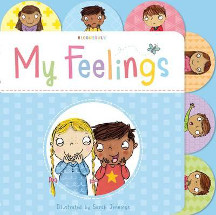
My feelings ill. by Sarah Jennings
Bloomsbury, 2016. ISBN 9781408869048
(Ages: 4-6) Board book, emotions. This is about how to cope with and
talk about emotions. It requires children to have a grasp on
labelling and recognising their emotions already as it does little
to identify what they are or what they look like. Rather than
telling the reader what it looks like to be worried or scared, shy
or happy, it gives practical suggestions for dealing with the
feeling ('When you feel scared . . . Run away fast. Say 'I'm
scared!''; 'When you feel happy . . . Whistle and sing!, Say
hello').
Young children often have difficulty dealing with emotions, even
positive ones, so this is a fantastic way to give them practical
outlets. The pictures clearly illustrate the suggestions, giving
children visual as well as verbal cues. This is a great book for
parents to read through in its entirety, but also to pull out during
emotional times to help young children find a way to deal with a
specific emotion. It is appropriately short, and the bright
illustrations and tab cutouts will keep young children engaged.
Nicole Nelson
The loneliness of distant beings by Kate Ling
Hodder and Stoughton, 2016. ISBN 9781510200166
(Age: 14+) Highly recommended. Multi-generational space exploration
leaves no room for love. With a eugenical system in place to provide
mission security, the people of Ventura live a life of structure and
control. They are carriers for the next generation and the
generation after, who may discover a life-supporting planet.
As part the third generation of a seven hundred year round trip, the
children of Ventura are responsible with continuing to produce
optimal offspring for the completion of the mission. On her
graduation, Seren's worst dream is realised when she learns that her
life partner will be Ezra, Captain Kat's more arrogant son. Seren's
discomfort and reluctance for the partnership is attributed to
hereditary mental illness, and so she finds herself with even less
decision-making power than ever before. As the son of Captain Kat,
Ezra, and his future bride, must share in her limelight - any wrong
doing open for public scrutiny. As if things couldn't be worse for
Seren and her precarious mental state, she meets Domenigo, one of
the fish-boys in production. Just a year age gap, the two are drawn
to one another and things quickly heat up. Facing a future of
persecution on discovery, Seren knows she must make the right
decision. She must marry her life partner. But can she after she has
experienced the pure love of Domenigo?
Having thoroughly enjoyed this novel, I would highly recommend it
for teenagers fourteen and up. While primarily a sci-fi romance, the
novel's focus is on Seren's feeling of powerlessness in the face of
societal expectations, and the disadvantages of eugenic systems.
Kayla Gaskell, 20
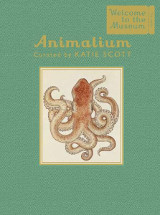
Animalium by Katie Scott and Jenny Broom
Five Mile Press, 2016. ISBN 9781760404307
(Age: 8+) Museums, Evolution. A museum to visit any time you like is
presented in this comfortably hand sized compendium of plants and
animals from around the world.
First published in Britain by Big Picture Press, the books that I
have read (Historium, Botanicum and Animalium)
are part of a series of non fiction books, entreating young readers
to look more closely at the plants and animals presented. Their
website tells us 'Big Picture Press is a new list of highly
illustrated books launched in September 2013, publishing as an
imprint of the Templar Company Limited (UK and Australia) and
Candlewick Press (US and Canada). We believe that books should be
visually intelligent, surprising, and accessible to readers of all
ages, abilities, and nationalities.'
And they have certainly striven to achieve that aim. Historium
(2015) is a highly illustrated and fascinating offering of
historical objects found in the British Museum. Animalium is another in the same milieu, offering incredibly
detailed illustrations of plants and animals across the world. The
large version of this book was chosen as the Sunday Times Children's
Book of the Year in 2014. Opening any page offers a plate of
illustrations on one side with information and a guide to the
illustrations on the verso.
Most pages are animals of the European, Asian and African continents
with a few showing animals our students would know, although the
galah may elicit a few laughs.
Presented in evolutionary order, the first pages deal with Porifera
or sponges, which developed some 540 million years ago, followed by
the Cephalopods and Fish leading up to the Primates and Hooved
Animals. Each page offers highly sophisticated illustrations by
Katie Scott, reminiscent of woodblock prints used in such books in
the past. On the other page, details are given about these animals
and plants, and interspersed with these pages are those detailing
habitats like Woodland, Mangroves and Rainforest. I can imagine some
children encouraged to dip in and out of this book, and see it more
of a library tome to be used by a class. A fascinating read.
Fran Knight
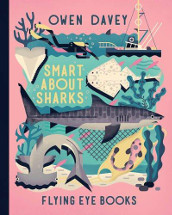
Smart about sharks by Owen Davey
Flying Eye Books, 2016. ISBN 9781909263918
(Age: 5+) Highly recommended. Sharks. Non fiction. A finely detailed
and fascinating look at sharks around the world is offered in this
enthralling hard cover book. Like the diver on the front cover we
are invited to dive down and look at what lurks in the waters
beneath. And no one will be disappointed. I can imagine readers,
particularly boys, poring over the information, the detailed
illustrations and comparisons to educate and then trick each other
with their vastly enhanced knowledge.
Sharks are fish and there are over five hundred different species of
shark. And many of these are detailed on the pages before us. Each
double page with its punning title, offers a different field of
information, along with a host of interesting diagrams. One that
fascinated me is entitled, 'Congratulations, it's a shark',
concerning the offspring of these creatures. The shark has three
methods of birth, I read, one is live birth, the second is eggs and
the third is eggs inside the mother which hatch, the baby shark
eating the rest of the yolk and sometimes its siblings to survive.
Wow! readers, like me, will be entranced. Another page, entiscale,
shows the various sharks drawn in relation to each other. The whale
shark stretches across the whole page, while others are so small
only their name gives their position away. And another, 'A bite
to eat', of course shows us the teeth sharks are known for.
Their rows of teeth can be replaced and one shark may get through
thirty thousand teeth in its lifetime. Each page has a host of
information and facts, and will keep the readers entertained for a
long time. The illustrations beg to be perused with close attention
and will not disappoint the most urbane of readers.
The book is rounded off with an index which points readers to pages
with specific sharks, using both their common and scientific names.
I loved this so much that I will now seek out Davey's other book, Mad
about monkeys.
Fran Knight
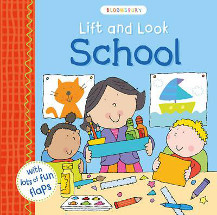
Lift and look school ill. by Simon Abbott
Bloomsbury, 2016. ISBN 9781408864012
(Age: Preschool) Highly recommended. Do you have little ones eagerly
anticipating starting school? If so, this is a perfect gift
especially as it has 'lift the flaps' which we all know are always
such a delight!
Very simple text, a sweet board book format and gorgeously vibrant
and extremely cute illustrations, this will surely be a winner with
any little people from around 3 to 5 years.
Find out what the children are playing, how they get to school,
where they go on a school trip and what they do in their classroom.
Others in this series include: Dinosaurs, Space and
Garden.
This will be perfect for our early childhood centre as our little
people countdown till starting Prep in 2017!
Highly recommended for small humans - pop it into a Santa sack for
your favourite teeny!!
Sue Warren
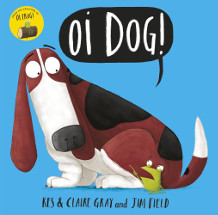
Oi dog! by Kes and Clare Gray and Jim Field
Hodder, 2016. ISBN 9781444919585
(Age: 4+) Recommended. Dogs, Verse, Word play. After the successful
Oi frog!, this trio has written another picture book
concerning a dog sitting on a frog. Frog is not too pleased so
offers alternatives to the dog sitting on a frog. He thinks the dog
should be sitting on a log, and wants change to occur. Dog is a
little perplexed and so asks what bears will sit on. Bears sit on
stairs is the response, and children will laugh out loud as they
predict what that word might be. Each time a new animals is spoken
of, readers will respond quickly with a rhyming word, adding to the
fun of the story. Crickets, moths, slugs, leopards, cheetahs and
pigs, boars, gnus, whales, kittens, dragons and puppies are amongst
the array of animals presented for the readers' amusement, and
combined with the natty illustrations, splashing colour and vibrancy
across the pages, the whole is a snortingly good tale to keep
children amused and engaged.
The huge list of animals and what they will sit upon is repeated at
the end of the book, with the dog then asking the one questions
still to be asked, where will frog sit? This is a funny interactive
book designed to keep readers' interest to the last page, following
on from their successful Oi Frog! (2015)
Fran Knight