Phaidon, 2016. ISBN 9780714871325
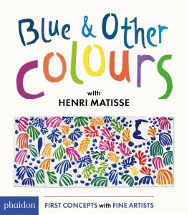
(Age: 2-6) Recommended. Board book, Matisse, Art, Colour. A board
book full of reproductions of Matisse's work with scissors, done
when he was old and arthritic, sitting in bed with painted paper and
a pair of scissors is offered to encourage younger children to
recognise colours through the medium of an artist's work. It is a
lovely book to hold and look at each page in turn. The text draws
the reader onto the next page, a child wondering what the words will
say as they explain the colours on each page. Some pages reflect one
colour, then another colour is added, then several colours are
shown, then the book comes back to one, adding a subtle level of
excitement for the reader. Reading aloud with a group of children
will encourage their colour recognition, involvement in an artist's
world and the possibility of trying the technique themselves. The
last double page shows a whole range of colours inviting the reader
to recognise and point to each in turn, the last page has a potted
history of Matisse and his work for the adult to read out to the
child and incorporate in the use of the book, while inside the front
cover is a list of all the works shown in the book with their
details. This is one of a series of board books published by
Phaidon, First Concepts with Fine Artists. Fran Knight
Ripley's Believe It or Not! Wild and wacky edition 2017 by Ripley's Entertainment Inc.
Scholastic, 2916. ISBN 9781338113242
(Age: 8+) Recommended. Crazy facts. Humour. The latest edition of
Ripley's believe it or not looks at crazy facts, and really weird
wonders of the world. It is sure to be an absolute winner with
people of all ages who like to read about strange and wonderful
things and often get a laugh or a sense of amazement about what goes
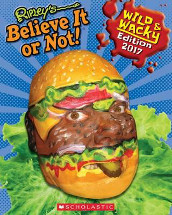
on in the world. The cover with its vivid face set in a lettuce leaf
and with a pickle protruding from the mouth will be enough to entice
the reader to open up the book and see what is inside.
There is an easy to read and enticing Contents page, with the
headings Extra-ODD-inary Legacy, Entertaining Enterprises, Bend over
backwards, Bizarre World, Funky Fauna, Cross your fingers, and
Culture Collection. An index is also available for those who want to
go back to a particular occurrence. The Extra-ODD-inary Legacy gives
an overview of the Ripley world and how it began, with pictures of
the different spots around the world where Ripley worlds can be
found. The reader is then off to read about the wonderful things
that have been gathered together. I was particularly intrigued by
the little girl who invented ZolliPops, tooth friendly treats and
the creation of cardboard shoes. The picture of a giant African
tortoise being taken for a walk, dressed in a pink outfit also
brought a smile to my face while the photo of the elephant selfie
was amazing.
Interspersed throughout the book are quizzes, which when answered
will send the reader off to sections that may interest them, another
way of browsing according to what the reader may want to read. The
photos are so vivid and interesting that they make the reader want
to read the captions and find out about the wild and wacky things
that are going.
This will appeal not only to reluctant readers but anyone who picks
it up and would make a great addition to a classroom or library and
will give individuals the chance to talk about strange things.
Pat Pledger
Classic nursery rhymes introduced by Chris Riddell
Ill. by Dorothy M Wheeler. Bloomsbury Education, 2016. ISBN
9781472932389
(Age: 4+) Recommended. Nursery rhymes. Nostalgia. This stunning
re-release of a book of English nursery rhymes, was first published
when World War One was raging. Apparently a chance discovery in
company archives exposed the original book which is now presented
with its original illustrations by Dorothy Muriel Wheeler
(1891-1966). Wheeler is best known for her illustrations for the
books of Enid Blyton, but she also produced postcards and a series of
cards, particularly featuring fairies, and illustrated books by Anne
MacDonald. First published by A. & C. Black (bought by
Bloomsbury in 2000) in 1916 as a music book, the nursery rhymes
featured were selected and edited by L. Edna Walter, and the
harmonies were written by Lucy E. Broadwood.
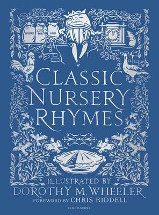
The watercolours accompanying the text in the new edition which
features an introduction from Children's Laureate, Chris Riddell,
have been restored giving the classic rhymes included in this volume
a new life while the musical arrangements created by Lucy E.
Broadwood have been kept for this new edition.
This lovely presentation of a book first published one hundred years
ago, will make any Gran happy as she recalls nursery rhymes of her
childhood and can present them to a new generation. The book
includes some old favourites, 'Little Jack Horner', 'Jack
and Jill' and 'Humpty Dumpty' and with its stunning
illustrations, redolent of books from long ago, the book is aimed at
the Christmas market.
Fran Knight
Timing the machine by Gary Crew
Ill. by Paul O'Sullivan. Harbour Publishing, 2016. ISBN
9781922134530
(Age: 9+) Recommended. Fantasy. Future. Science fiction. Time
travel. When Enoch becomes lost in the museum, he is at a loss to
even remember who he is, let alone why he is there, who his teacher
is, and how he was separated from his class. He questions himself as
he tries to find his way, stumbling over things in his path.
Bleeding, he begins to even question his own humanity, as he
continues to stagger on through the place. Mixed with time travel, H
G Wells' The Time Machine which the class is studying, a
museum full of strange offerings, Enoch's journey will intrigue all
readers. They, like him, will struggle to find out where he is and why
he is there. Sometimes there appears to be someone else in the room,
sometimes his hands become automated, sometimes he climbs large
staircases finding something at the top of the stairs that may
unravel the mystery. All lead the reader on, wanting to know about
the journey Enoch is taking. The mystical language, full of what if's
and why's, never offering an answer, will delight younger readers,
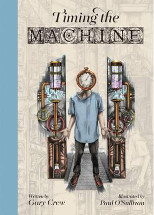
while O'Sullivan's illustrations will carry the reader into the
story, offering clues and hints, about what is going on.
This is a marvellously intriguing book, with writing that charms and
insinuates, complimented with illustrations that sometimes defy the
imagination, but always take the reader further along into a fantasy
world where time is immaterial and time travel an option.
I love the Escher style staircase, the hands that move with metallic
parts, the soaring Gothic building, the rolls of film on every few
pages that tell part of the story of Enoch looking for an answer. He
doesn't get an answer and neither do we, but the journey is
fascinating, and well worth the travel.
A sequel to The
visions of Ichabod X, which was shortlisted for the
Australian Book Designer's Award in 2016.
Fran Knight
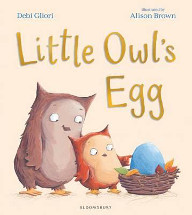
Little Owl's egg by Debi Gliori
Ill. by Alison Brown. Bloomsbury, 2016. ISBN 9781408853795
(Age: 3-6) Recommended. Little Owl is surprised and a little jealous
when Mother Owl announces there is a new baby owl inside the egg
Mummy has lain. He wants to remain Little Owl and is scared there
won't be enough of his mother's love to share with a new baby as
well.
Clever Mummy decides a walk in the woods with the egg safely in its
nest pusher will help. Little Owl is adamant: 'I'm your baby owl.
You don't need a new one'. Mummy pretends the egg will hatch
into an array of different creatures. Is it wiggly worm crawling
underground, a chocolate egg, a penguin eating a fish on the
freezing ice or a baby crocodile? Each suggestion is met with a
negative response from Little Owl, not a baby crocodile, until Mummy
suggests an elephant, and Little Owl loves the idea of water fights!
There's the suggestion of a dragon, much to Mummy's horror and a
wonderful imaginary creature who eats eighty legged snort beans and
green tubers. As they return to their home in the tree, Little Owl
contemplates all the suggestions and comes to an important
realisation that a baby owl may be the best thing of all.
Alison Brown's charming creatures take on human characteristics and
show a range of emotions as Mummy Owl and Little Owl venture through
the green woodland. Her paintings delightfully depict Debi Gliori's
humourous narrative and fantastic story. A story to share before a
new sibling arrives.
Rhyllis Bignell
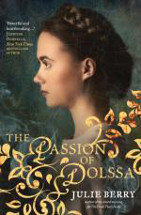
The Passion of Dolssa by Julie Berry
HarperCollins, 2016. ISBN 9781460752036
(Age: 14+) Highly recommended. Inquisition. Middle Ages. France -
History. Miracles. Dolssa de Stigata is a deeply religious girl who
believes that she must preach. Persecuted by the Inquisition and
hunted by Dominican Friar Lucien, she flees for safety and is found
by Botille, a matchmaker in a small seaside town. Hidden in Botille
and her sisters' inn, Dolssa talks to God and begins to help the
villagers. But danger stalks all of them.
This is an outstanding piece of historical fiction. Berry brings the
period and the characters to life - the deeply religious Dolssa and
her belief in God, the Friar Lucien who believes that Dolssa is a
heretic, and the three sisters struggling to make a living in a poor
inn. There is humour and heartbreak as Berry describes the daily
life of the villagers, their love and needs, as well as the horror
of the Inquisition that hangs over ordinary people and leaves a
sense of impending danger throughout the story. Botille is a
courageous young woman and her narration brings both tears and
laughter to the reader.
At the back of the book Berry gives an historical note, writing that
the historical setting is real and that 'Dolssa de Stigata's story
is based on the lives of several medieval female mystics'. There is
more information about the period and a glossary adds to the
authenticity of the narration.
This is a demanding and engrossing read, beautifully written, that
vividly describes the life and beliefs of the Middle Ages. For
readers who have problems with the ending, Berry has written a piece
on her home page: About
the Ending: Unraveling The Passion of Dolssa not to be read
until the reader has finished the book.
Pat Pledger
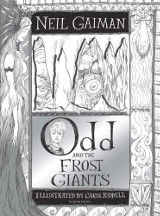
Odd and the Frost Giants by Neil Gaiman
Ill. by Chris Riddell. Bloomsbury, 2016. ISBN 9781408870600
(Age: 10+) Highly recommended. Fantasy. Myths. The story, first
published in 2009 and a World Fantasy Award Nominee for Best
Novella, has been given a new face with the fabulous illustrations
by Chris Riddell. Odd, whose name means tip of a blade, is left
fatherless when his Viking father dies after a raid. His mother
remarries but his step-father and step siblings don't want a boy who
is a cripple around. One winter that doesn't want to end sees Odd
fleeing to the forest and the old woodcutter's hut that his father
once used. There he encounters a fox who leads him to a bear that
has become trapped while trying to gather honey. Overhead an eagle
has hovered watching what was going on. Odd becomes aware that the
trio are Norse gods, who have been trapped in their animal forms by
the frost giants who have taken over Asgard the city of the gods.
Odd goes on an epic journey to find Thor's hammer and overcome the
frost giants all the while carrying a wooden sculpture that his
father had left behind.
The narrative flows along and keeps the reader engrossed in the tale
of Odd, who is a most engaging young man and whose courage in the
face of danger and disability is as strong as his resilience and
kind heart. The legendary figures of Thor, Odin, Loki and Freya are
fascinating and readers will laugh at Loki's antics and smile at the
Riddell's illustrations which make them seem life like. The
knowledge that Odd's mother had been taken from Scotland by his
father and that she had always sung songs in her own language,
provides a theme that readers will want to pursue and makes the
ending all the more poignant.
The black and white pencil drawings are stunning. The front cover
shows Frey, a frost giant and Odd, with a fabulous cut out of
icicles and when the reader opens it up there is the strange face of
a frost giant. The illustrations of the transformation of Odd from a
young boy to a tall young man and the three gods to their proper
forms are wonderful and readers will want to pore over them.
This is a story that begs to be read again and again for its
approach to adventure, Norse myths and Vikings, while the
illustrations ensure that it will be a keeper for families and in
libraries.
Pat Pledger
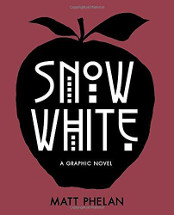
Snow White - a Graphic Novel by Matt Phelan
Candlewick Press 2016. ISBN 9780763672331
The classic story of Snow White is a dark one; her mother dies, the
wicked stepmother usurps her father's love and is jealous of her.
She survives a murder attempt and briefly finds friendship in the
seven dwarfs only to be poisoned; rescue comes only at the last
minute. This graphic adaptation embraces that darkness and imbues it
with 1920s style. It opens with the 'glass coffin' scene but here
'White as Snow' lies in Macey's Christmas window display with NYPD
crime scene tape in the foreground. The detective interviews a
street urchin, one of 'the Seven' and then the story flashes back to
the beginning. The monochrome pencil and ink illustrations and foggy
winter setting effectively suggest the coldness of Snow's life
making the rare splashes of colour quite startling. The stepmother
is a famous Zeigfeld Follies star who has enthralled her father and
the magic mirror is replaced by a ticker tape machine which seems
not only to have protected them from the stock market crash but also
to emit statements about who is the most beautiful. The Seven are a
group of motherless street urchins who protect Snow when she is
alone on the streets and take her in. When the inevitable happens,
the investigating detective is the one to give the kiss and wake
Snow adding colour to all of their lives.
The visual storytelling is multi layered. A quick read with little
dialogue but the attention to detail reveals a great cast of
well-drawn characters and an authentic feel of Depression era New
York. Not for the very young but a popular story cleverly retold. Classroom
ideas are available.
Sue Speck
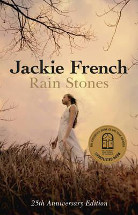
Rain stones by Jackie French
Angus & Robertson, 2016. ISBN 9781460753170
(Age: 10+) Highly recommended. Rural Australia. Drought. This newly
presented edition celebrates twenty five years since this book was
first published. With a new cover and an edition in ebook format,
times have changed, but not the charming set of stories reflecting
life for young people in rural Australia.
The opening tale, Rain stones is a story which tells of life
in rural Australia during a drought where mum must work in the town,
Helen must get tea ready while dad works on the old pump getting
what little water there is into the dam for the few sheep left on
the property. French breathes life into this scenario as Helen
strives to follow up the story about Aboriginal people bringing rain
through special stones. She asks the local historian and finds that
one of the boys in her class has Aboriginal heritage. She talks to
his father but seemingly to no avail, until both groups meet to
encourage rain. It remains a wining tale of coming together in
drought ridden Australia, and reflects values now part of that time.
In 'Afternoon with Grandma', a visit by a family to their
Grandma with Alzheimer Disease sees the two children told to go into
the garden, where they meet a girl they think is their cousin and
play with her learning all about her life and dreams. It is only
talking with their mother that they learn that their Gran's dreams
were the same.
In the third story, Ben meets Jacob at the swimming pool for lessons
and realises that he is blind, while another story concerns the
dinosaurs living in the hills around Canberra. All stories are quite
delightful, revealing the early writing of Jackie French for a new
generation of her avid readers.
Fran Knight
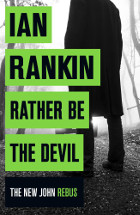
Rather be the Devil by Ian Rankin
John Rebus series. Orion Books, 2016. ISBN 9781409159414
(Age: Senior secondary to adult) Highly recommended. Cold case.
Crime. Edinburgh. John Rebus though retired, hasn't put away his
interest in crime or the criminals in Edinburgh. A cold case
stimulates his interest; the death of wealthy, promiscuous Maria
Turquand in a room at the Caledonian Hotel was never solved. Her
murderer was never found despite there being a notorious rock band
and all of its hangers on staying at the same hotel that night. Away
from the old 'Cal', Edinburgh's criminal underworld has seemingly
flexed its muscles when crime boss Darryl Christie is assaulted and
Big Ger Cafferty is the prime suspect.
Siobhan Clarke and Malcolm Fox have to put aside their differences
and work together with Rebus, not always a welcome partner in their
investigations. Christie's criminal dealings are of interest to
revenue and customs, particularly possible money laundering through
his betting shops. The fact that he's been assaulted could mean he
owes money, or there may be a takeover bid for his Edinburgh
businesses.
Rebus has a history with Cafferty so is a useful go-between for Fox
and Clarke, but is regarded with distrust by the hierarchy in the
force. He can be a loose cannon which is of course, part of his
charm.
Links between the cold case, old money and a struggle for supremacy
in the Edinburgh underworld lead the investigation in circuitous
routes, but who is pulling the strings? Is Cafferty a spent force?
Is Rebus' health a problem?
Rankin gives us the old Rebus forging ahead breaking rules, putting
himself in danger in pursuit of the perpetrators of crime, and of
course Clarke and now Fox are teamed with Rebus to make a familiar
and satisfying triumvirate. And for those who love the haunts of
Edinburgh, there are descriptions of both the known and unknown of
this city, so beloved by Rebus and his creator, Rankin.
Mark Knight
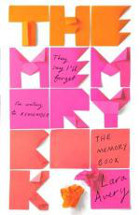
The Memory Book by Lara Avery
Quercus Children's Books, 2016. ISBN 9781784299248
(Age: 13+) Themes: Terminal illness, Dementia, family, friendship,
love, debating. In her final year of High School Samatha McCoy has
been diagnosed with the rare genetic disease Niemann-Pick Type C in
which cholesterol builds up in the liver leading to blockages in the
brain causing a type of dementia which is always fatal, usually
before age 20. Her close knit family is struggling to deal with her
diagnosis, wanting to keep her safe at home avoiding stress by
finishing the year home schooling. Academically gifted, Sam has won
a scholarship to New York University, her memory offers her the
chance to escape her small home town and emulate her feminist icons
on the world stage. Sam has to fight to retain her aspirations,
'Health stuff I can take but don't take away my future' p10. While
not socially adept Sam has strategies for fitting in and she has
found her niche at school by joining the debating team. Her
immediate aims are to win the Nationals and the give the
valedictorian speech at her school graduation. She musters all the
arguments and strategies that make her such a good debater and
fights for her goals. One of these strategies is to write a journal
for Future Sam 'the more I record for you, the less I will forget.
The more I write to you, the more real you will become' p12. In the
journal we learn about family and friends, about parties and
boyfriends, all the normal things important to 18 year old girls.
But there is also a slowing down, a movement from denial to
acceptance; a move towards family, old friends and the sights and
smells of home; a narrowing of focus worrying less about goals and
more about now.
Terminal dementia is a horrific diagnosis but we find courage,
persistence, love and strength demonstrated by the characters. The
love interest is a bit forced and the main character seems younger
than 18 but it is an interesting and emotional journey. Middle
school girls will love this book and anyone drawn to novels about
struggling with terminal illness.
Sue Speck
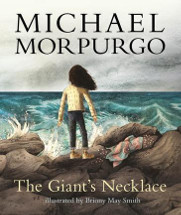
The giant's necklace by Michael Morpurgo
Ill. by Briony May Smith. Walker Books, 2016. ISBN 9781406357127
(Age: 10+) Recommended (with reservations for sensitive children)
Themes: Ghosts; Death. Young Cherry, the only girl in her family, is
keen to finish the excessively long 'Giant's Necklace' (a shell
collection on a string) before the family leaves their beachside
holiday home. Unfortunately, her focus on finishing the task
prevents her from noticing the changing sea conditions, and this
prevents her from leaving the shore safely. Her attempts to climb
the cliff to escape the wild seas leads her to the old abandoned tin
mine, where she encounters ghosts from a long ago mine collapse.
Although Morpurgo cleverly leads the reader to think this is a story
of survival, it is actually a ghost story and might be quite
confronting for readers too young to deal with the grief-washed
ending.
Morpurgo writes very engagingly with metaphor dripping from the
pages, and simple scenarios of family life revealed in a way that
children can connect to. The challenging theme of lives lost though
may mean that this is one of Morpurgo's books that may need to be
discussed with the child reader, rather than just placed in their
hands. The illustrations by Briony May Smith are colourful and in a
naive style, and perhaps may wrongly hint at a more light-hearted
story.
Carolyn Hull
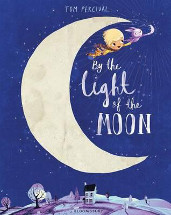
By the light of the moon by Tom Percival
Bloomsbury, 2016. ISBN 9781408852118
(Age: 3-6) Moving house is a difficult time for adults and young
children, their familiar rooms and play spaces are gone.
Ivan's old house had always been so warm and friendly. This new one
was NOT.
When Ivan cannot fall asleep in his strange new bedroom, he sits up
and stares out of his window. A magical shimmering ball of light
falls in the garden and he dashes downstairs to see what it is. Ivan
is led on a nighttime escapade past rocks, streams and flowers.
Suddenly the light changes into Moji a small friendly magical
creature, who paints the world with moonlight. Ivan becomes a brave
boy following Moji on a special adventure, up into space flying by
the stars and the moon. Moji's magic paintbrush illuminates the sky,
moonbeams shine down on Ivan's new house. Dancing through the
deepest forests and diving under the sea, Ivan's courage grows as he
holds Moji's hand.
When Moji paints the word home across the night sky, Ivan realises
that he can make new memories in his new house.
Tom Percival's computer-generated backgrounds use broad brushstrokes
in muted tones. A palette of blues, pinks, blacks and greys brings
the night setting to life, as motion lines create movement around
the stylised characters. By the light of the moon is a
gentle magical story, just right for those times when young children
need reassurance.
Rhyllis Bignell
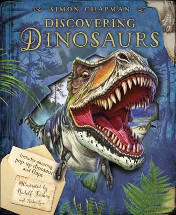
Discovering dinosaurs by Simon Chapman
Ill. by Rudolf Farkus and Mike Love. Bloomsbury, 2016. ISBN
9781408194614
(Age: 7+) Highly recommended. Dinosaurs, Non fiction, Fossils. The
spectacularly ferocious image of a Tyrannosaurus Rex on the front
cover is a winning invitation to this book with lift the flaps and
pop ups about the perennial favourite topic, dinosaurs. I can't
imagine too many people, kids and adults alike, moving past this
book on the shelf. I picked it up immediately, reveling in the feel
of this over-sized hard cover book and its thick pages revealing a
host of hidden things telling me more about dinosaurs than I had
read for a while.
Any good non fiction book is armed with a contents page, index and
glossary and these, apart from an index are offered in this book,
teaching young readers how to access information.
An introduction by Simon Chapman gives us the background and readers
will love the 'boys own adventure' lifestyle he seems to lead.
The first double page introduces the reader to the time periods
under discussion, Triassic, and the lift out flaps on each page
reveal the Jurassic and Late Cretaceous periods, placed over a map
of the world. Each double page thereafter reveals a different area
of the world and the dinosaurs particular to that area. So the first
page introduces the reader to where and when the dinosaurs first
appeared on earth, followed by the velociraptor, amongst many
others. Each double page tells us about the dinosaur with a fact box
of all those curious bits of information young children absorb. Some
pages have full page illustrations, some have many smaller pictures,
some pages have lift the flaps and some have pop outs. It all leads
to the last pages, one of which talks about their extinction while
the next tells us about fossils and what they show us. All in all a
fascinating addition to the range of books about dinosaurs which I
am sure will be well read. A forward thinking teacher, parent or
librarian might like to show kids how to use it carefully.
Fran Knight
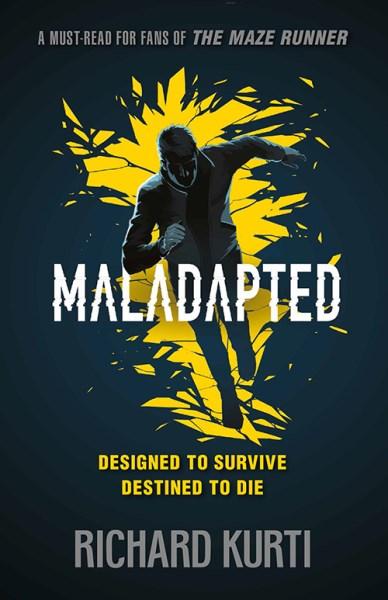
Maladapted by R. Kurti
Walker Books, 2016. ISBN 9781406346299
(Age: 13+) Recommended. Science versus Religion in this fast-paced
dystopian adventure. Cillian, a budding mathematician, is the sole
survivor of a terrorist attack on the Metro (subway). Triggered by
the trauma, hitherto untapped superpowers enable Cillian to save
himself. Sadly, his father's parting word, 'Gilgamesh', quickly
becomes his quest.
Within hours, Cillian's home is burgled and he knows he must look
for the answers to the sole clue to his real identity. But there is
another lost soul for him to meet in Foundation City. Tess is an
orphan. She was raised by an extreme religious group, 'Revelation'
who were responsible for the subway disaster and every other attack
on the high tech ruling elite. Tess is sent to observe and
ultimately destroy Cillian but the pair become friends, united by
their distaste for the extremism on both sides.
Of course the friends endure, but it is clear they have unfinished
business in Foundation City. In Maladapted, characterisation
is not one of Richard Kurti's strengths so readers looking to get to
know Tess and Cillian, will be disappointed. However, the
electrifying plot commands you to keep reading and we can expect
that the main characters will be fleshed out in the ensuing series.
Maladapted is crafted to satisfy fans of the Maze Runner
and Divergent series or similar novels in the popular
dystopian/sci-fi/horror category.
Deborah Robins