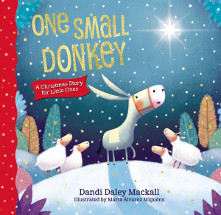
One Small Donkey by Dandi Daley Mackall and Martina Alvarez Miguens
Tommy Nelson, 2016. ISBN 9780718082475 One small donkey
Hunting for a blade of grass
Sees big horses full of power and might
Prancing proudly as they pass.
This is the story of The Nativity told from the perspective of
Joseph's donkey. Despite its apparent smallness and insignificance,
the donkey still played a massive role in this event that continues
to be celebrated around the world. Though the donkey wasn't the
biggest, fastest, or strongest of all the animals, he had an
important job all the same.
Told in rhyme, this is a way to explain the story behind all the
Christmas hype to the very young so they begin to understand what is
really being recognised at this time. With its bright pictures and
strong message that even the smallest of us has a role to play, it
will appeal to parents who want their child to begin to know this
enduring story and the common symbols associated with it including
the angels, shepherds and the birth in the manger.
Barbara Braxton
Horse of fire: Horse stories from around the world by Lari Don
Bloomsbury Education, 2016. ISBN 9781472920966
(Age: 8+) Recommended. Myths and legends. Horses. Unicorns. Short
stories. The fabulous black horse on the front cover will entice any
reader who likes horses to open up this book and dip into the
amazing array of stories about horses. As the author writes on her website,
'Any story with a horse in it has so much potential - for speed, for
power, for beauty, even for magic. Lots of the adventures I write
(about centaurs and about kelpies) are inspired by old myths,
legends and folktales about horses, so I've gathered my favourite
horse stories into this collection.'
Narrated in a conversational tone, the stories include many tales
from all around the world. Of course, the first, Pegasus and the
monsters will be one that readers will want to try immediately
as the name Pegasus has so many connotations, and they won't be
disappointed to learn about the beautiful Pegasus and the heroes who
used him to effect rescues. Another one that I really liked was the
Scottish folktale, The kelpie with the tangled mane, which
tells the story of Meg who lives beside a loch where mythical
kelpies and water bulls live. Flint Feet is a Navajo tale of
the creation of the first people and the way they used horses while
What you learn at Wolf School is a humorous story about a
wolf who thinks that he is very clever. At the back of the book, the
author has given the origins of each story and the name of a text
where it could be found, providing a good bibliography for those who
might like to further pursue their interest in these myths.
All the stories were very enjoyable and would be ideal to read aloud
to children at home or in the classroom. Independent readers who
love myths and legends as well as horses will enjoy the variety of
stories.
Pat Pledger
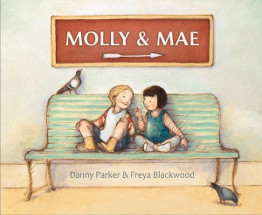
Molly and Mae by Danny Parker
Ill. by Freya Blackwood. Hardie Grant Egmont, 2016. ISBN
9781742975276
A railway station in rural Anywhere, Australia and Molly and Mae are
looking forward to their journey to the city. On the platform there
is fun to be had like hide and seek to play as they and the other
passengers wait for the train to arrive and their friendship is full
of laughter and giggles as the excitement builds. Even being stuck
in the bubblegum doesn't dampen their delight. And even as the
waiting goes on and on, there is fun to be had as they enjoy each
other's company. When at last the train comes the fun continues as
they colour in, dress up their dolls, experience the dining car, and
even do crazy stuff like hanging upside down from the seats!
But slowly as the trip seems interminable cracks start to appear as
boredom sets in. Molly thinks Mae is silly and tells her so and Mae
doesn't like it and before long the girls are not speaking to each
other, turning away and spending their time peering through the
window at the wet, smeary countryside. The whole world looks murky,
echoing their feelings. Will they resolve their spat or is this the
end of something special?
This is a story about so much more than a long train journey as it
mirrors real-life friendships - the excitement of new shared
interests, the pleasure in just being together and doing everyday
stuff and the anticipation of adventures to come. But there are also
times when it is boring, when difficulties happen and there is a
choice of building bridges and continuing on the main track or
branching off onto another one.
This is a true marriage of text and graphics. Blackwood's soft
palette and somewhat retro feel and clever headings of platform,
timetable, journey, signal failure, destination that replicate both
the stages of the journey and the development of the friendship
express Parker's concept and text perfectly and the reader is drawn
deeper and deeper into the story from the early morning endpaper
through the title page to the explosion of the big city station and
as night falls over the city. Blackwood has explained her thought
processes and choices here
showing just how much goes into such a project.
If teachers were ever looking for a book to explain metaphor, this
is it!
Would not be surprised to see this among the CBCA shortlisted titles
in 2017.
Barbara Braxton
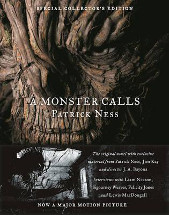
A monster calls by Patrick Ness
Walker Books, 2016. ISBN 9781406365771
(Age: 10+), Highly recommended. Death. Cancer. Nightmares. Fear.
Bullying. School. Hospitals. With this new collector's edition,
published to coincide with the film's release in 2016, extra
material is included, making this a larger heavier tome than its
first publication in 2011. Interviews with the cast, Liam Neeson,
Sigourney Weaver, Felicity Jones and Lewis MacDonald, extra
material from Patrick Ness, Jim Kay and producer, J A Bayona, stills
from the film, extra graphics from Kay, all add to the luxuriousness
of the book.
I read it from cover to cover, poring over the illustrations and
stills, reeling again at its impact. The story of one family,
particularly the lone boy and the effect of his mother's cancer,
will stop readers in their tracks as they read the tale, augmented
by the most emotive of illustrations. This is a marvelous
publication and will ensure a dedicated following of the book and
forthcoming film. My review written in 2011, follows.
From the start, the creeping menace of the Yew tree outside Conor's
window invades the imagination of the reader. The amazing
illustrations by Jim Kay storm through the book, evoking the shadow
world that the monster lives in, paralleling the world now inhabited
by Conor as he tries to care for his mother. The threat evoked by
the malice of the monster's presence is palpable, but Conor derides
its ability to make him cower in fear, as he knows something far
worse. He has lived with his nightmare for a while, waking at 12.07
each night with a thuddering heart and sick dread. His mother
sometimes stirs from her own disturbed sleep, vomitting in the
basin, or awake with the aftermath of chemotherapy.
In this phenomenal tale begun by the late Siobhan Dowd, and written
by Ness, we are treated to a superlative horror story, one that will
ensure that word of mouth impels its speed around any group of young
people from 10 to 15. Fenced in by the cancer which affects his
mother, Conor finds that he is invisible at school, his one time
friends avoid him, the bullies eventually giving up on him, bringing
his resentment to the surface. All the time, the monster calls at
12.07, telling his stories which impel him to action. His
destruction of his grandmother's front room brings no respite.
Beating up the bully, finds only compassion from the school, not
expulsion. Everywhere he turns he is pitied, not punished, and it is
only with the last story that the monster makes him understand what
he has kept hidden from everyone else as well as from himself.
Death makes its way into every family and this is the story of how
one boy deals with it in the most extraordinary way, transferring
his feelings to the Yew Tree outside the house, using it as a prop
for his emotionally charged life, coping with an absent father, a
grandmother he does not care for, and ultimately his dying mother.
What began as a horror story, pulling in the reader through its
breathtaking illustrations and storytelling, ends as an acceptance
of the reality of death and the coming together of the boy and his
mother.
Fran Knight
Undercover: one of these things is almost like the others by Bastien Contraire
Phaidon, 2016. ISBN 9780714872506
(Age: 3+) Recommended. Shapes. Identification. Similarities and
differences. The cover shows the reader clearly what will be found
on each of the pages inside the book. A set of hats awaits the eagle
eye, and readers will instantly laugh seeing the turtle as the odd
one out in a group of things that look surprisingly similar. The
stylishly presented three colour format with a clutch of things
continues on each page, prodding the reader to identify the shapes
as well as point out the oddity. Not only will they get used to
questioning what is on each page but they will identify the similar
objects shown and be able to recognise why one is different.
Identification, pointing out similarities and differences are all
important skills which the early learner needs to develop and here
is a tool which can be easily used at home or in the classroom to
further refine those skills.
The bold colours used, the humour, the wordless nature of the book,
its design, the spacing of the objects on each page, the selection
of the objects shown, all adds to the teaching credentials of the
book, and would be very handy in a classroom where the children's
exposure to these things is less than it should be.
Fran Knight
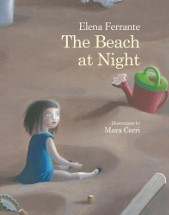
The beach at night by Elena Ferrante
Ill. by Mara Cerri. Trans. by Ann Goldstein. Text Publishing, 2016.
ISBN 9781925355741
(Age: 6+) Fable. Loss. Abandonment. Beach. This most unusual fable
for modern times is narrated by a doll, Celina, left on the beach by
its owner, Mari, besotted with her new playmate, a kitten. During
the night the doll explains what is happening on the beach, the dark
forbidding illustrations making the story feel most unsettling.
First comes the beach inspector, a gruff man who the doll does not
like, with his friend, Mr Rake. All the detritus left on the beach
is swept up into a pile and the man lights a fire. Readers will cry
out with distress seeing the pitiful bits and pieces on the beach
pulled into one pile to be destroyed. And Celina's eyes peer out at
the reader, calling for a response.
At first, Celina is warmed by the fire but after a while sees that
her friends from the beach are being affected. Bottle Cap sizzles in
the heat, Pony burns, and as Celina feels too much warmth, asks the
wave to come closer. Eventually it does and sweeps her away, away
from the man who is trying to steal her words. Eventually the kitten
finds Celina and takes her back to her owner who has cried all night
at her loss.
This unusual tale will have readers thinking about its
ramifications. A lost toy, rejected by its owner because something
has taken its place, is a familiar tale for younger readers, but the
level of horror on the beach lifts it to appeal to an older
audience. The stream of saliva taking the words from the doll's
mouth too, requires more mature refection by the reader. A
fascinating story well worth a look and offered to more mature
thoughtful readers.
Fran Knight
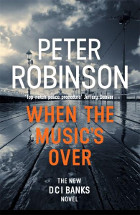
When the music's over by Peter Robinson
Hodder and Stoughton, 2016. ISBN 9781444786729
(Age: senior secondary to adult) Highly recommended. Crime fiction,
Cold case, DCI Banks, Rape, Celebrity crime, Racism, Prostitution.
When DCI Banks is promoted to Detective Superintendent, his first
case is likely to be his last at this posting because of the high
profile of the accused. He is to investigate an accusation of rape
against an under age girl which happened in Blackpool in 1967 by a
television and stage show celebrity now long retired. Having to
interview this man, now in his mid eighties, as well as the accuser,
takes all Banks' patience and stamina. The woman has not called this
out lightly, but the recent exposure of such people as Rolf Harris
and Jimmy Saville has brought it all back. And the police have
several other women come forward with similar stories. During this
investigation, Banks comes across the suspicious death of Caxton's
road manager in the same year, and this creates another level of
investigation which Banks finds was under-investigated, the paper
trail now no longer able to be found.
Meanwhile Annie Cabot is called to investigate the death of a young
girl, seemingly thrown from the back of a van, naked, in an out of
the way minor road. The investigation into her background reveals
connections with a group of Muslim men and so the cry of racism
stirs up some of the populace of Eastvale. But her short life is
exposed as one of a number of girls, groomed by these men to perform
sexual acts for them and their friends, part of a network across the
north of England, paralleling the sex abuse cases brought to court
in Rochdale, Bristol and others in England in the past several
years.
Both stories are disturbing, showing the level of sexual
exploitation that occurs within our community against vulnerable
women. And in some cases how personal influence keeps the stories
from being brought into the public eye. The women are all under age,
and those groomed for sexual exploitation from dysfunctional and
lower socio-economic communities where grooming can be done easily
at a local take away where young people gather. Both stories dove
tail each other, reflecting some of the nastiest aspects of
communities that I have read. Banks and Cabot and the usual
entourage keep unearthing evidence and piecing things together to
the satisfaction of all readers. And their investigations led me to
research the cases alluded to in the book, although with a great
deal of trepidation.
Fran Knight
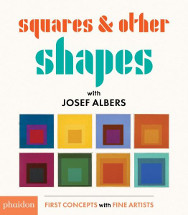
Squares and other shapes with Josef Albers
Phaidon, 2016. ISBN 9780714872551
(Age: 2-6) Recommended. Art, Board book. In the series, First
Concepts with Fine Artists, this board book reveals a series
of shapes through the art of twentieth century Modernist, Josef
Albers. On each page is an example of his abstract paintings: a
square, squares within square, rectangles, circles, lots of circles,
triangles and many triangles. Each page shows a bright illustration,
revealing a shape or series of shapes for children to recognise.
They will eagerly tell the adult reading the book what each shape is
and delight in the image given them. The adult reader will be able
to encourage their enjoyment at recognisinsg the shapes shown and
with their increased understanding of fine art. This is the first
book in the series, the second being Blues and other Colours
with Henri Matisse.
Each of the books presents an artist to the younger reader in a way
that will encourage identification, discussion and interaction.
Fran Knight
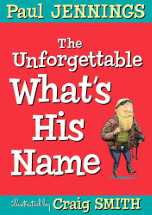
The unforgettable What's his name by Paul Jennings
Allen & Unwin, 2016. ISBN 9781760290856
(Age: 9+) Highly recommended. The unforgettable What's his name
explores what it is like to be invisible. The main character is
commonly referred to as 'What's his name' and feels like nobody sees
him. He has no friends. He feels like he doesn't belong. In a moment
of stress, he blends into his environment to escape a group of angry
bikers. He literally becomes the bush he is standing in front of. He
then blends into a wall and then becomes the tree. Eventually, he
can change at will. Mum doesn't believe him and his new biker friend
thinks he is a bit strange. Along the way, our main character makes
friends with a dog and rescues a group of monkeys. Maybe you can be
quiet and shy but still be amazing! The unforgettable What's his name is an adventure as well as
a trip of discovery for our young main character. Readers will not
find out his real name until the end. The story is thoughtful,
dramatic and funny. It is full of adventures and discoveries,
proving it is okay to be yourself and there is no need to change.
The text is descriptive, with just enough suspense to keep readers
wondering what will happen next. The accompanying illustrations are
detailed and colourful and readers can see if they can find the main
character as he changes and hides. The unforgettable What's his
name is a thicker novel at over 200 pages but it is still
ideal for more reluctant readers thanks to the illustrations. Highly
recommended for all readers aged 9+.
Kylie Kempster
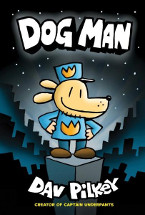
Dog Man by Dav Pilkey
Scholastic, 2016. ISBN 9780545581608
(Age: 8+) Recommended. Dog Man is a book that looks like a
novel, has a lovely illustrated cover - this was in a hardcover, but
is a comic. A quick flick through the book and you will see bright
illustrations and speech bubbles telling the story. Reluctant
readers aged 8+ will thoroughly enjoy this story as some pages don't
even have writing to read. It is also great for younger children
experimenting with their first novel style books or for older
readers with lower skills (they look like their mates).
Dog Man is a dog-headed policeman and is created by the author of
the Captain Underpants series. That alone lets readers know
they are in for some funny stuff. The story starts with how Dog Man
came to be. This is quite hilarious and the colourful drawings
explain the silliness well (you will have to read it to find out).
Now Dog Man might be a man with a dog's head and the villains might
keep trying to ruin his day but Dog Man always saves the day. Read
each new and hilarious chapter and find out how Dog Man fights
vacuum cleaners and robots while still saving the day and annoying
the police chief all at once.
Kylie Kempster
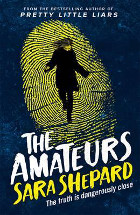
The amateurs by Sara Shepard
The amateurs bk. 1. Hot Key Books, 2016. ISBN 9781471405266
(Age: 15+) Some strong language. Mystery. Alcohol. Parties. Aerin's
sister Helena had been brutally murdered years before and when a
group of young people who belong to an online forum, Case not
closed, turn up on her doorstep offering to investigate the murder,
things begin to get out of hand. The amateur sleuths, Seneca, Maddy,
Madison and Brett all have different talents and together they begin
to unravel the truth.
This was quite a suspenseful plot and very intriguing to begin with.
I enjoyed the idea of the amateurs having a go at solving the crime
and having more success than the police had originally. Seneca was
the most interesting and well fleshed out character, but the others
were often immature and not very likeable. The romances between the
main characters didn't really jell and I found the constant partying
and some sexual innuendos off-putting. As the action progressed, the
country club scene and the wealth of the participants began to
become tiresome, but this may well appeal to a teen audience.
There were a succession of suspects, many red herrings and a
surprise ending which will lead to a second in the series.
Pat Pledger
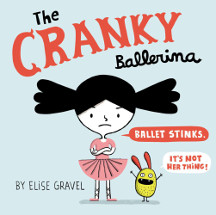
The cranky ballerina by Elise Gravel
Katherine Tegan Books, 2016. ISBN 9780062351241
Ada does not look forward to weekends, particularly Saturdays,
because Saturday is ballet day and she HATES ballet. Her
leotard is too tight and her tutu too itchy and as for the moves she
is forced to do and practise and practise... as she says,
'Arabesques are GROTESQUE.' As for pirouettes - well! Even with her
little monster sidekick who tries to offer support and
encouragement, she just doesn't like it. For Ada, it is definitely
NOT a case of 'practice makes perfect'.
But one Saturday morning when she is trying to please Miss Pointy
she pirouettes right out the door and into a whole new world, one
where she fits perfectly.
Across the world, Saturday mornings see young girls and boys going
off to do things like ballet and music and sport and so on because
their parents think they should, or they should enjoy them or the
parents are reliving their dreams, but how many are like Ada and
have no aptitude or passion for the activity? Many were the
freezing mornings I cycled many miles to piano lessons thinking of
excuses for not having practised until my long-suffering teacher
told my mum she was wasting her money. Based on the creator's one
disastrous attempt at ballet when she was four, this story will
resonate with those whose abilities, talents and interests lie
beyond those that they are expected to do.
The illustrations are very expressive - even the youngest non-reader
can tell that this is a story about an unhappy child who seems to
have a permanent scowl and for all their apparent simplicity, the
feelings of Miss Pointy and the other girls are very obvious.
With a predominantly gentle colour scheme, lime greens and bright
reds punctuate Ada's discomfort along with speech bubbles and
onomatopoeia giving it a fast pace that will encourage young readers
to read it for themselves independently without much trouble. The
final page is perfect.
Barbara Braxton
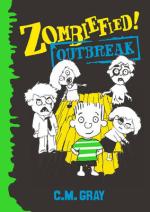
Zombiefied! Outbreak by C M Gray
Harper Collins, 2016. ISBN 9780733334238
(Age: 7+) Highly recommended. Zombiefied! Outbreak is book
three in the series and finds our main character, Ben, facing yet
another challenge. Since becoming a half zombie, Ben has had many
adventures and has been getting use to his new strength and infrared
vision. Unfortunately, Ben's brother is missing and zombie hunters
think Ben has attacked him. Ben is tricked into an underground room
where he discovers the hunters are his best friend's parents! What a
plot twist. Will Sophie defy her parents' orders and set him free?
While these events are occurring, a teacher is also watching Ben's
every move. Why does he seem to be everywhere Ben is? Does he have a
secret? Is he a zombie hunter or is he the Lurker (the zombie who is
very human and turns humans into zombies)? It is a race to find
Ben's brother and keep Sophie's parents safe. Zombiefied! Outbreak is a quick moving, hilarious tale. At a
time when zombies are popular, the story is an age appropriate and
engaging version for younger readers. The text is easy to read, the
characters are quirky, the events are funny and there is something
for everyone in the book. It is highly recommended to readers aged
7+ and will make a great addition to a school or class library. The
novel is also recommended for older students who want to read
popular fiction but are limited with their decoding skills.
Kylie Kempster
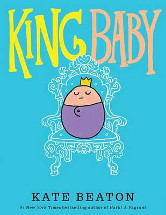
King baby by Kate Beaton
Walker Books, 2016. ISBN 9781406371758
(Age: 4+) Highly recommended. Babies, Family, Humour. No-one will be
able to hold back tears of laughter as the baby in this story is
shown at the centre of all that goes on within the family. We all
have experience of how a baby disrupts the orderly routine of the
household, and how it becomes the centre of everyone's attention,
but this wonderful picture book shows this with infectious wit and
humour. The proud parents show off their offspring to all visitors
in the first double page. They are all entranced, taking photos,
gurgling, cooing, holding, watching and kissing. But then it starts.
The demands come thick and fast: feed me, burp me, carry me and
change me, until the parents are exhausted, surrounded now not by
the neat, orderly house but a mess comprised of a load of baby
detritus.
I love the way the seemingly simple illustrations detail the baby's
moods and behaviors : aggression, boredom, smugness, contentment,
demanding and so on, all with a stroke of the pen for his mouth. His
crown is firmly stuck on his head as he goes from one development
stage to the next, despite his weary parents, but another story is
growing in the background in the last few pages, designed to knock
the crown from his head. I laughed out loud, with sniggers of
recognition at a baby's unfailing self centredness. This is a joy.
And an excellent read aloud and sharing story for younger readers
and adults alike.
Fran Knight
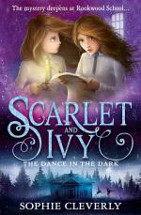
Scarlett and Ivy: The Dance in the Dark by Sophie Cleverly
Harper Collins Publishing, 2016. ISBN 9780007589227
(Age: 10+) Highly recommended. Scarlett and Ivy: The Dance in
the Dark is book 3 in the series. It refers back to the events
from book 1 and 2 so they are not needed to understand this story
but book sets are always good to read from the beginning. Scarlett and Ivy: The Dance in the Dark finds Scarlett and
Ivy, twin sisters, back at their boarding school Rookwood
after the evil principal has been removed. Everyone is hoping things
will get back to normal until the ballet teacher mysteriously
disappears, a strange (almost threatening) message is left on a
board, the horses are let out and a student is pushed from a window.
What is going on at Rookwood School? Are the girls and other
students safe or has the terror started again? Who is the Mistress
Zelda and what does her suspicious behaviour have to do with it all?
Can Scarlett, Ivy and their best friend Ariadne get to the bottom of
another mystery before someone else is injured? Scarlett and Ivy: The Dance in the Dark is an easy to read
novel with a quick moving storyline. It is also easy to follow and
easy to find favourite characters. The characters are a mixture of
different personalities and the subplots make the story interesting.
Readers will also cheer for Ivy as Penny (the bully of the story)
picks on her. They will cheer for Scarlett who just wants to protect
everyone. They will wonder who is behind all of the troubles but can
they read the clues and pick the instigator? The themes are well
suited to readers aged 10+ and is highly recommended for girls.
Kylie Kempster