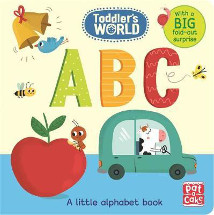
Hodder and Stoughton, 2017. ABC. ISBN 9781526380029 123. ISBN 9781526380050 Colours. ISBN 9781526380043 Animals. ISBN 9781526380036 On the Move. ISBN 9781526380012 Funny Faces. ISBN 9781526380005
(Age: 1-3) Recommended. 2017 has seen the release of six new
toddler's world learning board books from Pat-a-cake. Titled
ABC, 123, Colours, On the Move and Funny
Faces, each book is sturdy, vibrant, full of pictures and
ideal for very young children. Each page is filled with simple and
colourful illustrations paired with very simple wording. Pages are
thick and strong which is perfect for excited little hands. At the
end of each book, children are surprised with a large pop-up which
is a wonderful conclusion to each theme. Additionally, Funny
Faces has a 'look and laugh' mirror which is said to stimulate
baby's vision and help recognize the faces of the people they love.
Overall, the six books in the release are wonderful additions to a
toddler's library as they are excellent early learning resources.
Keely Coard
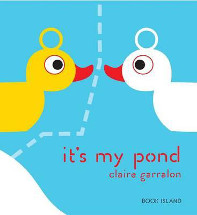
It's my pond by Claire Garralon
Translated by Sarah Ardizzone. Book Island, 2016. ISBN
9781911496021
(Age: 4-7) Recommended. It's My Pond follows a number of
different coloured ducks who claim 'it's my pond' until black duck
helps them realize that it can be everyone's pond.
With repetitive text, it can be used as a potential take-home reader
for slightly older ages, but additionally is a good resource for
children learning their colours and counting.
Keely Coard
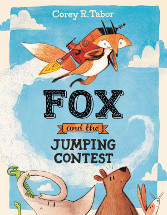
Fox and the jumping contest by Corey R. Tabor
Balzer and Bray, 2016. ISBN 9780062398741
The animals are having a jumping contest - Elephant, Bear, Rabbit,
Turtle, Frog and Fox have all entered - and Fox is determined he
will win. He even imagines how good the trophy will look perched on
his mantlepiece.
But Fox isn't particularly good at jumping so he figures if that
trophy is going to have pride of place in his loungeroom he will
need a bit of assistance. So while the other animals practise, he
schemes and plans and builds. His solution? A jetpack that he paints
to match his fur hoping the other animals won't notice - so it is
clear that he knows he is cheating.
On the day of the contest with the bird judges all ready and perched
high in the branches the animals show their talents. Frog does well
and gets extra points for style; Turtle doesn't do as well and
Elephant less so. Bear was loud and Rabbit was spectacular. And then
it was Fox's turn . . .
This is a story with a twist, and it's a twist that can spark some
great discussion points which are perfect for getting young children
to start to think critically, to philosophise and to empathise. Fox
with his jetpack strapped to his back disappears so high in the sky
that the judges can't wait for him to return so they begin the
awards ceremony. But just as Rabbit is about to receive the trophy,
Fox falls back to Earth and plops into it and takes first place. The
final scene shows Fox standing back admiring the cup on his
mantlepiece, right where he had envisioned it would be.
But does Fox deserve it? Has he cheated? Were there written rules
about external assistance or were they just assumed? Why do we have
rules? How do the other animals feel about the win? What about
rabbit? Has there been fair play and sportsmanship? What is the
twist in that final scene and was it a reasonable way to solve the
problem? What does 'compromise' mean?
Careful exploration of the text, verbal and visual, offers a lot of
depth to this story and it deserves re-reading to get the most from
it. For example, Elephant doesn't mind that she cannot jump well
because she is "good at other things" and that in itself could
provoke another discussion about how we all have our strengths so
comparisons are not always fair. Even very young children have a
strong sense of justice and with the pictures enriching the words so
well with their extra detail and action there is much to examine and
ponder.
Life and literature are full of characters who are determined to win
regardless and this is a surprisingly good story that can introduce
even very young children to contemplate, at their own level, the
philosophical question of does the end justify the means and giving
them an opportunity to start thinking on a more abstract level, from
different perspectives and consider what is not being said.
One to get brains moving . . .
Barbara Braxton
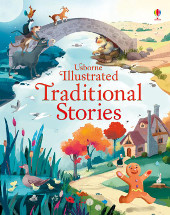
Usborne illustrated traditional stories
Usborne 2016. ISBN 9781409596721
This is a collection of 17 stories from around the world that have
been passed on from generation to generation so they are now part of
our literature but which don't fit into the fairytale
classification. Stories like The Boy who Cried Wolf, The
Gingerbread Man, Baba Yaga and The Little Red Hen
sit alongside not-so-well-known ones like Tam Lin and The
Fisherman and the Genie.
With lovely illustrations throughout and with a luxury padded
hardback cover, this is one of those must-have volumes in your
teacher's toolkit that you can take out and share whenever there is
a spare minute or two, continuing the tradition of passing them on
to a new generation.
Newly independent readers will also enjoy them as the familiar
stories, larger font and short story format will make them an easy
bedtime read. This series is filling a niche for younger readers
that has been empty for some time.
Barbara Braxton
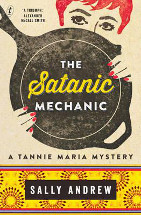
The Satanic mechanic by Sally Andrew
Text, 2016. ISBN 9781925355130
(Age: senior secondary to adult) Highly recommended. Crime fiction,
South Africa, Food. Tannie Maria is out of her depth. She cooks
beautifully, and often recommends recipes from her beloved Klein
Koroo and her family to her love lost correspondents at the Klein
Koroo Gazette where she works as the Dear Jane writer. The letters
she receives fill her with love for these people who have a need to
write to someone with their problems and her advice often begins and
ends with food. But she cannot solve her own problem. She has a
boyfriend, Detective Henk and they get along very well, particularly
after their involvement in the first of these novels, Recipes
for love and murder (2015). But try as she might, the final
act of love brings back so many painful memories of her abusive
husband who died some years before, that she cannot feel anything
but guilt and powerlessness at the thought.
She confesses this feeling and is advised to seek counseling and
ends up at an unusual PTSD group run by a man called the Satanic
Mechanic. Here the group sits in a circle in the middle of a laager
made by beat up rusting cars and vans grouped around a fire which
often holds food cooking for them to eat after each session, and
here they tell their stories. But someone is not who they seem, and
one man is killed during the evening.
The recent murder of a Bushman who took a mining company to stop the
desecration of their land, has caused anger amongst the community.
Detective Henk is investigating this murder and does not want Tannie
Maria to be involved, but with the death at the counseling group,
she is involved.
He breaks off their relationship because he cannot bear to see
another love die, and Tannie Maria accepts his decision.
But a last meeting at the PTSD group sees the resolution of the
murders and Tannie Maria at last confessing her guilt at her
husband's death.
This is a wonderful tale from South Africa, involving many
ingredients: a mining company and its plunder of Bushman land,
jealousy and guilt, counseling and PTSD. And above all, Tannie
Maria's marvelous recipes. The second book delves more into her back
story and brings this wonderful cook even closer to the readers.
Fran Knight
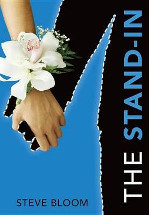
The stand-in by Steve Bloom
Carolrhoda Books, 2016. ISBN 9781512410235
(Age; 14+) Highly recommended. Bildungsroman. Brooks Rattigan is the
stand-in and the book's narrator. Desperate to be accepted into
Columbia University AND able to afford the fees, working class
Brooks founds his own business, escorting rich nerdy graduates to
their dances and formals. Celia Lieberman does not approve of the
date her parents have arranged and behaves much like Caterina in
Shakespeare's The taming of the shrew. The ending is thus
foreshadowed.
Complications arise when Brooks' best friend, The Murf, feels that
Brooks is abandoning his roots. He doesn't approve of Brooks' blind
ambition to attend the elite university, or his method of funding
it. Brooks' deadbeat father, himself a Harvard graduate, lets him
down and discourages him. Brooks is also attracted to a very
shallow, very beautiful high society girl. To make matters worse,
Shelby has a very jealous ex-boyfriend.
After a few initial spats, during which Celia is a very ungracious
date; she becomes the only person who is demonstrably supportive.
Both Celia and Brooks develop into the kind of friends who can rely
on each other. This is important because, much to our delight, no
two characters in fiction could possibly experience quite so much
bad luck.
Steve Bloom's concept is fresh and no doubt the movie rights have
already been secured. The characters and their relationships are
hilarious because Bloom knows exactly what they should do and say.
Brooks is sometimes inspiring - at others contemptible but we must
like him. We admire his grit to succeed in the face of failure - to
respect women yet exploit their situation at the same time. Most of
all we like that he falls for the one girl he started off hating.
Brooks Rattigan is a paradox and so are we.
Deborah Robins
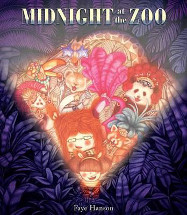
Midnight at the zoo by Faye Hanson
Five Mile Press, 2016. ISBN 9780763689087
(Age: 4-7) Recommended. Faye Hanson's beautifully created,
intricately detailed and vibrant colourful illustrations add to the
delight of reading Midnight at the zoo.'
Max and Mia's class are off to the zoo for an exciting adventure.
They've studied the map presented at the beginning of the story and
hope to see the ring-tailed mongoose, the red pandas and the
flamingos.
In their loud animal print bedroom with the 'Explorashon HQ' tent,
the brother and sister prepare for their special day. They are
definitely animal fans; everything in their bedroom has a pattern or
design, from their backpacks to pyjamas. In the morning, Max and Mia
'trundle like elephants to the car, cling like monkeys' to say
goodbye to Mum and even nibble their early snacks like lemurs.
Twenty excited children and one wide-eyed teacher enter through the
zoo gates filled with excitement. 'But not the flick of a tail or
swish of a whisker can be seen.' After a very disappointing day, the
teacher leads her class towards the exit. Without a headcount,
eighteen students and the teacher board the bus, whilst two are left
behind. Max holds his sister Mia's hand and with a torch from his
backpack, they look for a way out. In front of them, a locked wooden
door appears; what are they going to do?
As the clock strikes midnight, they are welcomed into another world
filled with animated creatures, fiery fireworks and fantastic
scenes. They discover flouncing flamingos, mischievous monkeys,
lanterns illuminating laughing lemurs and kingly cats. Max and Mia's
fantastic night-time adventures end with a comforting sleep nestled
in the fur of a majestic lion and lioness. Daytime comes and as they
reunite with Mum, they cannot wait to share their amazing adventure.
Fay Hanson's lively story Midnight at the zoo is filled with
fun alliteration and with charming descriptions. At times, the blue
text is hard to read as it blends in to the black of the night
scenes. Teachers reading this to a class may question the ratio of
one adult to twenty excitable children and the idea that she did not
know about Max and Mia's problem! The story ends with a magnificent
midnight map of the zoo, fountains of fireworks, colourful costumes
and dancing animals are illuminated.
Rhyllis Bignell
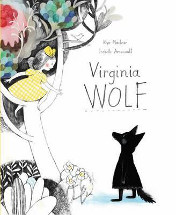
Virginia Wolf! by Kyo Maclear
Ill. by Isabelle Arsenault. Book Island, 2017. ISBN 9781911496038
(Age: 6+) Highly recommended. Mental health, Depression, Virginia
Woolf. With nods to The yellow wallpaper (Charlotte Perkins
Gilman 1892) on the endpapers, the story of Virginia's slide into
depression, becoming a wolf, is handed with such clarity that even a
younger reader can see what the story is about. They do not need to
know the story of Virginia Woolf or the book The yellow
wallpaper, but these echoes are there for older readers and
adults to recognise and perhaps seek out.
Vanessa is dismayed when her sister begins to sound like a wolf. She
keeps to her bed, growling at any attempt to calm her, her ears seem
to grow larger, she is disinterested in anything and everyone around
her, she tells everyone to leave her alone.
Akin to several books I have recently read, I need a hug!
(Aaron Blabey, 2015), Blue whale blues (Peter Caenavas,
2015), Mr Huff (Anna Walker, 2015) and Small things
(Mel Tregonning, 2016) each book in its own distinctive way tackles
depression in children and young adults. Each book could be used in
a group showing the readers that they are not alone, that others
feel like this too, with all books depicting the child overcoming
their low days with open communication and support from friends and
families.
Vanessa takes to her paints, making the walls in Virginia's room
bright and alive with colour and flowers, taking the word,
Bloomsbury at its basic meaning. Her continued support helps
Virginia overcome her depression, the ears disappear, she gets out
of bed, she becomes a smiling happy child again, and together they
leave her room to go out and play.
The illustrations showing Virginia often in shadow or a lump in the
bed, reflect the lack of happiness in her life. As the flowers
unfold, the trees become higher, the flowers brighter, the ladder is
extended out of the room and into the sunshine, into the world
outside. These will entice young readers to look at the reasons the
illustrator has included some of the things shown. I just love the
page starting with 'The whole house sank' with its topsy turvy view
of the girls amid various objects, repeated near the end of the book
with the line, 'The whole house lifted' with the same illustration
shown from a different perspective. Illustrators that make you think
and explore make a huge contribution to the success of a story, and
this is a wonderful example.
First published by Kids Can Press in Canada in 2012.
Fran Knight
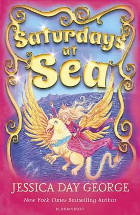
Saturdays at sea by Jessica Day George
Castle Glower series bk. 5. Bloomsbury, 2017. ISBN
9781408878248
(Age: 8-11) Recommended. Saturdays at Sea is the fifth and
final instalment of the wonderful, fantastical Castle Glower
series! Fans of Jessica Day George's imaginative stories will be sad
to reach the conclusion and with two more days to go - Sunday and
Monday there are opportunities for a return to Castle Glower and a
wedding or two to take place.
Written like a three act play, the story is firstly set in the
flamboyant and exquisite Royal Palace of Grath and the picturesque
seaside kingdom. The royal family and their entourage including
their magnificent griffins visit the Kingdom of Grath for the
upcoming wedding of Lilah and Lulath. They are also there to build
the ship from pieces from all the kingdoms including magical pieces
from the Castle Glower. Initially the ship builder Master Cathan
refuses to use the other materials until Celie speaks up; she
understand the reasons why the enchanted item need including.
The Grathian royal family are obsessed with customs; they change
clothes continually, have hundreds of dogs, a multitude of beautiful
rooms and speak in a rather poetic way. While the Castle Glower
family are used to a different style of talking and dressing, they
realise they must be accommodating for the sake of the engaged
couple. When Grathian Prince Orlath returns from his sea adventures
with his pet monkey, things begin to change. Celie, Pogue and Rolf
assist the prince with the shipbuilding and Celie's feelings of
missing Castle Glower are eased.
Lilah's quest to find the lost village of the unicorns directs the
second act of the story. After the wonderful festivities of the
betrothal celebrations, The Ship is ready for the maiden voyage.
This enchanted vessel determines its own course and there is nothing
to stop it. With Queen Celina's magic and her clever planning, they
are able to survive. Their time aboard the speeding ship proves
interesting. Magical places, mystical islands, trading ports,
overcoming dangerous conditions and griffin rides make the second
and third acts exciting.
Jessica Day George's fantasy series is an exciting and engaging read
that leaves fans wanting to read about Celie and Pogue's future and
witness the spectacle of Lilah and Lulath's wedding.
Rhyllis Bignell
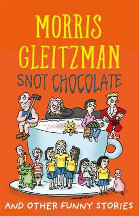
Snot Chocolate by Morris Gleitzman
Puffin Books, 2016. ISBN 9780143309222
The blurb reads, "Stop your mum picking her nose, read the secret
diary of a dog, catch a bus and then let it go, discover how one
slice of toast can make you the most popular person in school, start
wearing a crown and give up eating pig-nostril gruel, use a wrecking
ball to defeat a bully, show your big sister the very scary secret
in your wardrobe, unleash the awesome power of chips, live in a
house that gets wiped clean more often than a bottom."
But there is so much more to this collection of short stories from a
master storyteller who seamlessly switches between the poignancy of
Two weeks with the Queen, the gaiety of Toad Rage and
the seriousness and sincerity of the Once series. Gleitzman
himself says, "Nine stories, and I've made them different lengths
because different parents have different ideas about how long a
person should be allowed to read before turning the lights out."
With a title designed to attract that reader who loves to makes sure
parents and teachers have a stomach-churning moment when they see
it, nevertheless there are serious undertones to each as the central
character of each tries to grapple with a big problem affecting
family or friends using a thought process and logic that are
particular to that age group. Creativity is alive and well in
children - until the formality and seriousness of school try to
quell it.
Along with Give Peas a Chance and Pizza Cake, these
stories which give the author "a break from the stiff neck and stiff
brain you sometimes get writing book-length stories" might seem a
long way from the stories Gleitzman commonly crafts and which he is
so valued for, but as he says, he would "hate to forget that in
stories a laugh can have a teardrop as a very close neighbour."
However, despite the sombre notes this is a collection that will
keep those newly independent readers, particularly boys, reading and
help them transition to the next phase of their reading journey -
which will probably be a Gleitzman novel - as they show that even
short stories with wicked titles can have great, credible characters
and a depth of plot that makes reading so worthwhile.
Parents, teachers and teacher librarians are blessed to have such a
gifted writer as Gleitzman on their side.
Barbara Braxton
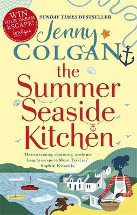
The summer seaside kitchen by Jenny Colgan
Little, Brown, 2017. ISBN 9780751564808
(Age: 16+) Recommended. Romance. Scotland. Environment. This is the
first book that I have read by Jenny Colgan, a Sunday Times top ten
bestselling author, and I found it immensely enjoyable. Flora is
living in London, trying to cope with her job and city living and
crushing on her boss, Joel. When she is asked to go back to Mure,
the isolated Scottish island where she grew up and where people
refuse to forget her past, she is uncertain but knows that she can't
refuse. Her firm's rich client wants to stop a wind farm spoiling
his view and her boss thinks that she can influence what happens on
the island with her insider knowledge of people and their
motivations.
Arriving back home, Flora has much to contend with - her father
seems to have grown smaller and more introverted and her three
brothers aren't very happy. Soon she finds herself immersed in
family life and the discovery of her mother's recipe books leads to
a love of cooking and also the opening of a little shop on the
harbour.
Although essentially a romance, Colgan keeps the reader guessing
about who Flora will end up with and the background of the island's
politics and personalities play an important part in Flora's
realisation of where she wants her future to lead.
The wonderful setting of a quiet Scottish island adds interest as
its inhabitants struggle to keep their young people on the island
and try to ensure that the millionaire building a resort actually
employs some of the islanders.
This is a feel good book, peopled with relatable characters and
events. Its warmth and uplifting plot made it very readable. I will
certainly follow this author in the future when I want to enjoy a
good escapist romance.
Pat Pledger
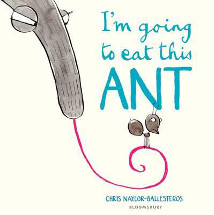
I'm going to eat this ant by Chris Naylor-Ballesteros
Bloomsbury, 2017. ISBN 9781408869901
(Age: 4+) Highly recommended. Ants. Anteater. Food. Cooking.
Anteater is hungry. He is sick of licking up wriggly, squirmy ants,
but he is hungry. He puts all of his efforts into just one ant - the
trouble is that it is the wrong ant. This ant is cunning and ties
the anteater in knots avoiding being licked into his mouth. This
very funny look at the contest between an anteater and his quarry
will have kids rolling in the aisles as they watch the contest
between the eater and the (usually) eaten.
Anteater imagines all the different ways he can eat this ant: in a
sandwich, sucked up through a straw, simmering in a soup, stir
fried, or in a sorbet. But the ant has other ideas. While anteater
is dreaming up the different ways of eating the ant, his long tongue
has been wrapped around a tree, making it an excellent bridge for
the ant and his friends.
Boldly outlined but spare drawings give a good impression of the
antics behind the words, and small differences in the way the eyes
are drawn for both creatures tells the readers lots about what they
are thinking, adding to the laughs for the readers.
They will learn lots about the two animals and the story will have
them seeking out more information, while the list of ways the ant
will be cooked will find favour (flavour) amongst the readers.
Fran Knight
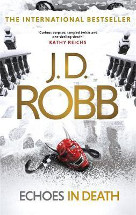
Echoes in death by J.D. Robb
In death bk 44. Little, Brown, 2017. ISBN 9780349410869
(Age: Adult) Murder. Fans of J.D. Robb will be thrilled with the
44th book in this series featuring Lieutenant Eve Dallas and her
cohort of helpers, including gorgeous husband Roarke. Eve and Roarke
are on their way home one night when a young woman stumbles into the
street in front of them. She has been attacked and her attacker
looked like the devil.
Investigating, Eve discovers other attacks have occurred, all with a
violent rape and burglary but this time the attack has resulted in
murder. It is clear that the man behind the masks is becoming more
violent and it is imperative that Eve finds him before more people
are murdered. Eve and Peabody and the rest of her team, ably
supported by Roarke, gets to grips with the backgrounds of the
wealthy people who are being targeted, and the reader easily gets
caught up in the police work involved in solving the crimes.
Witty repartee between Eve and Peabody gives a lift to the often
dark moments in the book, and the steady and deep relationship
between Eve and Roarke is as satisfying as ever. A theme of domestic
violence and how it affects women pervades the book and gives the
plot depth and complexity.
Books in the In depth series are always rewarding reads and
ones that fans know they will enjoy.
Pat Pledger
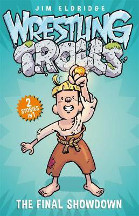
Wrestling Trolls: The final countdown by Jim Eldridge
Hot Key Books, 2015. ISBN 9781471402692
(Age: 7+) Highly recommended. The Final Countdown is book 6
in the series that sees Jack, a half troll and a prince, travelling
with his friends, a talking horse and a phoenix. They follow the
wrestling matches around the country and are quite famous for their
wrestling skills. This book is 2 stories in one. In the first story,
Jack receives a message for help from his grandfather. Despite being
a rather unkind person, Jack decides he needs to help his
grandfather. On arrival in the town, near where Jack's grandfather
is being held, villagers try to stop Jack and his friends. Luckily,
Jack gets to the castle but it is not his grandfather who is there
to meet him. Jack has been tricked by the wizard named Wazza. Wazza
is waiting for Jack and he wants Jack's ring. How will Jack get
himself out of this mess?
In the second story, Jack and his group of friends head to Veto
castle to help the orcs. The orcs are being kicked out of their
kingdom by a mean troll who has claimed the throne. Ironically, Veto
castle and the surrounding land is Jack's kingdom. He just doesn't
want it. Jack's friends Dunk and Big Rock are arrested by the troll
guard. To free them and save the orcs, Jack must wrestle the new
king. Unfortunately, Jack's ring has been stolen. This ring helps
him turn into a troll. How will he beat a troll in a wrestling match
without it? The Wresting Troll stories are fun and entertaining and
highly recommended for readers aged 7+. The characters are quirky
and the adventure moves quickly. They are easy to read and new
readers don't have to read them in order as each story is separate
from the previous one. The wrestling troll theme is a great way to
engage reluctant readers who are wrestling fans.
Kylie Kempster
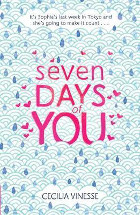
Seven days of you by Cecilia Vinesse
Hachette, 2017. ISBN 9781510200395
(Age: 13+) Seven days of you is a beautiful story about
Sophia's last week in Tokyo before her big move back to the United
States. This move was always planned and Sophia and her sister were
accustomed to flying back and forth between their mother and their
father throughout their childhoods. But this move was different for
Sophia, from the first instant that she set foot in Tokyo a couple
of years before, she knew that she'd find some sort of a home here.
Through the years, Sophia became friends with Mika and David and
they were the anchors within her life in Tokyo, lasting up until the
week Sophia is set to leave. Mika's old best friend James is set to
return from an American Boarding school exactly seven days before
Sophia departs. After some complications at the last time they saw
each other, Sophia is less than pleased to be seeing him again.
Through some significant events within the lives of all the friends,
enemies become allies and best friends become distant strangers. How
much will change in the last seven days leading up to Sophia's
flight from Japan, and who will still be there for Sophia when she
needs it the most? Seven days of you really captures the poetry of everyday life
as Cecilia Vinesse writes the story of Sophia's last week in Tokyo
so vibrantly and with so much emotion that the reader can imagine
the city streets. The characters that Vinesse has created are all
individual, each have a unique personality and take on life that
allows readers to be able to relate with the novel. Seven days
of you is aimed for a young adult audience (13+) as the
characters struggle with the concepts of love, friendship, loss and
family. Seven days of you is a sweet and memorable story
that imparts the importance of relationships and friendships that
are made in unexpected circumstances.
Sarah Filkin