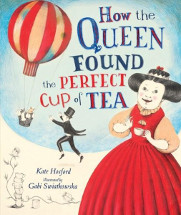
How the queen found the perfect cup of tea by Kate Hosford
Ill. by Gabi Swiatkowska. Carolrhoda books, 2017. ISBN 9781467739047
(Age: 4+) Highly recommended. Humour, Tea, Adventure, Quest. When
the queen sips her morning cup of tea, she finds something is amiss.
It simply does not have the taste she is looking for. Her servant
James is puzzled: is there too much milk or not enough sugar. She
takes to the skies in a hot air balloon to seek out the perfect cup
of tea. She calls in at several places and a child makes her a cup
of tea each time. The three are from different cultures and sharp
eyed readers will notice the very different ways that their tea is
made. Each time it is prepared, the queen becomes more involved, and
children will see that her participation in the ritual of making tea
is making her happier.
Repetition in the story makes it even funnier, as the same thing
happens but with a different outcome each time, until she finally
realises that she can make it for herself, and if she can make a cup
of tea, then many other things she can do flow on.
This is a funny tale, sure to raise a laugh from the audience,
whether read aloud or by themselves. Children will be sure to join
in once they see the repetition, and watch out for the many animals
that join in the fun along the way. The illustrations too compliment
the tale well, adding another level of humour to the story. Readers
will be looking to make a cup of tea at the end of their reading.
Fran Knight
The magic word by Mac Barnett
Ill. by Elise Parsley. Balzer and Bray, 2016. ISBN 9780062354846
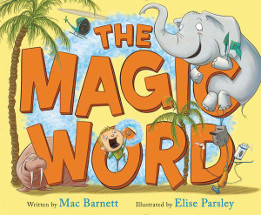
Paxton C. Heymeyer seems to have forgotten his manners, so when he
asks his babysitter for a cookie she asks him for the magic word.
But instead of saying, "Can I have a cookie, please", Paxton C.
Heymeyer shouts "Can I have a cookie, alakazoomba?" Suddenly, in a
puff of blue smoke he not only discovers a cookie in his hand but
the power to summon up anything he wants with that one magic word. A
walrus to chase the babysitter to the North Pole; a waterslide in
the living room; a jungle bedroom; anything his imagination lets him
dream. Even an elephant and a robot-servant!
But when Rosie comes to play he finds that things aren't quite what
he wishes for because elephants can't play cards or any of the other
things friends do together...
There would be few of our littlies who have not been asked for "the
magic word" so they will relate well to this engaging story of being
able to have whatever you want - it brings life to the saying "Be
careful what you wish for." Asking them what they would wish for or
dream of having will elicit a lot of discussion and drawing, but
there is also much to think about when Rosie refuses to play and
goes home. Friendship and happiness are not all about material
things and instant gratification, and this book may provide food for
thought for those who want to have the latest thing NOW, and those
who wish they could.
Barbara Braxton
Worm loves Worm by J.J. Austrian
Ill. by Mike Curato. Balzer & Bray, 2016. ISBN 9780062386335
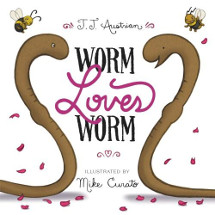
Worm loves Worm. So they decide to get married. It shouldn't be a
problem but suddenly all their minibeast friends chip in. "You'll
need someone to marry you. That's how it's always been done." You'll
need a best man, bridesmaids, rings, a band... and so on and so
on, because "that's how it's always been done."
Worm and Worm agree to each suggestion hoping that after they
acquiesce they can get married but no... there is always
something else. So when they are told that they need to have a bride
and groom, worms being hermaphrodites, they have no trouble with
being either or both - but that isn't how it's always been done.
Will they ever just celebrate their love by getting married???
This is a charming book that, on the surface, is just a story about
two worms wanting to get married because they love each other, and
that, to a four-year-old is a natural thing to do. It is just a
celebration of love. For those in different circumstances or a
little bit older there is a sub-text of marriage equality and things
can change - things don't always have to be because they have always
been. It's enough to love each other without all the other
trappings; it's about inclusion and equality and showing affection
regardless of any traditional views and values that have been
imposed on a natural state of mind. That's what little ones
understand and accept - intolerance is something they learn.
Choosing worms as the main characters is a masterstroke because
there are no physical differences between worms - there is nothing
to say which is female and therefore the bride or male and therefore
the groom. So the central message of love being the key ingredient
and the rest of the elements of a wedding just being seasoning
remains the central theme. Perhaps some of our politicians and those
who influence them should read this and get to the core of what
really matters.
A great addition to a school library collection that allows children
to see their own family structure in a story, to show others that
there are all sorts of family structures, and to explain marriage
equality to those unfamiliar with the concept.
Barbara Braxton
Big picture book of long ago by Sam Baer
Ill. by Wesley Robins. Usborne, 2016. ISBN 9781409598725
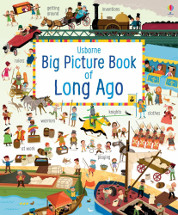
Take a city, an English city, and then take a journey back through
time and discover how people have lived and worked there over the
centuries right back to its Stone Age camp beginnings.
Interspersed with double-page spreads of how people travelled, what
they wore and the structures they built, this is a Richard
Scarry-esque picture book loaded with pictures and captions that
will fascinate the young reader fascinated with history. Or it might
be the one that sparks an interest as the reader looks for the
changes across the centuries and thinks about why they have
occurred.
More to this than meets the eye.
Barbara Braxton
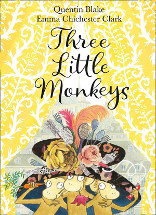
Three little monkeys by Quentin Blake
Ill. by Emma Chichester Clark. HarperCollins, 2016. ISBN
9780008164478
Hilda Snibbs is not like other people. She doesn't have a dog or a
cat or even a goldfish - she has three little monkeys. Their names
are Tim and Sam and Lulu and they are very lively. Every time she
leaves the house and leaves them on their own, they trash it.
Nothing is safe - not her hat, her knitting, her favourite shampoo,
the toilet paper...
She tells them she is disappointed in them, she asks what she has
done to deserve such wretched little monkeys; she wonders how long
she can put up with them - and each time Tim and Sam and Lulu look
at her with their big round eyes and say nothing. One day after they
had been into everything in her bathroom, she cries, "Oh, for a
peaceful life without these wicked little monkeys!" But when she
comes home the next day and they are gone, she realises how much she
misses them until...
This is a funny, lovable story that will become a favourite of
little ones as they recognise some of the mischief they themselves
might have created over time. Quentin Blake's words marry so well
with Emma Chichester Clark's illustrations - little vignettes that
are full of action and fun as they show the monkeys at work - that
this is a masterful collaboration. Even though the monkeys are so
naughty they remain lovable and it's Hilda Snibbs who becomes the
"villain". As Miss 5 said, "Why did she keep leaving them on their
own? She's stupid!" Three little monkeys is the perfect bedtime read-aloud as the
children delight in the antics and naughtiness of the monkeys and
see that they are loved regardless of what they do, while Hilda
Snibbs will resonate with exasperated parents who sometimes long for
the quiet life they had before their own little monkeys were born,
even though they know they wouldn't have it any other way.
Joyful.
Barbara Braxton
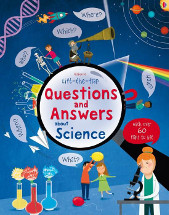
Lift-the-flap questions and answers about Science by Katie Daynes
Lift-the-flap questions and answers about Science by Katie Daynes
Ill. by Marie-Eve Tremblay. Usborne, 2016. ISBN 9781409598985
From the time they are born children are innately curious and as
soon as they are able to articulate the words, they ask questions so
they can make the connections they need as they try to make sense of
their world. As the nearest adult we try to help them with the
answers. Some of the answers are at our fingertips but some need a
little more digging.
Often those answers lie in science and this book is a great
introduction for the budding young scientist who has the questions
and wants a basic explanation that can be followed further if they
wish. Just 16 pages long, it is divided into double page spreads
with the headings what, why, when, where, which, who, how and yes or
no. Each page has several questions, the answers for which are
hidden under the flaps. Starting with the basic "What is science?"
and "What do scientists do?" it goes on to explore other questions
about science itself as well as others such as "Is the sky really
blue?" Simple explanations and quirky pictures under the flaps
provide a straight-forward answer as well as the starting point for
further investigations. Having the answers under the flap gives the
child an opportunity to consider the question and then suggest their
own explanation before checking to see if they are on the right
track.
Aimed at the young reader with an interest in science, nevertheless
it is a book to be shared with a grownup who can help with some of
the words, interpret the answers more fully and suggest other
sources for finding out more including the Usborne
web page for the book which has more questions, links to websites
and other books in the series that delve deeper.
Books like this start the young child on their way to being
information literate - able to locate, evaluate, analyse, interpret
information so they can then use it to satisfy their curiosity,
discover the world around them and ask new questions. With the
current emphasis on STEM (science technology, engineering and maths)
in the school curriculum not only does this book provide answers,
it demonstrates that those answers can be found in print as well as
modelling how to ask questions that require more than a one-word
answer to take an investigation further.
It could even be the springboard for an ongoing class activity with
a question posed each week so students can share their answers which
are then compared to the explanation provided, discussed and
investigated, sparking an interest in science that endures.
This is a dip-and-delve book - one the reader will come back to time
and time again.
Barbara Braxton
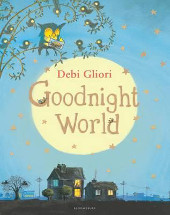
Goodnight world by Debi Gliori
Bloomsbury Children's, 2016. ISBN 9781408872734
"Bedtime and time to say goodnight to the world.
Goodnight planet, goodnight world,
Peaceful clouds around Earth curled."
In a gentle, lullaby-like rhyme the little one is getting ready for
bed and wishing everything a goodnight before sleep takes over. The
polar regions, the Northern Lights, the oceans and seas , cars,
boats, planes, birds, bees and fish - everything that he knows is
included in this final farewell for the day.
"Goodnight houses, nests and burrows.
Goodnight daylight, until tomorrow's."
The text is captured in a soft palette of muted colours, softened
even further by subtle tones and shadings and blurred lines and
within each picture everything is settling down for the night,
snuggled together and listening to a bedtime story. Even the tiniest
insect is reading or listening as the flowers and grasses curl
around them. In fact the whole theme is one of being curled up in
the arms of something that loves and protects, and that night and
darkness and sleep are a time of safety and security.
This would be the perfect inclusion as the final read for the
bedtime reading routine, gently calming everyone and sending them
off to dreamland comforted and comfortable, loving and loved.
Barbara Braxton
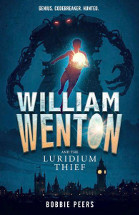
William Wenton and the luridium thief by Bobbie Peers
William Wenton bk 1. Walker, 2017. ISBN 9781406371703
(Age: 9+) Highly recommended. Norwegian film director Bobbie Peers'
debut children's novel is a written like a cinematic thriller packed
with action, intrigue and drama. His creative attention to detail is
outstanding, with the purpose built bots supporting the cybernetic
world filled with advanced technology.
The story begins with a grandfather's disappearance, resulting in a
family fleeing to hide in a small town in Norway. A secret
ingredient called luridium holds the key and there are sinister
forces that will stop at nothing to find it.
Eight years ago, William's grandfather, a world-famous cryptographer
and inventor, disappeared into a tunnel deep in the London
Underground taking a secret with him. Now William and his parents
live a secret life afraid to be discovered. William hides out in his
bedroom honing his code-breaking skills, researching famous
cryptographers and creating puzzles, continuing his grandfather's
legacy. When the Impossible Machine arrives at the local museum, he
disobeys his parent's instructions and slips away to solve the
encrypted puzzle. Of course, this is a trap and after his
achievement is publicised, he is kidnapped and taken to the
mysterious Institute for Post-Human Research. Here young candidates
undergo testing for their supreme scientific and technological
abilities. What an amazing and unusual environment filled with
cybernetic bots, robotic plants, even a Cosmotorium. William
befriends another candidate Iscia and together they investigate his
grandfather's disappearance, the reasons why he left and the
mysteries of the intelligent metal. William Wenton and the luridium thief is a journey into an
incredible new world where technology and science are celebrated.
This novel received the Norwegian Ark Children's Book Award in 2015.
Peer's imaginative and intense cybernetic world add excitement and
danger to William's dangerous quest for the truth, and this would
make an exciting class novel for Upper Primary students.
Rhyllis Bignell
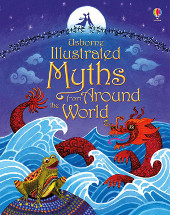
Usborne illustrated myths from around the world by Anya Klauss
Usborne, 2016. ISBN 9781409596738
What do Demeter and Persephone, Finn MacCool and the fish of Maui
all have in common? Well, they are included in this collection of
stories from around the world, beautifully illustrated by Anya
Klauss.
In times long past before the truth was known, many of the things
like the sun's passage across the sky or the formation of the land
were a mystery to those observing them so they made up stories to
explain the particular phenomenon. Even though they came from
far-flung places and diverse peoples their common thread was to
explain the seemingly inexplicable so that the world made sense to
them. Whether it involved giants, mythical beings and creatures,
magic or sorcery, each story sought to demystify and through their
telling through generations across thousands of years they have
endured, even though science may have intervened to expose the
truth.
As well as being a wonderful introduction to these sorts of stories
and embracing a range of cultures, such myths can also be the entry
point into scientific investigations for young and not-so-young
scientists. If Maui did not fish the North Island of New Zealand out
of the sea, how did it get there? If the changing of the seasons are
not caused by Demeter's love and loss, how are they formed? A great
way to link literature and science and start our students on their
own quests.
Barbara Braxton
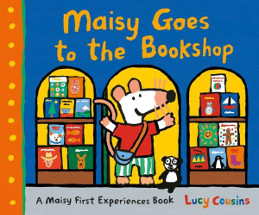
Maisy goes to the bookshop by Lucy Cousins
Maisy's first experiences series. Walker Books, 2017. ISBN
9781406369847
(Age: 3+) Recommended. Bookshops. Books. In the series, Maisy's
first experiences, which includes stories of Maisy as she goes
camping, or visits the library or goes to a hospital, the wonderful
Maisy is put into situations which may be new to some readers,
showing them what to expect and helping to diffuse any concerns they
may have.
In this book, Maisy is off to a bookshop for the first time.
Once inside she sees rows of shelves with books and finds it
difficult to select just one. She looks at several before making up
her mind. Ostrich the book shop owner shows her his favourite book,
one about birds, then she spies her friends, Charlie, Cyril and
Eddie. Each has their own favourite and can imagine themselves in
the story. They then go to the cafe for a treat, and Maisy pays
Ostrich for her book, receiving a receipt. On leaving the bookshop
Maisy catches the bus to her friend's house to give her the newly
purchased book as a present, and they read it over and over again,
as well as out loud.
A charming book with Cousins' very familiar black outlined images of
Maisy and her friends, the tale introduces younger readers to the
delight of books and using their imaginations to be part of the
story. Words relevant to visiting a bookshop are used, introducing
the reader to specific words used for book buying and reading. A
wonderful introduction for younger readers.
Fran Knight
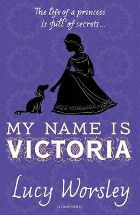
My name is Victoria by Lucy Worsley
Bloomsbury, 2017. ISBN 9781408882016
(Age: 10-14) Highly recommended. Historical fiction. Miss V. Conroy
is a very good girl. She is quiet, well-mannered and wants to
obey her father Sir John Conroy, the comptroller of the household of
the widowed Duchess of Kent. When her father takes her to Kensington
Palace to be the companion to the young Princess Victoria, she finds
that she is expected to spy on her and report back to her father.
Princess Victoria is being brought up under the Kensington System,
which aims to keep her isolated and dependent on Sir John and her
mother and keep control when she becomes queen.
Lucy Worsley, described as the 'much loved TV historian', has
written an engrossing and fast paced tale of the two young girls.
She has chosen to give them an alternative history. Even though
Queen Victoria's letters and diaries suggest that the two were
enemies, Worsley has written a story presenting the scenario that
the two did become friends, while ensuring that the historical
period and background are accurate.
There is plenty of intrigue in the Kensington household and Worsley
has the skill to bring this period to life as well give an indepth
description of the cruel Kensington System which made Victoria so
unhappy. The reader gets to know the characters of the two young
girls and can empathize with Miss V. Conroy who is torn with the
dilemma of what she should tell her father, and Princess Victoria, a
headstrong and determined girl who has to contend with very
difficult circumstances.
Worsley introduces My name is Victoria on YouTube.
Well researched and absorbing My name is Victoria will
become a favourite of readers who enjoy historical fiction.
Pat Pledger
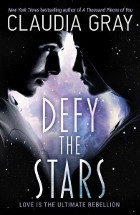
Defy the stars by Claudia Gray
Hot Key Books, 2017. ISBN 9781471406362
(Age: 14+) Highly recommended. Science Fiction. Artificial
intelligence. Robots. Space travel. Relativity. Pollution. Earth is
dying, and there is a war between it and Genesis, one of the colony
planets. The people of Genesis have closed down access to their
planet knowing that Earth will only destroy it the way their own has
been destroyed. In a raid on Genesis, Noemi a brave young pilot
boards a ship and meets Abel, a mech warrior from Earth. Programmed
to obey commands from humans, Abel at first seems like any other
robot to Noemi, but gradually she realises that he is no ordinary
mech, instead he is unique and has the ability to dream.
This is a truly fascinating, exciting and engrossing story. The
reader is swept along as Noemi and Abel fly through space trying to
find the parts that will enable them to block access to Genesis and
save the other young pilots who were preparing for a suicide
expedition to fight Earth. They travel to various colony worlds each
unique and intriguing, and meet the Vagabonds, a group who sail
forever in the stars. Life on board the space ship and on the colony
planets is vividly described and each of the characters is fully
realised.
What makes this a stand out novel though is the theme of what makes
a human. The gradual realisation by Noemi that Abel is more than a
robot makes her question all she has been brought up to believe. If
he has the ability to dream and to feel, is he then more than a
machine? Perhaps he should be given the right to make his own
decisions about whether he will die for Genesis. But then what will
happen to Noemi's world?
With a low-key love story, a high octane plot, and a stunning
exploration of what it means to be human. Defy the stars is a
riveting read. I can't wait for the next in the series.
Pat Pledger
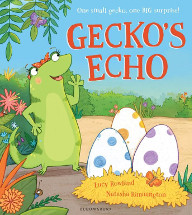
Gecko's echo by Lucy Rowland
Ill. by Natasha Rimmington. Bloomsbury, 2017. ISBN 9781408859506
(Age: 4+) Recommended. Animals. Families. Breeding. Rhyming story.
Underlining the adage of strength in numbers, mother Gecko in
protecting her eggs from the marauding thieves, needs to get help
from other geckos in her neighbourhood.
Told in rhyme, the story begins with the mother Gecko waiting for
her eggs to hatch, sweeping the area in front of her cave. The next
morning a snake slithers by, seeing a gecko and licking his lips at
the thought of gecko eggs for breakfast. But Gecko warns him that
she has one hundred other geckos inside her cave ready to come to
her aid at a shout. He quickly leaves. Similarly an eagle thinks
eggs would be a good feed and is told the same thing, flying away.
But when a rat calls wanting those eggs, he is not so easily fooled
by her threats, and takes a step closer. Children will laugh out
loud at the way the mother gecko protects her eggs, and be charmed
by her bravery.
Told in rhyming couplets the verse lends itself to children
predicting the rhyming word at the end of the couplet, while
learning some of the verses will be an easy task. Following the path
of the eggs from egg shapes to cracking open to reveal new baby
geckos will be a natural way for classes and families to talk about
babies, birth and family increase. The illustrations add
another level of humour to the tale and counting the one hundred
geckos on the middle double page will keep many children amused for
quite a while.
Fran Knight
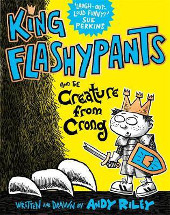
King Flashypants and the creature from Crong by Andy Riley
Hodder Children's Books, 2017. ISBN 9781444929607
When is the recommendation of 50 serves of vegies a day a good
thing? When you are king and not very old you need someone to help
you run the kingdom, some advice is good and some not so good, like
the recommendation everyone should have 50 serves of vegies every
day. Read this thrilling adventure to find the answer.
King Edwin Flashypants sets off to prove he is a proper king by
defeating the terrifying monster that gets bigger and grows more
eyes every time someone tells the story of it. King Edwin
Flashypants with his adviser and friend set off to save Edwinland and
prove that he is the rightful king. Emperor Nurbison on the other
hand is trying to do everything in his power to ensure King Edwin
Flashpnats is unsuccessful in his quest. King Edwin Flashypants and
his group encounter a number of trials along their journey and they
need to use their team work to try and overcome, while Emperor
Nurbison does his best to ensure that King Edwin Flashypants is not
successful. Who will triumph to become the rightful king of
Edwinland?
A funny story written in a way that will appeal to readers of
various reading abilities, it will have everyone laughing.
Karen Colliver
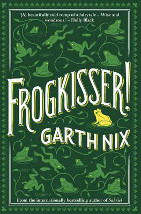
Frogkisser by Garth Nix
Allen and Unwin, 2017. ISBN 9781760293512
(Age: 10+) Highly recommended. Fantasy. Humour. What a delight to
pick up another fantasy by Garth Nix. He is one of my favourite
authors and I was not disappointed in this hilarious, thought
provoking and stirring fantasy adventure. Princess Anya is on a
quest to rescue a frog, who is not a frog but a prince who has been
turned into one by Anya's evil stepstepfather because he was in love
with Anya's sister, Morven. She is rather reluctant to move from the
library where she is comfortably ensconced, learning some magic
tricks, but she has made a 'sister promise' and knows that she will
have to do something about Prince Denholm. Accompanied by Ardent,
one of the Royal Dogs, she travels through the Kingdom of Trallonia,
trying to get the ingredients she needs to make a lip balm to use
when kissing the frog.
The humour is so infectious. I laughed out loud every time Gerald
the Herald (one of many) appeared and the news that he gave about
Anya was hilarious. Even the nickname Frogkisser will make the
reader chuckle as Anya valiantly goes on her quest. She meets many
strange creatures on the way, like the thief turned into a newt and
an otter turned into a strange being, as well as a princess turned
wizard, and many many frogs. I loved the Royal Dogs as will any
person who is a dog lover.
Underlying the fun of Anya's quest, is her gradual understanding of
responsibility. She is a princess, with many privileges, but she
begins to realise that with privilege comes an obligation to do the
right thing for her people. Although I waited for a prince to come
along for Anya, Nix didn't fall into the trap of having her kiss a
frog and find her true love – instead he concentrates on her
personal growth and quest. This is very refreshing.
There are some unexpected twists and turns all making for a very
enjoyable tale. In his acknowledgements at the end Nix
mentions Robin McKinley, Diana Wynne Jones and Lloyd Alexander among
others as influences on his work, and readers who have enjoyed works
by these authors are sure to enjoy Frogkisser as well. And if they
are not familiar with those authors then readers will be in for a
treat if they try books written by them.
Pat Pledger