Scholastic, 2017. ISBN 9781743817605
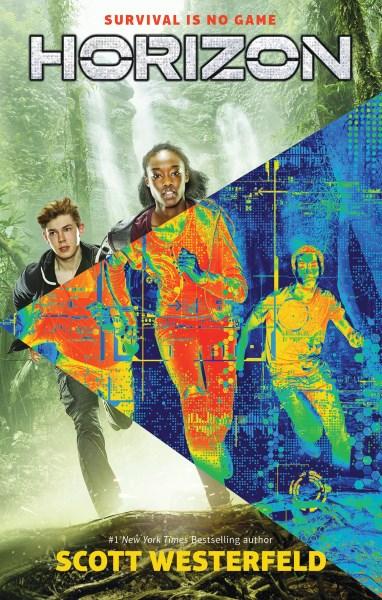
(Age: 12+) Highly recommended. Science fiction, Survival, STEM. On a
flight from the USA to Tokyo, eight teens on the plane are the only
survivors when it crashes. But where they expect snow and ice, is
jungle, with strange birds and even stranger noises. The eight must
work together to work out what is happening to them, but this is
difficult when the oldest in the group, Caleb, sees himself as the
leader, and hates being questioned by the four from Brooklyn Science
and Tech, en route to present their robots at the Robot Soccer World
Championship in Tokyo. In particular Molly and he do not see eye to
eye.
Yoshi goes off in search of water, while Molly experiments with the
device she has found on the plane, something which appears to lift
them off the ground. But once in the air they are attacked by
shredder bird which tear into their clothing and skin, so they need
to plan their journeys.
A wonderful story of methods used by the group to develop an
hypothesis then work out a solution, this story is brimful of
scientific argument and logic, as well as honing in on relationships
and survival.
When some of the group leave to try and find out what its over the
stone wall, the gravity machine comes in very handy to make their
ascent easier. But hiding in a cave they are besieged by tiny
robots, intent on stealing their mechanical objects. All is most
curious until they find themselves inside a set of office like
laboratories and they begin to work out where they are and what has
happened, leading to an idea of how to get out.
This is a heart in the mouth story, Westerfeld cleverly leading the
reader on making them try and work out what is happening, collecting
evidence, using their reason to make deductions and hypotheses. But
as they do not reach their destination at the end of this story,
another story is in the pipeline. Westerfeld tells us that this is
the first of seven books in the series, and is a mixture of Lost,
Lord of the flies and Hatchet. This is easily
accessible science fiction with the themes of survival and
relationships uppermost putting the readers into the skin of the
protagonists, drawing them into the lives on the page. I look
forward to the next in the series.
Fran Knight
Beyond the wild river by Sarah Maine
Hodder and Stoughton, 2017. ISBN 9781473639683
(Age: Senior secondary-adult) Recommended. This is a terrifically
well researched novel, and the story, and indeed the plot, are
finely wrought. I was captivated by the settings, described in rich
detail, from the new city of Chicago to the wild lands and rivers of
northern Ontario. Responding with violence to a burglar, one dark
night on a Scottish estate, a man is killed, a story is constructed,
and a very young Evelyn Ballantyre learns one version of events that
she accepts but with both a sense of having been told what was best
for her to know and a feeling that this version was not the true
story.
From a Scottish estate to the wilds of Ontario, Maine captures a
world of change, taking us from Scotland, on a sea voyage to the
United States in 1893, where the characters visit the Columbian
Exposition in Chicago, described in rich and fascinating detail, and
then go into the wilds of Canada to inspect, we deduce, an
investment of Evelyn's father. This is a fine section, introducing
us to a little known area and history for most readers outside of
Canada or the USA.
The story that ensues is a sequel, in a sense, to that terrible
night on Evelyn's father's estate in Scotland. Strangely, and indeed
oddly, it seems that the characters who were at the estate on the
night of the murder have come together for a journey up the Nipigon
River, in Northern Ontario, 13 years later. We realize that
Ballantyne has controlled all of this, with the characters of the
past all in close proximity for a trip that will be challenging.
Whilst it is not clear to us just what will happen, we are given
plenty of clues so that we are aware that some kind of dramatic
event will take place as the tension builds up day by day on that
journey. The terrain is described in wonderful detail, the
atmosphere of the Nipigon River and the campsites particularly
featuring as places of wonder for the European visitors. We read
about the way that campsites were positioned near the river, how the
fish were caught, and we learn something of the indigenous people of
that region. All of this is absolutely captivating.
That the conflict would be resolved is expected, but somehow the
resolution is just a little tawdry, and the characters involved in
it demeaned by the decisions. Yet in a sense the decisions and
actions are consistent with the characterization. Just as we readers
might have liked a happy ending, her resolution is consistent with
her characterization. Her strengths are in this narrative
consistency, in her richly detailed settings, and in her capacity to
create a story that is reminiscent of its time, its place and the
characters that she has created. This is a fine adult and older
adolescent romantic and historical novel.
Elizabeth Bondar
Margherita's recipes for love by Elisabetta Flumeri and Gabriella Giacometti
Simon and Schuster, 2017. ISBN 9781471162695
(Age: 15+) Well, this is a delicious read, a feast for the senses.
The writers almost dare us to not relish or enjoy the food, the
convoluted love stories, the solving of issues of love, loyalty and
friendship all set in the delightful towns and countryside of Italy.
Flumeri and Giacometti have previously written radio programs,
novels and a number of screenplays. In this novel, they focus on
food and love that are depicted as inextricably linked, choosing an
ideal setting that is a feast for all the senses, the adventures
mostly taking place in the enticing, glorious green hills,
vineyards, old homes of the small towns of Tuscany.
The story has a complexity that is used to build up the requisite
tension, and the outcome, while perhaps predictable, is a satisfying
one. However, it is not the characters who dominate this
food-lovers' novel, but the food itself. Described in richly
evocative phrases, food, in its powerful effect on the emotions and
behaviour of the characters, is really the star of this story. Food
dominates, and is used to create tension, to solve issues, to bring
people together, be it for friendship, family issues, business or
love. Descriptions of meals are passionately described, and we are
persuaded to see how the particularly powerful, sexually arousing
effects of dishes that persuade people to like, love, or indeed to
disdain, others. Melodramatic it may be, but it is a happy,
well-written and quite simply enjoyable book that brings a smile to
the face and enjoyment not dissimilar to watching a good cookery
program on television.
Elizabeth Bondar
The curious case of the missing mammoth by Ellie Hattie
Ill. by Karl James Mountford. Little Tiger Press, 2017. ISBN
9781848694484
Bong! Oscar is woken by the town clock striking midnight and strange
noises in the street. As he looks out his window he sees a huge,
hairy woolly mammoth. Instead of being scared, he is dressed and
outside in a flash where Timothy the mammoth explains he is
searching for his little brother. Together they continue the search
which leads them to the town museum where the door opens a crack to
reveal the inhabitants have come alive and are having a party.
Continued through the interactivity of gatefolds, lift-the-flaps and
speech bubbles the search progresses through the various sections of
the museum until... It is certainly the most extraordinary hour
of Oscar's life.
Apart from kids' universal curiosity about the mysterious creatures of
the past, this is a book that will delight young children as they
explore it over and over as it combines so much information as the
quest continues. There is so much detail included that there will be
something new to explore and learn with every reading. It is
certainly an intriguing way to help them discover their world and
enjoy having to be part of the action to move the story along.
Barbara Braxton
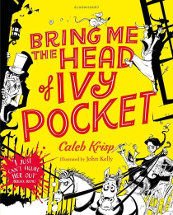
Bring me the head of Ivy Pocket by Caleb Krisp
Ill. by John Kelly. Ivy Pocket series; book 3. Bloomsbury,
2017. ISBN 9781408858721
(Age: 9+) Highly recommended. Themes: Orphans and orphanages;
Jewellery; Ghosts; Supernatural stories; Mystery and suspense
stories; Ghosts; England - Social life and customs - 19th century.
This is a fabulous conclusion to the Ivy Pocket series, here
ghosts are laid to rest, answers to mysteries revealed and lost
friends rescued. This feisty protagonist faces dangers head on,
relying on her quick thinking, fighting skills, acerbic dialogue and
fun disguises to rapidly race through across the country and into an
alternate kingdom.
Ivy's final missions are difficult ones; she needs to rescue
Anastasia Radcliff and young Rebecca Butterfield from dreadful
circumstances. Of course, the evil henchwoman Miss Always and the
creepy little Locks are chasing her across country, causing her
trouble at every turn.
As Esmeralda Cabbage, Ivy returns to Butterfield Park, scene of a
previously disastrous birthday party ready to confront Lady
Butterfield, Countess Carbunkle and Estelle Dumbleby. Hidden beneath
a secret passage in the ballroom is Anastasia's prison and Ivy is
there to assist with her friend's escape. With the concerns about
the Clock Diamond not working and her enemies closing in, Ivy's bold
antics and her willingness to overstep the boundaries are fun to
read. Ivy's exploits in the fantastical world of Prospa are intense
as she confronts her nemesis, delves into the mystery of the Shadow
and races against time to find the portal back into the real world.
John Kelly's comical drawings display some of Ivy's most intense
scenes; the Countess and her headdress of peacock feathers in flames
and Ivy's triumphant tea party are highlights.
Calvin Krisp's Bring me the head of Ivy Pocket will delight
those readers who have enjoyed the exploits, adventures and quirky
character of this fun female protagonist. This series is perfect for
a Middle Primary class novel, as the author's humorous narrative is
engagingly alliterative, deliciously descriptive and certainly
attention grabbing.
Rhyllis Bignell
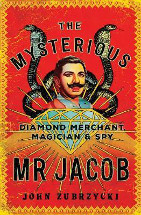
The Mysterious Mr Jacob : Diamond Merchant, Magician and Spy by John Zubrzycki
Transit Lounge Publishing, 2017. ISBN 9780995359437
(Age: 16+) This story, claimed by William Dalrymple to be 'one of
the most exciting narrative histories to come out of India', is
indeed utterly fascinating. Set in the late 1800s and early 1900s,
the story is centred on Alexander Malcolm Jacob, who arrived in
Bombay in 1865. His parentage is unknown, seemingly because he
mostly tended to claim different stories at different stages of his
life. It is not a light narrative, its stories often complex and
their 'truth' quite often questionable, yet it is, at times, so
mysteriously fantastic that it seems as if he could have been a
character in a fictional fantasy.
Jacob became well-known in his own world of commerce, in the Indian
world of the time, particularly through his diamond-dealing, the
stones he sourced often being worth millions. However, he was also
known as a great magician, his complex tricks often being challenged
as impossible, therefore judged to be real magic, and therefore
unacceptable. As there appeared to be many for whom the tricks were
too difficult to comprehend, he was ironically criticized for this
very complexity, judged to be too close to real magic for the
audience, who ranged from the wider European community of
expatriates and those from the world of the Middle East, as it was
known at the time.
Keeping to the narrative genre, Zubrycki creates a believable and
indeed mysterious character whose fabulous wealth and control of his
world seem to have been impossible, given his background. Indeed, it
is this aspect that was so referred to so often in the work by his
critics. His capacity to create apparent magic, the strength of his
personality, his persuasive powers, his ability to buy and sell
works of art, particularly fabulous jewels, made him renowned across
British India, and abroad. He is said to have bought diamonds from
Australia, to have had friends in many countries, to have worked
impossible sleights of hand that could not be analysed, which added
to his mystery, and yet, before he lost his wealth, status and
friends, he appears to have been charismatic, mysterious and to have
been a consummate magician. He was interviewed by pragmatic
journalists, and even these non-believers wrote that there was
something unreal about this man's powers.
It would be a suitable book for older adolescents, as an informative
and challenging account of an unusual man. However, I would suggest
that this is not a book for younger readers because of its subject,
its complexity, its literary/historical nature, its references to
the real world of the Raj, and India in this historical period
(comprehensible with an understanding of India's complex history),
and because of the unresolved, and indeed mysterious aspects that
are part of its complexity.
Elizabeth Bondar
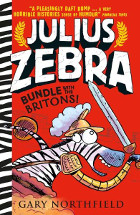
Julius Zebra: Bundle with the Britons by Gary Northfield
Julius Zebra series. Walker Books, 2017. ISBN 9781406373721
(Age: 8+) Ancient Rome. Animal stories. Gladiators. Humorous
stories. Champion gladiator Julius Zebra returns in another crazy
adventure accompanied by his zany animal friends. Life for the
People's Champion should be exciting; everybody loves this zebra, he
even signs hoof print autographs in the muddy streets of Rome.
Emperor Hadrian has promised Julius his freedom after one last fight
at the Colosseum, but the ruler has an alternate plan.
Unfortunately, they have one more task to complete, a tournament in
distant Britannia. Julius is disappointed as he was set to enjoy his
upcoming holibobs, while Felix the warthog wanted to add to his
extensive rock collection and Rufus the giraffe planned a relaxing
fishing holiday. Instead, they must travel on a stinky sailing ship,
far across the seas to an unknown place to fight in another
tournament.
Septimus the gladiators' trainer is a hard taskmaster on board; he
forces the animals to scrub the decks daily and sleep in hammocks
inside the stinky hold. An attempt to dress in chainmail and escape
the confines of the ship leads to a hilarious incident that
requires the rescue of the crocodile, warthog, giraffe, lion and
antelope.
Life in Roman Britain proves fraught with danger, the smelly streets
of Londinium treacherous, and their holiday home a hovel near the
small amphitheatre. The animals are quirky character drawn together
in difficult circumstances, unaware that their opponents are mean
fighting machines.
Gary Northfield's hilarious cartoons highlight how Julius and his
friends struggle with life in an unknown land, as they prepare to
face new combatants in the arena. The animals' irreverent dialogue
is sharp, witty and sarcastic. This is another laugh out loud story,
with plenty of jokes, gags and puns. These stories combine facts
about Ancient Rome life with humorous scenes and silly animal
antics.
Rhyllis Bignell
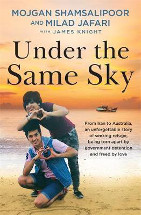
Under the same sky by Mojgan Shamsalipoor, Milad Jafari and James Knight
Hachette, 2017. ISBN 9780733637827
(Age: 15+) At a time when more than 20 million refugees seek shelter
in countries which wrestle with questions regarding asylum, this
story simply tells of the lives and experience of Mojgan
Shamsalipoor and Milad Jafari, two young people from Iran.
Mojgan's background was one of financial hardship, with her single
mother struggling to provide for the family and often having to
depend upon the charity of relatives to access accommodation. It
would appear that desperation drove her to remarry, hoping to create
a more stable life and home for Mojgan, her sister and brothers.
Sadly, the situation became nightmarish for Mojgan and her mother
when her brutal and violent stepfather commenced beatings and sexual
assault before arranging a marriage to a man old enough to be her
grandfather. Trapped by oppressive Sharia law which offered no
escape and administrative corruption which enabled and supported the
stepfather, Mojgan and her brother Hossein undertook the perilous
journey to escape Iran.
Also growing up in Iran, Milad experienced a more secure life in a
family provided for by his father who worked hard and enjoyed
financial success. Life became dangerous for this family however as
Milad came under police scrutiny for producing forbidden Hip Hop
music and other family members became imperilled from simply knowing
people who had been arrested and subsequently murdered for political
reasons.
The tension and fear experienced by these young people fleeing an
oppressive regime, risking their lives to the hands of people
smugglers and enduring a frightening, arduous journey by boat is
difficult to adequately express. Similarly the anxiety produced by
protracted detention, the seemingly endless asylum application
process and fear of terrible consequences if rejected and returned
to Iran is impossible to summarise.
Meeting in Australia, Milad and Mojgan fall in love and marry,
however their newfound joy turns to stress and fear when asylum is
refused for Mojgan and she is pressured to return to Iran.
Recent events have prompted renewed consideration of Australia's
asylum policy in relation to Moslem refugees by politicians, media
commentators and the general public. Evident in this book was the
fact that life for asylum seekers fleeing oppression is miserable
and this is removed from any ideological debate concerning whether
Australia ought or ought not accept Moslem refugees.
What affected me most powerfully was a sense of fury and despair
that the world's refugee problem is principally caused by political
and / or religious lunacy which foments oppression and violence.
Whilst this continues, millions of innocents will continue to be
driven from their homes where they might otherwise have stayed to
live productive and happy lives.
Rob Welsh
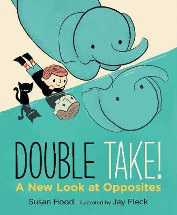
Double take! a new look at opposites by Susan Hood
Ill. by Jay Fleck. Walker Studio, 2015. ISBN 9781406377293
(Age: 4+) Highly recommended. Opposites. Perspective. Points of
view. More than a look at opposites, this interesting picture book
is also a challenge for the reader to ponder and delve into what an
opposite really means and to think about different points of view.
Hood has written an engaging, thought provoking text in rhyme,
looking not just at what a simple opposite can mean but how it
relates to who wants to know and the perspective of the person
asking: Who knows what's BIG
unless there's SMALL?
Does SHORT mean a thing
except next to TALL?
The illustrations done in a retro style by Jay Fleck are evocative
and add much to the text. The one on the back of the book with the
blurb was particularly engaging showing a tall flower in a small pot
with a bird looking at it and a short flower in a big pot with a
mouse looking at it. Another that caught my eye was the elephant
lifting a large weight that contrasted with the boy trying to lift a
small one: Who's STRONG
and who's WEAK
is hardly perplexing
Then the reader turns the page to see a double page spread with a
giant whale and the text: But STRONG can look WEAK
when a new champ is flexing.
The use of different styles of print to highlight the point being
made also adds to the fun of the book and would lead to easy
emphasis when reading aloud.
This would be a very useful book to have in the classroom, and its
easy rhythm and fun illustrations will engage both readers and
listeners.
Pat Pledger
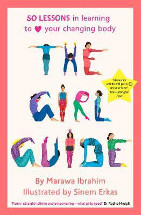
The girl guide by Marawa Ibrahim
Frances Lincoln Children's Books, 2017. ISBN 9781847809483
(Age: 10-15) Highly recommended. Star rating: 5/5. This is the book
I wish my mum put on my bedside table instead of 'Where did I come
from?'!!
Growing up is a tough gig, especially in a society where
advertisement and media plays a huge role (unconsciously or not) in
providing education to women around our bodies, growing up and the
portrayal of what is normal. What Marawa Ibrahim has done with this
book has taken ALL the things that happen to girls growing up and
written down what really happens. From periods, hormones and bras to
embarrassing moments, friendships and just being yourself, it is all
in there.
One of the things I really enjoyed about this guide is that each of
the 50 lessons are shown in a very light-hearted easy to read way,
however you also get the sense that these experiences really were
her own and that made me feel more comfortable in my own personal
experience. I feel that this will transfer well to the younger
female reader who reads this book either at the start of or
throughout their journey with their changing body.
Marawa tells us about her inner most embarrassing moments, and then
how she got over them. You get the pros and cons of the various
types of hair removal and the benefit of stretching and meditation -
there really is something for everyone.
The blurb states that The girl guide is "packed with
practical advice, this book is a stylish agony Aunt for any 10 year
old girl" and I feel that this is 100% true. It answers all the
questions you want to ask your mum or friends but are too shy or
embarrassed to, and does so in a way that any 10-15 year old girl
would completely understand.
Lauren Fountain
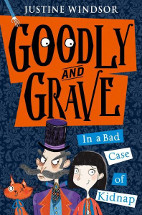
Goodly and Grave: in a bad case of kidnap by Justine Windsor
HarperCollins, 2017. ISBN 9780008183530
(Ages: 10+) Highly recommended. Magicians. Kidnapping. London.
Nineteenth century. The Penny Dreadful is full of the stories of
missing children in London, with dire predictions of what has
happened to them. Lucy Goodly meets her match at the card table at
one of London's seamier gambling establishments, when she is beaten
by someone with better skills at cheating. So convinced that she
would win, she set herself against the dastardly Lord Grave, and in
losing must return with him to Grave Hall and be his boot boy. Here
she finds strange things happening, the cook is a bearded man
dressed in women's clothing, she overhears people speaking of the
missing children, she goes into a room where she meets a talking
raven. Lucy must use her wits if she is to help solve the puzzle of
Grave Hall, rescue the children, release those entrapped by magic,
and get back to her own family.
Her suspicions of Lord Grave and all the others in his employ cause
Lucy to take the magic route offered by the raven and she lands in
the castle of Amethyst, Grave's enemy. But here too, she comes to
disbelieve what she is being told, and seeing the woman collect the
tears of the children, realises that something is very wrong.
A heart thumping thriller of a story, Lucy lurches from one grave
situation to another, often accompanied by other children, all
trying to deflect the lies they are being told. But who can be
trusted? Twists occur on every page, but Lucy's tenacity shines
through. Readers will love the humour as well as the plethora of
strange beings, working with Lucy to try and find out what is really
happening to the children kidnapped from the streets of London. And
for those completely enraptured with the situation Windsor presents,
the second in the series will follow soon.
Fran Knight
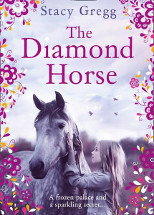
The Diamond Horse by Stacy Gregg
HarperCollins Children's Books, 2017. ISBN 9780008124403
(Age: 9+) Highly recommended. This book has two main characters,
each with their own unique story to tell, each with a challenge that
they need to overcome to be able to move on. These two characters
are connected in a way even they are not aware of.
Being a princess is not all it is cracked up to be. Anna lives in a
beautiful palace with a number of animals around her, some living in
the palace and others in cages in the grounds of the palace. Anna
has a special way with the animals that everyone around her is not
happy with. The main animal she has to be wary of is her older
brother, who is determined to make Anna's life unbearable.
Anna is faced with a number of challenges that she has to endure,
some things no princess should have to deal with.
Valentina is a circus performer with a love of animals, she does all
she can to protect the animals from the mean ring master. Valentina
is looking to her future and trying to do what she can to make her
life better.
I highly recommend this book. Once you start reading it is hard to
put it down.
Karen Colliver
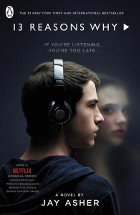
13 reasons why by Jay Asher
Penguin Random House, 2017. ISBN 9780141387772
(Age: 15+) Highly recommended. Suicide. A gripping story that you
can't put down, you need to know what comes next. The way the story
is written helps to keep you intrigued and wanting more, needing to
know how the various characters are intertwined and how their
stories impact upon each other.
The two main characters are telling their stories intertwined
together, the more you read the more you see how each character has
an impact on others sometimes on purpose and other times without
even realising it.
This book discussed a number of controversial topics that can be
life changing. Hopefully this book will spark conversations about
these topics that are not normally talked about.
This book reminds us that we never really know what someone else is
thinking or feeling or how what we say or do impacts on another
person.
This story could be set in any town with a park and a diner.
Hopefully after reading this book it will start some discussions
around the topics that are discussed, it may encourage people to
talk to their friends about things that are happening in their
lives.
What you do can have an effect on others that you may not be aware
of or intending.
Sometimes we don't even know what we are thinking or really feeling.
This book also highlights the impact that suicide has on the people
left behind and hopefully that will again spark discussion around
this topic.
Karen Colliver
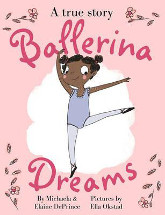
A true story: Ballerina dreams by Michaela and Elaine DePrince
Faber and Faber, 2017. ISBN 9780571329731
(Age: 7-10) Recommended. At first, with its pink background and cute
dancer on the cover I thought this was another ballerina story for
young girls but Ballerina dreams is a lot more than that.
Written by Michaela DePrince and her adoptive mother Elaine, this
story reveals Michaela's amazing journey from being an abandoned
orphan in Sierra Leone, West Africa, to an international ballet
dancer.
Michaela describes how she felt alone and valueless because as well
as loosing her parents she had a skin complaint called vitiligo.
Vitiligo made her skin loose some of its colour and she had
noticeable white spots on her chest and neck. This made her even
more of an outsider.
By chance, Michaela finds a torn page showing a picture of a
ballerina, blowing in the wind. Immediately she decides that is what
she wants to be. An amazing dream for an orphan with only one friend
but this is exactly what happens. She is sent to America and meets
her new mother, Elaine DePrince who supports her goals.
The book is aimed for year 2-4 students and the story has been
adapted for that age group but I listened to Michaela on a TED talk
describe the horrors she saw and experienced before arriving in the
USA. Yet her message is clear,
'It doesn't matter if you dream of being a doctor, a teacher, a
writer, or a ballerina. Every dream begins with one step. After
that, you must work hard and practise every day. If you never give
up, your dream will come true.'
The book fits easily into a young hand and has simple but effective
illustrations on most pages. It will appeal to young aspiring
ballerinas and they will learn a lot about the power of love and
conviction.
Watch Michaela dance on YouTube.
Jane Moore
Stargazing for beginners by Jenny McLachlan
Bloomsbury, 2017. ISBN 9781408879757
(Age: 12+) Highly recommended, Stars, Family, Competition, Space,
Responsibility. The first line of her speech says it all. 'Space to
me is about being free'.
When Meg goes to school she can leave her messy life behind: her
mother who still lives like she is a teenager, her grandfather who
is forgetful and as a result, sometimes dangerous, and the council
flat she lives in with mum and her eighteen month old sister, Elsa.
She is practising her speech for the competition which will win her
a seat at Mission Control at NASA for the launch of the next space
ship, but with no time to rehearse and a major hurdle to overcome,
it does not look likely that she will win. She is obsessed with
space, so much so that she identifies a football drawn on Ed's book
to be an asteroid, one coming close to earth in the next few weeks.
Without trying, she makes her group laugh uproariously at her geeky
slip and again eats her lunch by the wall near the girls' toilets,
alone. She has a strong aversion to speaking out loud, and giving a
speech in front of an audience fills her with dread.
But then Mum goes to Myanmar. Ostensibly taking a friend to the
airport, she rings Meg from the plane, leaving the girl with the
responsibility of her young daughter, telling her to go and live
with her grandfather. Meg is overawed. Her grandfather needs looking
after and cannot possibly look after them. How can she look after
the toddler, go to school, rehearse for the competition speech,
navigate the daily slights at school, avoid the authorities who may
take the baby away and deal with her eccentric grandfather.
This funny look at one girl's life made me applaud her tenacity,
daring and strength. With her mother away she needs to draw on all
her reserves to help them cope with the reality of being alone. And
she finds that she develops more love for her sibling, a bond she
was unable to share with her mother.
This is a wonderful story, beautifully written and full of
underlying humour. The insights into family and peer relationships
captivated me from the start and the continuous reference to space
and its part in her life, was wholly engrossing.
Fran Knight