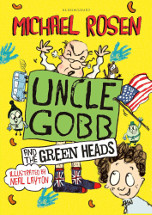
Bloomsbury, 2018. ISBN 9781408851340
(Age: 7-9)
Uncle Gobb is that really annoying relative who's overstayed his
welcome. Poor Malc and his mother have to endure his constant
roaring, his interfering ways and his opinions about everything from
learning history, to poetry and education. Uncle Gobb and the Green
Heads is the second over-the-top story that sees Malcolm, his
peculiar Uncle Gobb, their family and friends off to America. Malc's
dad lives there and he really wants to reconnect. Along the way
Uncle Gobb's genie 'Doctor Roop the Doop' and Malcolm's genie who
streams out of his nose provide comedic moments and varying levels
of assistance. Both protagonists have ulterior motives for
travelling.
At school, Malc suffers episodes of Blurting Out and Big Trouble;
with his best friend Crackersnacker they endure History and provide
creative answers for the Timeline Book. Brenda the Mender offers the
family her millions of air miles so they can travel overseas. More
bamboozling and confuzling action follows, as Malcolm and his best
friend, his mother, Uncle Gobb and the Weasels, Aunty Brenda the
Mender leave to fly to America. While Malcolm is planning to get rid
of Uncle Gobb, his relative also has an epic plan to get rid of his
nephew.
This is definitely a lighthearted story, where questioning an
adult's actions and motives aren't priorities. What a convoluted
plot, with stream of consciousness asides, absolute silliness,
jokes, fun chapter headings, and fact-filled text boxes interspersed
with Layton's bold cartoons. This book is suitable for the younger
reader who enjoys this humourous style of writing and silly
characters doing crazy things.
Rhyllis Bignell
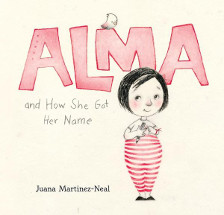
Alma and how she got her name by Juana Martinez-Neal
Candlewick Press, 2018. ISBN 9780763693558
(Age: 4+) Highly recommended. Themes: Ancestors. Family.
Names. Upset over her very long name, Alma questions her father
about why she has been given a name that doesn't fit on her page. He
then explains, showing her where each of her names comes from and
why she has been given that name. He takes a photo album from the
bookshelf and shows Alma some of the reasons she has her names: Alma
Sofia Esperanza Jose Pura Cabdela.
Sofia is for her grandmother, a woman who taught her father how to
read. Esperanza is for her great grandmother, a woman who loved to
travel and could not, following her son's voyages on her map. Jose
is for his father who taught him to paint and how to to really see
people. Each name has a tale to tell, as Alma comes to see the
importance of her names and her naming. Each name shows a different
aspect of her family and her forebears, and she can see how she gets
some of her characteristics, handed down from generations of people
who came before her.
Each page is built up with graphite images, enhanced with coloured
pencil and print transfers, all done on handmade textured paper.
The paper, not quite white, suits the idea of generations coming
before, of continuity, of family. I love the repeated stripey
trousers that Alma wears, paralleled with one of her ancestors, and
the predominance of paintings and books which litter the pages
underlining again the continuity of interests and skills which make
up her family.
The author's story of her own name follows in an afterword,
stressing again the ideas behind the picture book. A wonderful book
to use when talking of families and their similarities.
Fran Knight
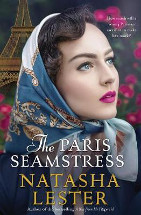
The Paris seamstress by Natasha Lester
Hachette, 2018. ISBN 9780733640001
(Age: 16+) Recommended. In 1940, young Parisian Estella Bissette finds herself unwittingly
drawn to help a dying man, and becomes the courier of secret plans
to the French resistance. She passes them to a dark mysterious
stranger, a spy, in an encounter that will change the course
of her life. Because of her actions, she has to leave France, and
finds herself on the last ship to New York, an escape route
available to her due to American birth papers that her mother has
kept secret and only now reveals. Estella has to leave her mother
behind and set sail to start a new life in a foreign land. She wants
to carve a career for herself as seamstress and designer with the
help of her friends Sam, a cutter at a fashion house, and Janie, an
adventurous Australian model.
In 2015, young Australian Fabienne Bissette attends the New York
exhibition of her grandmother's fashion line Stella Designs. She
also has a chance encounter with a two people she feels strongly
attracted to. Somehow the lives of Estella and Fabienne are
intermeshed with secrets that people have kept buried until it is
almost too late.
The story is one of dark secrets and family shame, but also of drive
and achievement by strong female characters, set in the context of a
burgeoning fashion industry in America during the war and post-war
years. The historical background has clearly been thoroughly
researched and author Natasha Lester, previously a marketing
executive for L'Oreal, shows her inside experience of the fashion
world and her knowledge of fashion history. Also, her intimate
knowledge of those iconic cities, Paris and New York, shines
throughout the novel. Less detail is provided about the third city
in the story, Sydney, but it is refreshing to read a historical
novel set in Europe and America with Australian characters leading
the story.
The novel maintained my interest throughout with its mix of romance,
war history, fashion world, and mystery. It would appeal to readers
of historical fiction, but especially to those interested in
fashion.
Helen Eddy
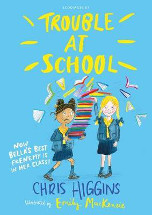
Trouble at school by Chris Higgins, illustrated by Emily McKenzie
Bloomsbury, 2018. ISBN 9781408868850
(Age: 6+) Recommended.
Themes: School stories. Friendship. Problem children.
Chris Higgins brings best friends Bella and Magda back in Trouble
at school an amusing story about first days, dealing with a new
teacher and difficult classmates.
Before the start of term, perfectionist Bella sets her school bag in
order and prepares her new uniform, she even organises her younger
brother Sid. Unfortunately when they stop to pick up Magda she ends
up with her friend's breakfast spilled all over her. To make matters
worse, Bella stays and helps in Sid's class for the whole morning
and Mr. Smart, her teacher, is not impressed. He's all about neatness,
order and discipline. As Bella's first day continues there's more
issues, some caused by Magda and some by troublemakers Claudia
Cleverley and her friend Hetty Snoop.
Magda's view of life, her fun and cheekiness help Bella to gain
confidence. There's the banter with the dinner ladies, Magda's
always wanting something exciting and the creative way they sort out
Claudia and Hetty. Miss Pringle the arty relief teacher brings a
totally different energy to the girls' class. Her unique teaching
style provides an opportunity for Bella, Magda and their classmate
Tom to express themselves. Emily McKenzie's comic illustrations are
fun and add humour to the story especially with the cow painting
reveal! Trouble at school is just right for a young reader beginning their
chapter book journey; with themes of friendship, developing
confidence, problem solving and growing in independence.
Rhyllis Bignell
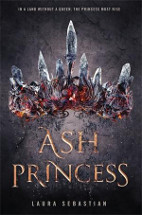
Ash Princess by Laura Sebastian
Pan MacMillan, 2018. ISBN 9781760555504
(Age: 12+) Recommended. Fantasy. The Queen is dead, the people have been enslaved, and princess Theodosia might as well be too. Confined to a pretty jail and watched constantly by three men, her shadows, since the castle was taken ten years before, Theodosia is now the obedient Lady Thora, and bears plenty of reminders to remain so. With every move of the resistance comes fresh pain and the familiar itch of skin knitting itself back together. She is an expert at surviving. When Ampelio is captured, everything changes. The man is familiar, and while Thora tries to ignore them, Theodosia's memories return. This man, who speaks hastily in Astrean, a language which has long since been forbidden, is her father. Unable to stay quiet, Thora mis-steps, speaking out in Ampelio's defence. The Kaiser, being a cruel man, rewards this disobedience not with a whip, as Thora expects, but with charging her with the execution. As the life floods from Ampelio she must decide whether surviving in this alien world is enough.
As the spark of rebellion grows into a flame, Thora/Theodosia is joined by three renegades who have replaced her shadows. Of the three, one is a childhood friend, Blaise, who is determined to see her safely away. But Theodosia is not finished. She can't leave without any retribution. Quickly, a plan is hatched to kill the Kaiser's right-hand man, the Theyn, and Prinz Soren. But will Theodosia be able to commit such cold acts when these are people she has been raised to admire? Can she, a young woman, rid Astrea of it's invaders?
While slow in places, the novel is overall a fun read. Recommended for fans of adventure fantasy twelve and up.
Kayla Gaskell, 22
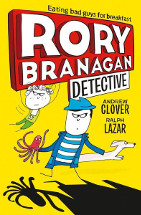
Rory Branagan detective by Andrew Clover and Ralph Lazar
HarperCollins, 2018. ISBN 9780008265830
(Age: 8+) "Hello. I am Rory Branagan. I am actually a detective.
People always say, 'How do you become a detective?'
And I say, 'Ahhhh... you don't just FIND YOURSELF suddenly
sneaking up on baddies, or diving out of the way as they shoot, or
hurtling from an open plane towards the ground! You have to want
it.'
And what made ME want it? I needed to find out what
happened to my dad... "(Publisher)
What a highly entertaining book to read. Children 8 years and up
will find this a highly entertaining read and will be proud of
themselves for reading such a lengthy novel with it having in excess
of 300 pages! Don't be put off by this - there are large
illustrations interspersed between the text with some pages only
containing a sentence. Rory and Cassidy are strong lead characters
and have many likeable traits. This is the first book in a series of
seven and the authors have successfully mixed crime with humour. Themes
such as suspense, mystery, determination and friendship are
developed throughout the book. It would make a fantastic read aloud
and one that would be enjoyed by boys and girls alike. A welcome
addition to the collection.
Kathryn Schumacher
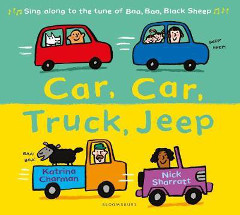
Car, car, truck, jeep by Katrina Charman
Ill. by Nick Sharratt. Bloomsbury, 2018. ISBN 9781408864968
(Age: 3-5) Recommended. Themes: Cars. Rhyming story. Sing along.
Read aloud, Nursery rhyme. Machines. Sung to the tune of 'Baa baa
black sheep', this funny story will delight its younger readers,
listeners and singers. In bright primary colours every possible form
of wheeled transport is shown and included in the rhyming couplets,
starting with
"Car, car, truck, jeep
Have you any fuel?
Yes sir, yes sir,
Three tanks full" children will quickly learn the rhyming sequence and
participate in the sing along, predicting the rhyming words at the
end of each pair of lines. There is a tank full for the red bus, one
for the train and one for the jet plane. From there, mum and the
kids go down the lane past the tractor, then see a motorbike weaving
its way amongst the traffic, they pass another train, see a
hovercraft, then a helicopter, a truck, a yellow taxi, a dumper
truck, police car and ambulance, until finally they are amongst a
lot of traffic all headed home, tired out by the day's work.
Each page will have children hunting out the things described in the
verse, commenting on what each does or sounds like, participating in
the rhyming lines and making appropriate sounds. A whole heap of fun
for younger readers and teachers alike, along the way discussing
with them what they can expect to see on the road and how useful
each of these machines is to our lives.
This may even lead to discussions about road rules and safety on the
road and in these machines.
Fran Knight
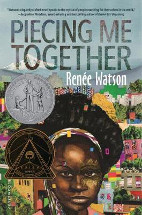
Piecing me together by Renee Watson
Bloomsbury, 2017. ISBN 9781681191058
(Age: Young Adult) For Jade, a young black woman living in New York
who attends a school that offers specific help to students,
particularly financial help for those who need it, the final years
of high school are pivotal to her future. She has to travel a long
distance to attend school and because of the straitened
circumstances of her family's life, often has little to eat. Taking
the opportunity to learn Spanish opens her mind to the meaning of
words, and she embraces the opportunity to think about her world in
a new way. We see the chapter headings as pertinent to the novel in
that they reflect Jade's thoughts and her joy in incorporating her
new knowledge into her life e.g. Chapter 10, presentar, to introduce.
To find out who she is and what possibilities exist for her in the
future, she feels driven to seek answers from her everyday
experience. This is limited, as her family struggles to have enough
to eat, she has to travel a long distance by public transport to get
to the school, and her mother needs to work long hours to support
them, desperate to keep Jade in school to enable a better future for
her. Fortunately, the school institutes a program that offers
mentorships by women not too much older than the girls, and this is
the door that offers hope.
We are gradually made aware of her family's poverty, yet, despite
this her mother is determined that their life be one that is
grounded in love and kindness. Watson's intention is to enable us to
recognise immediately that Jade's family is decent, good and
desperately clinging to the hope that Jade will be able to find a
path to a more hopeful future. Her turning point arises when she
decides to speak out about what is wrong with the program,
suggesting that what girls like her need is not just what has been
planned but what she has come to understand needs to be done.
Watson's writing is intensely powerful, without guile, and her
narrator's voice is a call that does not excite agitation or a call
for violent upheaval, structuring characters and plot that
foregrounds the need for a rational and calm approach to the
education of all minorities, one that will enable them to able to
choose and thrive in the world, taking their place fairly and justly
alongside all others.
This challenging book is exciting and uplifting in the hope it
offers, setting a challenge for people who do not realise the level
of poverty in which some people, impoverished by education and
financial background, colour or race, manage to live, in big
third-world cities such as New York.
The narrative fits perfectly into its niche, occurring in the
present, modern world that foregrounds the claim for equality but
too often falls short of this high ideal. It is suitable, and indeed
highly recommended, for adolescents and adult reading, its clarity
of issue never suppressing the wonderfully told narrative that
captivates us to the last page. The characters are deftly drawn and
match their circumstances, and the place, New York City, comes alive
through the vivid construction of place by its writer. It is a
compelling book precisely because it advocates change through ways
that do not frighten people, rather calling for the recognition of
the humanity of all and the need for us all to be equal, in all
ways.
Elizabeth Bondar
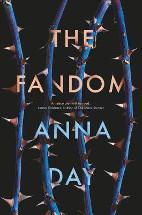
The Fandom by Anna Day
Chicken House, 2018. ISBN 9781910655672
(Age: Older teens - YA) Note on book: Not suitable for younger
readers. Anyone in any fandom's greatest dream is to be transported
into the canon world of their favourite story and live out the
events as the main character. Maybe except for fans of The
Hunger Games, Game of Thrones and now The Gallows
Dance. The story follows four teens who were transported from
Comic-Con to the canon world of The Gallows Dance, where regular
humans are looked down upon and discriminated against. Of course,
then it all goes wrong; they accidentally kill the main character
and Violet, our main character, takes her place in the story. The
Fandom is full of tropes and cliches, but is comforting in the
sense that you can anticipate what happens next. The comfortably
cliched style is reminiscent of novels like The Medoran
Chronicles by Lynette Noni and is pleasant to read and follow
along to; however, if you like suspense and surprise, you might feel
the book falls short. The only problem I had with the tropes and
cliches (without giving too much away) was the death-revival trope,
as it doesn't allow for emotional payoff.
Although friendship is meant to be a large theme within the story,
there doesn't seem to be much true friendship displayed throughout
the book, something which disappointed me. The action moves quickly
once the world is established, and though you know what's going to
happen as the story follows canon, the writing describes it
beautifully and of course, nothing ever really goes to plan. The
twists and turns keep you on your toes as you read. The teens and
the audience get a glimpse at how large and deep a story's universe
is and how much effort goes into creating such a detailed,
captivating world.
Day gives a satirical look at discrimination and oppression,
emphasising everyone's humanity and the futility of social
constructs. The main character Violet is a massive fangirl and a
brave but reluctant hero, whose sarcasm and wit bring a spark to the
book. The story was compelling and complex, with witty twists and
turns.
I would recommend this book to people who want something comfortable
and easy to read, but captivating nonetheless.
Stephanie Lam
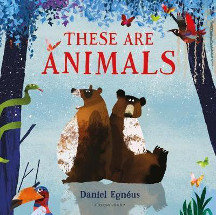
These are animals by Daniel Egneus
Bloomsbury, 2018. ISBN 9781408889909
(Age: 3+) Highly recommended. Animals. Humour. Read aloud. Movement.
Sound. What a lovely way to introduce animals to young readers. A
vibrant, colourful display of animals around the world is presented
with verve and movement, noises and sounds for little kids to enjoy,
join in, make the noises and move around copying the the traits of
the animals shown.
Neatly divided into areas: woodland animals, polar, grassland, night
time, rainforest and ocean, each section shows a range of animals
that survive in this particular habitat. Grassland animals depicts,
for example, giraffes, elephants, zebras and lions, encouraging
children to make the noises of the elephant and lion, copying the
expressions on their faces. Some readers may even question why these
animals live in this particular part of the world, eliciting all
sorts of information from the adults. Night time animals too,
depicts bats, owls and wolves and children will laugh with delight
trying out the noises that the owl and wolf make, while blinking
like the owl or hanging upside down like a bat. Each page is brim
full of ideas for younger children to take to heart: moving, making
noises, stretching, jumping, howling, squawking and swinging through
the trees.
This is a delightfully colour filled book of sound and movement to
introduce younger readers to the range of animals that exist around
us.
Fran Knight
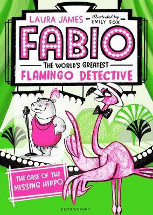
The case of the missing hippo by Laura James
Ill. by Emily Fox. Fabio: The world's greatest flamingo detective
series, book 1. Bloomsbury, 2018. ISBN 9781408889312
(Age: 6-9) Highly recommended. Themes: Detective story. Animal tale.
This is a 'classic' detective story involving the great Flamingo
Detective, Fabio. He is an intelligent flamingo, with a very tall
giraffe co-worker (who is not quite as clever, but he is very tall!)
and Fabio is exceptionally good at solving the problem of the
missing hippo. Putting together the clues and bringing the case to a
satisfactory conclusion (in a Hercule Poirot revelatory and
flamboyant style), is detailed very simply for a young reader, but
without underestimating their desire for a good story. This is an
interesting mystery - it is after all fairly difficult to hide a
hippo! Young readers will love the story, and animal characters add
a touch of humour.
Illustrations are scattered through the pages, done in a simple, but
amusing, cartoon style, and intensely vivid pink and green pages are
also randomly included. This colour explosion adds a burst of
interest for even the most reluctant reader.
Highly recommended for independent readers aged 6-9, and could still
appeal to an older reluctant reader as they will recognise the
subtle (or not so subtle) humour.
Carolyn Hull
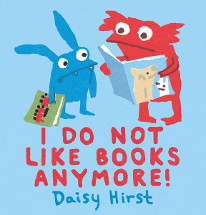
I do not like books anymore by Daisy Hirst
Walker Books, 2018. ISBN 9781406369137
(Age: 4+) Recommended. Themes: Books and reading. Learning to read.
Cooperation. Natalie and Alphonse love to read together. Dad reads
them picture books, Mum reads them scary stories, Grandma tells them
stories about the terrible shrew. And they love all of them, and
often make them up, retelling stories that they know.
Natalie is impatient to learn to read and to read a story all by
herself, even able to read it to Alphonse. But given a book to read,
she finds it unintelligible, and in desperation, throws it away. The
writing is a lot of squiggles, looking a lot like birds' feet, with
nothing in it that she recognises. Miss Bimble tells her that it
will take practice, and Mum and Dad tell her to be patient. She
sticks at it all week until she can read her cat book, but when
Alphonse offers her another book to read to him, she finds it a lot
like before, lots of squiggles. She gives up saying that her toy
elephant needs to be cared for. Alphonse asks her to tell him a
story and in so doing, encourages her to illustrate it and getting
Dad to write the words, she finds that she can retell it after all.
A charming story of trying different methods to help children learn
to read, the story will resonate with children who are in that stage
where writing is a bit of a jumble. But perseverance and help from
others leads to the children learning to read.
Fran Knight
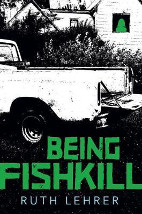
Being Fishkill by Ruth Lehrer
Candlewick Books, 2018. ISBN 9780763684426
(Age: Mature14+) Being Fishkill focusses on 12-year-old
Carmel Fishkill who is named after a highway exit sign her mother,
Keely, glimpsed while giving birth in the back seat of a car. Her
life is complex and she decides that starting seventh grade in a new
school is an opportunity to reshape her image, now that her abusive
grandfather is dead, and her drug-addicted mother has vanished.
Starting with a name reversal, Carmel becomes the tough girl,
Fishkill, but her plan is thrown off course when the more precocious
but equally tough Duck-Duck Farina befriends her.
The novel is dark, with moments of lightness, as Fishkill quietly
'fights' to establish an identity that is not based on her
dysfunctional family. This narrative is about a search for
connections and also enters the realm of the first stages of
exploring sexual identity.
For me, as a reader, Fishkill and Duck-Duck seemed much older than
their 12 years, and that caused a block in the plausibility of their
characters.
There are flashbacks to a disrupted and disturbing life with her
mother and grandfather. This is countered with Duck-Duck's mother,
Molly. who welcomes her into the home.
There are many twists and turns in this novel which would keep the
reader engaged. Emotions and experiences are intense and at times
confronting.
I would recommend this for more mature readers of 14 years and up.
Maree Samuel
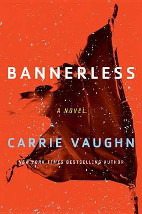
Bannerless by Carrie Vaughn
John Joseph Adams/Houghton Mifflin Harcourt, 2017. ISBN
9780544947306
(Age: 15+) Recommended. Philip
K. Dick Award (2017). Themes: Dystopian fiction, Science
fiction, Murder, Birth control. Years after an environmental
disaster has devastated the world, killing millions, the Coast Road
in the US has developed a thriving culture, where birth control is
mandatory and people must earn a banner if they want to have a
child. In Haven, Enid has not only earned a banner but is an
Investigator, helping to solve problems and mediate when necessary.
When there is a suspected murder in another town she is sent to
investigate and uncovers more than she was anticipating. Bannerless is a sometimes bleak and very different take on a
dystopian future, with less emphasis on solving a crime but
exploring a society that allowed it to happen. Through a series of
flashbacks the reader follows the progress of Enid as she grows from
a restless young woman roaming the roads with Dak to a responsible
member of her community trusted to obey the laws that allow it to
flourish and to enforce them if necessary. People live together in
small groups, grow their own food and look after each other, putting
the needs of the community before individual needs. Cities no longer
exist and much of the technological knowledge that ruled the world
before its downfall has disappeared. The Coast Road people managed
to salvage what knowledge they thought was most important, birth
control being one of the major needs.
Vaughan, better known for her Kitty series, featuring a
werewolf, shows off her writing ability in Bannerless, bringing
alive a different and unique take on a dystopian future. Its themes
of birth control, self sufficiency, sharing and group living, as
well as the ethics surrounding the murder of a loner, make it a
fascinating and memorable read.
Pat Pledger
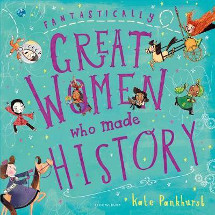
Fantastically great women who made History by Kate Pankhurst
Bloomsbury, 2018, ISBN 9781408878897
(Age: 8-12) Recommended. Subjects: Women - History, Women -
Biography. Fantastically Great Women Who Made History looks
at the lives, discoveries and achievements of many important women
from Hatshepsut in Ancient Egypt to Russian astronaut Valentin
Tereshkova. Kate Pankhurst's has an engaging and unique presentation
design, interweaving fun and interesting factual information with
stylish cartoon characters, bold coloured text boxes and visually
engaging fonts and sizes.
'To make history you need to be brave, bold and believe in yourself
- just like the women in this book.' The book begins with Harriet
Tubman who helped many runaway slaves escape through the Underground
Railroad between 1850 and 1860 in Maryland. Flora Drummond fought
for women's equality and for the right to vote in Edwardian England,
as did the author's relative Emmeline Pankhurst. Chinese Qiu Jin
wrote poems, articles and gave speeches about the unfair treatment
of Chinese women, in the late 1800's. She was passionate about the
cruel practice of feet binding and encouraged her students to
secretly rebel against the old-fashioned government rulers. English
inventor Ada Lovelace designed a flying machine in 1828 when she was
just twelve, and later worked with Charles Babbage on his Difference
Engine.
Pankhurst travels through history, focussing on inspirational women,
some famous and others who have made important contributions to
women's rights, people's lives and living conditions across the
arts, literature, music and world issues. Pankhurst concludes with a
challenge 'How will you make history?' Fantastically Great Women
who made History is an excellent resource suited to Humanities
and Social Sciences from Year 2-Year 9 reflecting on women's
influences in the shaping of Australia and the world.
Rhyllis Bignell