Old Barn Books, 2018. ISBN 9781910646229
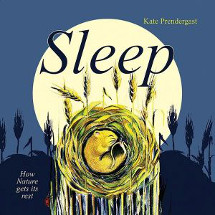
(Ages: 3+) Recommended. Themes: Sleep, Dreaming, Night time. A
picture book telling younger readers about how animals sleep is a
lovely book to use at the end of the day to get children ready for
bed, a quiet time to relax with an information book before bed time.
Its soft illustrations showing a range of animals and how they sleep
will show younger children that they are part of the animal kingdom,
and like all others, need their sleep. Sleep is a natural part of
the activities of the day, and each animal has some sleep to
revitalise themselves. Each animal models sleeping behaviour, some
sleep in groups, some alone, and some for only a few minutes each
day. Most children will be aware of their pets sleep patterns and be
able to tell each other how long their dog or cat sleeps, and then
widen the conversation to include other animals they may know of.
The book allows for younger readers to share the information and
wonder at the facts given to them in boxes at the end of the book,
reiterating what has been seen in the brief lines and soft
illustrations already looked at.
This is a warm inviting look at animals and their sleep patterns,
hugely valuable to use at night to model sleep behaviour but will
also intrigue readers with the depth of information given in so few
words.
Fran Knight
The prince and the witch and the thief and the bears by Alastair Chisholm
Ill. by Jez Tuya. Walker Books, 2018. ISBN 9781406365139
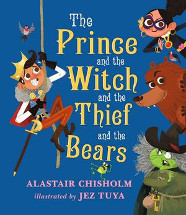
(Age: 4+) Recommended. Themes: Witches, Bears, Bed time story,
Family, Bed time. Going to bed one night, Jamie is determined that
tonight's story will be different. No more reading from a book, but
a made-up story full of witches, and knights and bears and of course
a prince and a thief to make it all the more interesting. So Dad
decides, why not, and proceeds to make up a story, one that Jamies
interrupts often with a particular slant that he wants included.
Dad starts off as all good bed time stories do, with "once upon a
time" but from there, Jamie interrupts with questions and
suggestions that Dad must include in his narrative. So the prince
rides to the rescue of the princess in the tower, put there by the
wicked witch. He must scale great cliffs with his horse on his back
to succeed where others might fail, he must free the girl, and as
the witch falls to her death, Jamie intercedes on her behalf and the
story is changed again.
Readers will laugh out loud at the story as it goes meandering along
with the changes that Jamie makes to make it more palatable, and
include all the characters he wants to hear about. Readers will
recognise many of the stock situations always fun in fairy tales but
laugh when they are reversed, making the tale one of a kind. Kids
will try this out for themselves, changing a tale well known into
something different and including more characters, and like Jamie
and his Dad, shelve some of them, in this case, the bears, for
another night.
A funny tale full of interest and enhanced with the hilarious
illustrations which flesh out the characters, enabling readers to
link the story to the images. And the slant given to the witch will
please many.
Fran Knight
Wonders of the World by Isobel Otter
Ill. by Margaux Carpenter. Little Tiger, 2018. ISBN 9781848577251
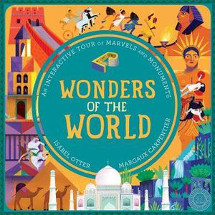
The sub-title of this book is An interactive tour of marvels and
monuments and indeed, that it what it is from cover to cover
as it explores the wonders of both the ancient and the modern world.
More than 2000 years ago, Antipater of Sidon, a Greek writer
identified seven must-see sites of the small world around Greece
(world exploration was limited and the Mediterranean was seen as the
centre of a flat world) and these became known as the "Seven Wonders
of the Ancient World", still referred to in books and quiz shows as
such. However, in 2000 AD a new list was compiled from the popular
votes from a list of 200 man-made landmarks and these are considered
to be the seven wonders of the modern world.
All 14 are explored in this colourful, interactive lift-the-flap
book beginning with a world map showing their locations and whether
they are ancient or modern selections. Each has an illustration of
the building, an introduction to it and then several pertinent facts
that are often hidden under a flap or other device demanding
interaction.
While Australia has no entry in the man-made wonders, it does
feature in the list of natural wonders on the final endpapers, which
are presided over by a magnificent pop-up Paricutin Volcano, the
youngest volcano in the world.
As well as perhaps laying the seeds for future travel, this is one
of those books that groups of young boys love to pore over and
discuss, a behaviour that appears to be crucial to their reading
development as they seek to discover the wonderful and the weird and
out-do each other with their discoveries. It is worth having in your
collection for that alone!
Barbara Braxton
Jake Atlas and the hunt for the feathered god by Rob Lloyd Jones
Walker Books, 2018. ISBN 9781406377712
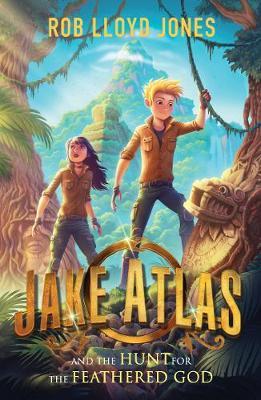
(Age: 10+) Recommended. "Jake Atlas and his family are on the run,
hunted by international police while chasing the mysterious People
of the Snake to stop them from hiding the secret history of
humankind. But when the family's friend, Sami, is poisoned, the
People of the Snake force the Atlases to work for them in exchange
for a cure." (Publisher)
This is a great adventure novel - Indiana Jones for children. Once
you start reading you want to know what happens next. Jake seems to
find himself in trouble for not thinking on a number of occasions
throughout the book. He has to work with his twin sister Pan and his
parents to help save a friend of theirs. During the story Jake finds
out interesting things about his parents and the double life they
have been leading. Jake desperately wants to be part of that world;
treasure hunting seems so glamourous.
During the course of the book Jake starts to realise that his
actions affect the people around him and he starts to see that his
parents do have his best interests at heart.
This is a great adventure novel and would appeal to adventure loving
kids, particularly boys.
I recommend this novel to children 10+
Karen Colliver
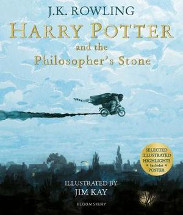
Harry Potter and the Philosopher's Stone by J.K. Rowling
Ill. by Jim Kay. Harry Potter, book 1. Bloomsbury, 2018. ISBN
9781526602381.
(Age: 8+) Highly recommended. Themes: Fantasy. Orphans. Wizards.
Magic. Good and evil. Harry Potter needs no introduction: the
enormous popularity of all the books as well as the films, has made
him into a household name. This is the first book in the series,
introducing Harry, the lonely orphan who has been forced to live in
a cupboard under the stairs by his unsympathetic aunt and uncle and
tells the story of his time at Hogwarts School of Witchcraft and
Wizardry.
People revisiting the Harry Potter books will be entranced
with the beautiful illustrations by Jim Kay, the talented Kate
Greenaway Medal winner, in this paperback edition (the hardback
version came out in 2015). He has kept the familiar image that
everyone has of Harry Potter from the films, complete with glasses
and dark hair, but added much to his expressions and gestures.
Pictures dot the pages, some on a full page, set in dark tones, as
Harry and his friends fight the evil at Hogwarts. More colourful,
smaller drawings complement the narrative and give the reader a
picture of what is going on in the text. J.K.
Rowling has said: "Seeing Jim Kay's illustrations moved me
profoundly. I love his interpretation of Harry Potter's world, and I
feel honoured and grateful that he has lent his talent to it".
This illustrated edition in paperback is beautifully presented and
could become a collector's delight. As well as a book to be
treasured by older readers, I can see it being used as a read aloud,
introducing Harry Potter to the 7-8 year olds, who will be entranced
with both the story and the illustrations. Bloomsbury has a page with
information about J.K. Rowling, games, discussion guides and a Harry
Potter night.
Pat Pledger
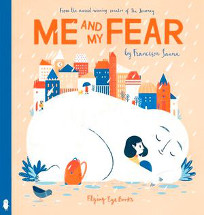
Me and my fear by Francesca Sanna
Flying Eye Books, 2018. ISBN 9781911171539
(Age: 6+) Themes: Fear. Anxiety. Friends. With mental ill-health an
issue for many children, a number of books promoting well being for
children have been released. In the past it has been rare to see a
character feeling anxious or depressed, and if they did exist in the
book, were a minor or secondary character. But now as the issue has
become more well known and recognised as a major concern amongst
younger people, there are more books around which encourage children
to talk about their fears, and see for themselves that they are not
alone. I wrote an article published in The Literature Base about
well being, and included a long list of books that will help
children reach out. (The Literature Base Volume 27, Number 3, August
2016) Me and my fear addresses the concern of keeping the fear
secret. In this book, the child is almost content with her fear,
illustrated as a small blob of white like a small animal that
sometimes cocoons the girl, sometimes almost smothers her. They do
everything together, the fear alienating her from her friends and
family. When she sits in the playground the fear tells her that no
one likes her, when she sits in the library the fear tells her he
doesn't like it here. She becomes more lonely but then a boy talks
to her and they begin to do things together, making the fear
smaller. The fear is still there but it is smaller and she realises
that many of the children have a fear as well.
A book to share with a class which will create much discussion.
Fran Knight
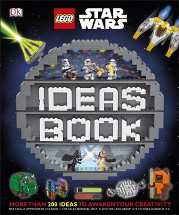
LEGO Star Wars ideas book: More than 200 games, activities, and building ideas by DK Publishing
DK Publishing, 2018. ISBN 9780241314258
(Age: 7+) Recommended. Themes: Lego. Star Wars. Inventions. A
fantastic book to give as a gift to young Lego and Star Wars
aficionados or to have in a Maker Space, this LEGO Star Wars
ideas book will keep children occupied for many hours with the
over 200 ideas that it contains for using Lego bricks that they may
already own. The contents page contains all 200 activities and is
organised under the headings of "Recreate", "Expand", "Challenge",
and "Use it". There is a further double page spread that asks the
question "What will you do today?" And includes questions like "What
are you in the mood for?" and "How much time do you have?" and then
gives suggestions for what to make.
It follows the themes of "Rethink, Rebuild and Recycle", giving the
user lots of alternatives of things to make at differing levels of
difficulty. There are activities like building Han's
electrobinoculars, make a mosaic, recreate the Star Wars characters
and even make a pencil holder shaped like a Jedi. One I liked was
"Be a Lego Portrait Artist", which showed how to make Queen Amidala
and General Grievous.
The index is also handy, and a skim through this would give readers
ideas about individual things that they could make, for example, the
entry for Han Solo, gives the page numbers for a 8-bit figure,
electrobinoculars and lucky dice.
The book itself is a sturdy, colourful product, with a thick hard
cover and should stand up to some hard use. Each of the projects is
well illustrated with excellent photos which would give a lot of
guidance to the person making the selected building.
Pat Pledger
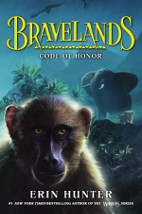
Code of honor by Erin Hunter
Bravelands series, book 2. HarperCollins, 2018. ISBN
9781460756287
(Age: 9-14) Recommended. Themes: African animals. Lions, Baboons,
Elephants, Quests, Survival. Code of Honor is the second
book in the Bravelands series from the creative Erin Hunter
team (Clarissa Hutton and Gillian Philip), well-known for their
popular Spirit Animals and Wings of Fire books. The
African savannah comes alive with beautiful descriptive imagery, as
the forces of nature test the wildlife to their limits. The plot
masterfully weaves a tale of murder, treachery and the fight for
survival. The interwoven narrative is told from three different
viewpoints, Thorn Middleleaf a young baboon, Fearless the lion cub
and Sky the elephant.
When the Great Mother elephant who wisely ruled the Bravelands is
murdered and her body left in the waterhole, trouble unfolds. As the
Great Flock, the Strider elephant herd, Brightforest baboon troop
and other animals gather here, all are questioning who is best to
take on the leadership. The Great Mother didn't have time to train a
successor and pass on the Great Spirit's voice. As the torrential
rain pours, Stronghide the rhino steps forward to claim the role.
Sky from the Strider elephant herd slips away with her cousin Moon
to search for answers in the Plain of Our Ancestors, taking a
fragment of her Great Mother grandmother's tusk along with her.
Meanwhile, the Brightforest baboon troop leader Stinger restructures
the group, causing problems which young Thorn realises is really a
devious plot to dominate his troop and stir up trouble in the
Bravelands. Attacks by the marauding green monkeys and vervet
monkeys drives the troop into dangerous paths as they search for
shelter.
Titan leader of Titan pride also plans for complete control of the
Bravelands by killing a large amount of predators, breaking the code
of only killing to survive. Disillusioned and forgotten cub Fearless
seeks advice from his friend Stinger the baboon.
Each of the protagonists show courage and resilience as they search
for the truth and stand up for what is right. Code of Honor
delivers exciting action, high levels of drama,
and convincing characters who are multi-dimensional. The savannah
setting, the natural environment, the drought and floods and animal
habitats are richly and realistically portrayed. The themes are
dark, treachery, murder, deceit, destruction and survival, with
complex conspiracies and intrigue. The misuse of power and its
consequences are an overarching theme. Fans will be keen to read the
third novel in the series, after the cliffhanger ending.
Rhyllis Bignell
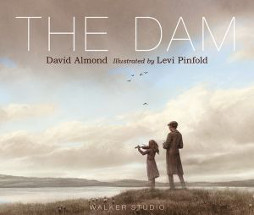
The dam by David Almond
Ill. by Levi Pinfold. Walker Studio, 2018. ISBN 9781406304879
(Age: 6+) Highly recommended. Themes: Music. Dams. Loss. Hope.
Picture book for older readers. Based on a true story told to Almond
by Kathryn and Mike Tickells, two musicians, The dam
celebrates the power of the human spirit and the beauty of music. In
the 1980's, Keider Water in Northumberland, the largest artificial
lake in the UK, was created. Farms and houses were submerged and a
village drowned, but before that happened a father and his daughter
visited the houses and in each, the girl played her fiddle for the
last time. Then the valley disappeared and a huge dam and lake took
its place. When the water rose and covered everything, it left a
beautiful lake and Behind the dam
Within the water the music stays,
Will never be gone.
Beautifully illustrated by Levi Pinfold, this poignant picture book
will linger in the memory. The text is sparse and beautiful and the
accompanying illustrations, first in sepia tones, and then gradually
becoming more colourful, are stunning and beg to be examined again
and again. The father and his daughter come alive on the pages, the
love between the two and for music shining through the pages, with
people singing and dancing on the banks of the lake as the
continuation of music is celebrated even though great changes have
been made in the landscape.
This is an unforgettable picture book, with author and illustrator
combining to give the reader a lyrical story with wonderful imagery,
truly a showcase of art.
Pat Pledger
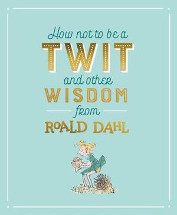
How not to be a twit and other wisdom from Roald Dahl
Ill. by Quentin Blake, Puffin. ISBN 9780241330821
(Age: 6+) Themes: Roald Dahl. Witticisms. Sayings. In this unusual
offering from The Roald Dahl Story Company Ltd, children can read
witticisms and sayings taken from Dahl's books. Based around one of
his most popular books, The Twits, the introduction tells us
that not being a twit is something to be aimed for and this little
volume will help you avoid the trap (of growing up).
With quotes from his broad acreage of books, and references to where
the quotes are from, this inviting volume of sayings will push
readers to search out the books from which the quotes came,
reacquainting themselves with the humour contained in Dahl's books.
To quote just a few: "What's so wonderful about being a little boy
anyway? Why is that necessarily any better than being a mouse?
Little boys have to go to school. Mice don't." (The Witches)
"It's impossible to make your eyes twinkly if you aren't feeling
twinkly yourself" (Danny the Champion of the World) "Life is
made up of a great number of small incidents and a small number of
great ones" (Going Solo)
And all illustrated with the dancing pen of Quentin Blake, the
familiar lines of his technique will enthral the reader, recognising
his drawings form other Dahl books they have read.
A sure fire book to reinvigorate interest in Dahl's stories and
Blake's illustrations, this volume, designed to fit comfortably in a
small hand, will be bought by those with fond memories of their
work, designed to pass it on to their children and grandchildren.
Fran Knight
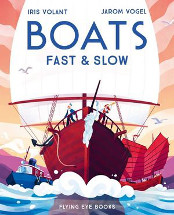
Boats: fast and slow by Iris Volant
Ill. by Jarom Vogel. Flying Eye Books, 2018. ISBN 9781911171522
(Age: 5+) Highly recommended. Themes: Boats, Non fiction, History,
Survival, Exploration, Migration. The history of boats is entwined
with the history of people around the world, as people look for
food, conquer other countries, build boats as a sign of their power
and influence, explore, migrate to new worlds, and use boats for
festivals and races.
From the beginning of this beautifully presented non fiction book,
readers will eagerly read of the ways boats have developed and
changed according to what is required by the population. The first
few pages are devoted to a definition of a boat: a vessel to carry
people across water, and then to elaborate on the different sorts of
boats that we may see. From there the book divides into four
sections: "The first boats", "War boats", "Work boats" and "Leisure
boats" with a double page between each section showcasing one
particular boat that is well known.
Each section gives detail about the style of boat and what it is
used for and where and when. In "War boats", for example is a page
on Viking longships and Pirates, while "Work boats" introduces the Cutty
Sark as well as steam boats. Double pages are devoted to
famous boats, like the legendary Nautilius and Ra's
barge, HMS Beagle and Spray.
Readers will love reading of these famous ships and how they
influenced our lives. After a fascinating read, children will find
two pages outlining the Semaphore flags and then a further double
page offers an illustrated index. Each of the endpapers has a map of
the world with illustrations showing where some fo the boats
resided.
All in all a wonderful read to educate and entertain, making sure
children and adults will know what they are looking at when they
visit some of these magnificent boats.
Fran Knight
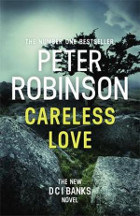
Careless Love by Peter Robinson
DCI Banks series. Hachette, 2018. ISBN 9781444786989
(Age: senior/adult) Themes: Crime, Yorkshire Robinson's latest DCI
Banks Novel, Careless Love is the 25th in the series. The
Yorkshire setting will be familiar to those who have read the books
and seen the TV adaptations. This new novel involves the discovery
of three bodies, two in Banks' area and one in the neighbouring
jurisdiction. There are problems about each of the deaths and the
scenes of the crimes. There is a definite lack of anything to
identify the bodies, no mobile phones, wallets, purses, credit cards
or keys. They are all well dressed, as if on a swanky night out, not
for a hike on the moors, while one appears to have committed
suicide.
The novel eventually reaches the point many readers probably guessed
at quite early in the narrative, that sex is the contributing factor
not drugs. It is now just the detail that needs expanding and
explaining to keep the audience attentive and reading.
Fans of DCI Banks will find the read satisfying, with the constant
references to his music knowledge and choices attempting to make him
more human and adding to the characteristics fans already know about
the man, but all it did for me was to make the reading easier by
skipping all those music citations. The most interesting addition is
Annie's father's partner Zelda, an eastern European woman much
younger than Ray. She has had a number of very nasty experiences
with sex traffickers and now, because of her photographic memory
recall works in London on occasions for one of the government
surveillance agencies. It is her piece of information that directs
Banks and Annie down a path towards an old adversary, one who will
stop at nothing. He has already tried to kill Banks, so fans will
eagerly follow the storyline to see how Banks extricates himself.
It is an easy read, but its satisfaction level may not please
everyone. A click on https://
www.inspectorbanks.com/ will tell you all you need to know
about Banks and the other 24 novels detailing his investigations.
Mark Knight
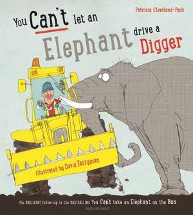
You can't let an elephant drive a digger by Patricia Cleveland-Peck
Ill. by David Tazzyman. Bloomsbury, 2018. ISBN 9781408879146
(Age: 4+) Recommended. Themes: STEM. Probability. Humour. Verse. A
range of improbably domesticated animals are given impossible things
to do, inviting every reader to simply laugh out loud at the antics
shown. Each double page shows an improbable scene: a shark in the
bath, a polar bear cutting hair, a seal acting as a chef, brushing
your teeth with a crocodile and more, all illustrated with gusto,
hinting at the possible things which may happen with the animal
doing something he is simply not designed to do.
Told in four line rhyming stanzas, each page invites the reader to
predict the last word of each line and many adults will find
children learning the stanza detailing the animal they like best.
Kids will love the looks on their faces as they try out their
impossible tasks, and the corresponding looks on the children's
faces as a shark appears in the bath or an octopus helps with
dressing or a wolf offers to read a bedtime story. Each page
bristles with laughter and kids will love looking at the detail
where other things are happening: mice carrying away the mousetrap,
a cat under the table eating the fish dropped by the seal or the
elephant's poo dropping onto one of the workers.
Full to the brim with hilarity, children will relish this unusual
tale, another from the duo who created "You can't take an elephant
on a bus". David Tazzyman is new to me and I found out more about
him here.
Initially a commercial illustrator, he illustrated the "Mr Gum"
books for Egmont in 2006 and has illustrated children's books ever
since. Patricia Cleveland-Peck has written some 14 books and more
information can be found here.
Fran Knight
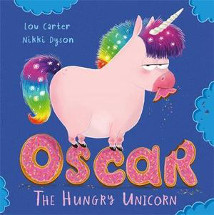
Oscar the hungry unicorn by Lou Carter
Ill. by Nikki Dyson. Orchard, 2018. ISBN 9781408355756
(Age: 3+) Recommended. Themes: Unicorns. Fairy tales. Food. Home.
Humour. Oscar loves to eat and despite what he eats, he is still
hungry. He eats his stable, the gingerbread house, the pirate ship,
the toadstools which house the fairies and the dragon's pizza. The
dragon points out that the pizza is to share, but Oscar takes no
notice. But at the giant's table, he finds that he is part of the
food going into the giant's mouth so runs away, despairing that he
will never find a home. He crosses the troll bridge eating it as he
goes, and just as the trolls begin to exact their revenge, Princess
Oola comes by with her boat. She scoops him up, telling how she
loves unicorns and takes him to her castle, where food is never
ending and Oscar finds a home. But he still looks at the moon with
avaricious eyes.
This lovely story about eating reflects many fairy tales which
readers will be familiar with. They will love the references to
these stories, spying the illustrations to see what parts of the
fairy story is mentioned. The fun illustrations suit the tone of the
story well, and younger readers will love peering into each picture
to see the details.
Teachers and parents will be able to use the story to talk about the
place of food in our lives, and the appropriateness of some of the
food available against a funny and inviting story.
Fran Knight
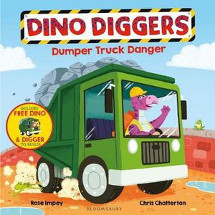
Dino diggers: Dumper truck danger by Rose Impey
Ill. by Chris Chatterton. Bloomsbury, 2018. ISBN 9781408872482
(Age: 4+) Recommended. Dinosaurs, Technology, Accidents. In
Dino-Town, the Dino Diggers are all ready for action. Dressed in
their hard hats and fluoro jackets, they can take on any problem
which comes long, so when the town bridge collapses after a heavy
rain storm, they are ready with their machines to clear the path and
help rebuild the bridge.
Young readers will adore the five friends, Terri,Tyrone, Bruno, Ricky
and Stacey, working out just why each has that particular name,
their size and physical attributes eagerly recognised by dinosaur
hunters. The problem of the bridge and the baker's van stuck beneath
causes the team some headaches as Tyrone takes his digger down into
the river bed to get the van out. He does this successfully but they
both end up on the wrong side of the bridge. Another problem creates
another solution, and all ends happily, with the dinosaurs reopening
the bridge in time for traffic. The Dino Diggers have done their
work.
Young readers will love looking at the array of work done by each of
the trucks illustrated, recognising these implements from seeing
them on their streets. The illustrations give a streamlined image of
each of them allowing kids to point out the features of each.
Recognisable work safety measures are included, alluding to the
possible dangers of this work, and showing readers what needs to
happen to keep themselves safe. In the last few pages is a cardboard
cutout of Stacey's dump truck with instructions on how to put it
together, continuing the fun of the book.
Fran Knight