Lady Astronaut book 2. St Martin's Press, 2018. ISBN
9780765378385
(Age: Adult-Senior secondary) Recommended. Themes: Science fiction,
Women astronauts, Space colonies, Mathematicians, Gender
stereotyping, Racism. This follows the heroine in the award winning
The lady astronaut of Mars (2014). When a meteor decimates
the U.S. and destroys the U.S. government, Elma York, a WASP pilot
and mathematician, manages to fly her husband and herself to safety.
She works out that the meteor will result to dire climatic change
leading to extinction and this spearheads the International
Aerospace Coalition attempt to put a man on the moon in an effort to
find a place for humanity. To Elma's dismay, experienced women
pilots are not included in the program and it is even harder for
African-American women to join in, but it is inevitable that women
must go in space as they are the ones who can have babies.
Elma is a strong, believable character and the gender stereotyping
and racism is portrayed very well. Her struggle to be included is
well documented and the reader is kept engrossed as she overcomes
one obstacle after another while growing herself in her
understanding of the issues facing African-American pilots and
mathematicians. Readers who have read the non-fiction book Hidden
figures : the true story of four black women and the space race
by Margot Lee Shetterly, or viewed the film Hidden figures,
based on the book, will see parallels in The Calculating stars,
and those who enjoyed the book will be encouraged to find out more
about the role of women in NASA.
Some sexual references may make this a book for older readers,
although Elma's relationship with her husband is one of being valued
and totally supported and provides a great role model of marriage.
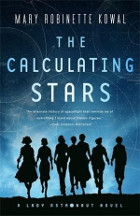
The cover shows women of all shapes and sizes and also overcomes
stereotypes about women's shapes.
This is a beautifully written, well researched science fiction book
and readers will be sure to want to follow Elma's journey in the
next in the series The fated sky.
Pat Pledger
The Queen of Sorrow by Sarah Beth Durst
The Queens of Renthia book 3. HarperCollins, 2018. ISBN
9780062413383
(Age: 15+) Recommended. Themes: Fantasy. Ambition. Family. Durst
brings her unique series to a satisfying conclusion in the third
book in the series, following The
queen of bloodand The reluctant queen. Queen
Daleina has been joined by Queen Naelin, both ruling the kingdom and
trying to keep the evil nature spirits at bay. When Queen Naelin's
children are kidnapped by the spirits, Naelin cares only for them
and is prepared to sacrifice everything to get them back. She
believes that Queen Merecot of Semo has been behind the kidnapping
and is ready to go to war. However, Merecot has grandiose ambitions
and all of Renthia is threatened by her actions.
This is an action packed book, while at the same time exploring the
emotions and actions of a mother whose children have been taken.
Queen Naelin has enormous power which hasn't been trained, and she
is willing to burn the kingdom to get them back. Queen Daleina has
to keep a calm head and look at the bigger picture while Queen
Merecot is ambitious and devious. The scheming, politics and actions
of the three women make for an interesting story. It is also
fascinating to read a series that has older main characters with
subtle romance, rather than the love triangles that sometimes
feature in fantasy series.
I would recommend this series to fantasy readers who enjoy character
driven plots and a fabulous forest setting where the inhabitants
live in villages in the trees and fight off attacks by spirits.
Pat Pledger
Dog Man: Lord of the Fleas by Dav Pilkey
Dog Man book 5. Graphix, 2018. ISBN 9780545935173
(Age: 7+) Highly recommended. Another in the wonderful Dog Man
series (others reviewed are Dog
Man, Dog
Man unleashed, and Dog
Man : A tale of two kitties ) this time a hilarious take
on Lord of the Flies. Dog Man is called into action once
again, but this time Petey plays a big role. Can he overcome his
evil ways and become a hero when he is needed? With his cute little
kitten clone telling him that he can change, you can never tell!
Once introduced to the Dog Man series, young readers can't
get enough of the crime fighter. At the beginning of Dog Man:
Lord of the fleas, is an introduction to the characters so
that readers new to the story can catch up. The book is so funny
that even adults will be constantly amused as they follow the
adventures of Dog Man. I was especially taken with the little
kitten's constant use of "Why?", and his strange Knock-knock jokes
that Pilkey has cleverly incorporated as part of the plot. The
reader will also empathise with Petey as he gradually tries to
change - lots of poignant moments there.
Readers are in for a treat with the bonus information at the back,
showing George and Harold reading The call of the wild by
Jack London in preparation for the next book, Dog Man; Brawl of
the wild, as well as showing How to draw The Bark Knight in 42
ridiculously easy steps, plus instructions for Cat Kid, Crunky,
Lightning Dude, Piggy and Bub. Then there are details about how to
read to your cat.
This is a fantastic, humorous book, sure to lift the spirits of any
child and will appeal to all readers.
Pat Pledger
In a house of lies by Ian Rankin
Inspector Rebus book 22. Orion, 2018. ISBN 9781409176893
(Age: Senior secondary - Adult) Highly recommended. Themes: Mystery.
Detectives. Murder, Police corruption. When a missing investigator
is found in the boot of a car, years after he went missing, it is in
an area that was originally searched by the police. This looks bad
for the police and is traumatic for the family. As the investigation
unfolds, it turns out that there are mistakes and lies and Detective
Inspector Siobhan Clarke turns to Rebus for information about the
old case. She needs his help to curb a stalker who didn't believe
that his nephew had murdered his girlfriend and wants the truth
uncovered. But there are lies and cover-ups everywhere and Rebus
could be in a fix. In a house of lies reads quite well as a stand-alone for
those who are not familiar with the Inspector Rebus series. I have
missed several of the books but could easily pick up on the main
characters who were all well described. Rebus is supposed to be
retired and is suffering from emphysema, but cannot manage to stay
away from any investigation that is going on. His police skills
shine as he uses his in-depth background knowledge of people and
places, cutting through red tape and ignoring threats from cops and
crooks alike. DI Siobhan Clarke stands out as she chases up clues
and withstands intimidation from her colleagues.
Set against the backdrop of an Edinburgh that wouldn't be familiar
to the tourist, Rankin has produced another engrossing murder
mystery that will keep the reader guessing to the final pages. The
restructuring of the modern Police Scotland and the budget cuts
facing the organisation provide an interesting background, as does
the contrast between modern day policing with CCTV, the Internet and
social media and the old policing ways of Rebus.
Everyone is telling lies and everyone has something to hide and the
readers has to weave a way through them all. In a house of lies is a welcome addition to the series which
fans will be very happy with, and readers new to the series are in
for a treat.
Pat Pledger
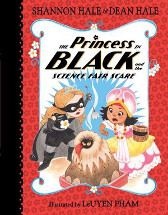
The Princess in Black and the Science Fair Scare by Shannon Hale and Dean Hale
Candlewick Press, 2018. ISBN 9780763688271
(Age: 5-8) Highly recommended. Themes: Fantasy. Princesses. Humour,
STEM. Princess Magnolia is off to the Inter-kingdom Science Fair
with her entry, a poster about seeds and plants. When she arrives,
she sees all the things that her friends have made - Princess
Honeysuckle has a mole habitat, Princess Orchid has a Bucket
Boosting Teeter Totter and Tommy Wigtower has a talking volcano that
turns out to be a goo monster that wants to take over the exhibits.
The Princess in Black comes to the rescue.
Fans of the series will be delighted with the latest addition of
this feisty, brave and clever heroine and children new to the books
are in for a treat. Not only are there interesting displays for the
Science Fair, the Princess in Black has to use her problem solving
skills to defeat the monster, with a lot of help from her friends.
Readers will effortless learn some scientific facts (how to make a
volcano explode, and how to distribute weight evenly) while having a
laugh at the antics of the goo monster as it creates mayhem at the
fair.
This is a great series: it is scattered with humorous illustrations
by LeUyen Pham and these will bring a smile to the faces of any
reader. Children will love the escapades of the Princess in Black
and would have fun coming up with their own disguises and secret
names.
Pat Pledger
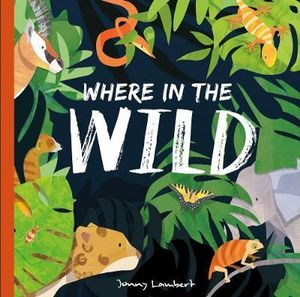
Where in the wild by Poppy Bishop and Jonny Lambert
Little Tiger, 2018. ISBN 9781848699557
Inspired by Theodore Roosevelt saying, "The wildlife and its habitat
cannot speak, so we must and we will", this book takes the young
reader on a journey through the world's key habitats and introduces
them to some of the creatures that live within them.
From rivers to jungles, the savannah, the desert, woodlands and the
frozen extremes, familiar and not-so creatures make an appearance in
colourful artwork and rhyming text. Using a double-page spread for
each, the two-verse rhyme begins with an introduction to the habitat
and then an inhabitant "speaks" to the reader about itself. The rest
of the pages are filled with a collage of flora and fauna, each with
a clever cutout featuring a creature that lives in the featured
habitat but which can adapt to the succeeding one to entice the
reader to keep turning, reading and learning. Some of these cutouts
have text which encourages closer observation of the illustrations,
making the reader engage more through this interactivity. The final
message about habitat destruction and the need to protect what is
left is very clear and ties in well with the initial quote.
Often, books from the northern hemisphere tend to feature the
creatures with which children from that part of the world are
familiar but this one spans the globe, although, thankfully, the
polar region is confined to the Arctic so there is not the confusion
of polar bears and penguins on the same page.
As well as being a comprehensive introduction to the world's
habitats so young readers can learn that there is more to this
planet than their immediate surroundings, its strong conservation
message can also lead to inquiries about the inhabitants of their
local area and their protection and promotion; the impact of humans
through the destruction of habitat, particularly deforestation; the
life cycles, needs and adaptation of creatures as their habitats
change (such as described in Moth); and even individual
responsibility and actions that could be taken to preserve what we
have left.
With the drought in eastern Australia drawing our attention to the
land beyond the city environs, this is a great opportunity to have a
look at the broader world and how it copes or doesn't, and this
would be an excellent introductory text.
Barbara Braxton
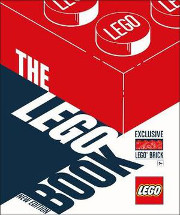
The LEGO Book - 60th Anniversary Edition by Daniel Lipkowitz
DK, 2018. ISBN 9780241314227
(Age: All) In 1932 and facing the Great Depression which was
engulfing the world, Danish master carpenter Ole Kirk Kristiansen
closed his carpentry business and turned his attention to making
wooden toys for children. Fifteen years later, after World War II
and all its development with technology and materials, particularly
plastic, Kristiansen purchased an expensive plastic
injection-moulding machine and his wooden toys were now made of
plastic. Using a name that is a contraction of leg godt which means
"play well" in Danish, the LEGO group was established and by 1954,
the idea of a building brick that locked together firmly so they
were stable but which also came apart easily was launched with the
Town Plan range of construction sets. Finally, in January 1658 the
block was perfected, the patent lodged and the rest, as they say, is
history.
And it is the history of that block from its evolution as a plan for
a toy that could be used to build virtually anything to that
realisation that is the focus of this fascinating new release,
marking the 60th anniversary of the building block as we know it.
Driven by the belief that children and their development mean
everything and that this must pervade everything that is created,
and based on the principles that the system must
provide unlimited play opportunities
be for girls and boys
inspire enthusiasm in all ages'
be able to be played with all year round
provide endless hours of healthy, quiet and safe play
inspire imagination, creativity and development
be topical and provide add-on value for preceding products
Those initial town construction sets have evolved into a world of
designs and models that span buildings, characters, transportation,
books, movies, furniture, fabric, licensed merchandise, even theme
parks! That journey is traced in full colour photographs,
easily-accessible text and the signature DK layout and makes this a
dig-and-delve must-have in any LEGO fan's collection or any library
whose clients are LEGO fans. Every page has something to pore over,
wonder at and learn, making it perfect as a shared conversation book
so important to emerging readers.
Something particularly special for the Santa Sack for any age!
Barbara Braxton
The case of the left-handed lady by Nancy Springer
An Enola Holmes mystery. Allen and Unwin, 2018. ISBN
9781760637392
(Age: 10-14) Highly recommended. Themes: Mystery, Sherlock Holmes,
Hypnotism, Kidnapping. In this second episode of the Enola Holmes
series (involving the younger sister of the famous Sherlock Holmes)
Enola is attempting to live independently in London in response to
her brothers' attempt to put her into boarding school. She is alone
after her mother disappears to make a new life away from her sons
and daughter. She starts to publish messages using ciphers to try to
communicate with her mother and this brings in the opportunity to
discuss with students the different ways to manipulate words and
numbers to communicate in code.
Enola sets herself up as a Scientific Perditorian under a male
pseudonym to make a living for herself assisting people to find
those who are missing. She continues to dress herself in a manner
that portrays an older independent woman in the hope that she can
elude her famous brother in his quest to find her. Enola establishes
a way to help the needy in the poorest parts of Victorian London by
disguising herself as a nun.
The pace of the story increases as Enola is almost murdered while on
one of her midnight forays. Soon afterward she overhears the story
of the disappearance of the sixteen-year-old Lady Cecily, daughter
of a baronet who appears to have eloped in the night. She decides to
try to solve this mystery as the police seem to be struggling to
make progress in finding the missing girl. This part of the story
introduces the notion of hypnotism and Enola encounters
possibilities she has never encountered before to try to solve this
situation. Close encounters with her older brother Sherlock form a
major part of the story and adds to the tension and interest.
Recommended for Upper Primary
Gabrielle Anderson
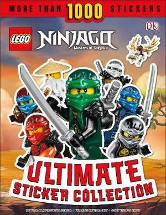
Lego Ninjago Ultimate Sticker Collection
DK, 2018. ISBN 9780241340325
Ninjago is one of 16 connected realms in this themed collection from
Lego. Its capital, Ninjago City is protected by Kai, Cole, Zane,
Jay, Nya and Lloyd from the powerful enemies including the
Vermillion and the Sons of Garmadon.
Young readers are encouraged to read the captions and then use their
visual acuity to select the appropriate stickers from the large
collection to complete the scenes. There are also extra pages and
extra stickers where they can build their own scenes of battles.
While these sorts of books may be seen as just another way of
marketing the Lego merchandise, they can play an important role in
the young fan's literacy development as they have to read the
captions and make the appropriate selections as they learn more
about the underlying plot and the characters. By having the
opportunity to build their own battle scenes they can retell the
story or make up their own, explaining and justifying their choices
- all critical elements of understanding and telling stories.
This may be one of those special treat books that you have in your
collection ready to engage or settle a child who needs some
distraction.
Barbara Braxton
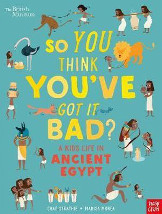
So you think you've got it bad? by Chae Strathie
Ill. by Marisa Morea. Noisy Crow, 2018. ISBN 9781788001359
(Age: 8+) Highly recommended. Themes: Ancient Egypt, History.
Subtitled, A kid's life in Ancient Egypt, what sets this
book apart is that the information given about life several
thousands of years ago is
compared with that of kids'
lives today. So when talking
about clothing, the reader is told there is not a tracksuit to be
had, and servants walk around naked, while all kids would be
expected to wear a pleated linen dress. The comparisons make this
book very funny, teaching the reader of life in Ancient Egypt, but
making it accessible by using today's customs.
Divided into ten chapters, concerning for example, Diet, Housing,
Family life and Discipline, each section makes fascinating reading.
Included in the chapters are paragraphs of text divided by humorous
illustrations are also boxes of information called "Fancy That!". I
learnt that the men did the washing in the Nile because of the
crocodiles, and that hyenas were fattened up for feasts, while rich
Egyptians ate raw cabbage as an entree! A double page towards the
end gives more information about the down side of being an Ancient
Egyptian, and this is followed by a glossary of terms and an index.
The illustrations are detailed and reflect the large amount of
information found in the text. They are limited to a few colours,
paralleling the muddy browns and sand colours of the landscape.
The whole is illuminating and should find a ready audience amongst
those fascinated by Ancient Egypt.
Fran Knight
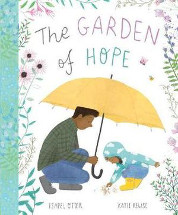
The garden of hope by Isabel Otter and Katie Rewse
Little Tiger, 2018. ISBN 9781848577138
"Things had changed since Mum had been gone. The house was untidy.
Maya, Dad and Pip were a bit of a mess. And the garden had become
wild and overgrown. "
Each of them was sad and anxious, trying to help each other as best
they could. One day, Dad tells Maya that whenever her mother was
feeling anxious, she would plant some seeds because she knew that by
the time they had grown, the worries would have faded. They were her
"seeds of hope".
So Maya decides to try her mother's remedy, starting with planting
sunflowers which were her mother's favourite. And gradually a
transformation occurred - the garden started to flourish and Maya
and her father started to heal. Despite the darkness and sadness,
there was still beauty and hope in the world.
This is a charming story with illustrations as gentle as the text,
that offer a wonderful strategy to help anyone, young or old, to
deal with grief. Sometimes when we are overwhelmed by our emotions
it is hard to see that time will pass - rather each minute seems to
drag into an hour - so having something as simple as planting seeds,
something that could be done in almost any situation, and watching
the progress of the flowers can not only offer distraction but also
shows that there is movement in time, that some some peace of mind
is possible and there can be unexpected rewards. For Maya, the new
garden brings not only beauty but bees and butterflies and other
little creatures who find a home and sustenance because of her
efforts. And because gardening can be a solo or a shared activity
that healing can help more than just the seed-sower.
Children love to plant things and watch them grow, and many schools
have established gardens, particularly kitchen gardens which supply
the school canteen. But how wonderful would it be to also have a
flower bed, one where a troubled or grieving child can go to potter
and seek tranquility and calm as they literally "smell the roses".
This is a gentle, understated story that would be perfect to share
with any little one suffering loss or heartache.
Barbara Braxton
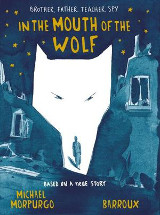
In the mouth of the wolf by Michael Morpurgo
Ill. by Barroux. Egmont, 2018. ISBN 9781405285261
(Age: Independent readers) Recommended. In the village of Le Pouget, in the
Languedoc region of south west France, Francis Cammaerts is resting
after the celebrations for his 90th birthday come to a close. As
dusk turns to dark and the church bell strikes midnight, he thinks
of those who have been a part of his journey to this ripe old age -
those who raised him, supported him and had so much to do with the
man he became. And from those reminiscences comes a story of
determination, danger, courage and heroism that would have gone
untold if not for Morpurgo's pen and Barroux's brush.
One of two sons born during the Great War, Francis grows up to be a
teacher while his brother Pieter is a burgeoning actor. But when
World War II breaks out, the brothers take very different paths.
Frances believes war is futile and barbaric, that people should not
descend to the level of the fascists and that only education and
pacifism are the "way forward for humanity". Pieter, however,
believes that pacifism will not stop Hitler, that the cruelty of
fascism had to be confronted and so he became a Sergeant Navigator
in the RAF. While he eventually went to join a bomber squadron in
Cornwall, Francis went to Lincolnshire to work on a farm having
justified his beliefs to a tribunal.
But when Pieter is killed returning from an air raid over France and
a bomb dropped by a German plane kills the family on the next farm
including including baby Bessie, Francis begins to rethink his
decision, particularly as he now has a wife and the birth of his own
child is imminent. He talks to Harry, his mentor from his teaching
days - a conversation that changes his life forever as it leads him
into the silent world of the secret agent working with the
Resistance in France . . .
As with Flamingo Boy, Morpurgo shines a light on the real
story of war and its impact on ordinary people by taking an unusual
perspective and telling the story through that. This is not a tale
of derring-do embellished with action scenes and special effects -
although it could be that in the hands of another - but a quiet tale
of remembrance and reflection, of the impact of the legacy of others
on a particular life, when that life itself has left its own legacy.
Morpurgo has said, "This book may read like fiction. But it is not.
That is because it does not need to be." It is the story of his own
uncles.
Generously illustrated using family photographs which are included
at the back of the book as well as biographical details of those who
had such a profound impact within the story, Morpurgo has produced a
work that not only tells yet another untold story of the war but one
which has shaped his life too.
One for independent readers wanting something different, compelling
and utterly readable.
Barbara Braxton
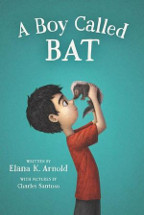
A boy called BAT by Elana K. Arnold
Ill. by Charles Santose. Walden Pond, 2018. ISBN 9780062445834
Highly recommended. Bixby Alexander Tam, known to those who know him
as BAT because of his initials, his love of animals and the way his
arms and hands flap when he gets excited, prefers life to be
logical, predictable, routine and without surprises. He's not good
with noise (so wears his sister Janie's earmuffs often), doesn't
like the mushy texture of some foods, is sensitive to the feel of
fabrics on his skin and finds it difficult to make eye contact and
hold casual conversations. Clearly, to even a non-teacher who
doesn't know the signs of being on the autism spectrum, this is a
little boy with special needs. But Bat is not unhappy or frustrated
- his mum, sister and teacher are sensitive to his needs, his peers
seem to accept him for who he is, and although his father, whom he
stays with "every-other-Friday" seems to struggle a little with his
non-sporty son, generally Bat is content and just gets on with
things. But when his mum, a vet, brings home a newborn skunk that
needs special care, Bat comes into his own, devoting his life to
caring for the kit and planning how he will be able to keep it and
care for it beyond the initial few weeks before the local wildlife
refuge can take over. He needs to show his mum that he is
responsible and committed enough, even contacting a skunk expert for
advice.
This is an engaging story that shows the reader the world through
Bat's eyes but which is not patronising, sentimental or emotional.
Bat's autism adds a different and interesting perspective to the
relationships between the characters but the concept of an
eight-year-old taking care of an orphaned animal and hoping to keep
it longer is a story that could be about any young person. I believe
that all children should be able to read about themselves in
stories, and those about autistic children are rare, so this one
which has such a solid, familiar storyline so every reader can
relate to it while learning about the world through unfamiliar eyes,
is a must-have.
Its sequel Bat and the Waiting Game is also available in
hardcover.
Barbara Braxton
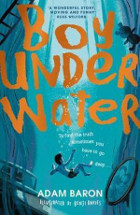
Boy underwater by Adam Baron
HarperCollins, 2018. ISBN 9780008267018
(Age: Independent reader) Recommended. Cymbeline Igloo is nine years
old, is the third-best footballer in Year 4 (joint), second best at
roller-skating. Even though he has only one parent while his friends
have two or even four, he is fit, healthy and totally normal in
every way. Yet, despite living in Lewisham in south-east London he
has never been swimming. His mum has never taken him near a pool, a
lake, a river, the seaside - always brushing away his request with
seemingly plausible excuses.
So when his teacher says that the class will be starting swimming
lessons the following Monday, Cymbeline is somewhat daunted. He
doesn't even own a pair of swimmers! But encouraged by his best
friend Lance (named after the disgraced cyclist) and goaded by the
class bully Billy, he agrees to a race against Billy in the pool.
Naturally, things end very badly for Cymbeline, not the least of
which is losing the swimmers he found in his dad's things in the
attic, but it is the response of his mother who is called to the
pool that is the most startling of all.
As a result of this incident, she ends up in a psychiatric hospital
taking Cymbeline's beloved soft toy Mr Fluffy with her. And
Cymbeline is forced to stay with his rich Aunt Millie and Uncle
Chris , to whom he is a burden, and cousins Juniper and Clayton who
make it clear they want nothing to do with him. Totally alone, his
mother hospitalised and not well enough to see him, and no cuddly
toy to take to bed to comfort him, Cymbeline is bewildered and
scared but determined to find out what is wrong with his mum to have
had such an extreme reaction. Surely the world seeing his willy
isn't enough to provoke such a response. And why has she taken Mr
Fluffy? Befriended by super-smart Veronique and even Billy, who has
his own issues at home, Cymbeline is determined to get to the bottom
of things. And when he does, it becomes clear that adults really
should paint the whole picture when they tell a child something big,
not just the bits they think the child can handle. Sometimes honesty
can prevent a lot of heartache - the child isn't left to fill the
gaps with their own, often wild, imagination.
Written in the first-person in a voice that really echoes that of a
9-year-old boy, this is a story that will engage the independent
reader with a storyline that has some meat to it and is totally
credible. Even though it deals with some heavy-duty issues, this is
done with a light hand, humour and empathy, providing an insight
into the lives of some of the children in our care that we might not
always see. Families falling apart for whatever reason is a common
story, sadly, and it's not always the teacher, in this case Mrs
Phillips, who is the confidante. Many children, like Cymbeline, are
carrying unseen burdens.
For me, a quality novel is one that engages me to the end and I can
hear myself either reading it aloud to students or book-talking it.
Boy Underwater is indeed, one of those.
Barbara Braxton
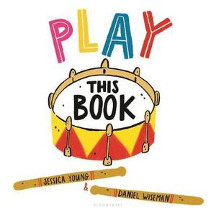
Play this book by Jessica Young and Daniel Wiseman
Bloomsbury, 2018. ISBN 9781681195063
Seven instruments sit alone on a stage - guitar, keyboard,
saxophone, trombone, drum, maracas and cymbals - waiting to be
played so there can be a show. But without the reader lending a
hand, there can be no band. And so how to play each instrument and
the sound it makes becomes the focus of this interactive book
featuring lots of different children introducing each instrument. By
the end of the story, all the instruments have been tested and are
brought together in a grand cacophony of sound appreciated by the
audience.
This is a wonderful opportunity to acquaint young readers with some
common musical instruments and the invitation for them to "play"
them will be irresistible. Interactive in a similar fashion to the
Herve Tullet books like Press Here, this one will engage
very young readers as they return to it again and again.
The importance of music in a child's life cannot be underestimated
and is encapsulated in this research
from the University of Canberra so Play this Book would be
an important addition to your early music teaching resources. A
natural follow-on would be Prokofiev's Peter and the Wolf
supported by Energy
in the Air: Sounds of the Orchestra. To round out the
experience, Birdsong
by Ellie Sandall gives the children the opportunity to make their
own music by using their voices and their bodies!
As is proclaimed in another classic, "Let the wild rumpus start!"
Barbara Braxton