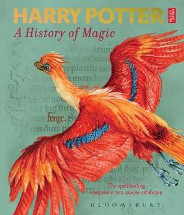
Harry Potter: A history of magic by the British Library
Bloomsbury Children's Books, 2019. ISBN 9781526607072.
(Age: 10 - Adult) Highly recommended. Themes: Magic. Fantasy. Harry
Potter. Another book for fans of Harry Potter, this handsome volume,
now in paperback, is sure to appeal to anyone who has read the books
or seen the Harry Potter films. Curated by the British Museum for
their 'Harry Potter: A history of magic' Exhibition, this book has
immediate appeal with its vivid cover and beautiful illustrations by
Jim Kay and copies of manuscripts from the British Museum. These are
dispersed throughout the book and make for a fascinating initial
perusal of the book, for those who like to flick through to get a
feeling of what is inside.
It has an introduction by Julian Harrison, the lead curator of the
exhibition and learned articles from people like Julia Eccleshare,
Lucy Mangan and Tim Peake, but what made it stand out for me were
copies of the original manuscripts that J.K. Rowling had written,
and pictures of some of her drawings of characters and scenes. It
was fascinating to see her annotations, her erasing of certain words
and the appearance of her characters in her clever illustrations.
The British Museum exhibition must have been a wonderful experience
for people who managed to see it, and this book makes it accessible
to all. It is a book that begs to be read from cover to cover, but
it rewards the person who dips into information that interests them.
I was really taken by the information about mandrakes and the
drawings of them were fascinating. Any reader will gain much
knowledge about the history of magic and will wonder at the
knowledge that J.K. Rowling brought to her books.
A table of contents gives easy access to different aspects of the
history of magic, including potions and alchemy, herbology,
astronomy and charms as well as care of magical creatures.
This would make a beautiful gift for any Harry Potter fan, and would
grace any school or public library collection.
Pat Pledger
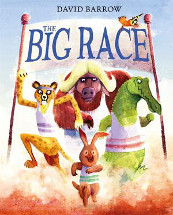
The big race by David Barrow
Hodder, 2019. ISBN 9781444929294.
(Age: 4+). Recommended. Themes: Competition. Friendship. On race day
Lion takes down the name of all those strong, big and fast animals
who wish to enter the race. At the starting line are the fastest,
biggest and strongest animals, Lion, Cheetah, Crocodile and Buffalo,
each determined to win. But alongside these animals is the little
Aardvark, scoffed at by the others. He is just as determined, and as
the field sets off, he is just behind the pack, running hard to stay
with them.
He swims, traverses the waterfall, rides his bike, all keeping in
touch with the rest of the field, and when they ascend in their hot
air balloons, he is there beside them in his personal lifting
apparatus. But when this goes pop and he lands near the finishing
line the others are in a struggle to get over the line, ending up in
a big scramble of heads and feet, bodies and tongues, but who came
first?
Children will love to read of this take on the tortoise and hare
story, as the Aardvark takes on the mighty animals, pitting his
strengths against theirs. The funny illustrations will be a treat
for all readers, adults included, as they see allusions to the range
of sports played out each day on our TV set, people vying with each
other, pitting their abilities against the others, all for a medal at
the end.
Fran Knight
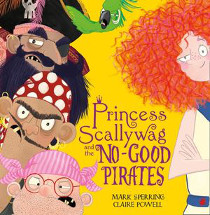
Princess Scallywag and the no-good pirates by Mark Sperring
Ill. by Claire Powell. HarperCollins, 2019. ISBN 9780008212995.
Princess Scallywag and the Queen are out on the royal yacht enjoying
the fresh air when they are invaded by three stinky, sweaty, no-good
pirates waving their swords and determined to take them prisoner.
But three stinky, sweaty, no-good pirates are no match for the
quick-thinking Queen and the persnickety princess, although it is
touch-and-go for a while as they desperately try to save themselves
from being made galley slaves, scrubbing the decks and walking the
plank!
A sequel to Princess
Scallywag
and the brave, brave knight, this is a bold adventure story
for those who like their princesses feisty, clever, and subversive.
Barbara Braxton
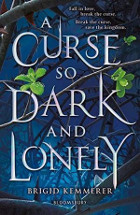
A curse so dark and lonely by Brigid Kemmerer
A Curse So Dark and Lonely book 1. Bloomsbury, 2019. ISBN:
9781408884614.
(Age: 13+) Recommended. Themes: Fantasy, Good versus evil, Monster,
Folklore, Cerebral palsy, Fairy tales retold. Kemmerer returns with
a retelling of Beauty and the beast for a modern audience.
Harper Lacy is sucked into the world of Emberfall after trying to
rescue a girl on the streets of Washington. There she meets Prince
Rhen, who is desperately trying to break the curse that an evil
enchantress has placed on him; every autumn he turns into a monster
killing everyone in sight, including his own family. The curse will
only be broken if a girl falls in love with him.
There is action a plenty as our intrepid heroine shows Prince Rhen
and his commander, Grey, what it means to be brave and daring, even
when she is in danger and in an unknown land. Readers will love her
feisty nature, her quick verbal come backs and her intelligence, as
well as her ability to overcome adversity. They will also empathise
with Rhen as he struggles to overcome his arrogance and begins to
care for the people under his care. Grey too is a young man that
readers will love for his loyalty. (Kemmerer has a deft hand with
male characterisation, as she ably demonstrated in her best-selling
series, Elementals). Minor characters are also fleshed out
well in the second half of the book, and readers will look forward
to the return of Harper's brother Jake and her guard Zo.
The setting of Emberfall feels real, with an enchanted castle,
people struggling with poverty and a Queen from a foreign land who
has begun an invasion. The story is narrated in two voices, that of
Rhen and Harper, and Kemmerer's easy to read style makes this an
engrossing read. The cliff-hanger at the end ensures that readers
will pick up the next in the series.
This is a story that will appeal to readers who have enjoyed Marissa
Meyer's stories. Those who like the fairy tale Beauty and the
beast could go on to read Beauty by Robin McKinley,
and Jane Yolen and Shannon Hale have written excellent books
retelling fairy stories. Juliet Marillier's Sevenwaters
series is another to recommend to readers waiting for the sequel to
A curse so dark and lonely.
Pat Pledger
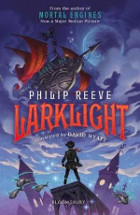
Larklight by Philip Reeve
Ill. by David Wyatt. Bloomsbury, 2006. ISBN: 9781526606617.
(Age: 10+) Highly recommended. Larklight is a rip-roaring
adventure science fiction book with a wonderful whimsical story and
terrific characters, now a major motion picture. It is set in
familiar Victorian times with the added dimension of the British
Empire ruling some of the planets. Larklight is a large dilapidated house that flies around in
space in an orbit near the Moon. Art Mumby and his sister Myrtle
live there with their scholarly father. One day Mr Webster,
supposedly from the Royal Xenological Institute, visits and they
discover to their consternation that he is an enormous white spider
like creature, one of the First Ones, who captures their father and
takes over Larklight. Art and Myrtle manage to escape in a lifeboat
and are rescued by the pirate Jack Havock, who takes them aboard his
ship The Sophronia. Many hair-raising adventures follow in
their efforts to foil the First Ones and save the British Empire.
Wyatt's wonderful, funny and detailed drawings are a joy to look at
and add to the enjoyment of the incredible creatures and objects
that pervade the story. The book is one that booklovers will want to
keep for its beautiful illustrations, (including a final one of the
author and illustrator recording a new species of ogleweed), long
involved chapter headings and humourous footnotes.
Apart from the breath taking adventures, readers will love the zany
humour and references to Victorian customs and the weird beings that
live in this world. Hoverhogs whiz around and clean up, winged
ships, powered by a device called an Alchemical Wedding, flap their
way through the aether and the Crystal Palace attacks London.
Readers can look forward to further adventures and lots of fun.
Pat Pledger
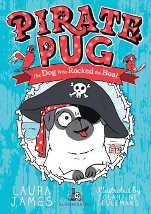
Pirate Pug: The dog who rocked the boat by Laura James
Ill. by Eglantine Ceulemans. Bloomsbury, 2019. ISBN: 9781408895948.
(Age: 5-7) Recommended. Themes: Dogs, Adventure, Pirates, Sailing. Pirate
Pug is the fourth fun adventure for this roly-poly pet and his
owner Lady Miranda. Although Pug can't swim, they are off on a
seaside, staying in the deluxe suite of the Smuggler's Rest Hotel,
Pebbly Bay. Running Footmen Will and Liam are responsible for
transporting the holidaymakers down to the beach in a sedan chair
which comes in very handy along the way. An unfortunate accident
with a beach ball sees Pug with an eye injury and he has to wear a
pirate patch.
The town of Pebbly Bay is preparing for the annual parade,
celebrating four hundred years of freedom from pirate rule. Lady
Miranda and Pug meet the mayor who's wearing a special memorial
chain that is snatched by Rio the parrot. A chase ensues, pitting
Miranda and her new friends against three mean boys who've been
throwing stones at Rio the parrot.
Ingeniously with Liam and Will's help the sedan chair becomes a
galleon and the children are off sailing to Finders Keeper's Island.
Laura James builds the tension and drama with Pug captured by the
enemy gang, a sunken ship and finally everyone needs to work
together to save the day. Pirate Pug is written in large easy to read font, with
colourful and engaging illustrations adding fun to this story. Laura
James explores the themes of friendship, teamwork and how to face up
to your fears. As a perfect transition from picture book to
beginning chapter books, share the junior novel with Junior Primary
classes opening up discussion about the characters' feelings and
actions, interesting settings and narrative writing.
Rhyllis Bignell
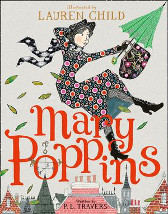
Mary Poppins by P.L. Travers
Ill. by Lauren Child. HarperCollins, 2018. ISBN: 9780008289362.
First published in 1934, Mary Poppins was the greatest success of
Australian born Pamela Lyndon Travers. It gained a new lease of life
when Disney produced a musical movie adaptation in 1964 starring
Julie Andrews and Dick Van Dyke and introducing the world to songs
like A Spoonful of Sugar, Chim Chiminee and of
course, Supercalifragilisiticexpialidocious. Now, with the
release of Mary
Poppins Returns, the stories of this magical nanny are being
discovered by a new generation and so the publication of a
reimagined, abridged edition of the original, beautifully
illustrated by Lauren Child, is the perfect way to build a bridge
between the movie and its original premise.
When seemingly staid and upright Miss Poppins arrives to be the new
nanny for the Banks children - Jane, Michael, and the twins, John
and Barbara - it seems that nothing much will change from previous
nannies. Good behaviour is encouraged, misbehaviour punished and
order and routine are important. But within her stern exterior are
some magical powers such as being able to slide up banisters, float
in the air, step into pictures, stick stars on the sky, and talk to
animals. Mary takes the Banks children on a series of magical
adventures, such as using a magical compass to travel around the
world, and suddenly the children find themselves forming a
relationship with her that they don't have with their busy,
neglectful, upmarket parents.
Lauren Child has created an edition of this classic tale that is
perfect for this time and generation and which should have pride of
place in any collection featuring classics which are being
introduced to a new generation. It is excellent as an independent
read-aloud but would also be great as a bedtime read-along,
introducing younger readers to the concept of novels with chapters
that continue the story with the same characters.
Barbara Braxton
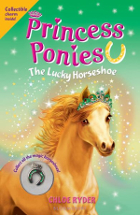
The lucky horseshoe by Chloe Ryder
Ill. by Jennifer Miles. Princess Ponies book 9. Bloomsbury,
2019. ISBN: 9781547601646.
(Age: 7-9) Themes: Ponies, Magic. Chloe Ryder's ninth Princess
Ponies story The Lucky Horseshoe takes Pippa and her
magical ponies on another entertaining adventure. It's St Patrick's
Day and poor Pippa's experiencing loads of bad luck, her cereal's
run out, she trips on the front steps and she's placed in a
different team for gym class. As she lays in bed thinking about her
day, she hears a noise outside her window and there are her friends,
Captain Rascal a black and white horse with a purple eye patch and
three other ponies. They need Pippa's help to stop Divine a
trouble-making pony from taking over Chevalia with an evil spell.
Just at the end of the street is a bedecked pirate ship tied up to
the bank. They set sail on The Jolly Horseshoe to search the
coves of the enchanted island of Chevalia to find Captain
Scallywag's hidden treasure. Their trip is filled with danger, high
seas, fierce winds and the mast caught by ropes. After Pippa climbs
high to free the sails, their magical seahorse friends tow them to
safety. Encounters with cowsharks, watching a special theatre
performance and meeting royalty, all lead Pippa up to uncovering
something special. Life on Chevalia is exciting and magical, this
young girl loves helping her friends and solving mysteries. Lucky
for Pippa, time in the magical kingdom is different to her earthly
time!
Chloe Ryder's junior chapter book is just right for young horse fans
who like a little magic and adventure. Jennifer Miles' line drawings
bring the enchanted horses of Chevalia to life.
Rhyllis Bignell
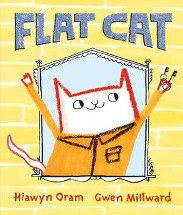
Flat Cat by Hiawyn Oram
Ill. by Gwen Millward. Walker Books, 2019. ISBN: 9781406371543.
(Ages: 3-8) Recommended. Themes: Freedom, Independence, Materialism.
Bright crayon illustrations bring the world around the flat cat to
life (because Jimi-My-Jim really is just a flat, line drawing).
Sophie lives at the top of a big apartment building in a beautiful
city with a beautiful cat. She really spoils Jimi-My-Jim with the
best food, toys, fancy collars and cheeky clothes. 'Most of the most
spoilt children in the world didn't have as many tantalising toys as
Jimi-My-Jim'. Jimi tries to be grateful and do what Sophie wants but
deep down he feels trapped. 'When Sophie went off with her parents
each morning Jimi sat at the window watching her go, watching the
world he longed to be a part of, watching a cat he so wanted to
meet'. He really does live a 2-dimensional life and starts to feel
and look flatter and flatter. When the chance to escape presents
itself, Jimi doesn't hesitate, making straight for the cat he so
wants to meet. The cat, named Blanche, shows him around town and
Jimi has the best day, ending in a party back at the apartment. When
Sophie and her parents arrive home to the mess all his new friends
disappear, leaving Jimi to face the telling-off alone.
'I think I know why you did it', says Sophie later, 'You wanted the
world, you wanted the wild and all I've done is smother you with
THINGS'. He is soon presented with his own set of keys and some
rules: keep out of fights, be in bed by ten and no dodgy friends in
the apartment.
The illustrations and text are humorous (children will love the
Jimi's ridiculous outfits and the dodgy cat party) but there is also
a nice message about how living life and doing gives us happiness
rather than things. It is also about how part of loving someone is
letting them be who they are, not just keeping them to ourselves.
Nicole Nelson
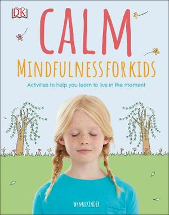
Calm mindfulness for kids: Activities to help you learn to live in the moment by Wynne Kinder
Dorling Kindersley, 2019. ISBN 9780241342299.
(Age: 8-12) Highly recommended. Themes: Mindfulness. Kindness.
Emotional wellbeing. Wynne Kinder brings her comprehensive
experience in mindfulness education and creating digital content for
the brain breaks program GoNoodle
to this Dorling Kindersley information book. Calm mindfulness
for kids is beautifully presented with photographs of children
engaged in calming and distressing activities. Presented in six
chapters, educators and children can delve in to the sections -
Focus, Calm, Move, Change, Care, and Reflect. They are guided
through each chapter, through the distressing, learning calm breath,
sensory experiences, caring for themselves and collaborating with
others.
Mindfulness is a key tool which underpins classroom harmony,
promotes positive energy and helps support children developing
positive emotional health. There are colourful circles placed
throughout to help grownups support and explain the activities. In
'Bubbles of kindness' there is an easy-to-follow exercise with the
ingredients listed, bubble mix and twisted pipe-cleaners. Adults can
help the child focus on sending kind bubble thoughts to their
friends and those they find difficult to relate with.
'Reflecting is a way to turn an experience into wisdom.' By making a
gratitude paper chain, siblings, families, classes and teams can
write something they are grateful for on individual strips of
coloured paper, then build a chain to decorate their home or
classroom. A mindful body begins with eyes closed focussing on
breathing and quietly stilling the body. Each activity boosts
self-confidence and builds esteem. They are malleable enough to suit
the individual child's flexibility and levels of understanding. Calm mindfulness for kids is an excellent resource for
teachers supporting students developing their personal and social
capabilities. Kinder illustrates that promoting children's positive
wellbeing can be achieved in short sessions, without expensive tools
and is inclusive for all. For families, this is a wonderful tool to
promote a well-grounded sense of self-knowledge and self-confidence,
great for parents and children
Rhyllis Bignell
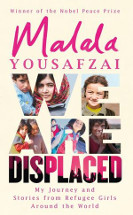
We are displaced by Malala Yousafzai
Hachette, 2019. ISBN 9781474610049
(Age: 12+) Highly recommended. Non-fiction.
Nobel Prize winner and campaigner for every girl's right to complete
12 years of free, safe and quality education, Malala Yousafzai
presents not only a short version of her own story in this new
publication, but has gathered together the stories of many brave
refugee girls she has met in the years following the attack on her
by the Taliban. Her aim is to help people understand the enormity of
the current refugee crisis, the biggest refugee crisis in history,
and to hear the stories of the people caught in it, ordinary people
caught in conflict and forced to leave their homes, choosing life
over death.
The refugee stories are gathered from around the world: Yemen,
Syria, Iraq, Colombia, Guatemala, the Congo, Myanmar, Uganda. The
stories are quite short but oh so powerful! The first tells of
Zaynab and Sabreen, two teenage sisters, who fled the bombs in Yemen
and travelled to Egypt to apply through the US Embassy to be
reunited with their mother who had already reached safety in the
United States. Zaynab, the eighteen year old, was granted refugee
status. Her sister, sixteen, was inexplicably, senselessly,
rejected, and left on her own. Zaynab was able to fly to Minneapolis
and undertake college education. Sabreen was left to risk her life
on a boat with other refugees crossing the Mediterranean to Italy.
The different fates of the two girls were cast by a careless and
cruel administrative decision.
Marie Claire's family fled the Congo, running from wild militia
groups terrorising the country. Marie Claire saw her father stabbed
in the head, and her mother brutally murdered, sacrificing herself
to save her children. Marie Claire and her extended family were
lucky to be approved by UNHCR to go to Pennsylvania, and be welcomed
by Jennifer, a warm-hearted volunteer with a refugee support
organisation.
There are other stories, of young girls in desperate situations,
seeking refuge and determined, like Malala, to build a better
future. They are sad but also inspiring stories, of people who if
just given a chance, are able to rise up to achieve their dreams.
The coloured photographs of each of the girls reinforce that these
are real people, who just by the chance of the place they were born,
have had to deal with the most terrible life circumstances. Their
stories reveal that they are also very strong, independent and
determined people deserving of our admiration.
Proceeds from We are displaced go to the Malala Fund for girls'
education. But the message of the book is that we can all help, not
only by donating money, but by educating ourselves about the refugee
situation, giving time and attention, having empathy, and being kind
to someone who has been displaced.
Helen Eddy
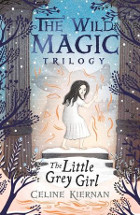
The little grey girl by Celine Kiernan
The Wild Magic Trilogy book 2. Walker Books, 2019. ISBN
9781406373929.
(Age: 9-13) Recommended. Themes: Fantasy. Ghosts. Witches. Scary
books. In the second book in The Wild Magic Trilogy, following Begone
the raggedy witches, Mup and her family travel to the castle,
where Mam is greeted, to her dismay, as the new queen. But the old
queen is still powerful and the kingdom is in danger. Mup sees a
little grey girl, a ghost who has extraordinary powers, and
discovers that she can make anyone exceptionally sad as she haunts
them with terrible memories from the past. What can she do to help
heal the kingdom?
This is a book that will appeal to children and young adults who
like ghost stories with brave protagonists who try to fight evil.
The little grey girl has frightening powers and children with vivid
imaginations will be able to see the terrible things that she
remembers from the dungeons under the castle. (It is not a story for
the faint-hearted to read at night.) However many readers will be
able to concentrate on the closeness of Mup's family, her friendship
with Crow, and her determination to help everyone, including the
little grey girl.
Mup is a very strong character who can stand up to witches and
ghosts, while acknowledging when she is wrong and being able to
apologise when her actions hurt someone. Throughout the story she
gradually learns about her powers as a witch and uses them to do the
right thing.
Kiernan's prose is vivid, sparse and easy to read and it takes the
reader on an adventure with Mup soaring through the air, sitting on
the castle roof with Crow, and using her witch light to explore the
tunnels and dungeons that are hidden under the castle floors.
Tiny illustrations throughout the book add atmosphere and add to the
tension. Readers who examine the front cover, too, will get a shiver
down their spines when looking at the shadow of the fierce dog
depicted there.
Older readers might like to continue reading about ghosts with City of
ghosts by Victoria Schwab, and younger readers might like the
style of books by Katherine Rundell.
Pat Pledger
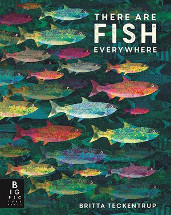
There are fish everywhere by Britta Teckentrup
Big Picture Press, 2018. ISBN 9781787410763.
As summer draws on, it is likely that many of our young readers will
have either been fishing or will have eaten fish or perhaps seen
them 'in the flesh' over the past few months. While those who have
caught them in rivers, lakes or the sea may be able to identify the
species of their catch, with over 33,600 described species in the
world, fish are the most diverse creatures than any other group of
vertebrates found in aquatic environments all over the world.
'Big or small, spiny or flat, spiky or blobby, bright or exactly the
same colour as the sand', fish have inhabited the planet for about
420 million years, and in this richly illustrated, informative book
from Britta Teckentrup, young readers can investigate all things
fishy, from the biological characteristics of fish to their evolution
to what lives where. Focused on providing initial answers to a
variety of questions it is a broad-ranging text that will satisfy
the reader's curiosity and perhaps inspire them to investigate
further. With information in manageable chunks and accessible
language it is an ideal starter text for the independent reader, and
with invitations to search for things, including the rarely seen but
most common fish on the planet, the bristlemouth, they are
encouraged to read and look carefully. Ideal for those with an
interest in these amazing creatures.
Barbara Braxton
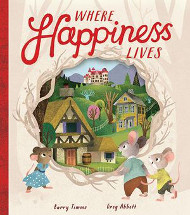
Where happiness lives by Barry Timms
Ill. by Greg Abbott. Little Tiger, 2018. ISBN 9781848699519.
In the beginning Grey Mouse is very happy and satisfied with his
sweet little house which has enough room for each mouse to have fun,
plenty of windows to let in the sun where he is safe and never
alone. But one day while he is out walking he spots a much larger
house that is hard to ignore, the home of White Mouse who invites
him up to the balcony to view an even more impressive house high on
a hill. Together they set out to visit it, so focused on reaching
their destination they are oblivious to all the sights, sounds and
smells that surround them on their journey.
When they get there, it is indeed a house like no other, and they
are welcomed in by Brown Mouse who delights in showing them round
her magnificent mansion. Grey Mouse and White Mouse feel more and
more inadequate as its features are revealed until they come to a
room that has a large telescope and they peek through it.
Told in rhyme and illustrated with clever cutouts and flaps to be
lifted, this is a charming story for young readers who will learn a
lesson about bigger not always being better, and the difference
between wants and needs, as well as being encouraged to reflect on
what makes them happy. Is it things? Or something else? Is the grass
always greener?
Both the story and the presentation have a very traditional feel
about them, making it perfect for young readers who relish the
places books can take them. And with the aid of boxes, rolls and
other everyday items they can have much fun creating their ideal
home!
Barbara Braxton
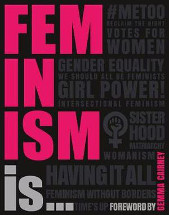
Feminism is... by A. Black et al.
DK, 2019. ISBN 9780241228029.
(Age: 14+) Highly Recommended. Non fiction. Feminism is...
follows on the heels of the recently published Feminists
don't wear pink and other lies - a collection of feminist
essays edited by Scarlett Curtis. Both books consolidate the concept
of intersectionality but Feminism is...takes the form of a
lively reference book. It might be a contradiction in terms, but
familiar frames for lucid explanations reward every page turned. The
thought-provoking topics form double page spreads within each
section, including a handful featuring key historical identities.
Each topic fans out across the gutter to engage with stylized
diagrams, bold boxed headings and a monochrome photo.
It's a ready reference with all the accessible features plus a
directory, glossary and index. Textbook sized, the topics are
classified into broad sections: A political and social movement,
Body and identity, Relationships and families, Education and work
and Culture and society. The simple language explains complicated
academic concepts and the spectrum of topics range from 'No Means
No' to 'Feminism and Sex Work.' A further delight is that every
topic gives equal weight to the opposing views of different schools
of feminist thought.
Like its counterpart, the gambit of feminism is linked by a central
idea - that intersectionality is at the heart of feminism. Feminism
cannot exist in a vacuum. The majority of humankind identify with or
belong to more than one marginalized and exploited group. Feminism
champions equal rights for everyone who is a victim of patriarchal
institutions - in reality that means fighting for as many men (of
character) as women. The media, legal system, education and religion
are the pillars supporting tyranny of a privileged system that
filters through family, language, work, politics, culture and
sexuality.
Feminism has evolved. The book may be aimed at youth, but it
provides everyone with access and clear understandings of hitherto
complex academic theories. Secondary schools should stock a feminist
reference book so thoroughly executed, if only for the simplest
definition proposed by Gemma Cairney in the foreword: 'It's a
hopeful term to associate ourselves with - it means you believe in
human rights'. As a result, Cairney was invited to take part in the
'My Life in Objects' series for The Pool. Meet her online on YouTube.
Deborah Robins