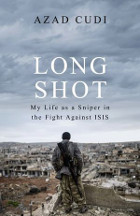
Long shot : my life as a sniper in the fight against ISIS by Azad Cudi
Weidenfeld and Nicholson, 2019. ISBN: 9781474609784.
(Age: Adult) As a Kurd living in Iran, Azad Cudi was acutely aware
of being considered a second class citizen. Conscripted into the
Iranian army, life became intolerable when he realised that Kurdish
soldiers were being deliberately deployed against fellow Kurds.
Sickened by the oppressive system and officers who manipulated Kurds
to fight against their fellow countrymen and women, Cudi deserted
from the army. A long and difficult journey followed and ultimately
he was granted asylum in the United Kingdom where he gradually
established himself. Sadly however he missed his family desperately
and was fully aware that any communication with them would be
monitored by the regime.
Eventually Cudi secured a position as a journalist in Stockholm
covering Kurdish affairs. When the Syrian war developed in 2011, he
felt compelled to join his Kurdish brothers and sisters in resisting
ISIS which was intent on complete genocide.
Having skills developed during his Iranian military service, Cudi
offered himself to the Kurdish resistance fighters who had almost no
armaments or supplies. Selected for training as a sniper, he devoted
himself completely to repelling ISIS jihadists from various places
in the Kurdish region of Rojava, between Iraq, Syrian and Turkey.
Cudi's principal service took place in the Northern city of Kobani
where he protected his comrades as a sharp shooter, covering their
advances and endlessly scanning territory for ISIS infiltrators.
It is hard to image the conditions endured by the very few defenders
who courageously occupied destroyed buildings and fought house to
house against vastly superior numbers of extremely well-armed and
supplied jihadists.
The behaviour of the ISIS militants was unnecessarily brutal. Not
satisfied with taking territory, the infiltrators were proud of
torturing their captives in the most barbaric, degrading and awful
manner possible.
This is a grim book. The content is necessarily confronting in order
to convey the desperate circumstances these Kurdish men and women
endured and it speaks volumes that they were all volunteers,
willingly risking their lives to resist maniacally bloodthirsty
invaders.
Being unable to wash for months, suffering malnutrition from
inadequate food and hiding in destroyed buildings would prompt the
most hardened soldiers to retreat, yet these dedicated volunteers
stayed. Their desperate resistance and sacrifice of many lives
eventually prevailed and the survivors witnessed the Jihadists
abandon the siege and flee for their lives.
There can be no avoiding the fact that Cudi's role as a sniper was
to shoot human beings and he was extremely effective in that
capacity, killing hundreds. In no way was he safe however. Every day
and night he was targeted by opposition snipers and artillery. The
relentless daily fight for survival had grave impacts on his
physical and mental health, to the point where he had to be
evacuated from the front lines as a broken man.
What is clear from Cudi's account however, is that he seeks to tell
a story beyond his own. He guides the reader to appreciate the
amazing Kurdish community which had developed a new way of life,
celebrating gender equality and observing higher principles of care
and respect for humanity. Cudi gives high praise to the female
soldiers, many of them commanders who capably led their limited
forces to drive the invaders out of their homeland.
For those who have returned to the region, there is hope that homes
and community can be rebuilt.
Rob Welsh
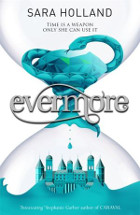
Evermore by Sara Holland
Hachette, 2019. ISBN: 9781408359525. 368p; p/b.
In the sequel to Everless,
Jules Ember is the last reincarnation of an ancient alchemist being
hunted by the vengeful sorceress Caro. Despite being a sequel, the
interesting fantasy setting explained itself well enough that it
could be followed quickly. Chapters are paced perfectly, between
their length and their contents, to keep the reader engaged without
making them feel forced to continue by a cheap cliffhanger. Jules'
struggle to push away people she loves out of fear she'll hurt them,
and regrets over the resulting rash decisions add a relatable side
to this fantasy story, drawing you closer to a sympathetic
character.
Vincent Hermann
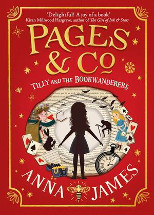
Pages and Co: Tilly and the Bookwanderers by Anna James
HarperCollins, 2018. ISBN: 9780008229863.
(Age: 9-15) Highly recommended. Themes: Books; Reading;
Literature; Fantasy; Adventure; Friendship. Pre-teen Matilda (aka
Tilly) lives with her grandparents in the Pages and Co Bookshop -
a place of mystery, adventure, fantasy and all the other genres as
well. The mystery of her absent parents though continues to hang
like a dank mist over her life, and some friendship dilemmas makes
the 'missing of her mother' into a potent force in her life. When
characters from some of Tilly's favourite books start to visit her
in the bookshop a world of possibilities open up and adventures
follow. Tilly's escape into books grows as bookshops and libraries
and the great 'Underlibrary' are revealed as part of the magic of
story and literature, and the ability to wander within a book, a
skill for a select few, is revealed as a possibility. But there are
risks! Fortunately, Tilly finds a friend in Oskar, the boy whose
mother runs the cafe across the road, and together they piece
together the puzzle of life as a bookwanderer and the mystery of
Tilly's mother's absence.
This is an awesome book for lovers of reading. With references to
many well-loved books and their characters, particularly Alice
in Wonderland, The Little Princess, Anne of Green
Gables and with side references to Sherlock Holmes and
Pride and Prejudice, this is a book to be enjoyed by those
who might already have encountered these classics. However, it may
also be an entry point to encourage reading of these books. There
are wonderful references to the joy of reading and the capacity for
readers to become 'lost' in a book, albeit the author has taken this
idea to the more magical extreme. I would think that this book could
also make a good shared book as 'a read-aloud' by a teacher,
librarian or parent. Getting lost in book together would be a
wonderful experience!
Highly recommended for lovers of reading aged 9-15. It is simple
enough for young readers, but also enjoyable for those who have
always loved reading and may have read the classic stories referred
to themselves
Carolyn Hull
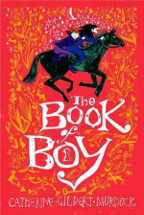
The book of Boy by Catherine Gilbert Murdock
Illus. by Ian Schoenherr. Chicken House, 2018. ISBN: 9781911490579.
(Age: 9-14) Highly recommended. Themes: Middle Ages, Plague, Relics,
Religion, Disability. Newbery Honor book 2019. It is the year 1350
and Secundus is a pilgrim who is on a quest to collect six relics,
'rib tooth thumb shin dust skull tomb', to put in the tomb of St
Peter in Rome. When he meets Boy, a goatherd, he takes him away from
the manor where he lives to help him to find the relics. Boy goes
along hoping for a miracle at St Peter's tomb, making him a normal
boy and taking away the hump on his back. There are mysteries for
the reader to solve: Why does Boy give all his food to the animals
that he can communicate with? And what is the strange smell that
surrounds the key that Secundus uses to open all manner of locks?
Murdock brings her medieval world vividly to life for the reader who
is taken through the empty villages and devastated countryside of
France, each leaving a picture of the plague killing everyone and
farms and houses being deserted. The religious beliefs that underlie
every aspect of the period are also described in a matter of fact
way as each relic is gathered, with both Secundus and Boy fervently
believing that a miracle will happen when the relics are put in St
Peter's tomb.
There is humour and pathos in Murdock's writing and it is easy to
become lost in her world as Secundus and Boy take on often dangerous
challenges in obtaining the relics. Her characters feel like real
people with believable fears and dreams, and Boy's generosity and
goodness is a delight to read. The woodcut-like illustrations at the
headings of each chapter, particularly of the animals that Boy
converses with, also add to the charm of the book.
This gives an excellent insight into the effects of the Black Plague
and the place of religion in society in the Middle Ages and would be
very useful for classroom discussion of Medieval times. However it
is the uplifting thought of Boy's spirit that will remain with the
reader.
Pat Pledger
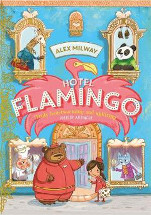
Hotel Flamingo by Alex Milway
Piccadilly Press, 2019. ISBN: 9781848127753.
(Age: 6-8) Recommended. Themes: Girls, Animals, Hotels - maintenance
and repairs. When Anna inherits the Hotel Flamingo on Animal
Boulevard from her great aunt Mathilde she's in for a big shock.
Dirty, dusty, with peeling walls, cracked windows and a broken
revolving door and only two staff members left, the hotel has fallen
on hard times. Anna is a determined girl and with the help of T.
Bear the doorman (bear) and Mr Lemmy the lemur who manages the front
desk, they start the mammoth task of fixing it.
'All this hotel needs is a little bit of love, and an awful lot of
cleaning,' says Anna. With a little help from Mrs Turpington the
turtle's three years in back rent, (she'd been hibernating in her
room all that time), they are able to hire staff. Stella the giraffe
is handy at maintenance, and fixes the revolving door in no time at
all. Madame Le Pig takes over as hotel chef, a little fazed by the
unusual diets of the animal guests.
Anna's ideas for revamping the hotel are wonderful; Stella paints
the facade a beautiful shade of sea blue and all the staff help to
make the hotel a bright and inviting place to stay. When a family of
sea otters move out of the swimming pool pipes, Anna offers them
free board in return for pool maintenance and life guard duties. Ms
Fragranti's dancing flamingo troupe provides special entertainment
for the guests on the special opening night. Even with a visit by
the undercover hotel inspector, Anna and her team rise to the
challenge.
Alex Milway's Hotel Flamingo is a gorgeous early chapter
book, filled with delightful animal characters and fun cartoon
illustrations. It celebrates teamwork, determination, creativity and
accepting others - even cockroaches! Just right for a young reader
beginning their novel reading journey. Read aloud to a class of Year
1- Year 3s and encourage them to write additional chapters, create
and draw new characters and have fun with Milway's story. There are
three more novels to come. What's next for Anna and her animal
friends?
Rhyllis Bignell
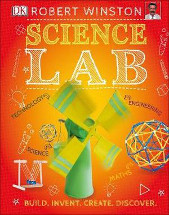
Science lab by Robert Winston
DK, Penguin Random House, 2019. ISBN: 9780241343494.
(Age: 9+) Highly recommended. Themes: Science, STEM, Technology,
Experiments. Robert Winston has collated an immensely practical book
that shares fantastic, child-friendly ideas for budding scientists.
With detailed plans for everything from levitating balls, suspension
bridges and even home-made guitars (plus many more), this book will
provide hours of fun for a STEM/STEAM-focused child. There are
explanations for the scientific principles at play in all of the
activities, as well as the photographic and written procedures for
each construction or experiment. Additional ideas to expand the
scientific thinking and exploration are also included for some of
the tasks. Experiments are organised under the following headings:
Forces and Motion, Liquids and Reactions, Shapes and Structures and
Light and Sound.
This is a wonderful book for a child who would enjoy putting
scientific principles into action. It is visually appealing and well
organised so that equipment could be gathered and prepared by the
child to make all of the projects. (Some tasks may require adult
supervision.) Teachers may also like the ideas in the book for
technology and science extension activities.
Carolyn Hull
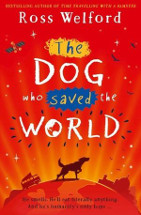
The dog who saved the World by Ross Welford
HarperCollins, 2018. ISBN: 9780008256975.
(Ages: 9-12) Recommended. Themes: Time Travel, Virtual reality,
Family Life, Dogs. Set in the near future Ross Welford's The Dog
Who Saved the World takes us on a fast-paced journey into the
world of virtual reality and time travel.
Eleven-year-old Georgie lives in Whitley Bay with her dad, brother
Clem and dad's girlfriend, Jessica. Unfortunately, Jessica is
allergic to Georgie's rescue dog Mr Mash and he's returned to St
Woof's dog shelter. Georgie volunteers at the shelter and loves to
take Mr Mash on beach walks joined by Ramzy Rahman her best friend.
Their lives change forever when Georgie's over exuberant animal
knocks an old lady down, eats her swim cap and scratches her watch.
Little did they know; this encounter was a master plan devised by Dr
Emilia Pretorius who needs the assistance of Georgie and Ramzy to
test her secret project. She also demands that they don't tell their
parents - alarm bells should be ringing!
The doctor is an eccentric genius who has built a VR machine capable
of sending people into the future. Some of the trips become quite
scary; a giant scorpion attacks them and split-second
decision-making is needed. At the same time, a deadly canine disease
sweeps across the country and Georgie's pet, Mr Mash, falls ill.
Georgie and her dog are both needed to save the world.
Welford's The Dog who saved the World is fantastical,
scientific, dramatic and even humorous. He builds the tension and
drama as he sends his feisty protagonist into the future to find
answers needed for the current issues. Realistic emotions underpin
the narrative, family relationships, friendships and the special
bond between a girl and her loved pet make this an exciting novel
for readers. Shared with an Upper Primary class, there are engaging
discussion points and research links, with changing the laws of
quantum physics, scientific espionage, future travel and the impact
of deadly global diseases.
Rhyllis Bignell
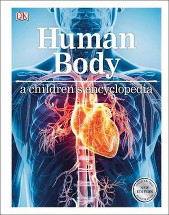
Human body: A children's encyclopedia by Richard Walker et al.
DK: Penguin Random House, 2019. ISBN: 9780241323069.
Highly recommended. Themes: Human Biology; Health. Dorling
Kindersley non-fiction publications are always brilliantly
presented, and this book is no exception. With exceptional clarity,
the intricate detail of the way the human body functions is
explained in language suitable for younger readers. Utilising small
text boxes of information; amazing photographic and scientific
diagrams and illustrations; and the occasional 'Wow!' bubble of
information, the format is very visually appealing and will be
enjoyed as a reference source for young readers.
[Note: The 'Life Cycle' Chapter is sensitively presented with detail
that is appropriate for a youthful audience. With a greater emphasis
on growth and change and genetics, rather than multiple pictures of
anatomy or genitalia, this is not a book that will need to be looked
at with adult supervision and libraries with younger students can be
comfortable with the content.]
Highly recommended as a reference text for young readers interested
in Biological Science.
Carolyn Hull
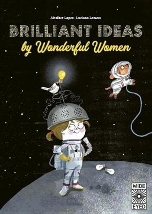
Brilliant ideas from wonderful women: 15 incredible inventions from inspiring women! by Aitziber Lopez
Ill. by Luciano Lozano. Wide Eyed Editions, 2019. ISBN:
9781786037053.
(Age: 8+) Highly recommended. Themes: Women, Inventors, Inventions,
Biography, STEM. Illustrated with cartoon like figures, which
children will enjoy, this book presents 15 great inventions that
women have pioneered in the 20th century. They are: Car heaters,
Monopoly, Disposable diapers, The dishwasher, Domestic surveillance
system , Kevlar, Maritime flares, Anti-reflective glass, Wi-Fi,
Syringes, Submarine periscopes, Diagnostic tests, Lifeboats,
Windshield wipers, and Ebooks, all things that are very useful and
have become common place in the modern world.
Each woman has an insert giving her biographical details, then
details about why she invented the product and what it was used for.
It was fascinating to read about women who invented things that made
their home life much easier to manage, and which have lightened the
domestic load for women everywhere. Marion O'Brien Donovan invented
the disposable nappy using a waterproof nappy cover from the
material that parachutes are made from. She went on to invent dental
floss and other useful things. Josephine Garis Cochrane invented and
marketed a dishwasher. In the medical sphere, many lives have been
helped by the invention of the medical syringe in 1899 by Letitia
Mumford Geer, and the first diagnostic tests for different diseases
by Helen Murray Free.
The illustrations are very humorous and complement the text, giving
the reader a very good idea of why the invention was so useful. The
humour of the drawings will ensure that not only will readers enjoy
the fun, they will remember the circumstances that inspired the
invention. The large illustration for the windscreen wiper, 1903,
invented by Mary Anderson, shows the frustration of the tram driver,
who had to stop the tram and get out and wipe the windscreen,
whenever it rained or snowed.
This will be a useful book to have in the classroom or library when
children are looking at inventions and inventors, and will inspire
many to think about how these women overcame many obstacles to make
the world a better place.
Pat Pledger
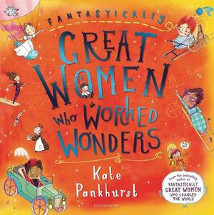
Fantastically great women who worked wonders by Kate Pankhurst
Bloomsbury Children's Books, 2019. ISBN: 9781408899274. Paperback,
32 pages.
(Age: 7-14) Highly recommended. Themes: Women, Biography, Inventors,
Explorers, Mathematicians,. Kate Pankhurst, descendent of Emmeline
Pankhurst, is back with another wonderful book about women that is a
must for libraries and classrooms and will be eagerly sort after by
the fans of her previous books, Fantastically great women who
changed the world, Fantastically
great women who changed the world activity book and
Fantastically great women who made Historyby Kate
Pankhurst.
The list of women includes Junko Tabei, Sophie Blanchard, Maria
Merian, Elizabeth Magie, the London Matchgirls, Rosa May
Billinghurst, Katherine Johnson, Annette Kellerman, Katia Krafft,
Rosalind Franklin, James Barry, Madam C.J. Walker, and Lotte
Reiniger. These women's lives and achievements, which span many
centuries and many careers, will fascinate readers who may not have
heard of them before. This introduction will also give children
inspiration about the types of careers and pathways that they too
could have if they are prepared to be bold and follow their talents.
Illustrated with appealing quirky figures, each woman has a double
page which gives her main achievements, and then inserts expand the
information. The layout is one that will be particularly appealing
to young readers who like little bites of facts. Two women who stood
out were Maria Merian and Annette Kellerman. Maria travelled to
South America in 1699 in a quest to study exotic insects and her
drawings and work helped to transform people's knowledge about the
natural world. Annette Kellerman was an Australian pioneer,
demonstrating that women could lead more active healthy lives. Her
exploits as a swimmer encouraged to women to swim rather than bathe,
and changed the nature of bathing costumes so that women could move
in the water, rather than be dragged down by heavy bloomers.
This book would be very useful when looking at people who have
changed the world and the way it is seen. What fun to tell children
that Lotte Reiniger invented the multi-plane camera, a breakthrough
for animation, each time they watch a Disney animated film.
Pat Pledger
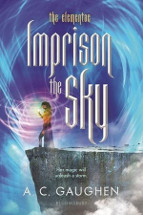
Imprison the sky by A. C. Gaughen
Elementae series, book 2. Bloomsbury, 2019. ISBN:
9781547602544.
(Ages: 12+) Highly recommended. Themes: Fantasy, Air, Magic,
Slavery, Science - Experiments. Aspasia was captured by the
Trifectate as a young child from her family. She was sold as a slave
to a ruler called Cyrus and made to do slave trading. Secretly she
is an Elementae with air powers. As time goes by, she puts together
a crew of Elementae on one of Cyrus's ships, the Anorca, to free as
many women, children and Elementae they can get their hands on so
they don't have to suffer slavery. Cyrus is close to discovering
Aspasia's secrets that could kill her. She searches the vast ocean
trying to find her brother, Gryphon, and her sister, Pera, before
Cyrus finds them and sells them off to slave masters, whom would
kill them. Aspasia travels to a slave sale in the Trifectate and
buys three new recruits who all hold an Elementae power. She
purchases two girls and one boy who has an extraordinary power that
she has never seen or heard of before. Aspasia's crew and new
recruits suddenly find themselves right in the center of a boiling
war that will cover every last millimetre of the ocean. Will she get
her freedom or will she die in the hands of Cyrus?
This heart stopper and page turner of a story will make you want to
read more. Each time I put the book down, my heart was racing and I
was breathless as if I just ran a race. The way the story was set
out and the way the characters acted and behaved made me feel as if
they were real people who lived in this world. At one point I was
going to ask my parents if we could fly to the Wyvern Islands and
visit Aspasia and her crew of Element. Personally, I was so on the
very edge of my couch that I actually fell off. This story is about
freedom and power and how saving people can bring good and bad. This
magical tale of Aspasia and her crew was absolutely a show stopper.
I would recommend this book for 12+ and I think I would give it out
of 5 stars probably 4.5 personally.
Ruby O. (Student, year 7)
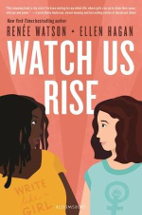
Watch us rise by Renee Watson and Ellen Hagan
Bloomsbury, 2019. ISBN 9781547600083.
(Age: 12+) Highly recommended. In this novel, Renee Watson and debut
novelist Ellen Hagan give voice to Jasmine and Chelsea, two teenage
best friends who are frustrated with the sexism and racism that
comes their way unnoticed. Creating a blog called 'Write Like A
Girl' as part of a Women's Rights Club they establish within their
school, they post poems and essays about feminism. While the blog
goes viral, and the girls are flooded with positive responses to
their creative content, some trolls emerge and things escalate
within the school, leading to the principal shutting the club down.
Refusing to be silenced, Jasmine and Chelsea risk everything to keep
their voices, and the voices of other young women, heard.
This is an empowering story about undying friendship, loving
yourself and others for who they are and the importance of fighting
for what you believe in no matter the challenges you face. With
poems, essays and journals scattered throughout, this is a powerful
read with the ability to inspire young 'art-ivists' to use their
artistic talent to speak out about the social issues they feel
strongly about. An important novel with a lot to say, particularly
in today's political climate, Watch us rise will have a
lasting impact beyond the reader turning the last page.
Daniella Chiarolli
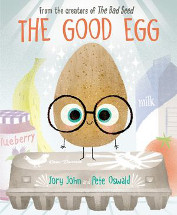
The Good Egg by Jory John
Ill. by Pete Oswald. HarperCollins, 2019. ISBN 9780062866004.
The Good Egg is verrrrrry good. It does all sorts of things like
rescuing cats, carrying groceries, watering plants, changing tyres,
even painting houses. If there is anything or anyone needing help,
it's there to assist. Back in the store where it lived with another
11 eggs - Meg, Peg, Greg, Clegg, Shel, Shelly, Sheldon, Shelby,
Egbert, Frank and the other Frank - altogether in a house with a
recycled roof, things weren't particularly harmonious because The
Good Egg found the behaviour of the others confronting. They ignored
bedtime, only ate sugary cereal, dried for no reason, threw
tantrums, broke things... and when The Good Egg tried to be the
peacemaker and fix their behaviour no one listened. It became so
hard and frustrating that its head felt scrambled and there were
cracks in his shell, so The Good Egg left.
As time went by, it began to focus on the things it needed rather
than what it thought everyone else needed and in time it began to
heal...
This is a sensitive story that explores finding a balance between
personal and social responsibility so that the egg, or any person
really, can live at peace with itself. It's about helping the
perfectionist lower their expectations of themselves so they are not
always struggling and feeling failure, and, at the same time, accept
that those around them will always have faults and to be comfortable
with those. Self-perception is such a driver of mental health and
self-imposed standards of excellence are impossible to live up to
and so the spiral towards depression begins, even in our youngest
students.
A companion to The bad seed, John and Oswald have combined
sober text with humorous illustrations to present an engaging story
that has a strong message of accepting oneself and others for who we
are, not who we think we should be.
Great addition to the mindfulness collection.
Barbara Braxton
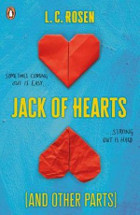
Jack of Hearts (and other parts) by L.C. Rosen
Penguin 2018. ISBN 9780241365014.
(Age: 18+) Themes: LGBTQ. Don't get me wrong, my secondary libraries
have acquired a number of LGBTQ novels beginning with Kate Walker's
Peter in the nineties. To be honest, the hedonism of the
students in this one, likely disturbs me more than their sex lives.
However, considering our secondary school populations can range in
age from 11 to 18 years, I'm not sure whether Jack of hearts
is that one step too far - much like Rammstein's imitative
pornographic music video became as immoral as the social commentary
they so powerfully achieved.
Previously published in the USA, Rosen's actual storyline is a
suspenseful cautionary tale of cyber safety. Jack, a highschool
student, falls victim to an anonymous stalker, who uses both text
messages and printed notes folded into origami shapes. Due to his
reputation as a promiscuous gay teenager, school authorities are not
much help, so Jack and his friends attempt to investigate the
identity of an increasingly ominous person - presumably also gay,
like Jack. The characters are fully fleshed out as they too become
targets. Jenna is a serious, aspiring journalist and straight. She
encourages Jack to write a weekly guest column for her blog, which
is essentially a sex advice column. Ben, is gay but unlike Jack, a
romantic who is waiting for a deep and meaningful relationship with
his first boyfriend. Jack's mum is a doctor and single parent, who
has a healthy relationship with Jack. Nance is that one teacher who
'gets it'. Jack himself, despite his own preferred 'love them and
leave them' lifestyle, is an insightful student of human nature,
advocating good communication, kindness and self-respect in every
piece of advice he gives.
Here's the thing, the quantity and explicit nature of Jack's own sex
life is the deal breaker for me. That said, I can't see the problem
including it with 18+ material. Perhaps, a solution would be to add
it to non-fiction as a relationships advice manual, where the
narrative element becomes a suspenseful and interesting
counterpoint; not that the publisher thought to develop either an
index or glossary. The gambit of Jack's relationship knowledge would
warrant both.
I enjoyed Jack of hearts because I am an adult, yet
obviously there are YA publishers whom Jack acknowledges for their
support, who feel otherwise. Lastly, Penguin includes a bonus first
chapter to whet our whistles for another LGBTQ title, The
miseducation of Cameron Post by Emily M. Danforth - now a
motion picture.
Deborah Robins
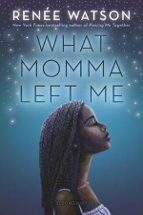
What Momma left me by Renee Watson
Bloomsbury, 2019. ISBN: 9781681199498.
(Age: 12+) Recommended. Themes: Family, Domestic violence.
Originally published in 2010, Newbery Honor Award winning author
Renee Watson's newest UK edition of What Momma Left Me,
seeks to uplift another generation of YA readers with a contemporary
cover.
Serenity and her younger brother Danny lose both parents as a
consequence of domestic violence. Serenity begins journaling her
healing in the home of their maternal grandparents. A new start in a
new community forces them to look outside themselves to develop
symbiotic relationships with wider family, parishioners, students
and hardest of all - professional counsellors. Serenity uses her
epiphanies to help her new friend, Maria, having learned that little
good comes of secrets. Danny's catharsis comes only after further
tragedy but to some degree from realizing that materialism cannot
fill that dark hollow of human despair, from which no one is immune.
Serenity crushes on Jay, who is somewhat of a rough diamond, but
stays focused on her school work and writing. Every chapter explores
both a line of scripture and a poetry device from her first period
Poetry class, to be learned and applied. The last chapter called
'Amen' begins with an Ode. Serenity's naive ode to a Red Velvet Cake
is an important metaphor and specially blended Mother's Day surprise
for her Grandmother. Readers are treated to the recipe in the end
papers.
Both Danny and Serenity falter but their family, faith and
community, reconnect them to bittersweet memories and dispel their
fears that they are not destined to repeat the same cycles of
violence. The novel arrives full circle back to the scripture that
sustains Serenity on the day of her mother's murder.
This is a book centred on grief, but certainly refuting the metaphor
that the disease of domestic violence is either inherited or
chronic.
Deborah Robins