So far this year, in my little part of the planet, we have had both local government elections and a state by-election, and a federal election looms within the next three months, So local young readers have been bombarded with advertising and so forth with vocabulary like 'party', 'candidate', 'vote' and 'polling booth'. But do they understand what an 'election' is?
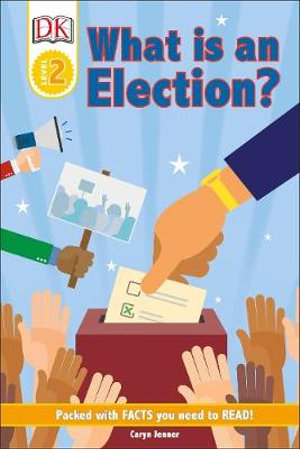
This book, part of the DK FindOut series, provides a simple but comprehensive explanation of where and how democracy began and how it has developed over the years and just what happens when people are required to exercise their vote every so often. Beginning with a close-to-home scenario of school elections for class president, it moves beyond to national elections and while the photographs are predominantly from the US, it does embrace the procedures in other parts of the world.
Because this is a levelled reader, ostensibly for 'beginning readers', the explanations are clear yet comprehensive giving the young person who at least has an awareness of the process being undertaken an insight into what actually happens. Therefore, IMO, the target audience would be those who might be involved in class elections who know that it is more than a popularity contest. Rather than an individual read, its importance lies as an introduction to that which will dominate our news bulletins in coming months shared and discussed by the class teacher, so students begin to understand what is meant by 'Let's have a vote' and the concepts of 'majority rules' and living with the consequences of the choices.
As we mature we begin to realise what a precious thing a vote is, and the need to exercise our rights in an informed manner. This book begins our students' understanding of that privilege.
Themes Elections.
Barbara Braxton
What big teeth by Rose Szabo
Titan Books, 2021. ISBN: 9781789097818. (Age:16+) Recommended for readers who like gothic horror.
Eleanor Zarrin has been sent home from boarding school after an undisclosed horrifying incident. Her grandmother had sent her away and she has had no contact with her family for years. When she arrives at her home, it is difficult for her to fit in with her strange family – a mother who has weird skin and sits in a bathtub of water, a grandfather and cousin who howl in the woods, a sister who has grown away from her and a father who is ineffectual. Then there is Arthur a being that some members of her family are in love with. When her grandmother dies reading the tarot cards, Eleanor is left in charge of the family and must learn about the darkness that she knows lives inside her.
This is a dark and complex tale that would appeal to fans of horror. The reader is constantly trying to work out what is going on in this monstrous family and just what skills and background each of the family members has. The arrival of Eleanor’s other grandmother and the way that she can manipulate people deepens the suspense and provides even more horror to the story.
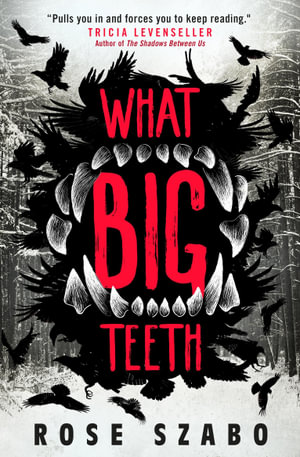
A tale for older readers, its great cover and title could make an effective centre piece for a display of horror stories. Readers may also enjoy The forest of hands and teeth by Carrie Ryan, The woods are always watching by Stephanie Perkins and the collection of short stories in Hometown haunts.
Themes Horror, Gothic, Werewolves, Good and evil.
Pat Pledger
Dragon City by Katie & Kevin Tsang
Simon & Schuster, 2021. ISBN: 9781471193125. (Age:9+) Highly recommended.
Dragon City is the third book in the amazing Dragon Realm series, written by Katie and Kevin Tsang. Once again, the story will keep you enthralled until the very last page. This novel will appeal to readers who loves mythical stories and adventure, while beautifully entwined with the power of friendship, trust and determination.
After Billy’s dragon, Spark betrayed him and chose to join the Dragon of Death, Billy and his friends Charlotte, Ling-Fei and Dylan are thrown into the devastation of Dragon City, a place of true dragon dystopia. Both the Human and Dragon Realm have been destroyed and this is the only place where humans and dragon can live. But this is far from a safe place, as it is filled with danger and devastation around every corner. With nox-hands and nox-wings to be wary of, Billy and his friends must overcome their fears of betrayal and evil to work together and trust each other again. Together they must find their beloved dragons and try to overpower the Dragon of Death. How will Billie and his friends be able to survive in this dangerous city? Will they ever see Xing, Tank and Buttons to reunite and share their special bonds? Could Billie reunite with Spark to change her back to the dragon she used to be, and he still heartbreakingly loves, or will they be lost to each other forever?
Katie and Kevin Tsang have written another amazing sequel in the Dragon Realm series for those lovers of fantasy, adventure and suspense. Dragon City is filled with expectation, excitement and enjoyment with vivid text to make an easy read, creating clear imagery for the audience. As you turn each page you feel as if you are actually there on the adventure with Billy and his friends! A definite great read, and one that won’t disappoint… especially for all those mythical loving, adventurers!
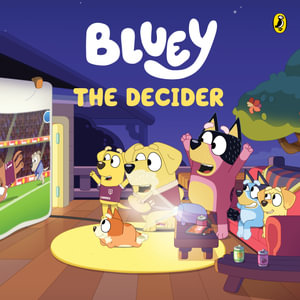
This colourful new Bluey board book tells the story of the Heeler family visit to Hammerbarn, a huge hardware store. Next door neighbour Lucky points out his new pizza oven to Bluey and Bingo’s dad Bandit who decides that he just must have one. The whole family travels to the hardware store and the two highly competitive sisters squabble over who gets what as Mum puts items in the trolley. Inevitably an item is broken and Mum must intervene to keep the peace and point out ‘that you can’t have everything.’ At the checkout there is more commotion from Bluey and Bingo when the checkout operator takes items out of the trolley for scanning. The pups are then pacified by being allowed to use the beeper. Dad’s pizza making is not quite up to scratch but he and the family enjoy sharing the pizza.
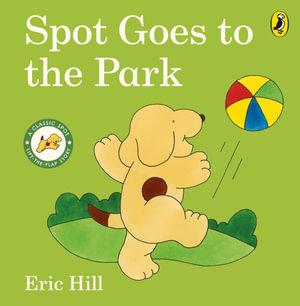
A classic lift the flap book about Spot will be welcomed by all young readers. The board book fitting snugly into small hands entices with a picture of Spot kicking a ball on the cover. With its preponderance of primary colours and deceptively simple outlines, the book will be readily absorbed by children.
A stress on friends and family has Mum asking Spot to go the park as it is such a nice day. But Spot has to get something out of the toy box before he leaves with Mum and Helen the hippo. Lifting the flap reveals what it is he is looking for. He rushes off through the garden gate with Mum calling that he wait for them. He chases the pigeons, and kicks the ball, losing it amongst the many things in the park. Children will love looking at the array of things to be found in the park, and talk about what they see there to do.
Children will thrill seeing other animals hidden in the undergrowth and playing with Spot and Helen.
A delightful afternoon at the park not only shows children what they will do at the park, but also models good behaviour of getting along, of playing together and of thanking the duck who retrieves the ball for Spot, an afternoon of fun with friends and family, and learning some lessons that will stand them in good stead when being with them.
First published in 1991, this book encourages using fine motor skills as well as the fun of exploration and adventure as Spot and his friends play and learn together.
Themes Play, Spot, Lift the flap, Family, Friends.
Fran Knight
The language of food by Annabel Abbs
Simon & Schuster, 2022. ISBN: 9781398502239. (Age:Secondary - Adult)
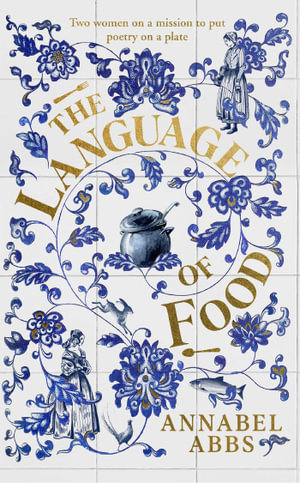
This is a story about our desire, as human beings, to handle food in a way that we can enjoy eating, and it is firmly about our love of food. This novel, constructed as an historical tale, takes us back in history to Avery Conifer, a woman who was well educated and loved expressing her creativity in writing poetry. When the publishers, who had been focussing on her writing poetry, and had released her poetry book in 1826, asked her to write a book of recipes, she decided to construct and to write her recipes in detail, and the resulting collection is believed to have been one of the earliest cookbooks. She stated that cookery had not been her forte and she wanted to refuse, but realised that she would not have an income if this were to happen. So she taught herself to cook and became one of earliest persons, it is believed, to publish a cook book in the English language. Her determination to recover from her feelings of discomfort enabled her to find the mental strength and imagination that would lead to her becoming a famous chef, initially in England and later having an effect on cooking across the English speaking world.
Beginning her new career in the creation of recipes, Conifer is determined to support herself and focuses on the notion of how to cook and what to cook. As her food becomes notable, she realises that she is enjoying both the creation of recipes, the cooking and the creativity that unexpectedly becomes part of her life. Her assistant becomes fascinated with the poetry, stunned by someone able to write such beautiful works, but she is also stunned by Conifer’s capacity to produce recipes and cook beautiful food. In reality, Conifer’s first cookery book was published in 1845, entitled Modern cookery for private families. Published a number of times over the first year, this book began the notion of the ingredients being listed, the exact amounts stated, and the method of cooking clearly explained.
Mrs Beeton, a famous chef, is alleged to have ‘filched’ some of her recipes, but she certainly introduced the practice of listing the ingredients first, at the top of the recipe, rather than the older practice of listing them last. Rather interestingly, Eliza Acton appears to have been the first person to have suggested nutrition as an important aspect of health, focussing on using fresh ingredients, and following the idea of considering what people cooked in different cultures at the time. Rich in detail and full of the love of food and cookery, this book takes us into a past world where the imagination was at the fore, prior to the exchange and sharing of global cookery that we know today. It would certainly be enjoyed and appropriate for secondary students interested in the art of cooking, and the historical invention of constructing recipes for others to use. An interesting and revelatory novel about the history of how humans changed in the consideration of preparing and cooking food.
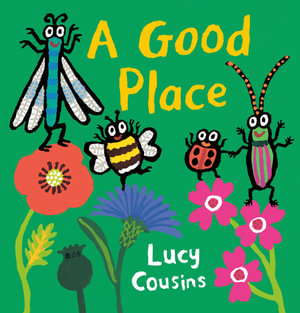
Lucy Cousins, the author of the very popular Maisy books, (including Maisy goes to the bookshop and Maisy goes to preschool) brings to life a good place for insects to live. Four friends, Bee, Ladybird, Dragonfly and Beetle all want to find somewhere to live, but it is not so easy to do that. Bee wants flowers, Ladybird wants leaves, Beetle wants dead wood and Dragonfly wants a pond. Bee finds some flowers, but they are growing on a busy pavement that is too dangerous. A tiny pond turns out to be a dirty puddle on a noisy road while a piece of dead wood is in a smelly pile of rubbish. Beautiful green leaves look promising until someone comes and sprays them causing the insects to cough and splutter. Despondent, the four friends are about to give up when Butterfly comes to the rescue showing them a gorgeous garden where they could be safe.
Cousins’ illustrations are wonderful. The bright and colourful images stand out against a coloured background while the insects are outlined with black, and each has a distinct and cheerful face. Right from turning open the cover, the reader is introduced to a habitat that is not suitable for insects to flourish – the grey and black pavement littered with a can and brown brick wall is obviously not a good place. As the insects explore more territory the young reader will be tempted to sing out the refrains, ‘Maybe this is a good place’ and then the disappointing ‘Oh no! this is not a good place.’ Children will eagerly talk about what is a good place for insects and could discuss whether they have a good place in their gardens or in a nearby park. They might also like to see if they can find insects in good places for them to live. Big bold print will also help the emerging reader while younger children will enjoy having the story read to them.
Another winner from this award-winning author is sure to be one that is treasured by young readers.
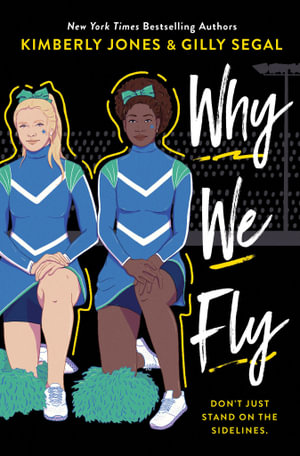
Eleanor (aka Leni) and Chanel (aka Nelly) are in their senior year of school. They are long-time friends and together perform at a high level in the school Cheer-leading team with hopes of winning State championships. With the pressures of preparing for their post-school futures, life has taken a twist for Eleanor because of a serious concussion that has kept her on the sidelines for a season, and her hopes and dreams are under a cloud. It is when she becomes more than a passing acquaintance with the superstar football hunk that the friendship between the two girls wobbles. However, when the Cheer team decides to support a famous past student and football star from the school and to ‘drop the knee’ during the anthem at the school’s Friday night game, things go in directions they did not expect. For one of the girls, the consequences and school suspension that follows threaten to derail her life. Their friendship stumbles further under the pressure and the growing romance between Eleanor and Three (aka Sam) also is on uncertain ground. What will the future look like for them all, and can they stand up for what is right … for the right reasons?
Australian readers will know about the Cheerleading culture from USA movies (and this story is destined for the screen too) but there are many aspects that are foreign. The main characters are from diverse backgrounds – Jewish and Afro-American heritage. They have friends from different backgrounds, including LGBTIQ friends, the football jock arena, and even the Jewish Rabbi. The activism issue, related to the ‘drop the knee’ practice for social justice, underscores the story of coming-of-age and the entry into College life in the USA. Were it not for the confusion of each character having multiple name references in the story, this would be a great easy-to-read teen-friendly story. With an eye-opening entry into the dramas related to a recent social justice movement and the life of the pom-pom wielding Cheerleaders, there is a definite teen appeal to this story. This story deals lightly, but thoughtfully, with serious issues.
Themes USA school life, Cheerleading, Activism, Social justice, Race issues, Leadership, (LBGTIQ minor characters and drug taking).
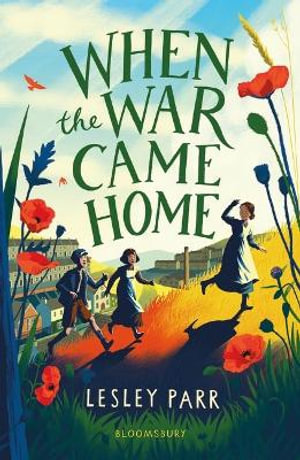
For some the war is still close, even though the conflict is over. Charlie has obvious wounds, Johnny has forgotten everything including his name, and Huw is grieving the loss of his good mate. For Natty, the central character in this book, there is loss of a different kind. Her mother has campaigned too hard for workers’ rights and lost her factory job, they have lost their home and now have to move to the Welsh countryside to live with cousins. Cousin Nerys is the same age as Natty, and Natty is not sure if she will survive the shift and Nerys’ enthusiasm. And she is angry at her mother and wishes she could go home. But where is home? The whirlpool of emotions Natty is feeling eventually leads by accident to a kid-run school-directed program of activism designed to care for students who are struggling to learn because of hunger, as well as some well-placed care and concern for Johnny and Cousin Huw, and renewed relationships and attitudes.
Lesley Parr has written a serious, but child-centric post-war story that is very like Michael Morpurgo’s approach to children’s story writing – serious topics, written with a light touch, but not patronising to young readers. When the war came home addresses a serious aspect of war, the post-traumatic consequences for young soldiers, but in a way that neither minimises the tragedy nor avoids the significance or the sadness just because the story is for young readers. The setting in the Welsh countryside adds the opportunity for Parr to scatter some very Welsh cultural expressions (including some scattered Welsh words with lots of consonants) and Welsh locality names. Hopefully young Australian readers won’t think these are typos, as they are far from easy to pronounce. Some aspects of the story may be foreign to Aussie kids eg school lunches, cruel teachers, Scholarship exams… but this provides opportunity to learn about different experiences at different times and places. The overall result is a very readable story with an element of pathos that can be recommended to male and female readers aged 11+.
Themes War, War-related injuries, post-traumatic amnesia, resilience, activism, Wales, school.
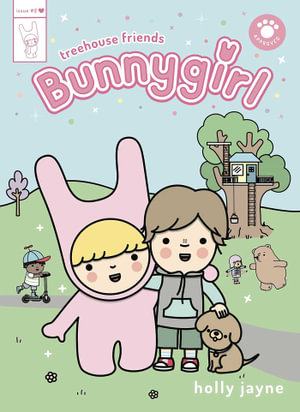
The second adventure of Bunnygirl by author and illustrator Holly Jayne continues with main character Bea aka Bunnygirl, continuing with her kind and caring manner. She and best friend Woof notice an amazing treehouse in the park and see a young boy standing on the balcony. They ask to come up but he tells them to come back later. Bunnygirl and Woof find out from their other friends that the boy does not let anyone visit his treehouse. Bunnygirl then decides that he may be shy and plans to share mini pancakes with him. This plan works and Bunnygirl and Woof are allowed to visit. They do find out that the young boy called James is indeed shy and they think about different ways of helping him make friends as for some children it is not easy. Bunnygirl and Woof chat with their other animal friends and they devise a clever strategy to help James become their friend. The outdoor cinema in the park proves a big success and the friends find out that James contributed to this.
This book is a worthwhile introduction for younger readers to the graphic presentation format with clearly illustrated panels providing simple text and images to engage the reader. As there is not text in every panel this book initially would be best shared between an older reader and younger child with directions for reading the panels very important in understanding the story.
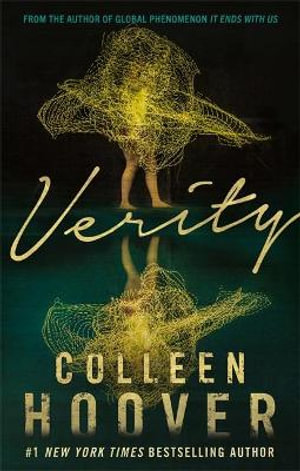
Lowen Ashleigh is a struggling writer on the brink of financial ruin when she accepts the job offer of a lifetime. Jeremy Crawford, husband of bestselling author Verity Crawford, has hired Lowen to complete the remaining books in a successful series his injured wife is unable to finish.
Lowen arrives at the Crawford home, ready to sort through years of Verity's notes and outlines, hoping to find enough material to get her started. What Lowen doesn't expect to uncover in the chaotic office is an unfinished autobiography Verity never intended for anyone to read. Page after page of bone-chilling admissions, including Verity's recollection of what really happened the day her daughter died.
Lowen decides to keep the manuscript hidden from Jeremy, knowing its contents would devastate the already grieving father. But as Lowen's feelings for Jeremy begin to intensify, she recognizes all the ways she could benefit if he were to read his wife's words. After all, no matter how devoted Jeremy is to his injured wife, a truth this horrifying would make it impossible for him to continue to love her.
This book is disturbing, creepy and thrilling... in the very best way. It was fast paced, with reasonably short chapters. Readers will be hooked from the first page. The story changes between Lowens POV and Veritys manuscript. You will be on the edge of your seat throughout and will be guessing until the very end. Colleen Hoovers writing is sensational and has written such strong characters. By the end of the story there is only one question left to ask... are you team letter? Or team manuscript?
Brother and sister, Isaac and Ivy Ramey take drugs for different reasons. The novel begins with the overdose of one, made ambiguous by their similar names. The teenagers’ respective backstories flesh out the plot throughout the rest of the book but the reader’s apprehension is palpable knowing one will not make it.
The other two main characters are the actual drugs they take, who are personified as Gods inhabiting a whole endless nightclub party/underworld where opioids are embodied youthful gods marking potential addicts for their sport and scoring higher as they groom victims. Roxy is Oxycodone (Isaac’s pain relief) and Addison is really Adderall (Ivy’s meth-based medication to treat her ADHD).
When not at school, training or hanging out, the human siblings find themselves in need of the medications more and more and eventually progress to the VIP room where the ‘Gods’ introduce them to harder drugs. Other drugs make their presence felt. e.g. Naloxone cares for users who overdose. Alongside the main plot are interludes from other drug addicts as the natural conversational tone of the drug (gods) demonstrate what they do and how they make their humans feel. Thus this novel potentially emphasizes the opioid crisis without glamourising it. Roxy lures Isaac away from his old life but we also see her salve his grandmother’s pain after an injury. These passages show the benefits of these medicines for palliative and mental health.
The authors sustain the illusion of chemical compounds as Gods operating in a different plane as does British author Neil Gaiman in his fantasy novel, American Gods (2001). Rick Riordan’s Percy Jackson series was also transferred to screen using this same device.
Should this powerful yet confronting novel find a home in a secondary school library? Given the authors warn that some readers may find it cathartic and intense, it could still be criticized as gratuitous even in the appropriate seniors M15+ shelves.
Themes YA, Realistic Fantasy, Mythology, Drug Abuse, Addiction, Brothers and Sisters, High School, Misfits and Underdogs.
Deborah Robins
Dinosaur Honk! The Parasaurolophus by Peter Curtis
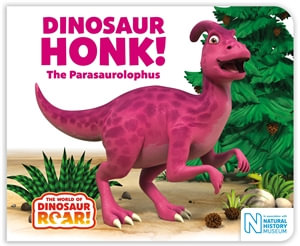
Dinosaur Honk! is another in the very popular The World of Dinosaur Roar! series and features the Parasaurolophus, a dinosaur that makes a honking sound like a goose. Dinosaur Honk loves to make a noise, waking up everyone and even making the rainforest floor shake. But sometimes she warns others of danger approaching and even uses her honk as a signal to start races between the dinosaurs.
Told as a rhyming story, Dinosaur Honk is a fun read aloud and fans of the series will recognise other characters like Dinosaur Boo, Dinosaur Whizz, Dinosaur Flap and Dinosaur Thud. Written in association with the Natural History Museum, the young reader will learn about the Parasaurolophus, especially from the double page spread at the back of the books which gives interesting facts about the dinosaur and then asks the reader to go back and find the features in the book. A helpful pronunciation guide is also given, and little children will love learning this new word. Bright and colourful illustrations are a feature of this series and Dinosaur Honk has a particularly appealing smiling face.
Another addition to a fascinating series will be eagerly read by pre-schoolers.
Themes Dinosaurs.
Pat Pledger
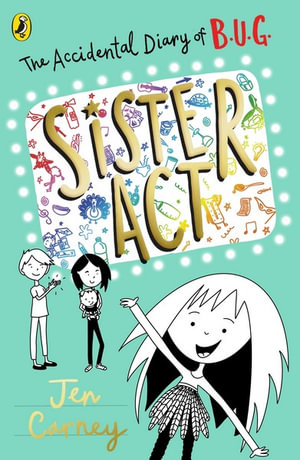
The Accidental Diary of B.U.G. Sister act by Jen Carney
The Accidental Diary of B.U.G. Sister Act is the third immensely funny diary of Billie Upton Green, written by Jen Carny. This fresh and modern book will have many readers in stitches of laughter. Written in a similar style to Tom Gates, by Liz Pichon, this novel will undoubtedly have everyone wanting to read Billie’s memoirs again and again, as they LOL!
Billie is bubbly, vivacious and a true lover of biscuits! Throw in her pure honesty and humour and she is instantly loveable. Her secret diaries share wishes, worries and words in the funniest way possible. If you haven’t read her other diaries, don’t worry because you can jump right in with this one! Right from the start you will feel like you known Billie forever. However, there are definitely no secrets to her, and at times the reader may get to know more than they actually bargained for!
Sister Act sees Billie desperately wanting her new sister to come and live with her and her two mums, but the whole process isn’t as quick as she would like! Then there is her Great Gran who didn’t even know she had an adopted sister, and of course Billie thinks she needs to meet her! All of this craziness is happening, and on top of that Billie has big ideas about the school musical, which has to be the best ever! How will Billie ever cope with waiting for her sibling, what will happen when Great Gran finally meets her unknown sister, and will Billie get to be a part of the school musical and make everyone proud?
Jen Carvey has written and illustrated a highly entertaining novel that will be loved by many. The quirky, doodle style images throughout are brilliant, and genuinely add to the hilarity of the story. This extremely fast paced ‘talk a mile a minute’ novel will keep you entertained and page turning to find out more about what Billie could possibly be thinking next. Carvey has written a highly relatable, modern and inclusive novel that will appeal to anyone who loves a great laugh.
Themes Relationships, Problem solving, Rights and Responsibilities.
As Northwind unfolds, the sheer intimacy and power of the description of the wilds of the far, far north alerts the reader to the notion that this book is written by one who knows. And so it is. Paulsen, Newbery Honour prize winner, beloved author of the Hatchet series and over 200 other books of which over 35 million copies have been sold worldwide, died recently - in October 2021. This adds poignancy to reviewing his last book.
Northwind, published early in 2022, exemplifies his finest writing. Indeed, at the age of 82, Paulsen knew how to evoke the northern natural world, the nature of life, endurance, survival and death and the workings of the heart and mind of a remarkable teenage boy called Leif. And how did Paulsen know ... the reader knows that no-one could write with such authority without experience. Young readers would benefit from researching Paulsen's life. He has lived his books. He has survived in the wild as a teenager. He has learnt to make his own clothes, build his own shelter and catch his own food. He owned a ranch in Alaska, he sailed the Pacific and he enjoyed dogsledding. He is a role model for self reliance, resourcefulness and endurance. These skills and attitudes emerge in his characters. Leif in Northwind is an inspiring example.
Set back in time, the story follows Leif, an orphan boy who has endured a cruelly, spartan life aboard sailing ships and amongst hardened men. A sinister disease kills everybody he knows, including a young boy who he tenderly tries to save. He is terribly ill himself but survives - this being the first of a number of rugged challenges that he overcomes throughout the narrative. An older sailor who had shown him kindness gives him basic tools and tells him to take a cedar canoe, go north and never look back. Thus begins an adventure that addresses starvation, living off the land and sea, battling the elements, bear attacks and many other fearsome challenges.
Written in the third person, the narrative describes Leif's journey. At times the reader is privy to Leif's thoughts which reveal a growing understanding of the purpose and nature of life and death. The writing moves with the beat of the heart; it moves powerfully in tune with the movement of the northern current and the chop of the oars. With strength and courage, Leif battles through awe-inspiring landscapes of fjords, islands, rugged coastlines, crashing waters, icebergs and ocean. A distinct feel of Norse mythology permeates his thoughts and his world. He finds solutions, he takes on terrifying challenges and as he learns he moves from being an outsider to being 'of' the place.
In an author's note at the end of the book, Paulsen explains how Northwind grew out of his own life. A captivating adventure story, Northwind needs to be placed in the hands of young people so that they can experience the wisdom, courage, fortitude combined with tender-heartedness and fine morality that flows from the pen of the outdoors man and author Gary Paulsen into his characters. Leif is the kind of role model that young people hunger for.
A highly recommended coming-of-age adventure/survival story.
Themes Survival in the northern wilderness, Norse mythology, Historical adventure, Life and death.