Amazing activists who are changing our world by Rebecca Schiller and Sophie Beer
Walker Books, 2022. ISBN: 9781406397024.
In the USA school students are walking out of school to protest the lack of gun control laws; in Australia, they walked out of school in 2021 to protest the lack of action on climate change... The names of Greta Thunberg, Malala Yousafzai, and other young activists are as well-known to them as those of their favourite singers and movie stars as the mantle of protest moves from its traditional university setting to the classroom.
But who are they inspired by? On whose shoulders do they stand?
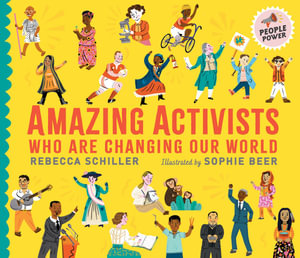
Defining an activist as one who uses their knowledge, skills and energy to make the world a better place by protecting human rights, ending prejudice and inequality and protecting the planet from harmful human activities so all its creatures are safe, this book introduces young readers to 20 people who have made a significant contribution to changing the world - some names familiar, others not-so - including Sonita Alizdeh; Rachel Carson; Favio Chavez; Mahatma Gandhi; Jane Goodall; Helen Keller; Martin Luther King Jr; Nelson Mandela; Wangari Maathai; Aditya Mukarji; Emmeline Pankhurst; Autumn Peltier; Boyan Slat; Gareth Thomas; Harriet Tubman; William Wilberforce; Ai Weiwei Emmanuel Ofosu Yeboah as well as both Yousafzai and Thunberg.
Each person has a double-page spread that includes an outline of what they have achieved, the core motivation for their actions, the particular powers that they employed, as well as a significant quote to inspire the readers to continue their work. There is also an activity suggested so that this can be done so the reader begins to realise that no one is too small to make a difference. For example, they are encouraged to build their public speaking powers so when they have something important to say they can speak out with confidence as Mahatma Gandhi did, or perhaps create something that will solve a problem as Boyan Slat did when he was confronted with an ocean of plastic rather than marine creatures on his first scuba diving trip.
Conservative, right-wing, middle-aged men in suits (and those who follow them) condemned those children who left their classrooms to protest - they should have stayed there to study and learn - yet it could be strongly argued that those same children were actually putting their learning into practice, determined to make the world a better place for themselves and others, because "there is more to life than increasing its speed" as Gandhi said. By introducing our students to those who have gone before, and those who are already forging a new path, through books such as this, Children Who Changed the World, and others, perhaps we can plant the seeds that will grow the future. Encourage each to "dream with their eyes open."
Barbara Braxton
Water by Catherine Barr and Christiane Engel
Otter-Berry, 2022. ISBN: 9781913074463.
Water is life! Freshwater bubbles, flows and floods with the most wonderful life on Earth - and all of us rely on it to stay alive. Yet, despite about 71 percent of the Earth's surface being water-covered, the oceans hold about 96.5 percent of all Earth's water, freshwater is becoming increasingly rare because of pollution and climate change. Although the recent rains and floods in eastern Australia might suggest otherwise, it is becoming more and more difficult for people and animals to find the clean freshwater they need to survive.
This book tells the story of freshwater around the world including the history of water, how the water cycle works, the different kinds of water and the amazing variety of wildlife that freshwater is home to. It investigates what happens to water because of climate change and global heating; the importance of clean water for health; the worldwide problem of water pollution and the devastating impact of water shortage on children's lives and education. Using a picture book presentation with accessible text and lively illustrations, this is designed to introduce younger readers to the need to be more thoughtful about their water use and perhaps instil lifelong habits early.
With its subtitle Protect Freshwater to Save Life on Earth, the reader is challenged to become more aware of this precious, essential resource and to take action, to use water wisely and protect freshwater to save our planet. Like so many things, thinking locally and acting personally can have a huge impact globally if we all collaborate and co-operate.
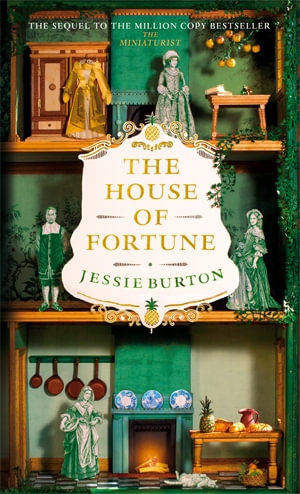
In many ways, this is a puzzling narrative. The world of one young woman in Holland is slowly revealed as her father and aunt prepare her for marriage, a marriage arranged by them with a man who demands a significant amount of money, that in fact this family do not have. Yet the marriage is deemed to be vital, and they must borrow funds to contribute to her marriage.
The world of 1705 is one that is rich with travel, music, drama and social expectations. As the family work towards a suitable marriage for Rebecca Bosman, she discovers that all is not what she would have expected in the social world into which she is plunged. In her discovery of her family secrets, and indeed their poverty, Thea is shocked, yet begins to understand the complexity of their lives and the challenges that they face. Her aunt, Nella, and her father have planned a way to address a marriage with a ‘good’ husband, and all seems to be going according to plan, until there is a discovery that shocks them.
Thea has to adjust to a situation that does not make sense, the trauma that she endures when the secret is revealed, having been kept hidden by her suitor, is one that leaves no room for recovery. Set in the distant past, we are drawn into the world where people’s actions, lives, and behaviour were so defined, with an expectation by the church that all would be done correctly and morally. Her final decision comes as a shock, when we witness her strength of character and determination to live a good life.
It is a companion to an earlier novel The miniaturist, written by Jessie Burton, and would clearly be historically fascinating for readers, as indeed it was for me. This would be suitable for adolescent readers, particularly those who would be intrigued by the social norms and expectations, particularly those imposed on women of that era.
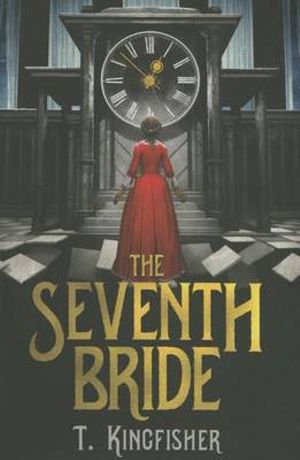
Another of Kingfisher’s inventive fairy tale retellings, The seventh bride is a new take on the classic tale, Bluebeard. Rhea is the daughter of a miller and is not interested in love or marriage so when Lord Crevan proposes she is surprised. She does not like Lord Crevan but is pressured by her parents and aunt to accept his offer. She cannot turn him down because there may be awful consequences for the family and they could lose the mill and although everyone knows there is something disturbing about the lord, Rhea goes to his enchanted castle. There she finds six previous wives all imprisoned in horrible ways. She is determined not to marry him and when he gives her magical tasks to perform, she knows she must use everything at her disposal to escape the castle and help the other wives.
Fans of fairy tale retellings will love Rhea, her fierce determination and her compassion and will be intrigued by the clever ways she manages to perform the tasks that Lord Crevan gives her. There are some moments of real horror to keep the reader breathless and others of friendship between the wives that are very moving.
Kingfisher always writes original and engrossing stories and fans like me will not be disappointed in The seventh bride and may like to try her book The Wizard's guide to defensive baking or some of Shannon Hale's wonderful retellings of fairy tales like Goose girl and Book of a thousand days.
Ducks Overboard! A true story of plstic in our oceans by Markus Motum
Walker Books, 2022. ISBN: 9781529502831.
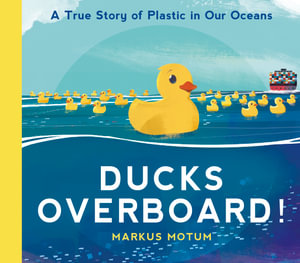
January, 1992, and far out in the Pacific Ocean in the middle of a ferocious storm, a shipping container slips silently off the deck of a cargo ship and gradually sinks to the bottom of the sea. Unlike many of these containers which sink and remain forever on the seabed, this one has been damaged by the storm and it it goes to its watery grave, it releases its cargo - thousands and thousands of plastic ducks, frogs, turtles and beavers - and they are left to travel the world's seas, taken by wind and current.
Based on true events, this innovative story tracks the journey of one of those 28 000 little ducks as it travels on ocean currents to meet sea life and discovers the rubbish from humans that endangers our oceans., highlighting the growing problem of plastic pollution. Trapped in the vast wasteland that is the Great Pacific Garbage Patch, the little duck thinks it is doomed but another storm frees it and it eventually washes up on a beach where someone is actually doing something to address the problem...
With 40% of plastic that is produced designed for single use only, and an estimated 8 000 000 tonnes of it finding its way into the oceans each year, some scientists are estimating that by 2050 there will be more plastic than fish in the ocean. While recent, and upcoming bans on the sale of single-use plastic items will hopefully contribute to diminishing these statistics, stories like these that bring the problem into the lives of our students so they are aware of it from an early age are essential. As well as explaining how the oceans' currents enable these "plastic islands" to form, there are suggestions to enable individuals to make a difference such as recycling or organising a beach cleanup, but it might also spark discussions about what could be done at the class or school level, such as a toy swap or a Nude Food Week, especially if before-after comparisons are done as part of a maths challenge.
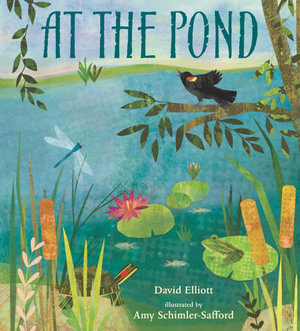
At the Pond by David Elliott and Amy Schimler-Safford
Candlewick Press, 2022. ISBN: 9781536205985.
The red-winged blackbird spreads his tail and sings his hello morning song; he has sung it since the bright and misty world began.
When the soft pink of the dawn sun starts peeking over the pond, a new day has begun for all the animals who live in it and around its watery edges. The friendly duck family, the mysterious water striders, and the busy beaver are a few of the many fascinating and familiar animals included in this glowing poetic tribute to the lively ecosystem of the pond.
Pairing poems with pictures, this is an introduction to the animals and plants that call the pond home, and while they may not all be those that young Australian readers are familiar with, it sets up the opportunity to investigate what a local pond might have and would look like. Do we even call them ponds? Or are they dams and billabongs?
This is another invitation to look more closely at the world around us, especially those parts we tend to take for granted, to extend vocabulary and writing skills to describe it in poetry or depict it in artworks, or if that isn't a strength, create a brief factual description using those included as a model.
Barbara Braxton
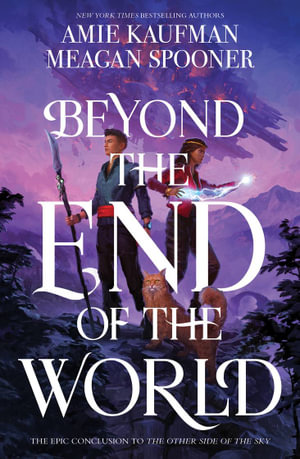
Beyond the end of the world by Amie Kaufman and Meagan Spooner
Allen & Unwin, 2022. ISBN: 9781760529581. (Age:14+) Highly recommended.
This sequel to The other side of the sky brings an end to Kaufman and Spooner’s fantasy duology in a most satisfying way. Continuing directly from the first book, the reader discovers Alciel, the city in the sky, where Nimh has been taken with Inshara. Nimh has lost her memory and Inshara is determined to wrest her power from her. Meanwhile North is determined to find a way to get back to his city in the clouds and rescue Nimh.
The story is told in two voices, that of Nimh and North, with brief passages from other characters scattered throughout the book. From Nimh we learn about the sky city, the Queen, the engineering, and way of life. From North the culture and clashes, power plays and the Fisher King are all described vividly. This dual narration ensures that the worlds of Alciel and Below, the beliefs and main characters, twists and plots all come alive as Nimh, and North try their best to understand what is going on and to save their worlds.
Kaufman and Spooner are talented story tellers who are masters of action driven plots and have a flair for writing believable scenarios that keep the reader glued to the page. The romance between Nimh and North is beautifully devised as well.
The authors have managed to blend what initially reads as a fantasy in with science fiction and it works really well to make a most satisfying conclusion. Readers who enjoy other books by these two authors are sure to enjoy this duology and may like to try books by Laini Taylor and Jay Kristoff.
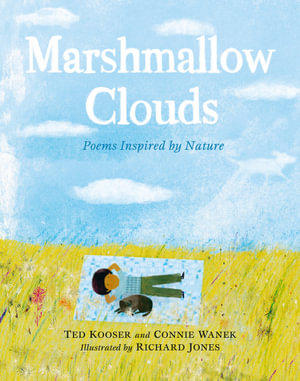
Marshmallow clouds: Poems inspired by nature by Ted Kooser & Connie Wanek
Walker Books, 2022. ISBN: 9781529507072.
There have been a number of books over the last couple of years like that have encouraged young readers to explore their immediate environment with critical, sensitive eyes to discover the detail hiding in the big picture.
But what if, as well as their senses and science brain, they also took their imagination out to play? And what they saw really did become a clown on the top of the hill, up on one leg, juggling a pie, rather than just a winter tree with a long-vacated squirrel's nest on the end of a branch?
The subtitle of the US version of this book by former US poet laureate Ted Kooser and and poet Connie Wanek is "Two Poets at Play Among Figures of Speech" and while a bit dull, nevertheless, it sums up this stunning collection of blank verse poems perfectly. By letting their imaginations out to play, and using similes and metaphors and other literary devices beloved of English teachers, a thunderstorm becomes something that has become lost in the dark of the house, not wanting to wake us but crashing into walls as they stumble about, occasionally striking a match to see their way; tadpoles become commas making them "the liveliest of all punctuation;" and a book is transformed into a sandwich with all sorts of goodness between its folded pitta covers!
Organized by the elements of Fire, Water, Air and Earth and accompanied by distinctive, sparse illustrations that interpret the words but which don't interfere with the picture created by the reader this is an intriguing anthology to dip and delve into, for letting the imagination roam free, wander, and stay healthy. So while we understand that a fire has no stomach, is "never full, never satisfied" and thus must never be set free, it is an entirely different story for our imaginations.
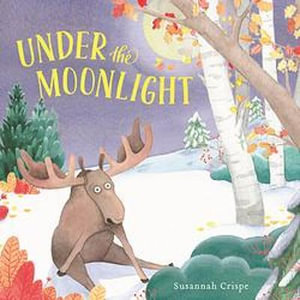
A bedtime story in verse this charming tale of a frightened moose will give hope to all who fear things that go bump in the night. Moose settles down in the snow for his night time sleep. Surrounded by the cold winter, other animals forage for their food in the snow drifts. But something disturbs moose and he wakes, a little disoriented and frightened. He spies a pack of wolves in the hill nearby, he imagines a creature lurking in the forest, a barn owl screeches over his head. He sees the bush quivering and investigating scares a rabbit. He enters a dark cave only to find a sleeping bear. He runs back to his spot in the forest and there finds a little mouse just as fearful as moose. Together they find peace and sleep through the night with each other as company.
A charming and uplifting tale of companionship, of friendship, of the power of togetherness to overcome fears and moments of anxiety, this story will have children empathising with the fearful moose and feeling relaxed as he finds a friend to share the night with.
Soft illustrations cover each page, giving a good impression of the environment in which Moose lives, and also radiating with the cold of the background. Kids will shiver reading the story and point out the many aspects which make Moose’s habitat cold. Many children will marvel at the flora and fauna spotted in the pages, adding to their knowledge of the place where Moose lives.
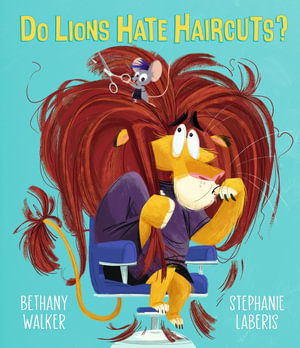
Do lions hate haircuts? by Bethany Walker and Stephanie Laberis
Walker Books, 2022. ISBN: 9781406388411.
Leonard the Lion is king of the beasts, master of the Savannah, leader of his pride and a great big baby when it's time for a haircut!
Nobody, NOBODY, can cut Leonard's hair to his liking. That is, until he meets a little mouse called Marvin. Despite his scepticism that a mouse could help a lion, Leonard gives him a try and is so impressed by the wild and whacky styles Marvin creates with his teeny-tiny comb and scissors that soon they are best buddies.
However Leonard wants Marvin to cut his hair and HIS HAIR ONLY. So when Leonard sees Marvin giving Zebra a new hairdo, Leonard is jealous and refuses to have his hair cut at all. But the folly of that plays out when he hears Marvin in trouble and he rushes to his rescue...
This is a fast-paced story that has several twists and turns, including the ending, and which will engage young readers, especially those who are not keen about getting their hair cut. Perhaps they will suffer the same fate as Leonard! Hilarious illustrations that are bright and bold really enhance the text and the creatures' faces are so expressive that discussing how each is feeling and why is a must.
Apart from a subtle message about finding friendship in unexpected places, this is a story that will be enjoyed just for the fun of it.
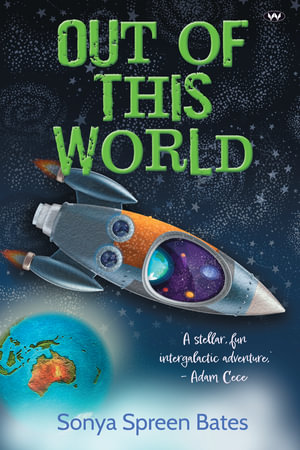
Out of this world: Star-studded haiku by Sally M. Walker and Matthew Trueman
Walker Books, 2022. ISBN: 9781536203561.
one minuscule speck grows into the universe a mind-boggling birth
Defined as a traditional Japanese three-line poem with seventeen syllables, written in a 5/7/5 syllable count which often focuses on images from nature, haiku emphasises simplicity, intensity, and directness of expression making it an effective way to get students to focus on the essence of an object and then use succinct, descriptive vocabulary to portray it so every word has to work hard.
In this stunning union of poetry, art and science, haiku is used to explore the universe through a lunar eclipse, beyond the orbiting planets, and into glowing galaxies and twinkling constellations out to Ultima Thule, the most extreme limit of the journey which "longs for a visitor with coal and a carrot", and all accompanied by the most imaginative illustrations that are almost photo-like so that not only does the reader learn about the vast beauty of space but they are left in wonder and awe of its magnificence. The minimal text structure of haiku means just the nucleus of the phenomenon is offered as a teaser, leaving the reader with a tempting taste to learn more...
the Eagle landed one giant leap for mankind footprints in the dust
Some of this is offered in the comprehensive, well-researched final pages which explore such topics as constellations and astronomers, the birth of the universe, stars, the solar system, moons and eclipses, asteroids, meteors, and comets, but the whole offers an opportunity for students to engage in their own interest-driven investigation with the challenge of summarising their findings in their own haiku and artwork.
Barbara Braxton
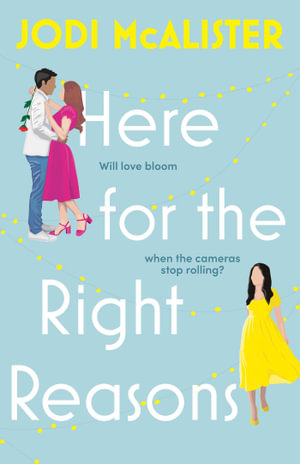
Here for the right reasons by Jodi McAlister
Simon & Schuster, 2022. ISBN: 9781761104961. (Age:Adult) Recommended.
As a fan of the YA Valentine series by Jodi McAlister I was keen to read an adult novel by her and I was not disappointed. The setting of a TV show, Marry Me, Juliet, is sure to engage anyone who is a fan of the TV show Bachelor, while people like me who do not watch reality TV will enjoy learning about how such shows are set up and filmed. Cece James and Olympic gold medallist Dylan Jayasinghe Mellor are both characters that readers can emphasise with. Cece has been brought up in foster homes and has trouble believing anyone can stay with her, while Dylan is plagued with anxiety attacks. Both have their own reasons for being on the show – Cece is an unemployed student and really needs the money, while Dylan wants to promote his men’s mental health charity. When Cece gets eliminated on the first night of the show, she thinks that everything is over for her, but the director of the show is persuaded to film a developing friendship between Dylan and Cece.
The other Juliets on the show are all accomplished and clever women and could become Juliet to Dylan’s Romeo and tension is built up amongst them. The global pandemic and lockdowns also mean that the women must stay in a bubble, and this gives McAlister the opportunity for the reader to get to know many of them.
This is a feel-good romantic comedy with some great dialogue. It is enjoyable to read about the antics of the Juliets to win over Romeo while the slow growth of friendship and attraction between Cece and Dylan is a delight to read.
Themes Romantic comedy, Love, Anxiety.
Pat Pledger
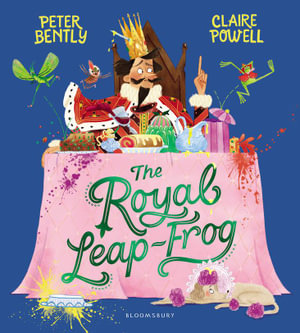
The royal leap-frog by Peter Bently and Claire Powell
Bloomsbury, 2022. ISBN: 9781408860113.
Peter Bently (The Great Dog Bottom Swap) has written a rollicking story that is great fun to read aloud. Claire Powell's illustrations are exuberant, brimming with personality-filled characters and intricate and amusing details. Her work is similar in style to that of Alex T. Smith (Mr Penguin series, The Adventures of Egg-Box Dragon). This is the pair's second retelling of a Hans Christian Andersen story (The King's Birthday Suit based on The Emperor's New Clothes is also available).
The Royal Leap-Frog is a witty take on the classic tale The Leaping Match, telling the story of a flea and a grasshopper who head to the castle to get the King to decide who can jump the highest. When a frog decides to join them they aren't enthused but they also don't feel threatened. 'Fine,' said the grasshopper. 'Sure,' said the flea. 'But you don't stand a chance. And the frog thought, We'll see!'. The competition itself is a domino effect of chaos: there's food being flung, fleas in collars and a flurry of pepper sneezes. The King and his people are completely underwhelmed by the whole messy affair. Can the frog impress him with smart thinking and be declared the winner?
The colourful, patterned Elizabethan dress worn by the royals as well as the outfits of the bugs are delightful, while the frog is clearly part of the bourgeoisie, with his raggedy buttoned shirt and necktie. Children will be ensconced in these vibrant pages and the fun story they tell. The takeaway message is that it is more effective to gain admiration by appealing to one's sense of self, rather than with your own prowess, but perhaps it would have been nice if the story was modernised slightly more (do we really need to be talking about the King being 'higher' than everyone else? And having princesses kissing frogs in the hope of finding a prince?).
Themes Fables, Rhyming Stories, Humorous Stories.
Nicole Nelson
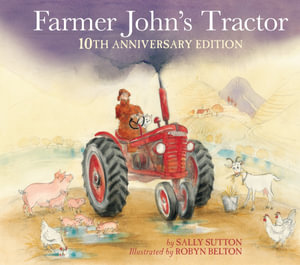
Farmer John's tractor by Sally Sutton. Illus. by Robyn Belton
An orangey-red old tractors sits in a shed, seemingly rusting and unused, until there is a flood. A car with two little girls gets stuck in the rising floodwaters. The jeep that tries to rescue them rolls on its side; a tow truck gets stuck and the fire-engine slams to a halt on a slip. Then Farmer John comes up with an idea. Unlocking the door to the shed, he brings the trusty tractor to the rescue.
Teachers doing a unit with young children about disasters and in particular floods, will find this beautiful picture book very useful. The illustrations in watercolours by Robyn Belton bring the wet weather to life. The swirling murky waters of the flooding river, the brown mud and the oppressive sky tell vividly what can happen during a flood. The oppressive atmosphere is lightened with humorous touches like the chickens nesting on the tractor and the little dog following the farmer around. There is a plethora of detail in each of the pictures for inquisitive children to pore over and talk about.
The story of the tractor, which is rusty but trusty, will appeal to young children as will the rhyming language that makes it a good read aloud. The fact that this is the 10th anniversary of Farmer John's tractor is testament to its lasting appeal.
Themes Tractors, Floods, Tractors, Weather.
Pat Pledger
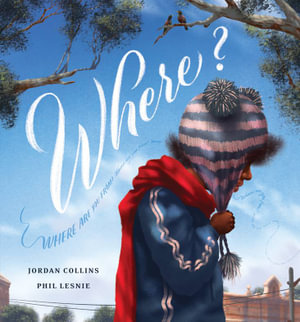
Where? by Jordan Collins and Phil Lesnie
Allen & Unwin, 2022. ISBN: 9781760526382. (Age:8+) Recommended.
Author Jordan Collins identifies as African-American-Greek-Australian and dark skin and curly hair mean that people are always asking 'Where are you from?'. This book, based on a slam poem Collins wrote as a young teen, is a direct response to that question. It asserts that we are all products of this solar system and this planet that we share. It celebrates our sameness and our shared humanity and ancestors. 'I'm from the interiors of collapsing stars, From the explosion that made the big bang and the iridescent glow of a nebula'. The language used by Collins, and Lesnie's (Feathers) illustrations, are atmospheric and remind us how tiny and insignificant we are compared to the vastness of this world and its origins. 'I came from the same ancestor as you, The primate who decided to walk upon two legs for the first time'. It's a lesson in perspective and significance. It's about focussing on the big questions and looking at the big picture. For many people the question 'Where do you come from?' is a complex one and there is no easy way to answer. Collins says in a note at the back of the book that this was written to give hope to other kids and let them know they aren't alone in feeling othered, but it also gives those same kids a way to answer the question as well as hopefully showing everyone why it's not a welcome or meaningful way to get to know someone. As Phil Leslie's note says 'Instead, ask me what I'm reading at the moment. You'll see my face light up. That's where I'm really from.' This is a powerful book with an overt yet important message.