Hezekiah Johnson is in his senior year at Cedar Regional High in Poconos, Pennsylvania. He is popular at school and is hoping to win a sports scholarship to his dad’s old college. Kai’s parents died nine years ago, he has regular therapy sessions with a youth social worker Dr Reuben and he lives with his Aunt and Uncle. From being sad and anxious, easily lashing out in anger, he has been able to turn his life around through hard work and sport. His best friend is Jamal and he has had a string of girlfriends, searching for the ideal loving relationship he believes his parents had. Zyla Matthews, petite, quiet also 17, attends St Catherines and lives with her needy and unreliable mother, maths whiz younger sister and Aunt Ida. Zyla is passionate about fashion and wants to win a scholarship to a Paris fashion college so has no time for relationships, spending every spare minute working on her portfolio. She doesn’t want to waste time focussing on disappointing relationships like her mother and Aunt Ida do. Her best friend Beatrice is from a rich family and they have a strong and supportive friendship. Kai and Zyla both have summer jobs at a local amusement park and when Kai’s toxic girlfriend gets him into trouble at work they find themselves attending the same amusement booth and become unlikely friends. After bonding over an incident with an aggressive customer the two start a relationship. Idealistic Kai falls head over heels for Zyla while she can’t quite believe she is succumbing to his charms and is wary about being just another conquest. As they navigate the pressures of school, family and their career aspirations with their differing ideas about what love is and how their relationship might endure the inevitable obstacles and doubts it becomes apparent that being in love is not in itself enough.
The timeline switches backwards and forwards between the start of their relationship the previous summer and the Seniors’ day trip in May and the point of view alternates between the two main characters and, later in the book, from others. The characters are well developed and the friendships and other relationships are well imagined, especially Kai’s therapist, an excellent advocacy for mental health support. But this is essentially a story about all consuming teenage love, not a mystery and it doesn’t pretend to have all the answers. I would have liked more detail about the main characters’ career aspirations. We learn that Zyla’s portfolio theme was “something to do with the beauty and versatility of Black women and how that played into fashion” on page 47 but after that there is not much and we learn nothing about Kai’s scholarship pathway. The plot is a bit thin and over the nearly 500 pages it ebbs and flows with some irritating repetitive parts but it will appeal to readers of Kristina Forest’s other young adult romances.
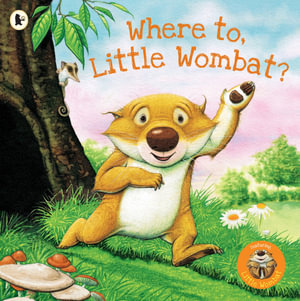
While mum cleans out the burrow, Little Wombat thinks about a different sort of home. He is sick of living in a burrow and Mum sends hm off to find somewhere new. He tries to climb up the tree and join Koala, but does not have the claws to climb and ends up back on the ground. He tries to join Frog on his lily pad but ends up in the pond. He sees Mole and Mole invites him in but wombats are much bigger than moles.
He looks at the turtle and the ants under a rock, but each time the place is simply not suitable for him. Finally the ants tell him of a nice comfortable nest nearby. He goes to try it out, snuggling down with some very large eggs already there. Children will laugh uproariously as the owner of the nest comes home to see Little Wombat off.
Little Wombat scurries back home to his nice clean burrow and mum tells him to invite all of his friends around for a sleepover.
A lovely story of being satisfied with what you have, of the grass on the other side of the fence not always being greener, of envy and wanting what someone else has, will delight all readers as they recognise the forces that make us all sometimes dissatisfied with our lot. Little Wombat is sure there is another home somewhere better than the one he has. In going on his trip, he realises that his home is the best, it is suited for his needs, while other homes require different characteristics which he does not have. Readers will love seeing how each home suits the occupant, and call out when Little Wombat tries out another home, only to find that he does not fit in some way. Readers will easily spot the way a home fits certain animals, building up their knowledge of Australian animals and their habitats. Watercolour illustrations ensure children recognise the environment each animal lives in, while the human characteristics blend well with the attributes that each animal presents.
First published in 2006, this adds to the array of books which present an issue to be discussed in class or at home.
Themes Envy, Compassion, Australian animals.
Fran Knight
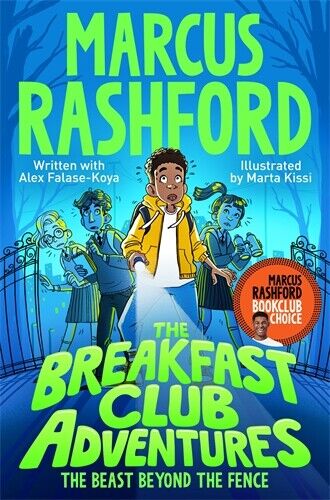
The Breakfast Club Adventures by Marcus Rashford with Alex Falase-Koya
Marcus Rashford is a football star who plays for Manchester United and England. He is passionate about eradicating child food-poverty and increasing children's literacy and access to books. This novel has been released as part of Marcus Rashford's Book Club - a program in collaboration with Macmillan Children's Books, where Rashford chooses two books a year that are made accessible to under-privileged and vulnerable children aged 8-12 across the UK. This is the first book in the Book Club to have been co-written by Rashford himself.
The story starts at breakfast club. Breakfast club is the supervised time before school where children are provided with something to eat along with the time to finish homework, catch up with friends or just relax before the school day starts. This is the perfect opportunity for kids to make new friends .. or start solving mysteries!
Twelve year old Marcus has lost his prized football over the school fence. He is resigned to never seeing it again until he receives a curious invitation to join the Breakfast Club Investigators (BCI).
This kicks off (pun intended!) a whirlwind of adventure and mystery, while testing boundaries and exploring friendships. Marcus gets to know the other members of the BCI, expanding and challenging his pre-conceived ideas of them being just 'the new girl', 'the popular girl' and 'the arty loner'. He learns they have all lost things and they all need help.
Their investigations challenge the BCI to face fears, think creatively and work together. There's a sub-plot regarding Marcus's relationship with his cousin and, after a falling out with the BCI, she helps him sort out his feelings by offering wisdom from a slightly older perspective.
This book is very appealing to middle grade readers - it centres on the relationships and issues they face in real life, and has a variety of diverse characters as well as engaging fonts and illustrations. The mysteries are all neatly solved in the end (including a few surprise twists) and the heart-warming lessons learnt are delivered with fun.
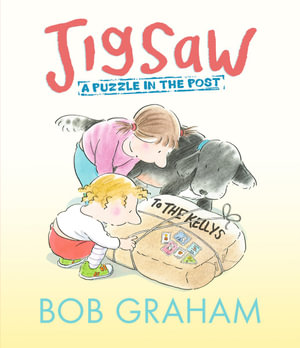
The Kelly family on the front cover is opening a large parcel. Mum, Kitty and their dog are all intrigued, as is the reader. The parcel is covered with stamps and an anonymous note inside wishes them luck. Dad and the girls unpack the jigsaw revealing the pieces for an African sunrise and they set to it. Dad sets his watch for late Autumn and they complete the edges by Winter. The girls play outside in Spring and Summer, while Dad works on. With Autumn coming closer they sort out all the colours, but they realise that the hippo’s shorts are missing. The missing jigsaw piece becomes a quest as they rack their brains for what may have happened to it. Mum recalls a piece that may have fallen to the floor and may have been swept into the bin. So the family goes to the rubbish centre. Here they are faced with a mountain of paper rubbish: old letters, notes, photographs and shopping lists to train tickets and newspapers from long ago. Every now and again a breeze lifts them all from the ground and settles them back down again, making their task even harder. The task seems overwhelming. They sadly go back home their hopes faded, where the missing piece falls from Dad’s shoe. The jigsaw is finished. Has it been luck or determination that has found the missing piece? Whatever has happened, the sun now comes up ‘out of Africa';. Kitty decides to write a thank you letter to the unknown sender and another problem needs to be solved by the family.
This book radiates love and family, hope and determination which will warm the hearts of younger readers who will view their own families with the same care and attention.
Graham infuses his characters with a universal humanity. Mum, Dad, the children and the dog could be any of us. His families are always inspiring as they work together on a problem, promoting hope, radiating love and a togetherness we all aspire to emulate.
His distinctive pen and watercolour illustrations create a world we look into, looking from above or below, each piece of the picture has a meaning and resonance with the readers, eager for the details shown on each page. Sometimes the page has a simple drawing on it, with no words or detail, sometimes an image covers both pages, sometimes there are several panels, but whatever the page offers, it is worth a second look and often readers will ask questions. How many teachers or parents will need to discuss a jigsaw, or postage or stamps or writing a letter, a post box, or recycling? Issues rise out of his work with a quiet insistence, the background to his stories often promising discussions on a different level. Activities are available in Walker Books Storytime kit.
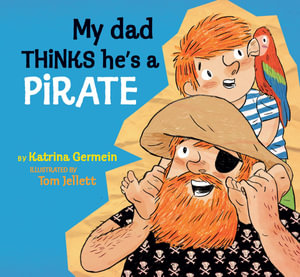
Another book in the My Dad thinks series (My dad thinks he's funny and My dad thinks he's super funny) will delight fans as this time Dad thinks he is a pirate. The family are off to the beach and Dad can’t resist his corny jokes. Wordplays and jokes like ‘Here’s our ship. I bought it on sail’’ and ‘The sea is so friendly. It always waves’ are strewn throughout the narrative with the refrain, ‘My dad thinks he’s a pirate’ popping up at the end of each double page spread.
It is fun to read aloud, and children who are independent readers will appreciate the play on words, sure to bring giggles as well as some groans. It is easy to relate to the story as many readers will know a relative or friend who delights in the sorts of jokes and wordplay that is found in the My dad thinks books.
The illustrations of dad with his ginger beard, shirt with skull and cross bones on it, and hairy legs are hilarious, and the pictures add another dimension of humour to the jokes.
My review copy came complete with a black eye patch, and I know my son and grandson are going to have great fun with this book. It is sure to leave the reader happy and will be a hit with its audience. A great gift for Dad for Father’s Day or for a laugh anytime.
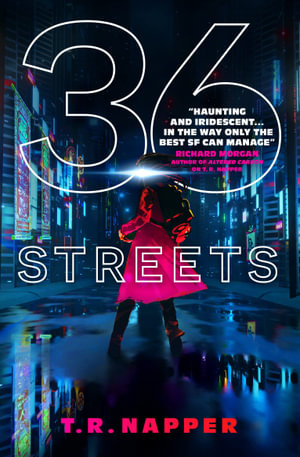
Cyberpunk is a form of science fiction that features high tech and futuristic themes along with dystopia and a dark underworld. An example of an early film in the genre is Ridley Scott’s ‘Blade Runner’. In interviews T. J. Napper refers to that film as a strong influence on his writing. 36 streets is set in a future Chinese-occupied Vietnam. Lin Thi Vu has been honed by her gangster uncle Bao to become a formidable fighting force sent out on assassin missions. In a new assignment, she becomes involved in a conspiracy built around a video game, Fat Victory, an immersive simulation of the American/Vietnam war that meshes the virtual with personal memory.
The novel is gritty with dramatic action scenes that see Lin brutally crushed, yet rise again and again, determined to defeat the forces ranged against her and take her revenge. It is a world of danger, deception, illusion and violence, and the costs to Lin are formidable.
The scenes set in the old world ‘36 streets’ of Hanoi are vivid; the underside of the city is alive, and reflects the in-depth knowledge Napper gained whilst working as an aid worker in Southeast Asia. This grounding provides authenticity to the virtual world of the future that the author creates. It is a mix of old Hanoi and the cyber world of video games, a world of super strength combatants, illusion and deceptive manipulation. However, this book, because of its violence, is not for all readers.
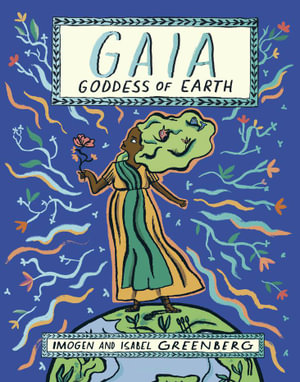
Gaia Goddess of Earth is an entertaining and enjoyable read. Written in very much a feminist mode, this complex and detailed story of Gaia, the Greek Goddess of the Earth, is simplified and told with both humour and serious intent. Gaia created the Earth in all its beauty, free from danger and trouble. However, her husband Ouranos, her son Cronus, and grandson Zeus all had other ideas. Their incredible greed and all-encompassing need for power meant that the Earth was subjected to famine, flood, war and destruction. Familial wars were fought between parent and child, siblings versus siblings with the mere mortals being caught up in the turmoil. It was a devastating time for Gaia. There is hope though, and Gaia does eventually achieve the peace she so deserves for her precious Earth. There is also a story within a story in this tale: the Earth needs to be no longer misused but cared for by all people. After all Gaia created only one Earth.
The gorgeous cover and stunning illustrations will appeal to all readers. The graphic novel-style format is a clever way to introduce children to ancient myths and legends and will be a popular read in a school or public library.
Themes Greek Goddesses, Graphic Novel Format, Myths & Legends, Ancient Gods, Environmental Issues.
This young adult book tells the story of a young girl who escapes her abusive father to find her missing sister. In 1890’s Chicago it is hard for a young girl to be listened to by men.
Zuretta is determined to find her sister Ruby who has disappeared. Everyone keeps telling her that she has just run off and forgotten her, but Zuretta refuses to believe it and is determined to find out what happened to Ruby. She learns very quickly that not everyone is who they seem, and it is important to be careful who you trust. Zuretta does, however, find someone to help her with her search for her sister.
The mysterious Castle where she finds herself working appears to have lots of secrets, mysterious rooms and doors that go nowhere.
Eash chapter starts with a note from the killer, and this adds to the intrigue as you try and work out who it is. The suspense in this book it well written and keeps you guessing right to the end, with several twists that are unexpected.
This is a well written book that draws the reader in.
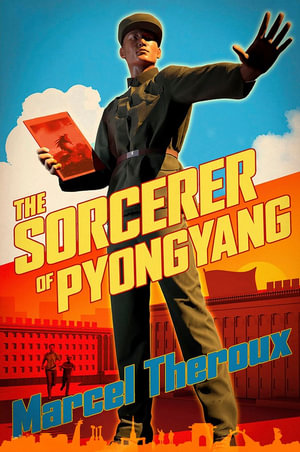
Through the twists of chance, a young boy in North Korea, 1991, comes into the possession of a strange book left behind by a rare visitor to the country, a book whose cover depicts a giant red troll abducting a near naked woman. It is the ‘Dungeon Masters Guide’, the core rule book for the game of Dungeons and Dragons. The images within the comic frames arouse Jun-su’s curiosity, and he determines to learn English in order to understand it better. Thus starts a journey that will lead him to the glory of recognition as a linguist and poet by the Supreme Leader, and then to the downfall of imprisonment and torture. The book changes Jun-su’s life in ways that he could never have predicted.
Theroux has actually been to North Korea as part of a strictly supervised tour by a delegation of journalists, with the climax of the visit, the Mass Games celebration of the country’s 70th birthday. In his video he comments on how he was never sure whether what he was seeing was real or just for show. In Theroux’ novel The sorcerer of Pyongyang, Jun-su has been brought up with the myths that glorify the Great Leader Kim Il-Sung, and Dear Leader Kim Jong-Il. People ascribe to the propaganda and live in fear of ever being caught out as irreverent or unfaithful. Behind the façade of the happy dedicated Korean life is fear of being arrested and sent to labour camps. The guide book to Dungeons and Dragons also introduces a fantasy world but it is one where the game players can choose their own adventure, undertake heroic deeds and slay monsters. It fascinates Jun-su; he and a core group of friends enjoy exploring the game. However, as one astute student points out, Jun-su appropriates the role of mastermind coordinator of the challenges.
In the Korean world controlled by the Supreme Leader there is no freedom, no adventure. Instead there is an ever-pervasive fear of false allegation, betrayal and disappearance. The fear is overwhelming; no one is immune to coercion, not even a mother or a lover. Betrayal leads to nine years imprisonment for Jun-su, with torture and labouring in a re-education camp.
Theroux has based his novel on stories collected from refugees who have managed somehow to escape from North Korea. That, combined with his own experience of visiting the country, provides a compelling insight into the totalitarian state, its mix of subservience and fear, and the power of propaganda. The sorcerer of Pyongyang combines aspects of fantasy, romance and thriller; at the same time providing insight into the reality of life for people in a very different, highly secretive society.
Themes North Korea, Totalitarian state, Fantasy, Propaganda, Surveillance, Fear.
Helen Eddy
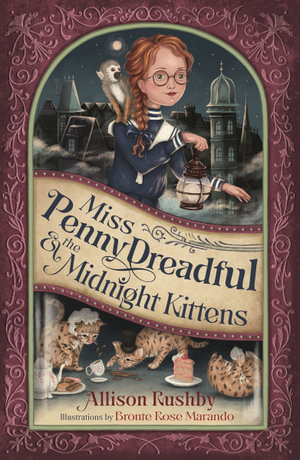
Miss Penny Dreadful & the Midnight Kittens by Allison Rushby. Illus. by Bronte Rose Marando
Nabbed again for drawing images of her teachers in her notebook, Penny is summoned to the Head Mistress’s office where she is met by her Aunt Harriet an adventuress and author, and her companions, a squirrel monkey called Jones and a strange spider-limbed man called Mr Crowley. They face the dreaded Miss Pugh and Harriet simply asks Penny if she likes the school. The decisive answer causes Harriet to extract Penny from the terrible school, taking her on the road to adventure. The first of these involves a group of kittens who come to life at midnight in Mr Toddington’s Museum, a collection of the strange and macabre. Penny and Harriet wait at midnight to catch a glimpse of the supposed bewitched kittens after seeing them during the day, a group of neatly arranged stuffed animals. But at midnight they indeed do come alive, cavorting in their display case, playing with each other. But Penny recalls her teacher’s mantra, use your logic, do not believe everything you see. And in looking more closely she helps to uncover a fraud.
Finding a sobbing girl in the stables early that morning, she spies the live kittens, about to be taken by a taxidermist because they have grown too big to be in the display. While Aunt Harriet is busy writing her next instalment, Penny takes charge, wanting to expose the fraud and save the girl from further sadness. She takes Lucy to see Lord Linkford who she met yesterday explaining loudly about the beauty of the stuffed animal museum and they strike a deal. The deal satisfies them all, except perhaps Mr Crawley and his associates.
A marvellous adventure story, steeped in the curious, will appeal to a wide audience, wanting sharp characterisation and an involved, winning, well told plot. And the first in a series adds to the thrill.
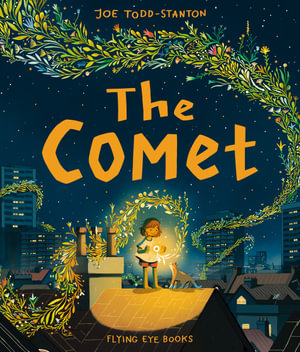
What a delightful book! Ultimately uplifting The comet traces the life of Nyla from the time when she sees stars and a comet in the sky above her country home, through a time of change when she must move to the city as her father has a new job, to when the apartment she lives in eventually becomes a home that the family loves.
Nyla is very unhappy in her new apartment in the city. Her father is very busy with his new job and does not have the time to spend with her that he had in the country. She can only see seven stars in the sky ‘and there are no sounds of waves to fall asleep to.’ One night she sees a comet falling to earth and a magical tree sprouts out of the light. Here the illustrations take over and the reader sees the most wonderful plants and flowers weaving through the sky. Then all is revealed – Nyla has painted the walls and floors and boxes in the room. At first Dad does not see that it is a comet but something magical starts to grow and the whole family turns the apartment into a home.
The illustrations beg to be examined again and again, as there are so many details to look at. I loved the double page spread turned sideways to show all the different families living in the building and the final endpapers show how happy Nyla has become in her new home. The love between Nyla and her father is heart-warming and is a standout in the book.
Joe Todd-Stanton tackles the difficulties of moving house and managing change for Nyla in a very relatable way, the narrative flowing smoothly when read aloud. The comet is picture book that could become a firm favourite at home and in a library.
Themes Moving house, Change, Comets.
Pat Pledger
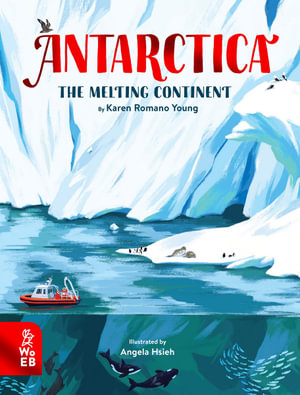
Antarctica The Melting Continent by Karen Romano Young and Angela Hsieh
What On Earth Books, 2022. ISBN: 9781913750534. (Age:10+)
Antarctica is one of the most isolated and harshest environments on the planet, often referred to as "the final frontier".
From her harbourside home in the very south of the South Island of New Zealand, as a young girl in the 1930s my mum would watch the ships head southwards to the ice, literally the next stop after they left the safety of the port of Bluff. And she began to dream. In 1968, after years of dedication and hard work, she broke the "petticoat ban" and she too, joined those sailing south from Bluff - on a converted fishing trawler that was the precursor to the luxury liners of today, as Lars-Eric Lindblad pioneered Antarctic tourism and she became the first female journalist to go south.
The Magga Dan tied up at McMurdo Sound, 1968.
Fifty+ years on and it is so different - or at least the getting there is, and the presence of women is no longer a novelty and the issue of where they might go to the toilet no longer a primary barrier!
Today, in the southern summer, tourist trips leave regularly for the ice, although most often it is via South America to the Antarctic Peninsula as the crossing of the Drake Passage is usually only about two days while scientists are there all year round and women work alongside the men. So, this new book provides an up-to-date view of this isolated continent in a narrative that draws on the author's own experiences as well as extensive research and interviews with scientists, combining a unique personal perspective with up-to-date information about the land and its inhabitants, the investigations being undertaken and the discoveries being made such as studying climate change to investigating ice cores almost a million years old to learn about the history - and future - of our planet. There is still so much to learn and do and the book's scope offers many opportunities for students' interest-driven investigations.
While most of its readers probably won't have the wherewithal to afford a trip on one of the many ships that have made it a bucket-list destination, perhaps this book will inspire them to take another route under the Australian Antarctic program and dare to dream - just as my mum did all those years ago! For that truly was "Dreaming with eyes open..."
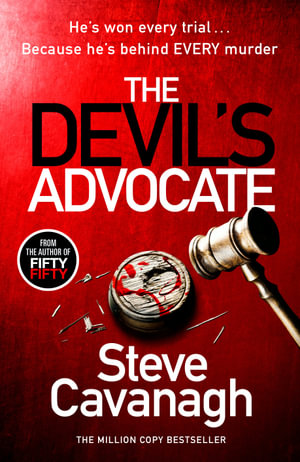
When a young woman, Skylar Edwards, is found murdered in Buckstown, Alabama, a corrupt sheriff arrests the last person to see her alive, Andy Dubois. It doesn't seem to matter to anyone that Andy is innocent. What starts off as a case of trying to get an innocent young man off of death row, turns into a much bigger and more dangerous problem than any of them had imagined.
The style in which this book is written with each chapter being written from a different characters point of view, makes for great reading. The chapters are written to reflect the different characters personalities adding extra depth to the story. it also added extra levels that keeps the reader guessing as to what is going to happen next. There were a couple of times during this book where I was convinced I knew what was going to happen next and then the story took a twist and something unexpected occurred. This is a very well written story that draws the reader in and keeps you hanging on right to the end.
This story showed how someone in power can use their power to manipulate the system to get the end they desire, even if it is wrong.
The manipulative lengths the district attorney Randal Korn went to, too achieve his goal was impressive, he was determined to let nobody get in his way, he didn’t care who he had to take out to achieve his end goal as long as he achieved his goal. All he wanted was to send someone to the death penalty.
The main characters in this book have their own unique personalities that show through adding further depth to the story. They each have their own stories that show through as they deal with the situation that is presented to them.
A very talented writer.
I highly recommend this book.
Themes Murder.
Karen Colliver
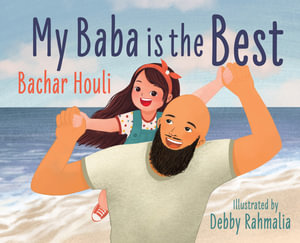
My Baba is the best by Bachar Houli. Illus. by Debby Rahmalia
A wonderful story about the strong relationship between a father and his daughters is presented by former AFL player, Bachar Houli. The young girl tells us about what she does with her father: a strong, bearded man who loves to be always active and doing something. He gives the best hugs, and the three are often in their backyard, keeping fit, the young girl trailing him with her bicycle as he runs. He takes the girls fishing, one of his favourite leisure activities. She has her own rod and needs help in reeling in the fish. The family sometimes go to the movies, but even better is staying home to watch a film together with a large bucket of butter popcorn. At night Baba comes into their room to pray with them as they go to bed, asking for protection while they sleep. Excitement is in the air as they prepare to go camping, the young girl writing a list of what they need to take. On the way she feels carsick and so must sit in the front seat with Baba! Once there, they put up their tent and prepare wood for the evening fire, making sure they each have a good stick on which to toast the marshmallows.
Each activity is shown as a collaborative effort within the family, underlining its strength and durability, recognising the special bond between fathers and daughters.
At night they play card games with the help of their head torches, and go to bed watching a kangaroo that comes to inspect their campsite.
A loving look at the father-daughter bond just in time for Father’s Day in September, is a delight. Smiling happy faces beam out from every page as they do so many thing together. Kids will love recognising the things they do with their fathers, and tell stories of what makes their father the best.
Indonesian artist, Debby Rahmalia gives a wonderful authenticity to the portrayal of a Muslim family, with the visit to the mosque, their participation in Eid after Ramadan, their visits to relatives after Friday prayers and the family prayers at night. Readers will be eager to find out the meanings of some of the unfamiliar words which dot the story, but finding that the family presented is not that much different from their own.
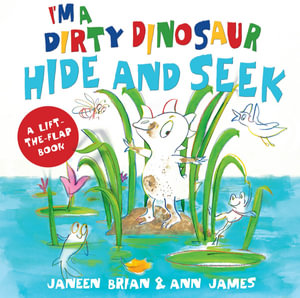
Fans of I’m a dirty dinosaur and I’m a hungry dinosaur will be immediately attracted to another story about the little dirty dinosaur, this time aimed at the very young in a lift-the-flap, sturdy board book format. The dirty dinosaur is looking for his friends, Bird, Bee, Frog and Fish, and little fingers must lift the flaps to see if they are hiding behind them. Each double page spread has two flaps, one with the dirty dinosaur’s friend hiding behind it and another with the words 'Not here!' The repetition of 'Not here!' will be enjoyed by children who will love to call it out and useful for beginning readers.
The rhyming story makes the book lovely to read aloud. Children’s vocabulary will be enhanced while gaining vivid images of the dirty dinosaur’s friends from phrases like this:
Where is Fish? Quick and slippery. Silver tail flippery.
Ann James’ illustrations are very appealing. The little dinosaur, with his cute face, cheeky grin and wide eyes prances through trees and flowers, stops by a pond strewn with water lilies and finally can be found making a huge splash on the final page. The soft pastel drawings are outlined with black crayon and minute details like little dragonflies and snails crawling up reeds will intrigue readers.
This is a lovely activity book that will intrigue and interest little children.
Themes Humour, Dinosaurs, Hide and seek, Read aloud.