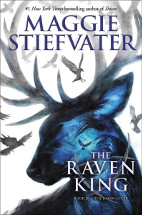
The Raven Cycle bk 4. Scholastic Press, 2016. ISBN
9780545424981
(Age: 15+) Highly recommended. The fabulous Raven Cycle
comes to a very satisfying conclusion in The Raven King.
Gansey's quest to find Glendower, the ancient Welsh king is
overshadowed by the fear that he will die, and probably from a kiss
that Blue Sargent gives him. The other Raven boys, Ronan, Adam and
Noah have all been drawn into his quest, and each has to find a path
through the magical dreams, tall forests of Cabeswater, predictions
from the women in 300 Fox Way and an assortment of villains out to
grasp the magic power that comes along the ley line.
Stiefvater manages to juggle numerous plot lines and many characters
in this novel with her masterful writing. Chapters begin with the
phrase ("Depending on where you began the story, it was about . . .
") and this gives a different perspective to where the story is
going and more information about the key players. The introduction
of Henry, as a new and trusted friend who plays an important part in
defining what happens to Gansey is handled brilliantly as is the
strange and frightening power of the demon who is trying to unmake
them all.
This is not an easy read, but it is a fascinating one that is very
difficult to put down. Fans of the fantasy genre will love it and I
wish I had the time to start at the beginning again and read through
all four books in this complex, imaginative and unpredictable
series.
Pat Pledger
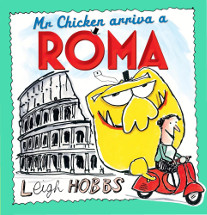
Mr Chicken arriva a Roma by Leigh Hobbs
Allen & Unwin, 2016. ISBN 9781925266771
(Age: 4+) Highly recommended. Travel. Rome. Tourism. After his
successful trips to Paris and London, Mr Chicken now heads for Rome.
As a child he had always been interested in Ancient Rome, and now
learning the language from his beginner's book of Italian, means to
see as much as he can. He has written a list of the sights he wishes
to see, including the Colosseum, the Vatican, the Forum and the
Spanish Steps, and he also wishes to meet some real Romans. On the
first endpaper is his list alongside many images of the places he
wishes to see and a list of words he has learnt. For readers the
first endpaper introduces them to Rome before Mr Chicken takes to
the air.
Business Class suits him with its superior food and greater leg
room, although his neighbour still looks uncomfortable. Landing he
is met by his guide, Federica, who takes him to her Vespa to tour the
city. His day in Rome is eventful as he sees all the sights he has
dreamed about as a child, but then when Federica leaves him at the
Mouth of Truth he falls into a deep sleep and dreams that he is back
in Ancient Rome. Here he finds his face on all the coins, and
statues of him are placed around the city, but when he lands in the
Colosseum, facing a ferocious lion, they both run from the other.
Federica returns, waking him and taking him for his big surprise,
dinner with her family. He gets to meet some real Romans just
as he dreamed.
Throughout the story Mr Chicken tastes a range of food, particularly
gelato and pasta and readers will laugh out loud at his efforts to
steal other people's icecream.
The wonderfully funny illustrations of Mr Chicken on the Vespa, and
stealing a lick of others' gelato, will enthrall younger readers.
And they will learn a few Italian words along the way.
Fran Knight
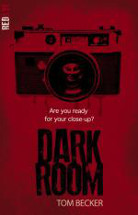
Dark room by Tom Becker
Red Eye series. Stripes Publishing, 2015. ISBN 9781847154576
(Age: 14+) Horror. Warning on back cover: Not for younger readers.
Darla hopes that she will have a new life when she and her alcoholic
father move to Saffron Hills. But life is not easy at the local high
school where the students are obsessed with beauty and image. Then
Darla begins to have terrifying visions of people being murdered. It
seems that there is a serial killer on the loose. Nicknamed the
Selfie Slayer, the killer likes to display the selfies and other
pictures of his victims.
This has all the hallmarks of an engrossing if gory, read for teens
- a girl who can see into the future, a serial killer who takes
photos, gorgeous girls and handsome boys and many red herrings
leaving false trails about the identity of the killer. Graphic
descriptions of the murders are not for the faint-hearted, but the
suspense keeps the reader on the edge of the seat until the mostly
surprise conclusion - although there were a few clues tossed about
on the way.
Darla and her father are well fleshed out as characters, and the
supporting cast of Sasha and her sidekick Frank are interesting
characters, but the action and suspense as Darla's visions become
gruesome reality are the most important and vivid aspects of Dark
room.
This is a story that may appeal to reluctant readers as well as to
fans of the horror genre since the narrative makes for a relatively
easy but scary read. The use of social media, cyberbullying, and
selfies make it relevant and contemporary as well.
Pat Pledger
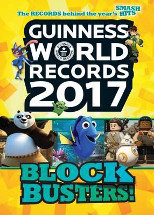
Guinness World Records 2017
Guinness World Records, 2016. ISBN 9781910561324
(Age: 8+) Highly recommended. The Guinness World Records
book needs no introduction to its many fans, who will eagerly pore
over the Guinness World Records 2017 with the new and
strange, fascinating, weird and horrible 4,000 world records ranging
from facts about the moon, music, movies, animals, sports, social
media and lego-ology. The contents page directs the reader off to
the different sections that may be of most interest and allows for
individual interests to be followed. But it is equally of interest
to start at the beginning and read snippets about records that jump
out - like the most times to be made homeless by hurricanes (Five)
and the largest tropical rainforest (Amazon).
Fast facts sections can be found on every double page spread and
each section is highly illustrated with beautiful and interesting
photographs. A detailed index will also help readers to find their
favourite records and The Stop Press has records that were
added to the database after the official closing date.
A section that is sure to appeal to children is the is the Toys
and Games which includes a record for the most views for a
Minecraft video channel as well as a Lego-ology chapter that gives
the largest Lego sets, the largest life-size house made from Lego
bricks and so on. The Sports section is another that will
enthrall readers while the Do try this at home contents will
give readers the chance to see if they could break a record. The Don't
try this at home contents will also fascinate and horrify with
its graphic pictures.
This is a well-produced, easy to read and fascinating book that will
appeal to people of all ages.
Pat Pledger
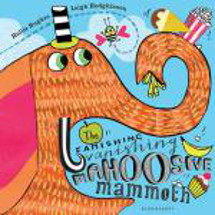
The famishing vanishing mahoosive mammoth by Hollie Hughes
Ill. by Leigh Hodgkinson. Bloomsbury, 2016. ISBN 9781408862780
(Age: 4+) Highly recommended. Mammoths, Appetite, Verse, Friendship.
When Mammoth wakes one morning he finds that he is so hungry that he
is vanishing. Bug tells him not to worry as he will find food for
him, and pulls a banana out of his backpack. The two go off to a
restaurant where he easily demolishes a meal, but feels hungry again
after. A tree is eaten on the way to the promenade, where he spies
an ice cream van. He eats some doughnuts and popcorn and chips,
fairy floss, rock and then a ship!
But even after this he feels like he is vanishing from too little
food.
The hairy mammoth's story told in rhyming verse, will elicit gales
of laughter from the readers as they follow his day filling his
tummy with food. Bug tried very hard to fill his friend's tummy but
calls a halt, when he tells the mammoth that he is thinking about
food too much and works out ways to distract him. They play on the
swings, go in a rocket, slide down the slippery dip, dig in the sand
for buried treasure. Mammoth realises that he has not thought about
food all day long, thanks to his friend, Bug, who has distracted
him. And his friendship is all Mammoth needs.
A delightful rhyming picture book about friendship, also lists food
that is found at the seaside for children to recognise. Readers will
love following the pair during their day at the beach, fabulously
illustrated in bold bright colours, and reading about all the things
that can be done when there. But over all it is Mammoth and his tum
that will intrigue the reader as he tries to allay his hunger and
the efforts of his friend at helping him do just that.
Fran Knight
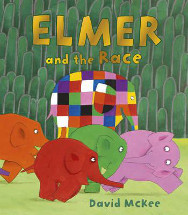
Elmer and the race by David McKee
Andersen Press, 2016. ISBN 9781783444557
(Age: 4-7) Recommended. Elephants. Competition. Elmer the patchwork
elephant is back and this time he organises a race when all the
young elephants decided that they wanted to find out who was the
fastest runner. Each had a different colour and there was great
excitement as they set off on the course that Elmer and Wilbur had
designed. On the way they face some obstacles - the cheeky monkeys
confuse the racers by throwing fruit and pointing in the wrong
direction and Yellow is naughty and trips up Green who is injured.
Readers who enjoyed the adventures of Elmer in Elmer, Elmer
and Rose and Elmer and Wilbur will be delighted to see
more of the characters in Elmer and the Race. The colourful,
eye-catching illustrations make this a stand out story book. Each
elephant has a different face and distinctive characteristics, but
Elmer with his gorgeous patchwork coat and Wilbur with his black and
white squares stand out amongst the colours of the young elephants.
The narrative flows along beautifully, making it a lovely story to
read aloud. There are lessons to be learnt on the way. Yellow cheats
but finds out that he is good at saying sorry. White is very kind
and helps Green, even though it means that he doesn't win the race
and Pink and Violet are funny, and even though Blue wins the race
and Orange comes in second, all of the young elephants win a medal.
Pat Pledger
The Ghostfaces by John Flanagan
Brotherband bk 6. Random House, 2016. ISBN 9780857980113
(Age: 12+) Highly recommended. I have read a number of books in this
series (but not all) and each of them is thrilling, dramatic and
full of action, and worthy of setting aside time to read and
definitely worth recommending to young male readers who will love
the life-threatening action and combat skills on display. (Note,
young female readers will also enjoy the adventurous spirit and the
fellowship of the band of 'brothers'.) Flanagan has mastered the art
of the historical adventure for teen readers.
In this latest saga we read of the exploits of the Brotherband, led
by the wise-beyond-his-years Hal, who together with a motley
collection of friends with unique skills combine to master their
sailing vessel and battle the elements and any human (or wild
animal) opposition. Their history is well documented in previous
books, but even if this was the first of the series that was read,
Flanagan gives enough detail of their personalities and individual
skills for it to be read as a stand-alone adventure.
Firstly, they have to survive the intense storm that threatens to
blow them far from home and into dangerous and unknown territory.
And then they must face a whole new way of life in a place that
leaves them marvelling and gives them a new sense of home, until
their existence is threatened by 'The Ghostfaces'. Although Flanagan
has created a fantasy world, there are parallels with Viking-like
and North American Indigenous cultures, and this too adds an
intrigue for the reader. A comprehensive sailing vocabulary is
included at the beginning to allow an understanding of the detailed
sailing scenarios that are described in detail. It doesn't take long
to feel like you too have been whipped by the storm in the opening
chapters. But beyond the sailing detail is a story of friendship
that binds these brothers together and allows them to overcome
adversity and loss, and to demonstrate how to esteem individual
strengths and forgive weaknesses.
Carolyn Hull
Romeo and Juliet by William Shakespeare, retold by Terry Deary
Terry Deary's Shakespeare's tales series. Bloomsbury, 2016.
ISBN 9781472917867
(Age: 7+) Recommended. Romeo and Juliet. Another in this series
taking Shakespeare's stories to a wider audience, offers Romeo and
Juliet as seen by the boy who plays Juliet as well as general
dogsbody behind the scenes. Through Sam's eyes we see the company
put on this wellknown play, donning his costume, helping others
with theirs, fetching actors to appear on stage, and watching the
audience. Through his eyes, Deary is able to breathe a different
perspective into the play, offering readers a look by someone their
own age, marvelling at the writing, acting and general demeanor of
the stage craft. The play itself is outlined from beginning to end
so that the reader gains a good coverage of what happens and why.
Stage directions, chats with the actors, illustrations of the Globe
theatre and London at the time all add to the background presented
in this series, making Shakespeare accessible to a younger audience.
And with the plague at London's door and in people's minds, the hint
of someone coughing is enough to divert the audience's attention,
but not for long.
Fran Knight
Up, up and away by Tom McLaughlin
Bloomsbury, 2016. ISBN: 9781408870150.
(Age: 4+) Recommended. Experimentation. Science. Space. This picture book will initiate lots of discussions about what makes up a planet, how they are made, what we can see in the night sky and so on, as Orson makes his own planet, but then has to make a tough decision. Orson loves to make things and one day decides to make something quite out of the ordinary: a planet. He collects together some rocks with some water and metal, and gathers as much empty space as he can. His next quest is for a big bang so he gathers some balloons and finds it makes the planet with ease. So there it is right in his bedroom, but it looks unhappy, so Orson tries to do things with his planet to make it happy. He reads all he can about it and so begins work cleaning it, feeding it, dusting it and tidying the oceans. But then it is so happy it begins to grow, and attracts a whole lot of things to its surface. Orson notices that the planet has become sad again, so decides that the best thing to do is to let it go. Sometimes this is a hard decision to make, but readers will empathise with Orson and his decision, comparing it with some they have had to make themselves. Another theme touched on in the story is that of the environment and how it can be protected. Orson's regime of cleaning his planet will touch a nerve with some children, understanding that we have not been good custodians of our planet and there is a need for more effort to ensure its preservation. Fran Knight
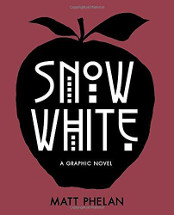
Snow White: a graphic novel by Matt Phelan
Walker Books Australia, 2016. ISBN 9780763672331 (Age: Secondary)
Traditional fairytales continue as such a rich source for
adaptations, retellings and reworkings that one is often amazed that
anyone can come up with a new approach.
Acclaimed graphic novel creator Matt Phelan has proven that it is
very possible to revitalise such stories with this interpretation of
Snow White.
With a dark and brooding style reminiscent of film noir, Phelan has
taken 1930s Manhattan as his setting for this evocative rendering of
the favourite tale.
A wealthy man loses his wife but holds onto his fortune despite the
relentless and ominous rat-a-tat-tat of the stock ticker. While the
rest of New York reels under the collapse of Wall Street the man
remarries a glamorous and wellknown Ziegfield Follies star who
swiftly ensures the pretty little daughter, Samantha, known as Snow,
is removed to a boarding school. Before too long, the wicked new
wife decides she cannot be certain that her husband's good fortune
will continue so she cold-bloodedly removes him from the scene via a
poisoned cocktail. Her wrath when she discovers that the canny man
has altered his will in favour of his beloved daughter is ugly and
malicious. However, if anything should happen to Snow, then she
would inherit it all and she is completely prepared to make that a
reality.
She engages a thug to do the dirty work but he cannot bring himself
to do away with the sweet girl and tells her to run. But the seedy
alleys of New York are no safe place for a young woman on her own
and she is pursued by two street hoods. In the nick of time she is
rescued by some small men - in fact, they are just boys who take her
to their hideout.
And so the story goes on - with a wonderfully satisfactory happy
ending.
The amazing illustrations done throughout in grey tones (until the
last few pages) have been done in ink, pencil and watercolour with
some digital adjustments and would be a rich resource to inspire
young artists. It is these illustrations which tell the story with
very little text and make for a sombre and gripping retell of this
classic.
A beautiful addition to your collection for secondary students
particularly those interested in creative writing and illustrating.
You can access teaching
notes and watch a terrific trailer.
Sue Warren
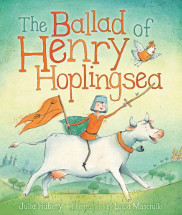
The ballad of Henry Hoplingsea by Julia Hubery
Ill. by Lucia Masciullo. Little Hare, 2016. ISBN 9781760121259
(Age: 4+) Highly recommended. Humour. Aspirations. Medieval times.
Love and friendship. When farmer Henry proposes marriage to his
girlfriend, Carmelita, she declines his offer with tears in her
eyes. She has never imagined herself as a farmer's wife, but longs
to be a princess, waited on hand and foot, with long flowing tresses
and a brave heroic knight who will fight dragons for her.
Undeterred, Henry goes off in the dead of night to join a Knight
School, where he will learn all the attributes Carmelita craves.
Told in verse, each pair of lines begs the reader to predict the
rhyming word, encouraging them to be more involved in the story of
Henry trying to win Carmelita's hand. Predicting the rhyming word
will cause lots of fun as will the story itself, along with
recognising the allusions to fairy tales which children will elicit
in the illustrations as well as the text.
The wonderfully energetic illustrations will have readers looking
for the scatter of things on each page, laughing at the view of
Henry on his majestic steed, his cow, with his rooster tagging along
as his squire.
The humour behind the farmer on his quest begs the readers to look
further at books presenting a view of Medieval life and perhaps
discuss the role of men and women in our society, and Carmelita's
aspirations could be considered when looking at the reality behind
what she wishes for. The old adage, 'be careful what you wish for'
may be a handy dictum for discussion.
Fran Knight
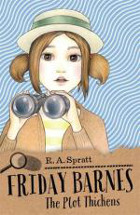
Friday Barnes: The plot thickens by R.A. Spratt
Penguin Random House, 2016. Friday Barnes series, bk. 5 ISBN 9780857989932
(Ages: 8+) Recommended. The fifth Friday Barnes book, finds Friday
embroiled in a prank battle with her former friend Ian Wainscott who
is none too pleased to find out that Friday's deductions are correct
yet again. The PE teacher is also out to get Friday as he ramps up
his fitness crusade. Then there is also the mystery of the defaced
artwork appearing around the school, attempted kidnappings and the
list goes on, with the consummate schoolgirl detective solving many
smaller mysteries throughout the book to keep readers enthralled.
The smaller puzzling occurrences lead Friday to solve the major
mystery of what the newly appointed, world-renowned artist come
teacher is up to at Highcrest Academy. Friday Barnes: The plot thickens is a great way to break into
the detective story genre for younger readers. The multitude of mini
mysteries makes this a high interest book while a more complex
over-arching mystery adds more depth. The narrative style is clear
and accessible and the school setting will engage primary student
readers easily.
This book is recommended for young mystery lovers.
Annette Mesecke
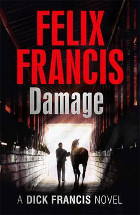
Damage by Felix Francis
Penguin, 2016. ISBN 9780718178833
(Age: 15+) Recommended. Mystery. Horse racing. Felix Francis follows
in his father's footsteps with an engrossing mystery set in the
horse racing industry and fans of the original Dick Francis novels
will be sure to enjoy this one as well. Jeff Hinkley is an
undercover investigator for the British Horse-racing Authority and
when asked to look into the activities of a trainer, finds himself
embroiled in a murder, illegal drug use and blackmail demands.
The action speeds along with Jeff using all his skills to find the
perpetrator. In the meantime he is facing the thought of his sister
fighting cancer and wondering where his long term romance is going.
He is also investigating the drug charge against the son of his
sister's husband and manages to solve this as a small subplot that
demonstrates his expertise as an investigator. Damage has the same feel that brought the Dick Francis books
such a popular following. An intimate knowledge of horses and the
racing industry, an interesting investigator who is intelligent and
a dire blackmailer who could bring the horse-racing industry to its
knees ensures that once again Felix Francis has produced a very
readable and satisfying mystery.
Pat Pledger
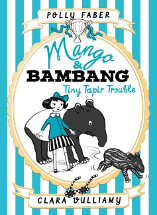
Mango and Bambang: Tiny tapir trouble by Polly Faber
Ill. by Clara Vulliamy. Mango and Bambang series, bk. 3.
Walker Books, 2016. ISBN 9781406361483
(Age: 7-10) Highly recommended. The third in the series about Mango
and Bambang will be an instant hit with fans and new readers alike.
The pair have a wonderful adventure at the seaside, and when Bambang
gets sick they discover just the sort of medicine a tapir needs to
recover. Then a parcel arrives for them and inside is a tiny tapir,
Guntur, who is rather naughty and causes trouble for Bambang.
Finally in the last section Bambang helps ensure that Mango wins the
chess competition.
The book is divided into four sections, with a contents page giving
the title of each of the little stories. The narratives are very
interesting with vocabulary that will entice children to learn new
words. There is the familiar beach scene where Bambang proves that
he is a hero and not a monster. When Bambang get sick the reader
learns along with Mango what a tapir eats and the habitat that it
likes. There is much humour as Guntur wreaks havoc at home before
become a handbag tapir for a celebrity and finally Bambang proves
how intelligent and observant he is when he discovers what is
happening at the chess tournament.
These fabulous episodes are illustrated with lots of attractive
black and teal pictures that will help emerging readers with the
story.
Themes of fitting in, being brave, worry about friendship and making
sure that friends are being cared for, are all things that young
readers will relate to and which make the book such a wonderful
read.
A book trailer from the
authors gives details about tapirs and the main characters.
Pat Pledger
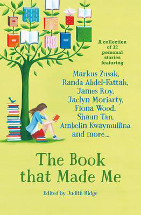
The book that made me ed. by Judith Ridge
Walker Books, 2016. ISBN 9781922244888
(Age: Mature upper primary - Secondary, Adult) Most avid readers
will understand how special it is to share a book with someone. This
may be through encouraging others to read a title, or from
discussion in study, book clubs or impromptu conversation.
This publication compiles submissions by authors who explain how
they were moved, comforted, inspired and influenced by books and it
differs from others in that the authors don't have pretensions and
make no effort to impress with a taste for high brow literature.
Originally I thought it might be a clever way to engage reluctant
readers, however I soon realised that this is a book for people who
love reading, those who want to cheer when someone else voices
exactly what they felt about scenes from their favourite childhood
tale or who want to feel cross that someone just didn't 'get' the
book which meant the most to them in their teens.
It meant a lot to me that different authors voiced similar thoughts
about titles. For example, Fiona Wood first encountered notions of
feminism from the strong, decent and very human main character in Anne
of Green Gables. Rachel Craw also recalls Anne as a powerful
female character yet notes that Trixie Belden was her first.
Benjamin Law fondly remembers the works of Roald Dahl, as does
Bernard Beckett who also experienced the joy of sharing this author
with his own boys via an audio book on a long car journey.
In many of the entries is a sense of yearning for happy, simple
moments from childhood, framed within the familiar setting of
favourite books. For some, it is clear that books helped the
endurance of difficult times, such as family disintegration and
isolation in remote locations.
I was transported by the authors who recalled the excitement of the
weekly visit to a public library, to select three books which would
be devoured, some several times, before the next visit. It was also
interesting to read the opinions of individuals from an array of
cultural backgrounds, to appreciate the value of different forms,
such as spoken narrative, comics and graphic novels. Clearly some
stories had almost universal appeal whilst others may have reflected
blinkered attitudes from their time.
Some secondary and a few advanced primary students will enjoy
reading the views and experiences of these authors, however many
contributors will be unfamiliar. Similarly, with some exceptions, a
lot of the titles discussed are so dated that they are unlikely to
be known. However, I'd be delighted if this book prompts readers to
search out these treasured favourites which they might otherwise not
have come across.
Rob Welsh