Ill. by Robert Ingpen. Walker Books, 2016. ISBN 9781922244550
(Age: all) Highly recommended. Christmas, Classic tale, The
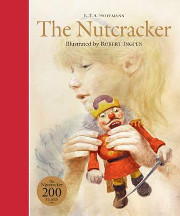
Nutcracker, Friendship. This wonderful edition of the well known
story, the basis for Tchaikovsky's loved Christmas ballet, The
Nutcracker, is given in its entirety, translated from
Hoffman's original German story by Anthea Bell and given a
brilliantly enticing new set of illustrations by the marvelous
Robert Ingpen, to celebrate its bicentenary. Children and adults
alike will thrill to the complete story offered here, set alongside
seventy glorious illustrations, reminding them of Christmases long
past, of half remembered stories of the nutcracker.
When her parents' good friend, Mr Drosselmeier gives Marie and her
brother a nutcracker for Christmas, Marie loves the little figure.
Her impatient brother throws it in the corner when one of his big
teeth is cracked, but Marie cradles him and puts him in the special
place with her other toys.
Unbeknownst to her, Mr Drosselmeier has given the figure to Marie
for a reason, one he cannot tell anyone. He once built a mousetrap
so well that all the mice in the town had been trapped and removed
from the place. The mice then cursed his nephew and only he knows
what can take away that curse.
When Marie is about to go to bed, mice invade the room with her
toys, demanding she feed them or they will eat up her nutcracker.
She complies but when she runs out of food, she turns to see the
nutcracker and the other toys lined up to defeat the mice. She wakes
the next morning, confused and upset to see that her nutcracker has
gone. But Mr Drosselmeier returns that day with his nephew and Marie
realises who he is and takes him as her friend.
This beautiful story of friendship is complemented with Ingpen's
sumptuous illustrations, soft edged and glowingly detailed.
This is a beautiful story to read at Christmas, reminding children
that love and friendship are precious and will outlive all the toys
they are given. This edition includes a biography of Hoffman and
celebrates his influence on fantasy writing, while the tale written
in 1816, includes a story rarely seen, The story of the hard nut,
which tells the reader how the nutcracker came to be.
This is a magical production and deserves to be shared.
Fran Knight
The anti-Boredom Christmas book by Andy Seed
Bloomsbury Publishing Place, 2016. ISBN 9781408870105
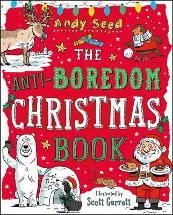
(Age: 8+) Highly recommended. The Anti-Boredom Christmas Book is
full of activities to make sure readers do not get bored over
Christmas. It has some hilarious activities and is full of jokes,
facts, quizzes and other stuff. Each chapter is themed and readers
can learn how to make some simple Christmas crafts, challenge their
sister to a Christmas quiz or make dad laugh with some Christmas
jokes. There are plenty of discussion pages as well which will make
for some fun conversations. They include asking questions of family
members and getting them to choose Christmas things they prefer.
Readers can learn some new games like 'Table Tinker' where someone
makes changes to the Christmas table and the other guests have to
guess what is different. Try a game of Fangman (a take on the
traditional Hangman) where players draw a vampire face to 'hang' the
players as they guess the wrong letters. Highly recommended for all
readers aged 8+. This book would make a great stocking filler and
could also be used in the classroom. Students or teachers could
choose an activity to do each day in the lead up to the end of the
school year and Christmas.
Kylie Kempster
Crooked Kingdom by Leigh Bardugo
Six of Crows bk 2. Indigo, 2016. ISBN 9781780622309
(Age: 14+) Highly recommended. Fantasy. Goodreads Choice Award
Nominee for Young Adult Fantasy and Science Fiction (2016). The
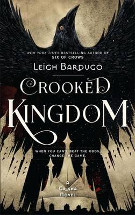
stunning sequel to Six of crows, see Kaz Brekker and his
crew fighting for their lives. They have been double-crossed and Kaz
is determined to have his revenge. In a series of daring heists,
they are fighting for their lives and Kaz needs every bit of his
cunning and intelligence to find out about the deadly drug known as
jurda parem and to bring some peace to his team.
Once again the world building in Crooked Kingdom is
outstanding. The city of Ketterdam is brought to life, with its
canals, warehouses, merchants and people making a fabulous
background to the adventures of the six young people.
The daring exploits of the crew keep the reader totally engrossed as
they break into houses, fool dangerous people and fight off their
foes. The action is breathtaking but so is the characterisation.
Each chapter is told by one of the six characters and it is done so
well that the reader has no problem following such a large group of
main characters as well as a plethora of minor ones.
The characteristics of each person are richly elaborated, with
details of each person's background and reason for being in
Ketterdam gradually evolving as their story is told. Kaz of course
is central to the story and Bardugo leaves us very satisfied with
how he evolves. Of course with such a large cast and with so much
danger to contend with, there are some casualties on the way and
lots of surprising twists as well.
This is an excellent sequel to Six of crows and I look
forward to reading anything else that Leigh Bardugo writes in the
future.
Pat Pledger
Dog on a digger: The tricky incident by Kate Prendergast
Old Barn Books, 2016. ISBN 9781910646144
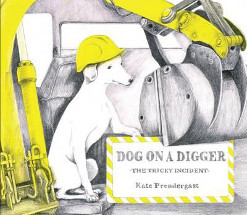
(Age: 3+) Recommended. Kate Prendergast draws from her transport
industry background creating detailed images of machinery set
against an urban landscape filled with heavy machinery. This
wordless picture book with detailed black and white pencil drawings
with highlights of yellow and blue is a story of friendship, loyalty
and thoughtfulness.
Dog lives with his owner in a caravan surrounded by trucks, heavy
equipment and building supplies. The panoramic front spread
highlights the urban landscape at night; an owl flies by watched by
a city fox. Morning comes and dog wakes his master up with licks to
the face, time to start the day; meanwhile the food truck's owner
and her little white dog open up ready to sell hearty meals to the
workers. Dog joins his master in the cab of the big yellow digger
ready to move all the building rubble into the truck. Both of them
wear yellow safety vests. The digger's scoop is humanised - bolts
become eyes and the large mouth opens and closes eating up the
rubble and scrap wood.
At morning teatime, Dog plays with the small white dog sharing a
bowl of food, while their owners chat over a cup of tea. In an
instant, the little canine disappears and Dog sets off in a hurried
search climbing the stairs of the building next door to see where
his friend has gone. With the aid of Dog's owner, he guides him to
rescue the lost animal stuck in a grate beside the canal. Dog on a digger is an enjoyable picture book, when shared
with a class; students can add their own narrative, writing text in
sticky notes on each page, developing a class book. Pet ownership
and being responsible are topics for discussion as well. For Art,
explore pencil sketching, highlighting one element in colour;
introduce expressive drawing and humanising inanimate objects like
Thomas the Tank Engine and the yellow digger.
Rhyllis Bignell
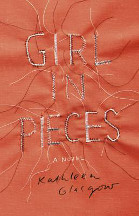
Girl in pieces by Kathleen Glasgow
HarperCollins, 2016. ISBN 9781460751053
(Age: 15+) Recommended for mature readers. Charlie is really messed
up. But so is everyone at Creeley, the health facility for girls who
self-harm. Part One of Girl in Pieces chronicles their
despair fuelled by anxiety or abuse of one kind or another.
Charlotte (Charlie) is dealing with loss of her father in childhood
and more recently, her best friend.
In Part Two, Charlie is thrust back into the tenuous reality of the
outside world. She is not ready but both she and her counsellor,
Casper, have prepared some strategies to avoid self-harm. Mickey,
her childhood sweetheart, reaches out to her with a bus ticket and a
new start interstate. Inevitably, Charlie's attraction to Riley, a
musician and addict working with her in a coffee shop, can only lead
to one thing.
The author, who has a history of self-harm, takes us on a journey of
gradual understanding. Glasgow's insights into the thoughts of those
who self-harm are palpable and full of wisdom. We come to know
Charlie's own triggers for cutting and the horrific physiological
consequences of cyclical self-loathing. The use of flashbacks
confirm that she blames herself for attracting catastrophe.
Life keeps disappointing Charlie but in Part Three, the inclusion of
her sketches in a local art show gives us hope that she can
ultimately find peace in a world in which she has never felt
welcome. The abiding message of this confronting First Person tome,
is that you are not alone. You can choose self-annihilation of one
kind or another and there'll be no shortage of company - or you can
keep trying. Girl in Pieces provides insightful explanations
for addiction of any kind, but the sub-text is the importance of
mentors, artfully achieved from very well fleshed out and equally
flawed but resilient characters.
Deb Robins
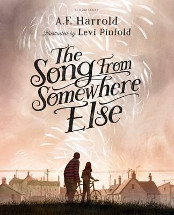
The song from somewhere else by A.F. Harrold
Ill. by Levi Pinfold. Bloomsbury, 2016. ISBN 9781408879337
(Age: 9+) Recommended. Fantasy. Bullying. Acceptance. Fear.
Friendship. This is an amazing story of bullying and friendship, yet
it also enters into the fantasy world that lives in parallel to our
own world. Frank (or Francesca) is alone while her friend is away on
holidays and her pet cat has gone missing. The story begins with an
encounter with the local Junior School bully and his two goons while
she is out putting up Missing Cat posters. Her fear rises and
overtakes her until Nick, the big ostracised kid from her class,
rescues her from another incident of humiliation. Unfortunately he
is not a 'Prince Charming', but rather is the lumpish and large kid
who is also the butt of everyone's jokes, and the one that everyone
in class avoids because he smells. Without realising it, Frank
becomes Nick's friend, and the connection between the two lonely
kids is tightened by the mystical and magical music that floats from
within Nick's house and which has a restorative influence on Frank,
but is also part of the intrigue of the unusual Nick. This music
entices Frank's curiosity, and she becomes acquainted with Nick's
fantastic family secret. The tangles that this weaves are like
shadows that creep around in the middle of the night, with the
capacity to trip you over in the uncertainty of each step forward.
Frank's encounters with the fantasy world raise her uncertainties
about how to act; the moral dilemmas she has to face confront her
with her selfishness and her struggles to be friends with the boy
she formerly shunned. But the story ends well, despite her mistakes.
The black and white illustrations in this book are atmospheric and
ethereal in some places, which adds a hint of mystery to the story.
Although we have a fantasy tale at the heart of the story, it is
also a 'real-life' tale of friendship, acceptance and the impact of
fear. Frank's quirky family adds an element of humour to the
otherwise dark mystery. There is nothing in here that would cause
nightmares, but it is a moving tale of overcoming dark influences.
Carolyn Hull
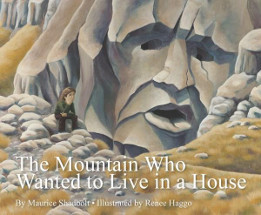
The mountain who wanted to live in a house by Maurice Shadbolt
Ill. by Renee Haggo. Starfish Bay Children's Books, 2016. ISBN
9781760360030
(Age: 4+) Recommended. Humour. Mountains. Environment. Problem
solving. As the mountain stares down at the people in the town, he
is envious. People come to him to ski or have picnics, to climb and
watch the birds in the trees, but he wants to be just like them and
live in his own house where he would be protected from the cold and
wind and ice and snow, and not be lonely. So one day with a yell, he
begins to walk to the town. People become very anxious and drive
away, or walk or paddle down the river. One boy, Thomas stands in
front of the mountain to ask what he is doing, and finding that the
mountain wants to live in a house, begins to discuss the problem
with him.
He tells him about his mother sometimes washing his jumper only to
find that it shrinks, so he heads off home for soap and water, but
this doesn't work at all. Next he fetches a hammer and begins to
chop bits off the mountain, but the mountain doesn't like this idea.
At last the boy has a clever idea, and races back home to fetch his
father to paint the mountain. In that way the mountain would fit
into a house and be seen by everyone. So the mountain can stay where
he is but also be in the house.
I really like this story of working together to find a solution to a
problem. Readers could begin to discuss why things in the
environment are where they are, and how we can protect them. They
will enjoy the illustrations of the mountain's face peering out at
the readers and could talk about how to go about painting a mountain
scene. First published in New Zealand by Deep Creek Press in 2015.
Fran Knight
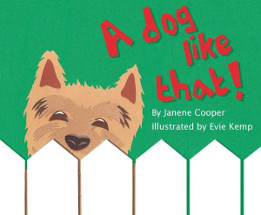
A dog like that! by Janene Cooper
Ill. by Evie Kemp. Starfish Bay Children's Books, 2016. ISBN
9781760360047
(Age: 4+) Recommended. Dogs. Pets. Comparisons. In this enticing
book, each group of pages introduces a different dog and its owner
and what it does best. Uncle's dog, a labrador, is clever and does
what he is told, but the girl who owns the scruffy dog on the cover
tells us that her dog is not like that. He does what he likes. Her
Grandpa's dog is a watch dog, and keeps guard at night, but the
scruffy dog sleeps. The neighbour's dog is fearsome, barking at all
the other cats and dogs, but the girl's dog likes everyone and licks
them all. Each dog is shown for something it does best, and the girl
is told that all dogs should be like that. But as we read on we find
that her dog is nothing like the other dogs: it sleeps with the
girl, is happy to see everyone, is scruffy and rumpled, and unlike
other dogs that leap and jump, her dog sits at the gate and waits
for her.
Her dog knows when she is sad and licks her face, and stays in her
room with her when she has done something wrong. And that is what
dogs should be.
The bold illustrations have the reader looking straight into the
face of the scruffy dog, comparing its behaviour with the other dogs
and knowing which dog is the best. Each page uses one main colour
with the dog prominently positioned by the words in a large font. It
is a delight to read and look at the illustrations and I can imagine
children reading it aloud, repeating the refrain, 'Dogs should be
like that' with growing knowledge that the best dog is not like that
at all. First published in New Zealand by Deep Creek Press in 2015.
Fran Knight
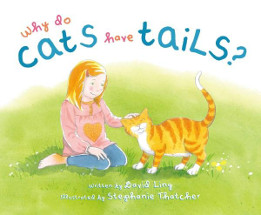
Why do cats have tails? by David Ling
Ill. by Stephanie Thatcher. Starfish Bay Children's Books, 2016 ISBN
9781760360085
(Age: 4+) Recommended. Cats. Pets. Problem solving. Surrounded by
their family's cats the little girls ask their Grandpa why the cats
have tails. Grandpa thinks up some wonderful reasons which will
bring gales of laughter to the listening crowd. He suggests that
they might use them to swing through the trees, but the girls tell
him that this is the reason monkeys have tails. He then suggests
that they could use them to swish away the flies, but the girls tell
him that cows use their tails in this way. Perhaps the tail helps
them swim faster, he says, but no, cats don't like to swim. Suppose
the cat uses his tail as a warning, but no say the girls,
rattlesnakes do that. Grandpa then asks the girls to offer a
suggestion and this is one the readers will discuss as they finish
the book. The pastel illustrations add warmth to the story, but are
a little washed out in my review copy. I do like the cat's paw
endpapers. First published in New Zealand by Deep Creek Press in
2015.
Fran Knight
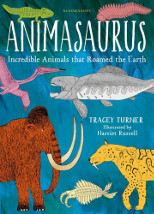
Animasaurus: Incredible animals that roamed the Earth by Tracey Turner
Ill. by Harriet Russell. Bloomsbury, 2016. ISBN 9781408884850
(Age: 8+) Recommended. Animasaurus is a prehistoric
compendium filled with fascinating facts about the plant-eaters, sea
creatures, predators and creepy crawlies that once inhabited the
Earth. Discover amazing information, their statistics, habitats,
diet, size and weight and compare these with photos of modern day
relatives.
Unusual dinosaurs not commonly known such as the Therizinosaurus
lived on the Mongolian Plains 75 million years ago scared predators
away with its metre long claws. The fossils of Gigantopithecus or
giant ape were discovered in India and Southeast Asia. They grew to
three metres in height, had big teeth just right for their
vegetarian diet. Deep under the sea Cameroceras, nine-metre long
shellfish with metre long tentacles and sharp beaks used a
jet-propulsion swimming style to stalk their prey. Animals that are
more familiar are included as well -Giant Kangaroos, Woolly Mammoths
and Megaladons great white sharks.
Each double-page spread includes an introduction, exploration of the
animal's features, a map, timeline and size comparison to a human.
Centred on bold backgrounds of earth, sea and sky tones are Harriet
Russell's simplistic creature drawings.
As part of the Earth and Space Science strand of the Australian
Science curriculum, Animasaurus links to geological
processes and history, the fossil record and past environmental
conditions and changes over time. This non-fiction volume provides
information suited to student research projects and enquiry-based
learning. Fans of scientific encyclopaedias and budding
palaeontologists will also enjoy this book.
Rhyllis Bignell
The last beginning by Lauren James
Walker Books, 2016. ISBN 9781406358063
(Age: 13+) Recommended. Clove Sutcliffe is determined to solve the
mystery of Katherine and Matthew who vanished 16 years ago only to
be reincarnated at every key point in history. As Clove follows her
quarry from life to life, historical era to historical era, it seems
that she too is being stalked. Ella is as enigmatic as the mysteries
Clove must solve to unravel the past and secure her future.
The sequel to The Next Together, Lauren James's debut novel,
The Last Beginning, is a fitting follow on. The characters
are believable and the literary devices used at the beginning of
each chapter add credibility and interest. The book also provides
satisfying links with its prequel allowing for a truly satisfying
conclusion.
Ros Lange
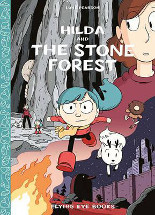
Hilda and the Stone Forest by Luke Pearson
Hilda series, bk. 5. Flying Eye Books, 2016. ISBN
9781909263741
(Age: 8+) Highly recommended. Luke Pearson's fantasy adventure
series stars Hilda the lively, blue-haired young girl, her pet
deerfox Twig and Tontu a house spirit who can walk through walls. In
Hilda and the Stone Forest she is swept up into the magical
adventures of her house spirit's world, chasing little nisse-sprites
through the forest of trolls. Hilda's mother becomes worried at her
disappearances and her dishevelled appearances and suspects her
daughter is lying. Sent to her room as a punishment, Hilda sneaks
out of her window to take an enchanting flight on the back of the
magic raven with her friend Frida. Grounded, for three days, Hilda
watches the world from her bedroom window as the troll fires burn on
the mountain.
While trying to stop Hilda from escaping through the wall with
Tontu, mother, daughter and Twig fly through the air and land in the
strange, shadowy forest of the trolls. Their journey takes them deep
into the mountain inhabited by trolls, where they learn to rely on
each other's abilities. Fantastical creatures, trolls with two
heads, a baby troll, worms with giant teeth and threatening
landscapes with rock falls, dead ends and dark caves prove dangerous
for Hilda and her mother. With the help of Twig and surprising
assistance from an unexpected character, they finally return to the
safety of their home in Trolberg.
Pearson's graphic novels are dynamic and fast-paced with his
creative illustrations displaying his understanding of connectivity
to space, time and movement. There is an energy created by images
that wrap around, with the unexpected placement of action panels and
diagonal lines, which burst across the page pushing the action
forward. The characters move across, up, down, defy gravity and
burst out from the scenes with minimal speech bubbles; the reader is
immersed in the drama. Pearson's use of a muted palette is visually
engaging with swathes of colours, greys, reds, earth tones, leaf
greens, colouring the characters and their backgrounds. Hilda and the Stone Forest ends with the assurance of more
magical stories to come.
Rhyllis Bignell
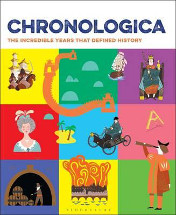
Chronologica: the incredible years that defined history compiled by the Whitaker's Almanack team
Bloomsbury, 2016. ISBN 9781472932945
(Age: 10+) Highly recommended. This is exactly the kind of book I
would have loved as a rather nerdy child. I had quite the obsession
with books of 'general knowledge' and random facts and perused them
for hours. Clearly, why I love trivia competitions so much now.
Since December 1868, the famous Whitaker's Almanack
has been published in the UK chockfull of all the year's happenings.
As an iconic publication, the work has been referenced in other
literary texts from Stoker's Dracula to Fleming's Moonraker.
This volume spans 100 years and devotes three pages to each year
featured covering several topics. For example, 1789 - why was this
year important? George Washington was elected as the first American
president, sailors mutinied on HMS Bounty and the storming of the
Bastille initiated the French Revolution.
I have had such fun 'dipping' into it over the past few days and I
know that kids with similar tastes will love doing so as well.
There is something to fascinate all types of tastes from popular
culture (when was Nintendo founded, the creation of the first pizza)
to more serious historical events.
For your non-fiction reader, this would be a terrific addition to
Christmas shopping and would certainly keep him/her absorbed for
quite some time over the holidays!
Highly recommended for children from around ten upwards.
Sue Warren
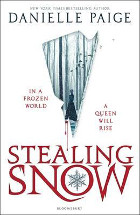
Stealing Snow by Danielle Paige
Bloomsbury, 2016. ISBN 9781408872932
(Age: 11+) Recommended. Snow's life changed dramatically when she
was 6 - she tried to walk through a mirror and was committed to the
Whittaker Psychiatric Institute for the next eleven years of her
life. A rather harsh outcome for one fairly insignificant act. When
the reader meets her, Snow has institutionalised living down to a
fine art, which is why it comes as a surprise when she ditches all
that she knows for an icy, magical kingdom, where even Snow wonders
whether she is simply having a psychotic break or has overdone her
meds.
In a fast and furious retelling of the Snow Queen, Danielle
Paige hooks the reader with a magical tree, witches, thieves who
steal faces before they thieve, werebeings, an evil king, a
formidable foe and 3 males who have captivated Snow even though she
struggles to remain true to Bale, her only friend from her
institutionalised life.
While most of the characterization is lacking in depth, the tempo of
the storytelling compensates. Paige is also expert at creating true
villains which is a boon for the reader and which led to one of the
most unexpected twists in the book. It's enjoyable. Read it.
Ros Lange
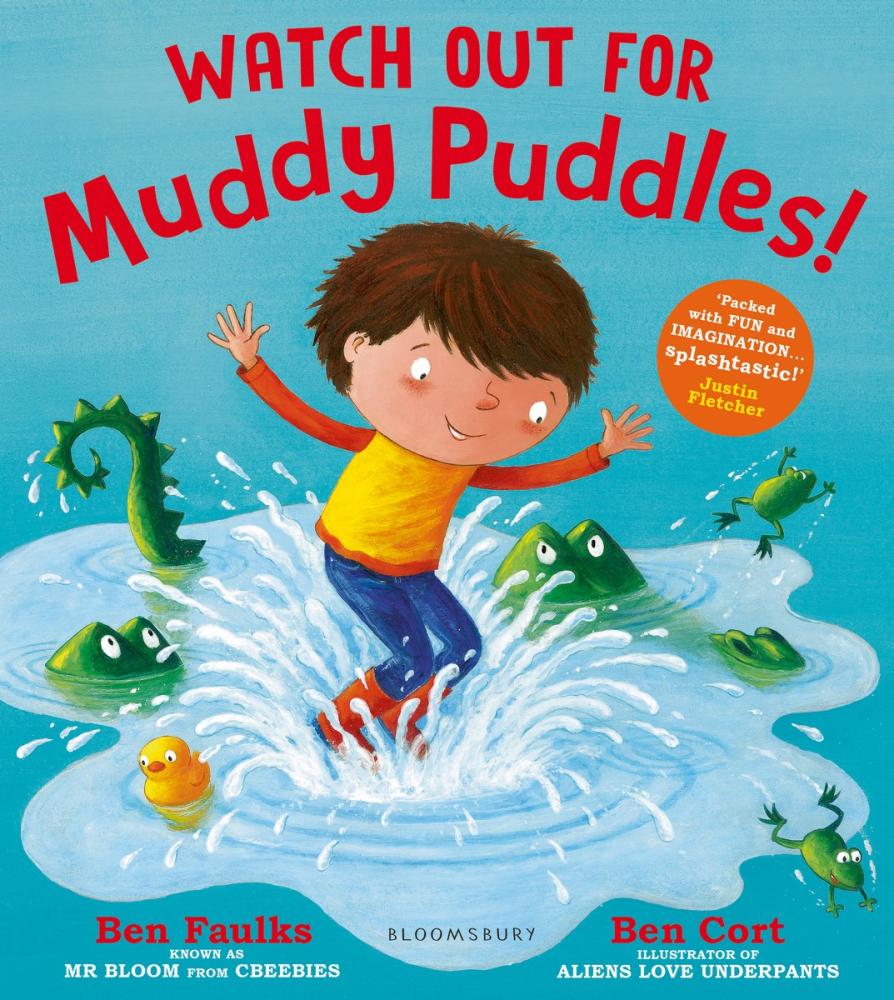
Watch out for muddy puddles by Ben Faulks
Ill. by Ben Cort. Bloomsbury, 2016. ISBN 9781408867204
(Age: 4+) Recommended. Humour, Water, Rhyming story. English readers
know well the author of this rollicking rhyming story, as he appears
as Mr Bloom in the TV show for kids, Mr Bloom's Nursery.
Australian audiences need not be concerned however as the story of a
young boy splashing through puddles with his wellington boots,
warned to watch out for what lies beneath the surface, will grab the
readers' attention as he plays in the water. From crocodiles, to two
frogs kissing, to pirates and polar bears, each thing lurking
beneath the surface could be there to catch an unwary child.
But treading on the water sees the boy swirling down underneath the
surface to find out what lies below. He goes through layers of all
sorts of things including fossils and granite but the worst thing of
all to find in a puddle is the big bad rubber ducky. The children
run as fast as they can from this monster until they come to a
puddle that is just their size, and splash around in it most
unconcerned, but watch out for it may contain more than you think.
With rollicking rhyme to read aloud, great illustrations to ponder
over, I can imagine kids calling out in anticipation of something
that lurks beneath the surface of the puddle. And wouldn't it be fun
to read this on a rainy day then go out with your boots and try it
out.
Fran Knight