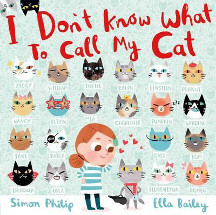
Ill. by Ella Bailey. Simon and Schuster, 2017. ISBN 9781471124129
(Age: 4+) Recommended. Cats, Family, Decision making. All readers
will enjoy reading the covers of this inviting book, seeing the
cats' names reflecting their attributes. I laughed out loud at
Dali's moustache, Elton's eyes and Ziggy's scar, and readers will
pick up the humour before they open the first page.
When a cat choses the protagonist as its owner, she has a lot of
trouble finding a suitable name. She scrolls through many: Betty,
Lorraine and Ethel and so on, until a visit to the vet shows her
that she needs a boy's name. Then a similar scrolling through a
number of boys' names occurs with the cat rejecting them with his
bahviour. Readers will laugh out loud at the animal's antics, and
sympathise when it appears to run away, doffing the clothes in which
it has been dressed. Surprisingly the girl goes to the zoo, and
selects an ape for her pet, but he destroys her house until the zoo
keepers retrieve him.
When he disappears back to the zoo, her cat reappears resplendent
with his name, Tricky on a plate around his neck. She is ecstatic
and draws a line across the floor, delineating how they will now
interreact with each other.
With detailed digital illustrations the relationships between the
young girl and the animals will cause lots of laugh, as they work
out their boundaries. Readers will have a great time finding the cat
on the pages where he has run away, shouting out to the little girl
where to find him.
As the children read this story they will assimilate information
about how to look after a pet and some of the responsibilities in
doing so.
Fran Knight
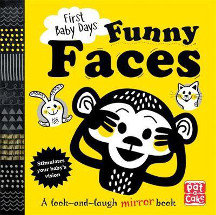
First Baby Days series
Pat-a-Cake, 2017 Funny Faces. ISBN 9781526380005 On the Move. ISBN 9781526380012
(Ages: 0-2) Recommended. Board books, high-contrast illustrations.
These high-contrast board books have been designed to stimulate even
the youngest children. Testing them out on my own two-month-old gave
credibility to this claim; she was more engaged with the
illustrations in these two titles than with other brightly coloured
illustrations. Not only did she look at the pictures for longer but
she also followed the book with her eyes. When held in front of her
she also became calmer, seemingly enjoying the stimulation.
Each book contains one bright colour (yellow, red) as well as black,
white and grey. The illustrations are bold with simple patterns and
the text encourages the parent to interact with the child (e.g.
'Hello, little panda. Wave to little panda!'). Infants love to look
at faces so will love the big expressive faces of the animals in Funny
Faces and enjoy looking at themselves in the large, clear
mirror (many mirrors placed in books are tiny and don't reflect
well). They will also enjoy the noises of the vehicles in On the
Move (Brrm! Choo! Zoom!) and tracking the impressive pull-tabs
(there are pull-tabs within pull-tabs), which are robust enough to
withstand rough treatment.
These two titles are great for infants but will also entertain
toddlers.
Nicole Nelson
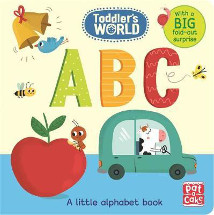
Toddler's world series
Hodder and Stoughton, 2017. ABC. ISBN 9781526380029 123. ISBN 9781526380050 Animals. ISBN 9781526380036 Colours. ISBN 9781526380043
(Ages: 1-3) Recommended. Board books, concept books. Each of these
bright, colourful board books has playful illustrations that
toddlers will love to explore and big, interactive foldouts on their
final page. Their simple format allows children to lead the
exploration and encourages parent-child interaction. The books use
toddler appropriate content to teach simple concepts and include
things that toddlers love (balls, rockets, balloons, animals,
vehicles, etc.). These are English publications so objects or things
are not necessarily Australian (e.g., wood animals are badgers,
hedgehogs, etc.) or are called something different (e.g., pepper
instead of capsicum), but this doesn't greatly detract from their
value. In Colours, ABC and Animals, which
are separated into sections and have labelled pictures, toddlers
will enjoy pointing out and naming things familiar to them. The
counting book uses many number representations (figure, dots, number
of items, written word, highlighted number in sequence), meaning
children are exposed to number in its many forms.
The last foldout page in each of the books asks children to
consolidate their learning (count how many, name the animals, etc.).
All of the books are incredibly robust to withstand even the
toughest toddler treatment.
Nicole Nelson
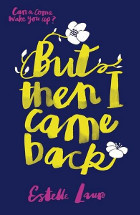
But then I came back by Estelle Laure
Orchard Books, 2017. ISBN 9781408342541
(Age: 14+) Recommended. Eden's life was all figured out - she was
going to go to New York and dance with the Bolshoi, she was going to
be a star!
After the accident however, all her plans are thrown into doubt.
Having woken from a coma a month after falling into the river, Eden
doesn't know whether she'll ever dance again. There goes fame,
fortune, and college plans. Instead she is consumed by the
depression of the displaced, and the mystery of her fellow coma
girl, Jasmine, who she met on the 'other side'. Preoccupied by
Jasmine and the mysterious black flowers, Eden finds herself
neglecting her old life and her family in order to try and help this
stranger come back. But is her determination solely because she
feels close to the other girl, or because of the boy with the white
roses and chocolate eyes? It seems that when everything is going so
wrong, something has to be so right.
Sequel to This
raging light, But then I came
back can be read in addition or on its own. Intelligent and
thoughtful, Estelle Laure (and Eden) make many literary references
throughout the novel to the canon. It is a novel about recovery,
discovery, and comfort with a pleasant possibility for what might be
beyond the veil. A relatively easy read, the novel addressed issues
surrounding family, depression, and future thinking. I would
recommend this novel for students aged fourteen and up.
Kayla Gaskell, 21
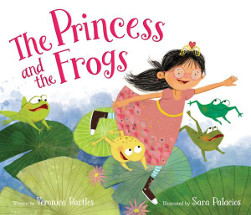
The princess and the frogs by Veronica Bartles
Ill. by Sara Palacios. Balzer and Bray, 2017. ISBN 9780062365910
Princess Cassandra had everything she could possibly want - hundreds
of dresses, thousands of books and servants to bring her anything
she wanted. She should have been the happiest princess in the world.
But there was one thing she didn't have - she was lonely playing by
herself and desperately wanted a best friend. In particular, she
wanted a pet - one that would match her best dress, swim and jump
and play all day and at night sit on her pillow and sing to her. So
the Royal Pet Handler set off on a quest to find the perfect pet,
but nothing was quite right. The mouse was too squeaky, the kitten
refused to swim, the hippo wouldn't jump and none of them were
green. The task seemed impossible until one day the Royal Pet
Handler arrived with a frog. It seemed just perfect. It was able to
swim, jump and play, AND it was green. But when Princess Cassandra
put it on her pillow and kissed it goodnight, it turned into a
prince!
"Princes aren't pets," she declared and banished it to the royal
kitchens. So the Pet Handler went in search of another frog and the
same thing happened. Again and again and again, until there were
princes everywhere. Then one day, the princess found her own frog
but the same thing happened, except this time the prince wanted to
stay a frog. Will she ever get the perfect pet?
This is an hilarious take on the traditional Princess and the Frog
story made even more so by the terrific pictures from Palacios who
brings the characters to life through their facial expressions. Who
would have thought there were so many different frogs?
A playful bedtime read that might make little ones think twice about
kissing things goodnight!
Barbara Braxton
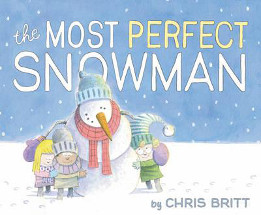
The most perfect snowman by Chris Britt
Balzer and Bray, 2016. ISBN 9780062377043
Built in the first flurry of winter snow, Drift was the loneliest of
snowmen. With his stick arms, small mouth and coal eyes he stood
forlorn and forgotten amongst the bare winter trees. He dreamed of
having a smart scarf, warm gloves and a long orange carrot nose like
the other snowmen so he could join in their banter, their fashion
parades, snowball fights and other fun stuff. But he was too plain
and different to be included, so his days were spent swooshing and
sliding through the woods, stopping and standing in the shadows to
watch the others at play.
Then one day some children gave Drift all that he wanted - a fluffy
blue hat, warm mittens, a soft scarf and even a long orange carrot
nose. Suddenly the other snowmen found him acceptable now that he
had his new accessories and watched as he played all afternoon with
his new friends. But that night a blizzard blew and Drift lost his
smart new clothes and no matter how hard he looked, he couldn't find
them. All he had left were his scarf and his long orange carrot
nose. Then he heard a tiny voice - a little bunny was lost in the
snow, frightened and shivery cold. Drift knows he can save the bunny
by wrapping it in his soft scarf and giving it his long orange
carrot nose but can he bear to part with them? Can he go back to
being that plain snowman with skinny stick eyes, a small nose and
coal eyes?
This is a charming story about what it means
to be 'perfect' and whether it is about looking a particular way or
having the right things or whether it runs deeper than that. What is
the meaning of the old adage 'Clothes maketh the man' and is it
true? Are we more visible and therefore perhaps more powerful
because of our external appearance?
It also raises the concepts of selfishness and selflessness and
whether even giving just a little can make any difference. Do we
need to be applauded and rewarded for doing something kind or should
it be enough to know that we have made a difference? Do we have to
be the person giving the boldest and brightest present at birthday
parties or is it the phone call saying thank you afterwards that is
most remembered?
The soft palette echo the gentleness of both the story and its
message but this is more than just a story to welcome winter.
Barbara Braxton
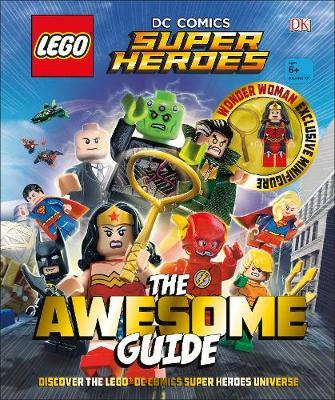
LEGO DC Comics Super Heroes: The Awesome Guide by Calvin Scott
DK Children, 2017. ISBN 9780241280393
(Age: 8+) Recommended. Sure to appeal to LEGO fans, The Awesome
Guide is just that. It gives details of all the super heroes,
their origins and the two cities, Metropolis and Gotham City that
dominate the world of DC Comics super heroes. Then there is
information about the planet Krypton, the superpowers possessed by
the heroes and their secret identities, vehicles and weapons. Of
special fun will be the section where readers can answer a quiz to
find out 'Who is your alter ego?', 'hero, friend, ordinary bystander
or, gulp, villain!'
The villains found in the comics are not omitted either. There is a
section based on their identities, skills and weaponry and readers
can do a quiz to find out how bad they are.
Each of the sections are illustrated in a double page spread,
vividly featuring the LEGO hero or apparatus, and many having small
blocks of information showing a Bick-sized fact and a Stat Scan.
There is a Table of Contents, a list of the LEGO sets and an index.
There is also a Wonder Woman exclusive mini figure contained in the
cover.
Although the reading level is definitely for an older audience, this
book and especially the action figure contained in it will appeal to
Lego fans who are much younger and who will appreciate an adult
reading sections to them.
This would be an ideal gift for any child who enjoys Lego and
superheroes.
Pat Pledger
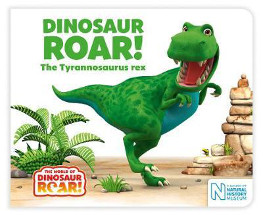
The world of dinosaur roar. A series created by Peter Curtis with rhyming text by Jeanne Willis
Macmillan Children's Books, 2017. Dinosaur roar! : The Tyrannosaurus rex. ISBN 9781509835669 Dinosaur Boo! : The Deinonychus. ISBN 9781509834952 Dinosaur Munch! : The Diplodocus. ISBN 9781509835652 Dinosaur stomp! : The Triceratops. ISBN: 9781509835690
Ages: 1 - 6) Recommended. Board Book. Written in association with
the Natural History Museum, this series of four rhyming texts
introduces the very youngest of children to the world of dinosaurs;
each character being endowed with a delightfully cheeky personality.
The dinosaurs depict behaviour typical of what we have come to
expect of each species. Vegetarian Diplodocus incessantly munches
leaves whilst Tyrannosaurus Rex threatens the others more
aggressively as we might expect of the carnivore.
The fabulous rhyming text is great fun for the adult reader too but
be warned - for best results refresh your dinosaur vocabulary and
pronunciation before you begin reading with your little one! The
different dinosaurs from the series 'support' the main character of
each individual narrative with their slapstick but just scary enough
antics. The final pages of each story provide some basic facts about
the dinosaur focussed on in that text. This is a very fine series
for stimulating the imagination particularly of the child with a
fascination for dinosaurs. I certainly would have jumped at a series
like this for my eldest son who had to be restrained on a daily
basis, from boring his Year 1 class to death on this subject quite a
few years ago now.
Elizabeth Avery
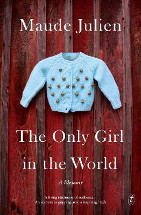
The only girl in the world: a memoir by Maude Julien
Text, 2017. ISBN 9781925498110
(Age: Mature senior secondary) Recommended for mature readers who
should be given opportunities to discuss the content. Maude Julien's
memoir details a horrific childhood of deprivation and suffering
inflicted by parents determined to create an exceptional being who
would not suffer from any intellectual or physical weakness. Maude's
father was a wealthy French company director who had a Nietschzean
belief in his own power and consequently despised human emotional
fragility. He raised a poor miner's daughter, Jeannine, from infancy
and in time she became the mother of Maude, the author. The couple
isolated themselves from the world and raised their child to master
all skills and eliminate all weakness. Part of her training taught
her to regard other people with suspicion and fear. She is set
constant endurance tests and never shown any affection. Maude's
teacher is her mother, who is a victim of Louis almost as much as
Maude is. Maude is woken in the night and made to sit in darkness in
the cellar to overcome her fear of rats. She is forced to traverse
the grounds of their mansion again at night without a light. She
must sit for hours without moving. Bells are sewn onto her jacket to
ensure that she does not move. Louis wants a guard dog so Linda, an
Alsatian, is purchased. Linda loves Maude but her father forces
Maude to shut Linda in a tiny cage during the day. Maude must not
allow herself to be ruled by sentiment. She must excel academically,
despite being taught by her mother who does not understand what she
is teaching. She must be a gymnast, despite having no trainer, and
she must learn a range of musical instruments. Oddly, despite their
suspicion of the world at large, Maude's parents allow frequent
contact with a vicious gardener who sexually abuses the child, and
her accordion teacher is a sadist who stubs out his cigarettes on
her knees. Louis has a philosophy that is a mixture of Masonism and
Nazism, but the essence is that he must be recognised as godlike. He
tries to force Maude to promise to watch over his grave for the rest
of her life. He fails in this but he does force her to toilet and
bath him, and share in his copious consumption of alcohol. He
eventually organizes her marriage which he does not intend to be
consummated. However Maude seizes her chance and escapes.
Psychologically Maude is saved by the love her few animals, Linda
the dog, Arthur, a pony, and a duck, give her, and ultimately by a
fine and wily music teacher who manages to extricate the seventeen
year old girl from her isolation. She begins to recognize her
talents as a writer and musician, and to understand that it is
possible to enjoy being with others. She has many disabilities, a
damaged liver, nightmares, and chronic distrust among them, and it
takes many years of different therapies before she functions as a
happy and successful person. The message finally is that
psychological damage can be repaired, but at a great cost over a
long time. The importance of simple loving kindness in raising a
child is critical. The memoir is engrossing but an emotionally
difficult read. The cruelty inflicted on the child and the animals
is almost unbelievable and is certainly disturbing. It can be
recommended for mature readers who should be given opportunities to
discuss the content.
Jenny Hamilton
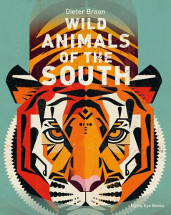
Wild animals of the south by Dieter Braun
Flying Eye Books, 2017. ISBN 9781909263970
(Ages: 5+) Australian animals. African animals. South American
animals. Antarctic animals. This is a translated edition of a German
publication, with a second book, Wild animals of the north, also
available. There are many of these artsy, illustration-based
non-fiction books around for children and lots of them are
extraordinary in terms of their visual appeal as well as their
ability to engage young readers, many of whom are becoming more
discerning about the aesthetic qualities of their reading material
as well as shying away from text-heavy books. This one is organised
into four regions: South America, Africa, Asia and Australia. In
keeping with the visual focus, the contents are graphical (using a
map) and the index, organised by region, is pictorial (confusingly
not ordered alphabetically).
The introduction sets a conservationist tone for the reader as it
draws attention to the many species of animal currently threatened
with extinction. It opines 'We are intruders in the animal kingdom
and with every animal that dies out, our life on this planet loses a
part of its power and colour and beauty'. This is a wonderfully
written statement with the power and clarity to resonate with adults
and children alike. The author, by providing breath-taking
illustrations that display their beauty and immenseness, emphasises
that wild animals need to be respected and protected. The
illustrations are not completely realistic, but they are
scientifically accurate and incredibly detailed. The colours are
bright and vibrant, but not always true to life. Many of the
animals, composed of layered geometrical shapes, appear to pop off
the page, piercing you with their intense eyes.
This is a book to appreciate visually but is in no way a reference
or research book. Despite the introduction telling us, 'this book...
tells us how and where they live, what they look like, what they
eat, how they find each other or hide from one another and all the
other things they get up to' the illustrations really are the main
event and they deserve to be. Scientific names are given alongside
common names but aside from this inclusion (which is probably done
to give an exotic feel rather than for educational purpose) minimal
and sometimes no information is given about the included animals.
What information is given is limited in scope and often pertains to
one aspect (e.g. the kookaburra's laugh). In addition, it is far
from comprehensive; it includes only eighteen Australian animals and
a mere eight from the Antarctic region. While clearly not intended
as a reference book, it seems odd that information is not given for
each animal. Nevertheless, this is a beautiful book of art sure to
be treasured by animal lovers and young artists.
Nicole Nelson
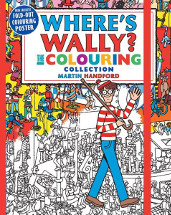
Where's Wally? The colouring collection by Martin Handford
Walker Books, 2017. ISBN 9781406375701
(Age: 8+) Highly recommended. With the interest in colouring in
going strong, both children and adults will find lots of pleasure in
this colouring book featuring Wally. Even those who are not so keen
on colouring in will still love the opportunity to find Wally in the
many black and white scenes that can be found in the book. Wally is
lurking near a pond, in a dinosaur park and in the middle of a
medieval festival as well as many other exciting and interesting
places. The pages present quite a challenge for the colourist to
complete, with their small and intricate drawings, and definitely
would be rather difficult for little hands to manipulate.
The paper is thick, the book sturdy and there are other challenges
to complete. I was taken with the Super Sneaky Villains who all look
like Wally with the exception of having mostaches and had fun trying
to find Wally in the pages of villains. At the back of the book is a
giant size poster featuring dinosaurs (and Wally is rather hard to
find here), which could be pinned up in a library, classroom or
bedroom and completed at leisure.
This book will give hours of relaxation and fun. It would also be a
fabulous gift for children who have to while away hours on a long
car or plane journey.
Pat Pledger
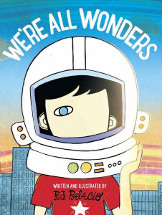
We're all wonders by R. J. Palacio
Penguin, 2017. ISBN 9780141386416
(Age: 4-7) Highly recommended. Paperback, 32 pages.
Imagination. Play. Emotions. Feelings. Acceptance. Tolerance. Special
needs. R. J. Palacio's best-selling novel Wonder introduced
readers to Auggie Pullman an ordinary boy with an extraordinary
face. This novel inspired the Choose Kind movement that encourages
everyone to choose kindness, be tolerant and accepting of other's
unique qualities. We're all wonders with its simple, bold statements and
colourful, graphic illustrations introduces Auggie and his dog Daisy
to younger readers. Palacio's desire is to help children understand
the need for tolerance, acceptance and kindness. Auggie does
ordinary things, riding a bike, eating an icecream and playing
ball, however he does not look ordinary. On the portrait wall, even
though there are students from different backgrounds, countries,
with different facial features, he stands out. His loving mother
says he is a wonder but he knows others see him as different.
Palacio's emotive, stylised illustrations beautifully portray
Auggie's emotions when his feelings are hurt: the little boy, his
dog, even the blue bird in the wagon all are drawn with their heads
down looking dejected. His helmet is drawn as a symbol of protection
and he blasts off across a starry galaxy to Pluto where all the
creatures who have the same unique faces welcome him. Auggie is
shown looking back to Earth wishing that there is room for everyone
to be loved and accepted.
This simple picture book is a fantastic starting point for families
to discuss tolerance, acceptance and physical differences. From the
front cover, to the last page where the world is reflected in
Auggie's one eye, this is a powerful picture book. We're all
wonders is a key book for teaching ethical understanding in
the Early Years: identifying and appreciating similarities and
differences in people; exploring how people feel when they are
included and excluded from groups and demonstrating appropriate
language when encouraging others.
Rhyllis Bignell
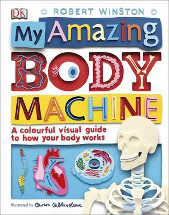
My amazing body machine by Robert Winston
Ill. by Owen Gildersleeve. DK Publishing, 2017. ISBN 9780241283806
Young children are always fascinated with their bodies and how they
work and this new publication from DK is the perfect starting point
for those who are ready to delve a little deeper.
Divided into nine sections, each dealing with a different but
related phenomenon of the body, with bite-sized chunks of
information in accessible text interspersed with colourful
informative diagrams and photos, this would be an ideal addition
to the family reference library, ready to consult when questions are
asked, as well as the school library collection. Having it out on
display so students can leaf through it as they wait will spark lots
of curiosity and a desire to find out more. The perfect introduction
to the role of the encyclopedia as a starting point to finding out a
little and sparking the desire to go to a more specialised book to
find out more.
DK have been at the forefront of introducing non fiction to young
readers for decades and this is no exception.
Barbara Braxton
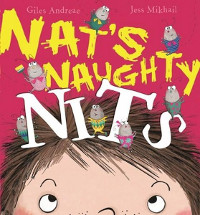
Nat's naughty nits by Giles Andreae
Ill. by Jess Mikhail. Orchard Books, 2017. ISBN 9781408329375
(Age: 4-6) Hardcover, 29 pages. Lice. Rhyming stories. Humorous
fiction. Health. Daily living. 'There are nits in the treetops,
Nits in the town,
Nits on the toilet seat with their pants pulled down!'
Giles Andreae tackles a new but very familiar subject in this funny
rhyming story. Nat's naughty nits have come to play, they have
invaded his hair and his life, they are even playing football,
eating treats and sleeping safe and sound. There is an abundance of
little black creatures up to all sorts of mischief, until Mummy
appears with her shampoo and comb. Nate's nits are gone, and he is
looking very smart until we see them travelling along the tabletop
off to find a new head.
Jess Mikhail's lively nits wear a bold array of outfits perfect for
their insect bodies, as they engage in a humourous range of
activities. Their funny expressions, up close antics and settings
are delightful, an amusing accompaniment to Andreae's rhyming story,
which is presented with a range of font sizes from big and bold to
tiny. Nat's naughty nits is a fun story to share with a family or
class, especially as an introduction to healthy living and how to
cope with this very common school problem.
Rhyllis Bignell
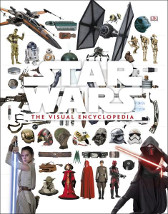
Star Wars: the visual encyclopedia by Tricia Barr, Adam Bray and Cole Horton
Dorling Kindersley, 2017. ISBN 9781465459626
(Age: 8+) Highly recommended. Encyclopedia, Star Wars, Film history,
Technology. The most amazing compendium of all things about Star
Wars is presented in this large format, heavy tome. What a
coverage: from set design to costume, machinery to ammunition, space
ships to galaxies, characters to flora and fauna, here is a
wonderful contribution to the plethora of books now written about
Star Wars, giving a bird's eye view of all the thought, design and
making that went into the preparation of the worlds created for that
series of films. Watching any of the films makes the audience gape
in wonderment at the array of things shown, but reading this book
underscores the brilliance of the creators, the range of ideas
developed, the level of sophistication of all the people who worked
on it. I couldn't put it down.
Divided into five sections: Geography, Nature, History Culture and
Science and technology, all aspects of the film are covered, with
the last taking up almost half of the book. The first section,
Geography, shows all the planets, both inner and outer that make up
the galaxy, as well as other celestial bodies traveling in space.
Specific detail is given about the mountains, rivers and make up
some of the planets, leading into urban geography and architecture.
Nature describes and shows some of the creatures which make up this
galaxy, leading from the most grotesque of animals to the human and
not quite human. History fills us in with the war between the powers
in the galaxy, with a timeline of events to make sure we know what
happened and when, in relation to other events. This section
includes all the protagonists, and there are many of these. Culture
shows us the design of the clothing, and leads onto food an art.
But the last section, Science and Technology, is huge. Droids,
security and medical droids, communications technology, equipment
and field gear, are described in detail, until the munitions pages
are reached. Here every reader will revel in the illustrations and
descriptions of the rifles, blasters, projectiles and shields, light
sabers, and starfighters. I loved the range of things explained and
illustrated and will look at the Star Wars films with a new
appreciation of the depth of design that went into these now classic
sci fi films.
Fran Knight