Ill. by Mauro Gatti. Flying Eye Books, 2017. ISBN 9781911171218
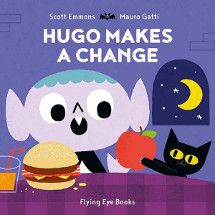
(Age: 3-5) Themes: Diet and Nutrition, Vampires. Hugo the vampire is
a carnivore, he's 'crazy for red, juicy meat!' After dark, he prowls
through town looking for a meal. He' a hungry young creature with
only one thing on his mind, gobbling up 'hot dogs, a roast and a
ham, a T-bone or two and a big leg of lamb.' Hugo Makes a Change
is an entertaining rhyming story all about nutrition and eating a
balanced diet. Emmons and Gatti have created a lively tale with
bright, bold digital images.
Hugo discovers his meat only diet leaves him bloated, slow, and
lacking any energy. He comes to the realisation that he needs to
change his food choices. Instead of visiting steakhouses and diners,
he drops into a vegetable garden where he sees new foods with
wrinkly leaves, red lumpy blobs and long green mystery objects.
Hanging upside down on an apple tree he tastes a small juicy fruit
and discovers a new taste sensation. One big white fang pierces the
skin and Hugo's life changes. Back to the vegetable garden he walks,
sharing a delicious picnic with his friendly black cat. His kitchen
bench is filled with a variety of fresh produce and he plans
delicious meals using meat, fruit and vegetables. Hugo's energy
levels rise as he enjoys raisins on a moonlight ride and has healthy
snacks watching television.
Emmons' simple poetry is engaging and this story provides teachable
moments and opportunities for discussion about healthy food choices.
Toddlers and preschoolers will enjoy the graphic pictures, vibrant
backgrounds and identifying the foods mentioned in the rhymes.
Rhyllis Bignell
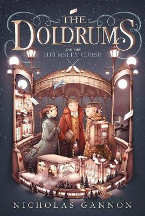
The Doldrums and the Helmsley Curse by Nicholas Gannon
Greenwillow, 2017. ISBN 9780062320971
(Age: 9-12) Themes: Good and Evil, Adventure stories, Friendship.
Nicholas Gannon's beautifully crafted sequel The Doldrums and
the Helmsley Curse brings Archer's infamous explorer
grandparents' home after a lengthy and mysterious disappearance.
Their return causes much controversy in Rosewood with the Chronicle
newspaper printing false accusations about them orchestrating their
iceberg shipwreck and supposedly cursing the city with Arctic
weather. With the help of his close friends, Oliver and Adelaide,
Archer sets out to find out the truth because family loyalty and
honour are worth fighting for.
Grandma and Grandpa Helmsley are summoned to a grand banquet and to
give an account of their actions to the members of the Society.
Archie, Oliver and Adelaide use their time to explore the rooms in
the huge building, uncovering more secret plots and learning of the
Society's President Herbert Birthwhistle's plans to destroy the
Helmsley's reputations. While Oliver's father continues to print the
truth in The Doldrums Press, townsfolk aren't convinced and set out
to banish the explorers.
The three friends learn to rely on each other as the creatively plan
to unravel the mystery, outwit unscrupulous villains and narrowly
escape from some dangerous situations. Visits to the delicious
Duttonlick's Sweetshop, creating special chocolates with behaviour
altering Doxical Powder makes for a funny party scene. Adelaide's
wooden leg does little to hinder her full engagement with the
activities and the addition of a new friend Kana further assists
their plans. As the blizzard worsens and Christmas approaches,
Archer's determination to help his grandparents heightens the
excitement. Their derring-do capers include the use of a ham-radio,
a crazy ride in a three-wheeled van and the judicious use of a
dumbwaiter.
Nick Gannon's architectural drawings, stylised colour illustrations,
black and white spot sketches add definition to the literary text. The
Doldrums and the Helmsley Curse presents a new world, brimming
with charm, relatable characters, with plenty of action and
intrigue, perfect for confident readers.
Rhyllis Bignell
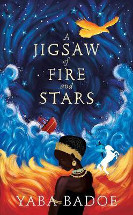
A jigsaw of fire and stars by Yaba Badoe
Head of Zeus, 2017. ISBN 9781786697981
(Age: 13+) Themes: Magical Realism, African folklore, Human
trafficking, Resilience. A Jigsaw of Fire and Stars is a
fast-paced present tense narrative told from fourteen year old Sante
Williams' point of view. As a baby she was tucked in a
treasure-filled sea chest and thrown overboard from a sinking
African refugee boat. Sante was rescued by a ragtag bunch of adults
who live on the edge of society performing as Mama Rose's circus
troupe. Together with Cobra the snake handler, her closest friend
and Cat the knife thrower, these children grow up within the
confines of a unique close-knit family environment. Sante's
companion Priss the golden eagle is her constant friend, a powerful
protector in troubled situations. Sante is a mind-whisperer too, she
conjures up dreams and memories of the past when she plays on her
bamboo flute.
When Sante's musical performance is observed by two mysterious
characters, Grey Eyes and the African, her life begins to unravel.
They seek the treasure from the sea chest and employ unscrupulous
measures to capture Sante, her friends and the goods. The rescue of
a troubled teenager Scarlett from drowning, soon adds a much darker
element to Sante's perilous situation. She is running from a drug
and human trafficking ring and Sante, Cat and Cobra join forces to
help her. Sante's headstrong ways lead them into many precarious
situations, narrow escapes, fleeing across Spanish rooftops,
stealing motor scooters as she calls on her spirit guides and eagle
Priss for assistance.
Badoe's lyrical novel draws imagery with powerful alliterative
descriptions, unusual dream sequences and intuitive scenes. Sante's
world is peopled with flawed characters out for their own gain, even
those close to her have different agendas. The author takes the
young adolescent reader into some topical issues - sexual
exploitation, human trafficking, the near-suicide of one character
and the killing of refugees by sinking their boats. The main
character has a distinct voice, driven by the desire to learn about
her heritage. A Jigsaw of Fire and Stars is an unusual story
alternating between action that rushes chaotically and dream
sequences that conjure up sensory memories of her past African life.
Rhyllis Bignell
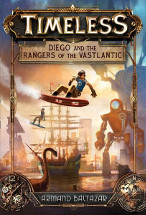
Timeless : Diego and the rangers of the Vastlantic by Armand Baltazar
Harper Collins, 2017. ISBN 9780008258955
(Age: 10-14) Highly recommended. What would the world look like if
the past, present and future collided together? Timeless : Diego
and the Rangers of the Vastlantic describes that world in
words and approximately 150 beautifully executed illustrations.
Diego Ribera lives in a merged world, created during the
catastrophic Time Collision. At the beginning of the novel, Diego's
parents who have come from two different time periods, are
celebrating his thirteenth birthday. His father Santiago, a gifted
engineer, gives Diego his present, a gravity board which allows him
to fly a skateboard type device. More importantly, Diego also learns
of another gift, a special inherited skill that allows him to
develop the same amazing talents of his father.
Santiago, New Chicago's top engineer, is abducted by the evil
Aeternum and his followers, who are trying to alter the Time
Collision's world. It is up to Diego, his teenage friends and a
small band of pirates to try to rescue his father and other
prisoners.
This novel is an epic accomplishment for Armand Baltazar, a former
art director for Disney and Pixar. The intensely coloured plates
show a world where dinosaurs walk alongside robots and steam punk,
fantastical machines exist beside WWII planes.
Illustrations imitate a movie and students who have enjoyed this
same cinematic style in Brian Selznick's, The invention of Hugo
Cabret will appreciate this colourful version.
This is obviously the first book in a series as the final pages
reveal a surprise that will encourage the reader to continue with
this fantasy/science fiction world.
I highly recommend this novel for students from middle primary
school to early high school years.
Jane Moore
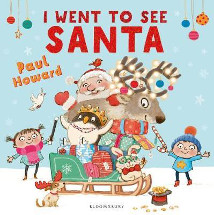
I went to see Santa by Paul Howard
Bloomsbury, 2017. ISBN 9781408844724
It's a classic scenario of little ones and their need to be just
that bit better than their friend. So when the little girl announces
that she went to see Santa and got a pair of Christmas glasses, her
friend says well he not only got Christmas glasses but also an
amazing magic set!
And so it goes on and on, getting more and more fabulous until the
most unexpected end!
Young children love stories like this where they can not only join
in but also help the ageing, forgetful adult remember all the things
in the list. If you share this with more than one, prepare for a
rollicking, raucous time that will bring joy and delight and an
affirmation that stories and books and reading are FUN!
Barbara Braxton
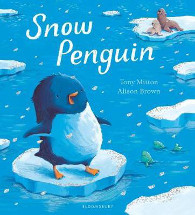
Snow penguin by Tony Mitton
Ill. by Alison Brown. Bloomsbury, 2017. ISBN 9781408862957
(Age: 4+) Recommended. Themes: Penguins, Antarctica, Adventure,
Exploration. In the Antarctic, one little penguin decides to explore
his surrounds. He leaves the warmth of his family, and looks
outward, standing on a piece of ice which cracks and floats away
from the land. On his little piece of ice he sees the most wondrous
things: a blue whale which thrashes its large tail nearby, its baby
calf at its side, a school of orca swim by, an elephant seal waking
from its nap, a seal and its pup.
Told in rhyming lines, the words are easily remembered by young
people willing and eager to say the story out loud, while predicting
the rhyming word at the end of each sentence.
It is when the baby penguin sees the seal and its pup that he begins
to think about his own family and wonders how to get back to them.
Thankfully his piece of ice knocks into the ice near the pack of
penguins and he is able to be reunited with his family.
Younger children will love reading of the little penguin and its
adventures on the ice, reading along with the teacher or parent,
predicting the words that rhyme, learning about the animals and
their environment in the Antarctic. The illustrations add to the
enjoyment of the read, covering every page with the cold blues and
whites of the Antarctic environment.
Fran Knight
What's going on down there?: A boy's guide to growing up by Karen Gravelle
Ill. by Robert Leighton. Bloomsbury, 2017. ISBN 9781681193618
Recommended. Themes: Sex; Growth and Development. This is a very
simply written, down-to-earth explanation of the growth and
development that occurs during puberty, focusing on the
circumstances for boys. It does also include brief discussions of
the changes that girls will experience in puberty. It includes small
humourous illustrations to make the reader comfortable with the
emotionally charged revelations of all the changes that a young
man's body will experience. With simple explanations of puberty,
sex, contraception, sexually transmitted diseases, what constitutes
sexual harassment, making babies and 'normal', this book gives
accessible information that is mostly helpful for a younger reader.
This would also be a good reference for those who want to be ready
for discussing these issues with a young boy in the pre-puberty or
beginning puberty phase. Teachers and parents should probably
pre-read this book before handing it over, to be sure they are ready
for questions and to enable an open discussion about 'What is going
on down there!' Some minor references to moral decision-making with
regard to sexual choices is included, but the purpose of the book is
primarily to discuss physical changes and to explain sex to a young
reader.
Carolyn Hull
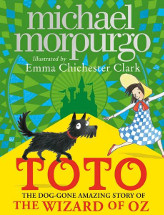
Toto: The dog-gone amazing story of the Wizard of Oz by Michael Morpurgo
Ill. by Emma Chichester Clark. Harper Collins Children's books,
2017. ISBN 9780008134600
(Age: 5+) Highly recommended. Themes: Fantasy tale; Home; Kindness;
Resilience. Michael Morpurgo has added his wonderful skills to
retell the story of Dorothy and Toto and the Wizard of Oz. Told from
the perspective of Toto, who tells the tale of the journey to the
Land of Oz to the young and weakest puppy (who might need its own
message of kindness, courage and goodness); this is a beautiful
rendering of the traditional tale. Dorothy's friendship with
Scarecrow, Tinman and the cowardly Lion is retold in a warm and
powerful way, highlighting the value of friendship and self-belief
against the odds. The potentially scary moments in the story are
always forewarned by the narrator Toto, with comforting comments to
remind the reader that all will turn out well in the end. The
strength of the story is always in the honourable and good and kind
way that Dorothy responds, her resilience in the face of difficulty
and in her mantra that "home is home . . . and home is best" even
when uncertainties cross her path. And of course Scarecrow, the
Tinman and Lion also learn valuable lessons too.
Illustrations by Emma Chichester Clark are naive and warm and
intriguing, and will appeal to young readers. This is certainly a
book that would make a wonderful read-aloud for a parent to a child
and the lessons that could be shared would enrich their
relationship. The mastery of Morpurgo's writing skill is that the
book would be loved by both adult and child, and I am sure, read
more than once. I was also impressed with the way that the wicked
witches had minimal 'fright-power' for a young reader (no scary
dreams likely after reading!)
Carolyn Hull
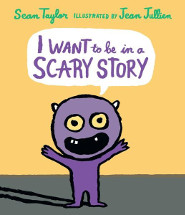
I want to be in a scary story by Sean Taylor
Ill. by Jean Jullien. Walker Books, 2017. ISBN 9781406363463
Ages: 3 - 7) Highly recommended. Picture Book. Little Monster is the
cute, purple coloured cartoon character of this tale. The text
spoken by LM is in matching purple. He clearly loves stories and
announces to the narrator that he would like to be in one himself
(herself?) Nowhere is Little Monster's gender identified but seems
male for whatever reason I can't quite put my finger on which
probably reflects on my upbringing. Certainly though, any little
girl monster reading the story is in no way excluded.
The story he would like to be in needs to be scary so he says. The
narrator, having a sound understanding of little one's psyche better
than he does, suggests maybe a funny story would be a more suitable
idea. The very bold and brave LM however, disagrees and insists on
"scary". The story begins to unfold with the setting of spooky
houses and forests and suggestions by the narrator to populate it
with witches and ghosts. As each page turns, the little reader can
see LM's consternation unfolding at the thought of personally
encountering these challenges and LM saves face by announcing that
he would definitely prefer to be the one to do the scaring. Even
that obviously has its less than acceptable challenges and so LM
takes the narrative direction into his own hands. He creates the
wonderful compromise of a funny, scary story that suits his
specifications down to the ground. He, of course, enjoyed it so
much, he would like to be in another story again tomorrow.
I enjoyed reading this book and I'm pretty sure my 4 year old
granddaughter is going to enjoy exploring "scary's" acceptable
boundaries with me as we read it.
Elizabeth Avery
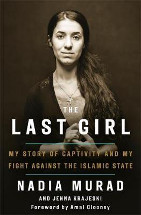
The last girl by Nadia Murad and Jenna Krajeski
Virago, 2017. ISBN 9780349009759
(Age: Senior secondary - Adult) Highly recommended. The Yazidi
people are a religious minority group living primarily in a northern
province of Iraq. Because they worship a fallen angel, Melek Taus,
the peacock angel, they have been branded devil worshippers by the
Islamic State of Iraq and Syris (ISIS) who have selected verses of
the Qur'an to justify treating the Yazidi as property not humans.
Thus Yazidi may be traded as slaves or killed without any qualm of
conscience.
Nadia Murad, a Yazidi, born and raised in the small village of
Kocho, Iraq, has documented how ISIS lay siege to their village,
killed the men and elderly women, took the young men for
brainwashing as soldiers and suicide bombers, and forced the girls
and young women into sexual slavery. Nadia was sold and traded on
the slave market by ISIS extremists, and repeatedly subjected to
torture and rape. She survived and eventually escaped, bravely
assisted by a Kurdish Muslim family, and she lives on to reveal to
the world the genocide of the Yazidi undertaken by ISIS, and to
fight for the survivors of human trafficking. She is the 2016
recipient of the Sakharov Prize for Freedom of Thought, along with
friend Lamiya Aji Bashar who was seriously disfigured by a landmine
in her bid for freedom. The last girl is Nadia's story, beginning with the humble
Yazidi village life, of extended family and close community, where
her simple girlish dreams were to become a hairstylist or
beautician. Then in 2014, her village was encircled by ISIS and the
people massacred, the girls taken away on buses to Mosul to ISIS
headquarters to become sex slaves. Some committed suicide, some like
Nadia eventually escaped, others continue to suffer somewhere in
Iraq or have been trafficked to Syria.
If you think this all sounds too horrible to read, Murad spares us
the graphic details. Her way of coping at the worst times was to
shut down her mind, and she does the same in the book, she shuts
down on the details, and just tells us the events. It is
nevertheless a very moving story, one that needs to be heard.
As Amal Clooney says in the foreward to the book, amazingly Nadia
Murad's spirit has not been broken, and she continues to campaign
for justice. 'She has become the voice of every Yazidi who is a
victim of genocide, every woman who has been abused, every refugee
who has been left behind'.
Students studying modern slavery or the refugee crisis could gain
insight from reading this book. Other readers could gain a better
understanding of how ISIS is an extremist group that is a threat to
all people, Muslims and Westerners alike.
Helen Eddy
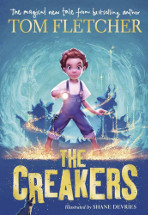
The Creakers by Tom Fletcher
Penguin, 2017. ISBN 9780141388762
(Age: 10+) Recommended. "What silently waits in the shadows at
night? What's under your bed, keeping just out of sight? Do you ever
hear strange, creaking noises at night? Ever wonder what makes those
noises? Lucy Dungston always did. Until, one morning, Lucy discovers
that all the grown-ups have disappeared - as if into thin air. Chaos
descends as the children in Lucy's town run riot. It's mayhem. It's
madness. To most kids, it's amazing! But Lucy wants to find out the
truth. Lucy lost her dad not long ago, and she's determined not to
lose her mum too. She's going to get her back - and nothing is going
to stop her...
...except maybe the Creakers." (Publisher)
Tom Fletcher is certainly a talented author. He has managed to
capture his audience once again as in The Christmassaurus.
It will certainly be a big hit with the girls with the lead
character being a short haired heroine who is kind, smart and brave!
Lucy is an inspiring role model who stands up for what she believes
in and feels quite comfortable making friends with children that are
usually outcasts. It is interesting to find the hidden message of
the importance and usefulness of recycling and sustainability with
waste products. The book will ignite the imagination in all and
engage even the most reluctant reader. With snippets of unbelievable
magic and laugh out loud moments, Fletcher's book has mastered the
art of describing things in a funny way. I can see children aged ten
and up (as there are a few scary bits) enjoying this read - a must
have for the library collection. It would also make a great read
aloud with some adult humour sprinkled throughout.
Kathryn Schumacher
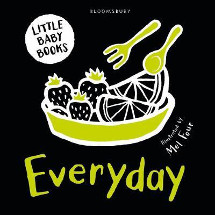
Little baby books: Everyday illustrated by Mel Four
Bloomsbury, 2017. ISBN 9781408873762
(Ages 0-2) Recommended. Board picture book. Mel Four has very
cleverly and simply brought to life 5 commonplace monosyllabic
nouns: car, sock, cup, duck and bear for the youngest readers
although a child up to the age of 2 would no doubt find it of
interest.
The main object of interest is depicted on the left hand side of the
page with its word clearly shown in lower case. Very shiny luminous
coloured paper is inserted into a black board background
highlighting the important parts and giving a different texture and
look to the rest of the page. This is quite a contrast to the usual
pastel colours of baby books. The right hand side of the page simply
outlines other objects a child might associate with the noun in
question. For instance we have 'cup' shown clearly on one side of
the page with an accompanying meal on the other. 'Sock' seems to
have fallen out of its really untidy chest of drawers with other
common articles of clothing spilling out all over. I really love the
'duck' page with little gold foil ducks happily standing out against
the black as they sail along in their bathtub.
Simple, but very attractive and effective.
Elizabeth Avery
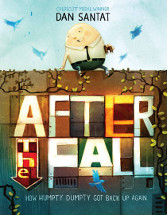
After the fall by Dan Santat
Lothian Children's Books, ISBN 9780734418319
(Age: 4+) Highly recommended. Themes: Humpty Dumpty. Nursery rhyme.
Confidence. Children will simply love this sequel to a beloved
nursery rhyme, Humpty Dumpty. The fate of that famous egg is not
known but Santat plays with the story, giving a very funny sequel
after the fall. The subtitle, How Humpty Dumpty got back up
again, will alert readers to the tale they are about to read,
and without thinking they will readily recall the nursery rhyme and
be ready for anything. Humpty tells the reader what happens after
the fall. He declines to call it the Great Fall, preferring to use
the words a 'just an accident', but the results of his accident are
far reaching. He can no longer climb the wall to sit there watching
the birds, a once favourite past time, he cannot sleep on his bed as
it is the top bunk, he cannot climb the ladder to the higher shelves
in the supermarket even though his favourite cereal is at the top.
But he still loves watching the birds, although now from the ground.
When a paper plane flies past he decides to try making a paper plane
to soar with the birds. After many unsuccessful attempts he finally
makes a magnificent paper plane and is able to fly it with the birds
he so likes. But it flies over the wall. A decision must be made.
This is a wonderful look at what frightens us and how we can
overcome fear, developing confidence to do something we are unsure
of, taking a risk, stretching a boundary. Humpty is very frightened
of the wall after his accident, his fear reflected in the number of
things he can no longer do. With lashings of humour, Santat develops
his sequel to this well known rhyme, encouraging readers to think
about things which they may be worried about and what steps they
need to take to overcome their fear.
Santat's illustrations are wonderful, from the title page with its
playful font, to the little additions of aptly named breakfast
cereal, children's at the top and more mundane adult fodder at the
bottom, to the images of the city in the background, each adding an
intriguing level of interest for the astute reader. Each page is
very different, some taking a bird's eye perspective, some Humpty's,
while all entreat the reader to look again, to work out what they
are seeing, to think about Humpty and what he is doing to overcome
his fear, and then how it relates to them, soaring with him on the
last magnificent page.
Fran Knight
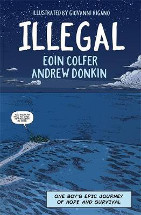
Illegal by Eoin Colfer and Andrew Donkin
Ill. by Giovanni Rigano. Hodder Children's Books, 2017. ISBN
9781444934007
(Age: 11+) Recommended. Themes: Refugees; Conflict; Freedom;
Survival. The flight to freedom is not easy for many in our world.
This Graphic novel illustrated in colour, clearly shows the journey
of survival of Ebo, a school-aged child with a beautiful voice, who
leaves his home village where he lives with his drunken uncle, to
find his siblings - one of whom has made the long journey to Europe.
With time shifts indicating the passage of time, forward and back,
we see the incredible difficulty he faces. First, he struggles to
find his brother, and then he becomes an illegal boat traveller as
he travels through very uncertain waters to reach Europe. The entire
journey is fraught with difficulty and risk, and the young boy faces
death on many occasions. Throughout this book, the reader is able to
connect to the concept, highlighted in the quote at the beginning of
the book, that no human can be 'illegal'. Ebo is a survivor, but the
book highlights that the journey to freedom for many people who flee
poverty, war or other conflict is not always successful - and yet
they too are humans with the same desire to live well, and to live
in safety.
The style of presentation as a graphic novel will provide
opportunity for many younger readers to grapple with the serious
issues that the world faces in meeting the needs of people who have
no official documents to travel. This is an epic story of hope and
survival, but it is also a sad story. An additional short, black and
white graphic tale of a young woman's journey to England is included
at the end of Ebo's story. Illegal does not shy away from hard issues or circumstances -
people smugglers, violence, bandits, murderers, but the format of
the graphic novel does make it possible for a younger reader to
understand without too much detail given.
Carolyn Hull
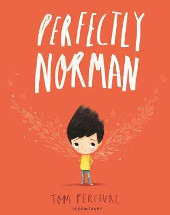
Perfectly Norman by Tom Percival
Bloomsbury, 2017. ISBN 9781408880975
"Norman had always been perfectly normal. That was until the day he
grew a pair of wings!
He had imagined growing taller or even growing a beard like his dad,
but not growing a pair of wings!
Norman is very surprised to have wings suddenly - and he has the
most fun ever trying them out high in the sky. But then he has to go
in for dinner. What will his parents think? What will everyone else
think? Norman feels the safest plan is to cover his wings with a big
coat.
But hiding the thing that makes you different can prove tricky and
upsetting." The coat became a burden, even an embarrassment and
Norman began to resent the wings until he realised it was the coat
making him unhappy, not the wings. After all, no-one else has wings,
so why him? Can he find the courage to discard the coat? What does
he discover when he does? In this poignant story about being
different, Percival has set the text against striking backgrounds of
various shades of grey depicting normal and dull while giving Norman
bright colour and light so that his feelings of being unique are
highlighted physically as well as emotionally. He has also chosen to
depict a diversity of characters, each unique in their own way and
each of whom accept Norman as normal, so really, what does "normal'
mean?
For a wonderful part of their lives, children don't see difference
and they just love who they are but then awareness starts to develop
and they start to see themselves with new and often unkind eyes.
They want nothing more than to be the same as their peers, to not
stand out, to be normal and anything that makes them unique, whether
it is skin colour, wearing spectacles, being an only child or
growing a set of wings, becomes a burden that they would rather not
carry. But the freedom when the coat is shed...
Accepting and celebrating who we are and what we are, especially
those things that make us special and unique is so important for our
mental health and at last, we are starting to understand that the
self-talk and messages we give ourselves as we interpret our
interactions and experiences as a child can have an incredible
impact on the well-being of our older selves. The more children can
encounter books like Perfectly Norman and discuss them so
they understand that there is no 'normal' or 'perfect' the healthier
they will be. It is our responsibility as teacher librarians,
teachers and other significant adults in their lives to make sure
they meet lots of Normans and not only grow to love their own wings
but to use them to fly!
Barbara Braxton