Ill. by Catherine Hyde. Zephyr, 2017. ISBN 9781786695895
(Ages 10+) Recommended.Themes: Personal identity, Africa social life
and conditions, survival, resilience. " . . . climbing is like the
journey of life. You start slowly. You try one way and if it doesn't
work out or you meet some obstacles, you keep searching until you
find another trail. There is always a second chance."
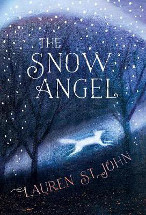
Lauren St John's The Snow Angel is a powerful and
confronting story, a drama played out in three acts, the joys of
family life, in the slums of Nairobi and finally new beginnings in
Scotland. Makena lives with her parents in the busy city of Nairobi,
sharing her father's passion for mountain climbing. She is
fascinated by snow and often dreams of climbing Mt Everest with
Hilary and Sherpa Tensing, and to her delight her father leads her
on a trip to climb Mount Kenya. His sage advice stands her in good
stead when her life takes on a tragic turn. After the mountain trip
her parents leave to nurse Aunt Mary, an aid worker in faraway
Sierra Leone. Struck down by the Ebola virus, her parents leave
behind their daughter who is forced to grow up quickly, facing a
destitute life, struggling to survive.
Forced to leave the family who are minding her, then due to a series
of unfortunate incidents, she ends up running away, sleeping in a
skip, fighting off attackers and desperately looking for food. With
a street savvy albino girl Snow, Makena quickly learns the ways of
slum life, gang warfare, starvation and experiences children being
abducted and sold into slavery.
Music brings joy to their lives and the recurring motif of snow and
magical sightings of the silver fox are signs that lift the young
girl's spirits. Fortuitously Makena's life is changed when she meets
Helen an orphanage director for the forgotten children of Kenya. In
the third act, Makena's luck changes as she flies off to Helen's
homeland Scotland, and slowly makes a new life with her. The Snow Angel is wonderfully written, the shades of African
life, the class and social divide, life and death, the confronting
survival of the impoverished are all realistically portrayed. The
harsh realities of Makena's life are told honestly and make this a
book suited to a teen audience. The moody, dark drawings add depth
to this emotional story which seamlessly explores themes of
friendship, survival, and courage and seeking positivity in the face
of despair. Even in the darkness there's a little glimmer of light
shining from the tail of the magical silver fox.
Rhyllis Bignell
A lion is a lion by Polly Dunbar
Walker Books, 2018. ISBN 9781406371536
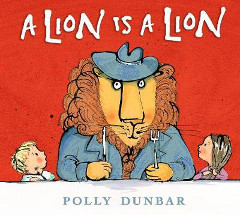
(age: 4+) Recommended. Themes: Humour, Proverbs, Lions. This
initially tongue in cheek look at a lion charming his way into the
family, doing things that lions definitely do not do: walking down
the street with an umbrella, swinging on a lamp post, wearing a
jaunty hat, then coming inside to sit down with the children at
lunch time begs the readers to be wary of the lion.
The question is always there, that despite appearances, is the lion
still a lion. At first he is shown wearing his hat. Then he adds
another piece of clothing to his body, entering the home of the two
children ready for lunch. He plays with them in the house, swinging
them around and listening to the music. Sitting down to lunch at the
table, he eats all his greens, but after lunch he wants desert. His
demenour changes, his teeth look much bigger than before, his eyes
more cruel. The children realsie that he is still a lion and get rid
of him from their home. So the lion is still a lion despite
appearances and the words that come from his mouth. A lesson to be
learnt, and children will be encouraged to discuss what they can do
when confronted by someone or something which appears benign but is
not.
Several proverbs spring to mind when reading this book, proverbs
that can be shared with the readers. A leopard cannot not change his
spots, beware of strangers, once an eagle - always an eagle, a wolf
in sheep's clothing, don't judge a book by its cover, and so on.
These could be discussed with the class or readers as the book is
read, and lead on to many discussions after the book has been put
aside.
And it makes a wonderful read aloud. Roar.
Fran Knight
Ice Wolves by Amie Kaufman
Elementals book 1. Harper, 2018. ISBN 9781460755273
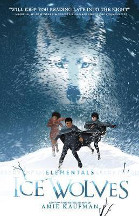
(Age: 10-14) Recommended. Anders and his sister Rayna are orphans
who survive on the streets of Holbard. They live by their wits
stealing and scheming together, with Rayna being the planner and
organiser of the pair. They are inseparable twins who imagine their
life will always include each other. Both children keep their
distance from the Ice Wolf patrols who ensure the city is safe from
its sworn enemies, the evil Scorch Dragons.
"The Trial of Staff" is a gathering that selects the next 12 year
olds destined to become the new generation of shape shifting Ice
Wolves. By holding the staff, the chosen children will transform
into an Ice Wolf, join the Ulfar Academy and train to fight the
Scorch Dragons.
The twins attend the busy congregation to pick the pockets of the
many attendees but fatefully both children touch the staff. Anders
takes on the form of an Ice Wolf but his twin Rayna shape shifts
into a Scorch Dragon and after being attacked, flies away with other
hovering dragons.
Anders realises he must train at the Academy to secretly discover
how he can reunite with his sister, who he still loves and misses.
The wolf pack demand loyalty above all else and Anders soon finds he
is torn between betrayal of his own pack and the love for his twin
sister. Ice Wolvesis obviously the first in a series as the book ends
with an exciting cliff hanger.
Amie Kaufman has created a fascinating fantasy world that
investigates different perspectives of good and bad.
Most of the book concentrates on Anders as he strives to find his
sister and rescue her. It is only at the end of the novel that his
long-held truths are questioned.
Amie Kaufman is a New York Times award winning Young Adult author. Ice
Wolves is her first solo fantasy novel aimed for a younger
audience. I recommend this book to fantasy readers from 10 - 14
years old.
A book trailer is available at this site.
Jane Moore
Dotty Detective: The birthday surprise by Clara Vulliamy
HarperCollins, 2018. ISBN 9780008248413
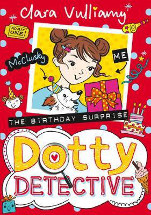
(Age: 7+) Recommended. "Dot, her best friend Beans and her dog
McClusky all love sniffing out a good mystery and together they will
solve the case and save the day . . .
Dotty is sporty, funny, creative, clever and FEARLESS: She is great
with codes and puzzles and most of all - if there's a mystery to
solve - she's your girl. This time round her trusty sidekick, Beans
and TOP DOG, McClusky are keeping secrets from Dotty - will she like
their surprise?"(Publisher)
Dot is a stationery-mad girl with a fondness for coding and
detection and each of the brilliant Dotty Detective books shows her
solving a mystery at school or at home, with the help of her best
friend Beans - and of course McClusky the dog.
The fifth book in the series (although they do not have to be read
in order), will be popular with both boys and girls aged 7 and up.
Dot's friendship with Beans is threatened with the arrival of a new
boy in the class. She is now faced with a dilemma of who will help
her solve the mystery when it presents itself to her? Once again
Vulliamy has hit the nail on the head with the way she is
introducing the children to the appealing mystery and detective
genre while combining everyday life issues including siblings,
friendship and school life. Although it is not a graphic novel, I do
love the snapshots, codes and doodles that are interspersed in the
text. These will certainly be a hit with a wide range of children
and would make a great read aloud.
Kathryn Schumacher
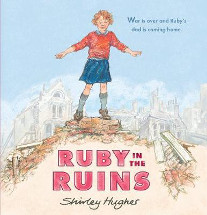
Ruby in the ruins by Shirley Hughes
Walker Books, 2018. ISBN 9781406375893
(Age: 4+) Highly recommended. Themes: World War Two, London, The
Blitz, Children affected by war. As 1945 comes around, Ruby and her
mother are still living in London, surrounded by devastation as
night after night bombing raids on their city flatten the streets
and houses around them. But they stay, despite neighbours moving to
safer places, in case Ruby's Dad comes home.
Hughes' illustrations depict the area in which they live with an
emotional overlay, looking as they do like any flattened city which
children see every night on their evening news.
Ruby and her mother snuggle down each night in their big double bed
until the all clear sounds in the morning, and when peace is
declared those left in the street celebrate with a street party. One
by one the men return, but when Mum hugs a tall thin man who comes
down from the train, Ruby is shy, unsure of who this stranger is. At
home, he seems to take up the whole space, and Ruby has to return to
her rather dilapidated room in the attic.
One day the boys ask her to go exploring with them and she runs off,
with Mum telling them to stay in their own neighbourhood.
But exploring an old site with a warning sign Ruby falls. One of the
boys rushes off to get help, and it is her father who returns with
him to help her home. He is a stranger no more.
In tightly packed prose, Hughes outlines a story common to many
children, getting to know again a parent who has been away for a
long time. Set during World War Two in London, the story has a wider
significance for many children emotionally lost during war time or
bombing or dislocation. Readers will certainly learn more about the
effect of war on Londoners during the The Blitz, but will also see
parallels to many other children over the world, at a loss trying to
understand the effects of war upon their families. This production
with its haunting illustrations, will draw in the reader as they
look at the details shown, and eagerly peruse the endpapers with
images of banners and instructions advertised by those in charge
during World War Two. The book will create a platform for discussion
in the classroom when war and its effects upon children is
discussed.
Fran Knight
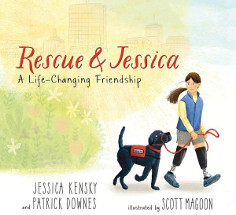
Rescue and Jessica by Jessica Kensky and Patrick Downes
Ill. by Scott Magoon. Candlewick Press, 2017. ISBN 9780763696047
(Age: 7+) Recommended. Themes: Service dogs, Disability. When
Jessica is in hospital she is told that she is having a leg removed
while still recovering with her other damaged leg. She is unsure of
what life holds for her when the doctor recommends she have a
service dog. Reading the endpiece we find that Jessica is recovering
from her injuries sustained at the Boston Marathon bombing in 2013
and so readers will see that this tale is based on a true story of
Jessica meeting and learning to walk with her dog, trained to be at
her service. Understandably there is some trepidation on her part,
and this book exposes her concerns by paralleling them with those of
the dog, Rescue. He wanted to be a Seeing Eye Dog, but when told he
would be a Service Dog, was disappointed. But in training and then
meeting his partner, the two became firm friends.
This easily read book with copious illustrations details the
training that both members of the team receive in preparing them for
their life together. Children will love seeing the way the dog is
trained, and how Jessica learns to adapt to life with a prosthetic
leg. Part way through their orientation, Jessica learns that her
other leg is not as healthy as it should be and so is also removed.
This informative book will tug at the heart strings as the dog and
Jessica are shown working together. It is amazing what these animals
can be trained to do and readers will pore over the information
given at the end of the book, and look further to extend their
appreciation of man's best friend.
Fran Knight
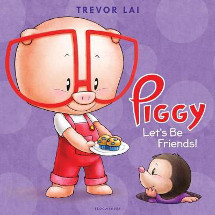
Piggy: Let's be friends by Trevor Lai
Bloomsbury, 2018. ISBN 9781681190686
(Age: 3-6) Recommended. Animals, Friendship, Cooking. Piglet sees a
mole in his garden, but just as he is about to become friends with
the animal, it burrows underground and gets away. Piglet loves
making friends, he also loves reading and having tea parties with
his friends, and another friend is always welcome.
Mole likes reading too, and he bakes cakes, but is very shy and when
he is nervous he sneezes. One day, Piglet makes a tea party and
invites Mole. Mole bakes a lovely cake but bringing it into the
garden, he becomes shy and sneezes, sending the cake into the air,
landing on his head. Before anyone can help, he scurries down into
his hole, embarrassed. Piggy and his friends decide what to do to
make him overcome his shyness and be friendly with the rest of the
group, and the story ends neatly as it becomes smiles all around.
This is a nicely told story of inclusivity, of helping out those who
are in need of friends, of including everyone in what is happening.
It would make a cute introductory story to talk about friendships
and friendship groups in the class, encouraging everyone to be
inclusive. Piggy's huge glasses will certainly intrigue younger
children, and the baking of cakes throughout is an extra treat for
the eyes.
Fran Knight
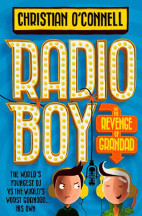
Radio Boy and the revenge of Grandad by Christian O'Connell
HarperCollins, 2018. ISBN 9780008200596
(Age: 9-12) Recommended. Spike runs his own radio show from his
backyard shed and with the help of his friends Artie and Holly, all
seems to be running well . . . until the arrival of Spike's grandad
who has been kicked out of his home by Spike's exasperated Nan.
At first Spike lets his narcissistic, showy Grandad talk on his show
but eventually Spike has to "sack" him so that his listeners no
longer have to hear Grandad's repetitive, rambling stories. Grandad
seeks revenge by entering the local "Radio Star" competition, a
contest Spike desperately wants to win.
Spike has other worries, his unlikable headmaster, an unwinnable
love interest and an embarrassing father playing in a band on TV.
Like many radio shows Spike set crazy challenges for his listeners
and funny situations are common occurrences.
There are laugh out loud moments when Spike tries to help his friend
Artie steal back his "kidnapped" cat and things go terribly wrong at
the live reporting of the local show by the four "Radio Star"
contestants.
I found Grandad a very unlikeable character who not only bullies and
demeans his son, Spike's dad, but seems to have no empathy for Spike
and his young friends. He is a self-obsessed character who only
wants the spotlight to be on him.
This is the second "Radio Boy" novel. The author Christian O'Connell
is a famous radio star himself as he "presents Britain's biggest
commercial breakfast show on Absolute Radio".
He has worked with Australian comedians, Hamish and Andy, who are
mentioned on the book cover. My research on Christian shows he has
recently accepted a radio job in Australia, so I am sure he will
become well known here too.
The fun illustrations are by Rob Biddulph, who has created his own
award-winning books.
I recommend this book to 9 to 12 year olds.
A book trailer is available at this site.
Jane Moore
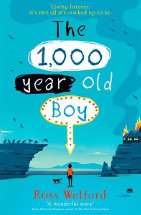
The 1000 year old boy by Ross Welford
HarperCollins, 2018. ISBN 9780008256944
(Age: 10+) Highly recommended. An intriguing title and a fascinating
story about a boy who has been alive for 1000 years. With his mother
(and accidentally the pet cat too) 11 year old Alfie Monk uses a
magical "life-pearl" to halt aging. They are not immortal and can
all still die from injury or accident but will not grow older.
An everlasting life means Alfie and his mother have lived through
great changes but they must move on when people become suspicious
that Alfie never grows into adolescence or adulthood. This means he
must continually leave his normal, aging friends and move to new
homes.
Alfie's father died 1000 years in the past, so it is Alfie, his Mum
and Biffa the cat who have to face the future together but life
changes drastically when a fire destroys not only Alfie's home but
kills his mother as well, leaving Alfie burnt and alone. It is at
this stage he needs to trust 21st century Roxy and Aidan, who
desperately try to be his first real true friends and help him find
the last "life pearl" to begin the aging process for Alfie, so he
can live a normal life.
This a well written and at time humorous story where alternate
chapters give the viewpoint of either Alfie or Aidan.
There is a realisation that eternal life has as many drawbacks as it
does advantages. Alfie has had a variety of historical experiences
that gives him a vast knowledge of the past but he can never have a
real life in the present.
This is a captivating read, where the ending keeps you "on the edge
of your seat" as all is revealed by the final chapters of the novel.
I also enjoyed Ross Welford's What Not to Do If You Turn
Invisible and look forward to reading his other title Time
Travelling with a Hamster which also plays with "time".
I highly recommend this book to students from age 10 years +. A
worthy addition to any library.
Jane Moore
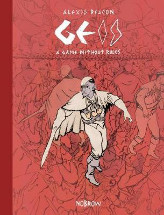
Geis: A game without rules - Book 2 by Alexos Deacon
Nobrow 2017. ISBN 9781910620274
(Age: Middle school - Senior students) Themes: fantasy, medieval,
contest, rules, allegiance, trust. To open this beautifully
illustrated graphic novel is to enter a disorientating medieval
world of sorcerers, serfs, courtiers and nobles. The endpapers
depict a set of a sort of tarot card with titles such as Justice,
Death, the Sun, the Tower, and the action in the story seems just as
arbitrary as a hand of cards. The characters are confined in a
castle where all are compelled to take part in tests. This time the
sorceress Niope divides the people into two teams, one dressed in
black, the other in white, they are told to play the game but no one
knows the rules. The sorceress has servants who are masked,
reminiscent of chess pieces who spy on the teams and do her bidding.
They give each player a coin and a stick, the white sticks can be
used as chalk and the black as charcoal. Some ancient writing
appears on the floor which when translated reads As it is written so
shall it be. It soon becomes apparent that anyone can announce a
game and make the rules then both teams have to play, the winners
collecting coins from the losers. The episodes that follow are
intermeshed with other power struggles within the castle which take
more than one reading to grasp.
The subtle use of colour helps with scene shifts and supernatural
effects but there is a large cast and a list of characters with a
synopsis of the previous volume would have made it more enjoyable.
However, its density will appeal to those looking for a more complex
graphic novel with puzzles and paradoxes to keep the reader engaged.
This is the second text, I would recommend reading the first, Geis:
A matter of life and death and I am sure middle school
students and senior student lovers of fantasy or illustration will
be asking for book three, The Will That Shapes the World,
coming soon.
Sue Speck
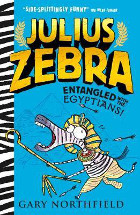
Julius Zebra: Entangled with the Egyptians by Gary Northfield
Walker, 2018. ISBN 9781406371802
(Age: 6+) "After being shipwrecked on the shores of Egypt and
mistaken for a Horse God, Julius can't believe his luck! Soon he and
his bedraggled friends will be living it up in the city of
Alexandria; preened and pampered like gods. Then a fancy boat
procession will take them down the River Nile to Giza where, of
course, a lavish party will be thrown in Julius's honour - as well
as getting the obligatory tour of the Pyramids. BUT it is this very
tour that seems to signal the end to their glorious fortunes in
Egypt. On a visit to the Tomb of Cleopatra, Felix is unable to
resist a rather lovely looking treasure for his rock collection . .
. He pockets the jewel and immediately a curse falls upon the group.
And so the ridiculous adventure begins where Julius fights for his
life as the Egyptians come to unravel the truth and realize that he
is not quite what they thought he was . . . "(Publisher)
This highly entertaining book travels between the worlds of fact and
fiction. It will sit alongside Horrible Histories
beautifully in the library. Children will love the peek into
gladiatorial lives and times. Children from six and up with dive
into this book and the almost graphic novel format will appeal to
even the most reluctant readers. The third book in a humorous series
is sure to be a winner with its ridiculous plot and hilarious
characters. I can see our Year 2 classes sharing snippets of this
book as they launch into their lessons on the Romans.
Kathryn Schumacher
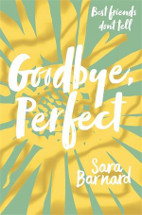
Goodbye, Perfect by Sara Barnard
Macmillan, 2018. ISBN 9781509852864
(Age: Senior Secondary) Highly recommended. Themes: loyalty,
relationships, friendship, choices, boundaries. Eden and her best
friend Bonnie never seemed to have much in common but they have been
best friends since primary school. They are both about to sit their
final GCSE exams and both have little sisters; but Bonnie is a
straight "A" student, head prefect, with parents who expect their
perfect daughter to excel. Eden and her sister were adopted when
Eden was nine as her addict mother could not look after them. Eden
struggles at school but thrives in her garden, her own space where
she has ownership, responsibility and can demonstrate achievement
supported by her adoptive parents who are professional gardeners.
The best friends have studied together, shopped together and shared
the secrets of their hearts, or so Eden thinks until the police turn
up at her house asking if she knows where Bonnie is. Eden had that
morning got a surprise text from Bonnie saying she was running away
with Jack, a secret boyfriend Bonnie had mentioned but who Eden
thought was imaginary she was so evasive about him. The text also
said "don't tell anyone" so loyal Eden denies she has any knowledge.
"I didn't think twice about lying for Bonnie. As far as I was
concerned, she'd asked, and I'd agreed, and that was that. I didn't
need any more details or context. A promise is a promise, and a best
friend is a best friend." p9. However it turns out that Jack is
their music teacher, Mr Cohn, the relationship is a crime not only
because he is her teacher but at fifteen and a half Bonnie is also
under the age of consent. Everyone, especially the police find it
hard to believe Eden knew nothing about the affair and she starts to
question how well she really knew her friend and whether she is
doing the right thing agreeing to keep their location a secret.
Eventually Eden confides in Connor, her level headed reliable
boyfriend and builds bridges with her older step sister Valerie and
they find a way forward that does not compromise Eden's values.
Issues of secrecy, betrayal of trust, loyalty, friendship
responsibility and choices make this an important book for young
adults who are entering a world where they have to make their own,
sometimes difficult decisions. Through flashbacks entitled
'Conversations that took on a Different Meaning after Bonnie
Disappeared' Eden sees she had missed signs that her friend had not
had the perfect life she had imagined missing how unhappy Bonnie had
been.
Told in the first person from Eden's perspective the text is
enriched with newspaper articles sensationalising the affair along
with social media posts all of which contrast with Bonnie's secret
text messages which assert that she is happy and in love, seemingly
oblivious to how her actions have affected everyone else. In the
face of it all Eden struggles to do what she believes is right. With
strong believable characters dealing with complex modern lives
encountering real life decisions, this is a book that should be
recommended to all senior students and it would lend itself to class
discussion about any of the main themes.
Sue Speck
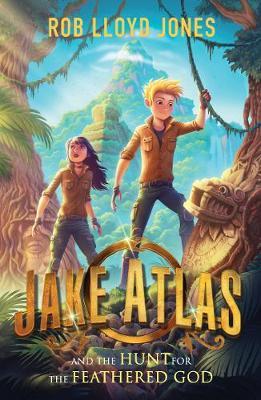
Jake Atlas and the hunt for the feathered god by Rob Lloyd Jones
Jake Atlas series. Walker Books, 2018. ISBN 9781406377712
(Age: 10+) Highly recommended. Themes: Adventure, Egypt. Aztecs.
Jake Atlas at 12 and a half years old is often in trouble. His
parents are archaeology professors and so are a little out of the
ordinary. Adventure seeks Jake out and the resultant books are a
thrilling ride through ancient civilisations with lots of research
that enhances the text and so will intrigue eager readers. In the
first outing for Jake Atlas, Jake Atlas and the Tomb of the
Emerald Snake, the Atlas family are on vacation in Egypt when
Jake's parents go missing just hours after checking in to the hotel.
An adventure ensues taking them all over Egypt and finally into a
showdown with the People of the Snake.
With Jake Atlas and the feathered god, the readers will
again be on the edge of their seats as Pan and Jake match wits with
mercenaries and treasure hunters and the Lady of the Snake. The
family is on the run in Egypt from the People of the Snake, and are
doing all they can to stop them playing with the future of mankind,
ending up in Honduras where the Feathered God once was found. Into
this intrigue step the International Police, hot on the trail of the
villains, and with Jake's high tech gadgets, fun abounds.
The events are exciting and the vocabulary easy to read. This novel
is highly recommended to all readers aged 10+. It would also be a
great read aloud novel for the year 7 classroom as they study
ancient civilisations.
Fran Knight
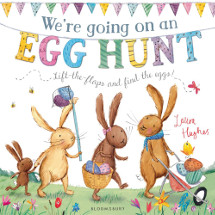
We're going on an egg hunt by Laura Hughes
Bloomsbury Children's Books, 2018. ISBN 9781408889749
(Age: 2-5) Recommended. Lift the flap book. Themes: Easter,
Counting, Egg hunt. The Easter bunnies are off on an egg hunt,
determined to find all the eggs. There are ten of them hidden under
flaps, but there are other surprises on the way.
Children will love to chant along with the refrain that is repeated
throughout the book: We're going on an egg hunt.
We're going to find them all.
We're REALLY excited . . .
HOORAY for Easter Day!
Lifting the flaps reveals the eggs, and children can count along as
they find them. There is another refrain for children to join in Oh, no - . . .
Can't go over them.
Can't go under them.
Can't go around them.
The bunnies are very cute and readers will delight in seeing all the
farmyard animals that they come across in their search for the eggs.
This is a fun board book, sturdy in construction and a great read
aloud in preparation for an Easter egg hunt.
Pat Pledger
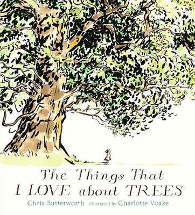
The things that I love about trees by Chris Butterworth
Ill. by Charlotte Voake. Walker Books, 2018. ISBN 9780763695699
(Age: 4+) Highly recommended. Themes: Trees, Environment, Seasons.
With the sparest of words, Butterworth encapsulates the reality of a
tree as it has leaves in spring, blossoms and forms fruit in the
summer, which is ready to pick in the autumn and then becoming bare
in the winter. Each season is described in spare prose, making it at
once easy for younger readers to understand and impelling older
readers to find out more. The illustrations bear testament to the
tree and its life cycle through the four seasons, reaffirming the
words as they travel with the tree over its year.
Each page has a new adventure with the tree that is loved. The first
double page shows a young girl coming out of her front door of the
flats to see the bare branches of the plum tree hovering over the
balcony. The tree is covered in tiny sprouting leaves with buds
forming and getting bigger.
We see the buzzing bees as the tree wakes. It is spring.
Later in summer, trees are dressed in their finery, covered with
bright green new leaves. The plum tree has small round fruit
appearing.
As autumn approaches the trees develop coloured leaves as they begin
to shed, and the nuts and fruit ripen for the animals to find and
eat or store.
Winter sees the wind has blown the leaves form the trees, leaving
them bare and stark in the cold. The last double page shows the girl
outside her flat looking at the tree as it waits for spring to come
around once again.
Children will love reading of the trees and their cycle of life, the
contribution they make to their surroundings, and the animals that
benefit from their being there. On each page is the story of the
tree and its life cycle, but also on each page in a different font
are sentences giving facts about the trees. Children will readily
absorb the details as they read the book and its illustrations, a
distinctive style which perfectly suits the words with its lightness
of touch, spare colour and use of white space. I love the branches
arching over the pages, and the floating leaves scattered across
many of the pages, and the perfect stillness of the bare trees in
winter, their magnificence barely needing to be mentioned will make
the reader gasp as they turn the last pages.
At the end of the book is a brief index, allowing children to learn
how to use an index and giving them a reason to go back and look
again at what they have read.
Children will be encouraged to take longer looks a the trees around
them, noting their changes through the seasons, seeing what animals
depend upon the tree and its produce, seeing what they can do with
the tree. Next to the index is a range of things children and
classes can do: collect leaves and nuts, make outlines, collect
leaves, make a shelter etc. I am sure readers and teachers will be
able to think up a pile of other things that children can do when
they finish reading this stunning book, encouraging children to look
anew at what is found outdoors.
Fran Knight