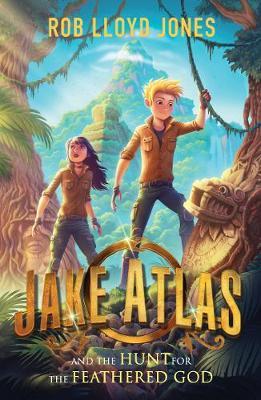
Jake Atlas and the hunt for the Feathered God by Rob Lloyd Jones
Walker Books, 2018. ISBN 9781406377712
(Age: 9+) Recommended. Themes: Action, Adventure, Twins, Mystery,
Aztec - history. Hunted by international police and hiding from the
evil People of the Snake, treasure hunters and tomb raiders Jake
Atlas and his family are in danger. During this enforced stay in an
English stately home twins Jake and Pan hone their martial art
skills, train in using new developed technology, learn ancient
languages and bicker, argue and question their parents' motives. Why
aren't they searching for the second emerald tablet? When their
friend and tech whiz Sami is poisoned, they are forced by the People
of the Snake to undertake a dangerous mission to discover the tablet
in exchange for a cure.
Their destination is a legendary Aztec tomb dedicated to the god
Quetzalcoatl, hidden in the Honduran rainforest. The Atlas family
must face traitors, bandits, big cats, tarantulas and crocodiles and
learn to rely on other's abilities to help them. Their arguments and
squabbles lead them into deeper trouble as they face monsoon rains
and arduous conditions on their lengthy trek in the jungle. They
barely survive ancient Aztec snares, climb a cliff built from
skulls, leap over a huge waterfall, escape from a trap made out of
swinging blades as the momentum builds to a crescendo.
Rob Lloyd Jones channels Indiana Jones, Lara Croft Tomb Raider and
Alex Rider in this fast-paced action adventure. Each of the main
characters are relatable, Jake's gung-ho attitude means he's quick
to jump into dangerous situations while his sister Pan is a thinker,
skilled in linguistics and a student of history. A family of tomb
raiders and treasure hunters is unique in this fiction genre and
adds a different and realistic perspective. The author's
historically accurate facts are fascinating and eye-opening - the
Aztec's religious practices of human sacrifices and worship of
Quetzalcoatl. Filled with exciting new technology - nano-drones,
smart-goggles and satellite trackers and Biosteel reinforced jungle
suits, "Jake Atlas and the Hunt for the Feathered God" will
appeal to a wide range of readers.
Rhyllis Bignell
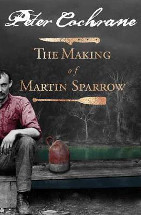
The making of Martin Sparrow by Peter Cochrane
Penguin, 2018. ISBN 9780670074068
(Age: 16+) Recommended. Set on the Hawkesbury river, a community
struggles to survive in the early years of the New South Wales
Colony.
Emancipated convict Martin Sparrow has led a disastrous life but has
been granted the standard thirty acres of land to farm. Having no
knowledge or experience, Sparrow's agricultural endeavours are
hopeless and he appears to have been set up to fail in the sense
that he cannot possibly meet the Government's produce requirements
or repayments to his creditors.
In 1806, a monstrous flood completely destroys all of his miserable
possessions and produce, prompting him to fantasise about bolting to
the fabled paradise West of the Blue Mountains. Aptly named, Sparrow
is revealed to be physically weak, unremarkable and unable to assert
himself. Lacking a strong sense of identity or purpose, he is
susceptible to suggestion and manipulation by violent men with no
scruples. Naively accepting tales of easy living in nature's bounty,
surrounded by exotic, affectionate women, Sparrow agrees to
accompany desperate men on a shambolic expedition to cross the
mountains to the mythical land of plenty.
Cruelty and suffering appear on many levels in this story. Convicts
struggled in freezing cold and blazing heat to build roads and
infrastructure in a colony clawing for survival. Military overseers
mistreated convicts, free settlers and each other whilst government
administrators profited from the labour and hardship of the convicts
and settlers.
The treatment of the local Dharag people by vicious soldiers and
bloodthirsty settlers is extreme. Foraging for food on their
traditional land is considered theft by settlers who respond with
unspeakable brutality, torturing, raping and murdering without any
consideration of moral or legal restraint.
Some of the female settlers also lead brutal lives, subjected to
sexual violence and exploitation, illegal imprisonment and even
being traded and sold by men who consider them property.
In a landscape filled with harsh individuals trying to eke out an
existence, Sparrow embarks upon his ill-conceived journey and for
the first time in his life comes into contact with solid, decent
people. These include a Romany girl who has been grossly mistreated,
the local constable charged with trying to sort out complex and
dreadful crimes, an eccentric explorer and a kindly landowner.
Fighting to survive in the bush, Sparrow stumbles from one disaster
to another, yet the extreme nature of his adventures and reaching
the point of no return cause him to commence thinking for himself
for the first time in his life. Part of Sparrow's awakening involves
consideration of the welfare of others and he develops a capacity
for moral consideration and altruism which he had not previously
possessed.
Grim in places, this novel is still instantly appealing to those who
enjoy historical fiction. I knew I would enjoy this book from the
outset and was captured and taken on a long, dark journey.
Recommended for age 16+
Rob Welsh
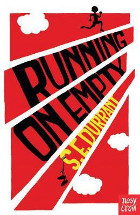
Running on empty by S. E. Durrant
Nosy Crow, 2018. ISBN 9780857637406
(Age: 10+) Highly recommended. Themes: Disability. Athletics.
Family. Grief and loss. Persistence and perseverence. AJ is a pretty
normal kid, trying to work out life after the death of his loving
and gracious grandfather - a man who was a mentor and an inspiration
in his life. This grandfather had created a passion for running in
AJ's life and he was desperate to honour his grandfather's memory by
continuing to run. And... his parents have learning difficulties.
Because of this AJ is very much missing his grandfather's support,
because now he has to take on even more responsibility and try and
avoid any bills that 'have red' on them. AJ also has an Aunty, Uncle
and young cousin, Aisha, in his life. None of them have a problem
with AJ's parents - they are all just people trying to do their very
best; and Aisha just brings joy wherever she goes with her innocent
enthusiasm and honesty. This is the story of the pre-teen AJ as he
adjusts and strives and copes with supporting and caring for his
parents, while trying to make them proud and protecting them from
the worst of reactions from those outside the family, including his
school teachers. AJ also has the added fear that if anyone finds out
that Grandfather can no longer help them, that he might have to be
taken into care. His growth and budding maturity is hinted at in his
insights into how others may react, and in his own misdirected
responses to those around him, but he lacks the discernment that
would save him from some pain.
This is a beautiful story of unconditional love, of people doing
their absolute best in the most trying of circumstances and of one
young boy's fierce loyalty in the face of loss and great difficulty.
This is a book that will inspire, as AJ only knows the richness of
the love he shares in his family. AJ and his parents' honourable
simplicity and naivete will be evident to an older reader, and this
makes this a book that can be enjoyed by older readers. Just as the
two books, The boy in the striped pyjamas and
Wonder communicate complex ideas through a naive
narrator, this book speaks with incredible power through the
youthful voice. A pair of running shoes becomes a powerful symbol of
love, hope and care. This is a 'must read' book, and will be enjoyed
by all who pick it up to read. And please allow young teenagers to
read it too, because they will recognise the themes, but also be
buoyed by the persistence of AJ and his parents despite their lack
of privilege.
Highly recommended for ages 10+
Carolyn Hull
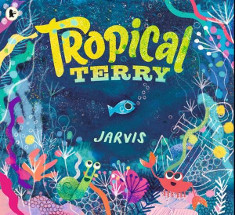
Tropical Terry by Jarvis
Walker Books, 2018. ISBN 9781406378627
(Age: 4+) Recommended. Themes: Difference. Friendship. Coral reef.
Fish. Terry is an unexciting blue fish swimming amongst the coral of
a coral reef. His large eye watches as the beautiful, differently
coloured coral fish swim by and longs to be with them. They seem to
have all the fun as they swim by in a large group, showing off their
plumage and colours. But Terry's friends, Cilla the crab and Steve
the sea snail, tell him not to worry but to keep playing with them.
They play hide a fish (which Terry is very good at as he blends into
the background so well) and dodge a dolphin, while the coral fish
above swirl around and around. Terry is dismayed, so he takes a fish
net and gathers up a lot of seaweed, asking his friends to help make
him look more interesting.
When they finish making him up, he looks stunning, equaling the coral
fish in appearance and they accept him as one of their own.
The brilliantly coloured illustrations reveal the secrets of a coral
reef with its large numbers of brightly coloured fish, the corals
and seaweed alongside the other sea animals. The colours are
engaging and younger readers will enjoy picking out all the
different things they can see.
But with Terry gamboling amongst the coral fish, going around and
around, a hungry eel passes by targeting the brightest fish he can
see, Terry. Terry must avoid being eaten and his friends Cilla and
Steve call out to him helping him escape the eel.
All ends happily as the coral fish come to realise that appearance
is not all it's cracked up to be, and readers will be able to
discuss concepts such as difference, envy, friendship and keeping up
with the crowd.
Fran Knight
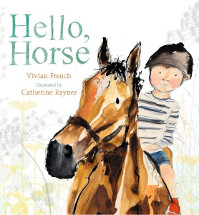
Hello, Horse by Vivian French
Ill. by Catherine Rayner. Nature Story Book. Walker Books,
2018. ISBN 9781406349948
(Age: 5-10) Highly recommended. Themes: Horses, Fear. Another in the
highly successful and exceptionally well produced series, "Nature
Story Book", comes a heart-warming story from popular author Vivian
French and illustrated by Kate Greenaway Medal winner Catherine
Rayner. With two such talents, the book can only be beautiful!
The little boy featured in the story meets Shannon, a big brown
horse. Initially he is intimidated by the size of Shannon but
Catherine reassures him that the horse is very friendly and gentle.
As the story develops the boy learns much about horses and gradually
overcomes his fear. By the end of the story the reader sees the
little boy riding along a leafy lane.
On most double page spreads, not only is there the fiction story,
but in different print, there is information about horses'
behaviour, their size, what they eat and how to groom them. At the
back is an index that tells the reader to look at both sets of type
when finding a word, and there is a 'More Information' section.
As a lover of horses, it was immediately evident to me that the
author and illustrator knew and loved horses and this was confirmed
by the 'Author's Note' at the end of the book, which states that
Shannon the lovely bay mare featured in the book is real and has
belonged to Catherine for more than twenty years. Catherine's water
colour illustrations of Shannon the horse are delightful and the
horse's gentle inquisitive nature comes to life as the little boy
gradually gets to know her.
This such a beautiful story that begs to be read aloud at home and
in the classroom. Readers will not only learn about horses but the
story would help children who are fearful of such a large animal and
those familiar with horses will revel in the details found in the
book.
Pat Pledger
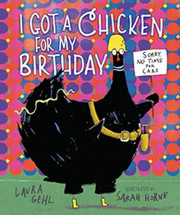
I got a chicken for my birthday by Laura Gehl
Ill. by Sarah Horne. CarolRhoda Books, 2018. ISBN 9781512431308
(Age: 4+) Recommended. Themes: Poultry, Birthdays, Presents. Ana
really wants tickets to the amusement park for her birthday and she
has told her abuela (grandmother) three times. But the day of her
birthday arrives with a large gift wrapped crate and inside is a
chicken. She is disappointed, but realises that she needs to feed
it, and going to do just that, the chicken displays a sign saying
she has no time for food. Ana thinks that perhaps she likes
scrambled eggs, but going to the chicken she has another sign
telling her that she has no time for laying eggs, and gives Ana a
huge list of things to collect and buy.
When all the things are amassed for the chicken, she spends her time
with pencil and ruler, working out dimensions, and then roping in
Ana's dog to help. Next she has the cat working as well. The hamster
becomes the tractor driver, and lots of other animals call in to
help. Readers will be agog to see what the chicken is building, as
lengths of wood are hoisted into the air, and a framework built.
By now readers will be making guesses at what they will eventually
find, and laugh out loud at the illustrations showing the animals
donning builder's belts, hard hats and wielding building tools for
the task.
Readers will have guessed that Ana's abuela has given her what she
wanted for her birthday but in a more roundabout way than she
expected.
The vibrant illustrations are full of humour, reflecting the
disappointment Ana holds in not getting what she wanted, but
intrigued with what the chicken and the other animals are doing.
Young readers will love picking out the various farmyard animals
portrayed, and recognise aspects of building and the equipment
needed for such a task.
I particularly love the look on the chicken's face as she goes about
her task, especially when capped with a safety helmet.
Fran Knight
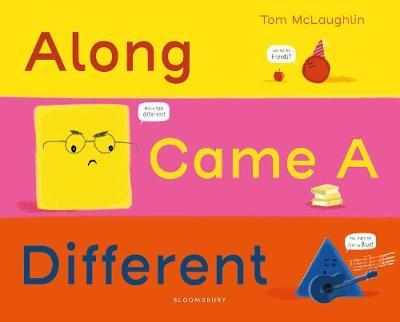
Along came a different by Tom McLaughlin
Bloomsbury, 2018. ISBN 9781408888926
(Age: 4+) Recommended. Themes: Difference, Rules, Shapes. The Red
shapes loved being red. They loved wearing red hats, eating red
apples and sang red songs. But along cam some Yellow shapes. They
loved being yellow, eating yellow bananas, yellow books and yellow
cars. But the two groups found fault with each other, forcing each
other to make areas for themselves separate from each other. But
then along came another different, this time, a Blue shape. The Blue
shapes loved their blue guitars and blow ties, but ran foul of the
other two shapes, the red and the yellow.
The three groups then separated themselves from each other, making
rules about what they could and could not do.
By now readers and listeners will have realised that the story is
telling us about how we separate ourselves from others, making rules
and regulations to further restrict interaction. Younger readers
will be able to see that rules often divide, but be heartened when a
new group comes along in the book, overturning all the rules made by
the first three groups.
The new group is quite different, reflecting all the colours that
have gone before, and talking to the three shapes, encouraging
interaction, communication and friendship. Children will easily see
that discussion and communication is better than making rules which
only serve to divide. Being different does not mean that we have to
make rules to divide us from our friends.
Fran Knight
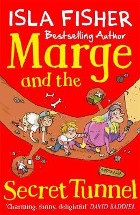
Marge and the secret tunnel by Isla Fisher
Ill. by Eglantine Ceulemans. Marge in charge series, bk 4.
Piccadilly Press, 2018. ISBN 9781848127333
(Ages: 6-8) Themes: Babysitting, Family Life, Adventures. Isla
Fisher's amusing stories about flamboyant Marge the babysitter and
her unique style of babysitting Jake and Jemima are fun to read
aloud and just right for a newly independent reader to enjoy. These
three short stories involve a secret tunnel that might lead to
Australia, Marge's unusual shopping techniques and a rather crazy
search for Clover the lost kitten.
In "Marge and the Secret Tunnel", when Marge arrives to babysit
Jemima and Jake, she's wearing a pink ski suit, goggles and a
helmet, the perfect outfit to explore the secret tunnel Jemima's
discovered in the backyard. Marge shares some Australian slang and
some fantastic palace stories as they travel through the dark space
into their neighbours' yard. They solve the mystery of their
disappearing toys and make a new friend Angie.
Marge's unique style, singing ability and unusual approach to
shopping makes for a fun adventure for Jake and Jemima. Racing
shopping trolleys down an empty mall and discovering what happens
when the shopping centre is locked for the night make for more silly
escapades.
In the final story, Angie's fluffy, white kitten Clover is lost and
Marge and the children decide to play detectives.
Isla Fisher's entertaining stories are just right for young newly
independent readers. Marge's unique fashion sense, her entertaining
ways and ability to turn the ordinary into humorous and fun
activities make her a loveable character. Eglantine Ceulemans'
cartoons add to the fun of the stories.
Rhyllis Bignell
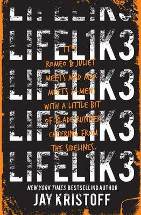
LIFEL1K3 by Jay Kristoff
Lifelike book 1. Allen and Unwin, 2018. ISBN 9781760295691
(Age: 15+) Recommended for adrenaline junkies. Themes: Dystopian
fiction, Robots, Artificial intelligence, Memory, Extrasensory
perception. This book grabbed me right from the first page where the
reader meets Eve, a prisoner in a cell, who has to watch her family
being killed one by one. From then on, the story takes the reader on
a wild ride, with Eve fighting a in a robot gladiator that she has
built herself, only to find that she can destroy electronics with
the power of her mind, having the Brotherhood chasing her across the
barren landscape for her weirdness and then finding an android named
Ezekiel who claims to have known her from the past. With her best
friend Lemon Fresh and a little robot called Cricket, she treks
across irradiated glass trying to find her grandfather who has been
taken away by androids.
Time just flew away as I followed Eve's journey. There is so much
action, fighting and violence as well as some slight romance and
heart breaking moments, that the book will hold the attention of all
readers who like a fast paced sci-fi thriller. For those who have
read Asimov's book "I, Robot", the whole idea of robots and
artificial intelligence will be questioned as the androids in
"LIFEL1K3", change the 3 laws of robotics and start questioning what
they can do.
Kristoff brings his characters to life, especially Eve's friend
Lemon Fresh, whose delightful wit brings much humour to the story.
The robots' characters are so well developed that they seem like
real people and this also makes that reader think about where
artificial intelligence could lead the world.
With a totally unexpected twist at the end, readers will be sure to
pick up the next in the series and I for one, will be reading some
of Kristoff's previous award winning series, "The
Lotus War" and the "Illuminae
files" written with Amie Kaufman.
Pat Pledger
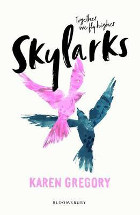
Skylarks by Karen Gregory
Bloomsbury, 2018. ISBN 9781408883617
Highly recommended. As a high school student in 2018, for the
majority of my life, I've seen the call for justice within queer
representation and have witnessed the better part of a community's
growth. "Skylarks" by Karen Gregory is a heartfelt, insightful novel
which proves that human resilience will never die, it may waver
throughout hardships but will only grow stronger and bolder. When
Joni, the novel's protagonist, was little she dreamt that she could
fly. During Joni's adolescence, times have taken their toll on her
and her feet have never felt more glued to the ground, this is until
the poised and privileged Annabel makes an appearance, Joni's dream
of flying may come sooner than she thought. Throughout reading
"Skylarks", the quote 'love has no boundaries' was reinstated with
every page. Over the years, love has been stigmatised and almost as
if people have been given a set of rules restrictions they must
follow when it comes to love. There's been discouragement and
prejudice that has scared people from being who they truly are. The
wonderful thing about Skylarks is that the relationship these two
young women form cannot be identified, it isn't simply emotional or
sexual; however the bond between Joni and Annabel is human. It's
real. It's heart-warming; it's heartbreaking and beautiful but has
its own element of sadness which is a relationship that two human
beings have formed. The storyline wasn't rushed; situations didn't
happen to fill up space on a page and it represents the struggle
young adults face in the eyes of political and social activism.
Overall, I would definitely recommend this book to other people. I
can't think of a specific target audience I would recommend this
book to as love doesn't respond to age, gender, ethnicity or faith
and neither do books. 10/10
Rylee Bogisch (Student)
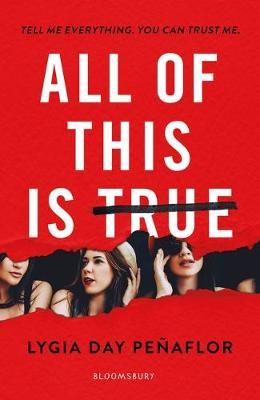
All of this is true by Lygia Day Penaflor
Bloomsbury, 2018. ISBN 9781408890936
(Age: 15+) Unusually scripted, this novel is not constructed in the
common form of a novel related by a known or unknown narrator.
Daring to be quite different, this new form of storytelling is
constructed through the use of a various personal and written
interactions, using narrative accounts of experiences, scripted
interactions and television interviews. As we read the individual
'parts', we are challenged to build a story of the events, as we
understand them to have happened, and it is in our recognition of
what we gather that appears to be a valid account of the truth of
the events as we think they have occurred. We are certainly drawn
into the world of the text by what we realize as the wrongful use of
data, collected without the permission of the characters concerned.
Its 'story-telling' methods consist of television interviews of
people involved in the events, of other apparently on-line
interviews, of excerpts from a New York magazine, of one character's
story, and of passages from the novel that engendered the whole
'story' that we gather as it emerges. It is through these repeated
models that Penaflor chronicles events, past and present, to
construct her book. We construct our idea of the story, and indeed
of what we decide is 'truth' or 'lies', and indeed of the element of
'betrayal', by linking what we discover in the various models.
The novel begins with the script of a television interview and the
story evolves through each passage, as the novel segues between the
various models. The narrative is constructed through articles in the
New York City Magazine, interviews of characters involved in the
'story' by unrevealed interviewers, excerpts from a new book written
by this television interviewer, using, illegally, it is alleged, the
adolescents' opinions and stories, as gleaned from the TV 'chats'.
Added to this is the questioning of the young people involved by an
unnamed interviewer, through which we glean sufficient understanding
to create a 'story', As readers, we work to make sense of the
events, and thus we are drawn into the affront felt by the
characters, those emotional responses of those whose words, in
interviews, were used by the writer of the novel, without
permission, to construct her new novel.
Complex, challenging and emotive, this new work is powerful, set
absolutely in the world of modern media, both private and public,
and responding to the ideas of betrayal and loyalty, and of naivety.
Penaflor has created a 'text' that is very vibrant, and reflects
that part of life where adolescents must decide on their set of
values, of aspirations, of what matters in this world, of who they
are and what they will become, and most of all, what they will
value. This is appropriate for adolescents, and would be apt for
adults, especially those who work with young people.
Elizabeth Bondar
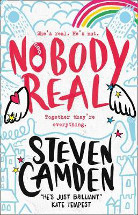
Nobody Real by Steven Camden
HarperCollins, 2018. ISBN 9780008168384
(Age: 16+) Real or Not? This book teeters between reality for
the central character, Marcie, and the world and life of her
imaginary friend, Thor. The reader is always in a state of
uncertainty as the world of imaginary friendship is revealed. This
is not a straightforward or juvenile revelation. Marcie (or Mars as
she is often called) is dealing with an uncertain future as she
stands on the cusp of leaving school and facing the prospects to
come. Her secret 'friend' Thor is facing a transition of his own . .
. a transition that is revealed through his counselling sessions.
Maturity comes with all sorts of challenges.
Marcie's family life is complex and Thor has enabled her to survive
through the traumas of her childhood, but what will happen now that
childhood is disappearing? Her real-life friend, Cara, is ready to
launch, but Marcie is far from ready and their relationship is
showing the first signs of complication. Will Thor be able to
manipulate circumstances and her attitudes so she is ready to be the
person she should be? Coming out of her corner is fraught with
problems. Her father is a writer battling his own life-blocks and
with limited input into the personal dramas that she faces. His
battle with creativity is in juxtaposition to Marcie's imaginary
creation and the closeness and comfort that Thor brings. The angst
of the teenage Marcie, is replicated in the creative struggles of
her father.
This book is highly original, captivating and complex and requires
extreme persistence to unravel the unique floating 'voices' that
communicate Marcie's realities and the world of the imagination.
This confusion is part of what makes this an interesting read and
adds a level of intricacy and perhaps a hint of the manic or
perplexity that a mature reader would find worthy of persistence. I
liked the idea of the imaginary friend (creature) who is not ready
to fade from his critical role as confidante; but the complexity of
the journey will only be appreciated by those who read in
'meal-sized' portions, rather than a 'snack and nibble' approach, as
confusion will be a companion. If the identity of the narrator was
clearer (perhaps with chapter heading hints), then the reader would
not need to spend critical time re-reading sections to identify
whose voice is being heard, and whose feelings and identity is being
revealed. (Note: differing fonts used for different 'voices' do not
always clarify the confusion.) 'Living inside someone's head' is
inherently confusing, so the author has deliberately created mystery
as he reveals what is real and what is not.
Carolyn Hull
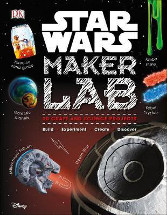
Star Wars Maker Lab: 20 Galactic Science Projects by Liz Lee
DK Children, 2018. ISBN 9780241314234
(Age: 8+) Highly recommended. What person won't be tempted to pick
up this book and see just what craft and science projects can be
made using the ever popular Star Wars brand? This book has 20
projects that can be made at home or in a maker lab. Some of them
include making a lightsabre beam, kyber crystals, Jabbba slime and a
Mustafar volcano, as well as a Hoth snow globe and galactic planets.
There is a 'Before you start' section which emphasises safety, a
note to parents that the projects may require parental supervision,
how to use the templates found at the back of the book and where to
get supplies. Each project gives a level of difficulty from easy,
medium to tricky, tells the maker what supplies they will need with
clear illustrations and then gives a step by step instructions,
accompanied by pictures. Much of the equipment is stuff that would
be found around the house, but some needs to be specially purchased,
like batteries and light pens, and The Death star tractor beam, for
example, needs a glue gun.
Each project gives a Star Wars context with pictures and there is a
'How it works' section that explains the science in clear concise
language and an illustration. A glossary at the back gives
definitions of many of the scientific terms, as well as references
to the Star Wars Galaxy.
This would be a very useful addition to a school library with a
maker-space, but would be an equally ideal gift to a child, giving
lots of inspiration for things to do during long holidays.
Pat Pledger
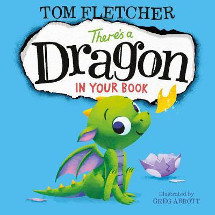
There's a dragon in your book by Tom Fletcher
Ill. by Greg Abbott. Puffin, 2018. ISBN 9780141376127
(Age: 4+) Recommended. Themes: Dragons. Humour. With the opening
page warning of the egg which is about to hatch, eager fingers will
turn the page with glee, anticipating what may happen next. A baby
dragon appears from the egg and the book asks the reader to tickle
her nose which has a not unexpected consequence, a sneeze, which
makes small spot fires around the page. Readers will be puzzling
over what to do next as they watch the cheery little animal joining
in the quest of how to put out the fires. Her suggestion put into
place, the book gives another warning to the reader as the problem
escalates, each time a solution begetting another problem to solve.
Readers will laugh out loud at the situations she finds herself in,
and admire the solutions, seemingly the one that is needed.
When all is peaceful once again, the dragon flies off, only to find
another heap of problems around the corner.
A funny, involving text with illustrations that beg to be closely
looked at, this dragon book will keep readers amused to the end, not
only reading a highly amusing tale, but learning a lot about dragons
along the way.
A sequel to the highly successful, There's a monster in your
book.
Fran Knight
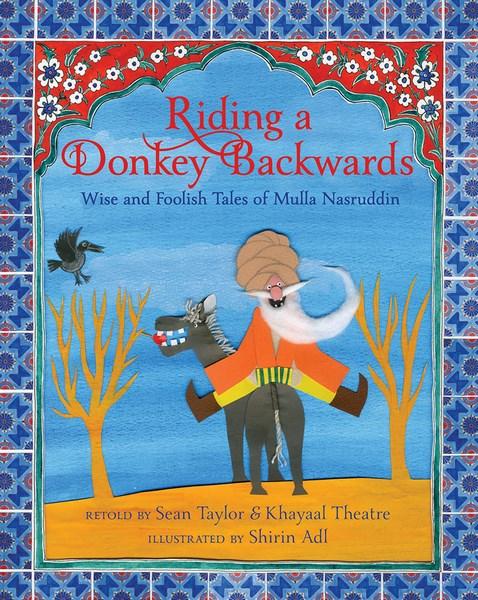
Riding a donkey backwards retold by Sean Taylor and Khayaal Theatre
Ill. by Shirin Adl. Otter-Barry, 2018. ISBN 9781910959305
(Age: 4+) Highly recommended. Themes: Read a loud, Myths and
legends, Middle Eastern stories, Trickster. Uqman Ali and Eleanor
Martin set up the Khataal Theatre, devoted to performing the poetry,
stories and tales from Muslim culture, many of which feature Mulla
Nasruddin, a trickster whose stories figure in the myths and legends
of countries from Asia to Turkey. Some of Mulla Nasruddin's tales
are brought together in this book, retold by Sean Taylor and
illustrated by Shirin Adl, stunningly reflecting her Iranian
background. Reading these stories is an absolute treat, learning why
Nasruddin sleeps in his bed in the thieves' house after his goods
were stolen, or why he rides his donkey backwards, or what 'the
other side' means to someone already on the other side. Beguiling,
full of humour, wisdom and jokes, while begging to be read out loud,
children will love the use of language and the seeming simplicity of
the tales as Nasruddin tells of incidents in his life. One very
short tale tells of Nasruddin walking with his umbrella. When it
begins to rain he opens it and sees it is broken. A young girl asks
him why he brought it if it was broken. He replied was that he
didn't think it would rain.
Another story details Nasruddin's early days at school where he fell
asleep when he was supposed to be drawing. When the teacher woke him
and asked him to come to the front of the class and show his
drawing, he only had a blank piece of paper, but he used this to
explain that it is a donkey eating grass. Scoffing, the teacher was
then told, that the donkey ate the grass and when it was all gone,
it left.
Teamed with vibrant, energetic illustrations reflecting the Iranian
motif, they are filled with detail and delight for young readers to
absorb. An introduction gives readers background to the stories
across the Muslin world, and a glossary at the end will help explain
some of the unfamiliar words. A worthwhile addition to any school
library wanting a range of stories from across cultures and
religions.
Fran Knight