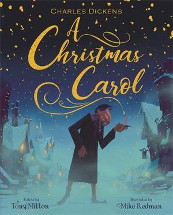
A Christmas Carol by Charles Dickens, retold by Tony Mitton
Ill. by Mike Redman. Orchard Books, 2018. ISBN 9781408351673
Highly recommended. Themes: Christmas; Charles Dickens; Generosity;
Poetry; Rhyme. This is wonderful poetic rendering of the classic
story from Charles Dickens, A Christmas Carol. Mitton has
told this story of transformation in a clear and simple way, with
rhyme seeming unforced and natural and therefore very appealing for
a young reader. The younger generation are unlikely to read Dickens'
original work, but references to the old Miser Scrooge who is
changed on Christmas Eve when confronted with a number of ghosts,
has become part of the common experience and vernacular and
therefore this story is worth sharing in this easy to read form.
The illustrations provided by Mike Redman are delightful, with
initially dark and sombre detail befitting Dickens' work. (Scrooge's
work chair is impossibly high, and his office is grey and dismal).
When Scrooge finally repents of his former ways and generosity flows
to Bob Cratchit and his ailing son Tiny Tim, colour flows more
freely.
This is an easy to read book and can quite easily be used by many to
reflect on the need to consider others at Christmas and to be
generous with what we have . . . before it is too late.
Highly recommended.
Carolyn Hull
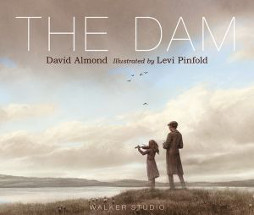
The dam by David Almond
Ill. by Levi Pinfold. Walker Studio, 2018. ISBN 9781406304879
(Age: all) Highly recommended. Themes: Conservation, Environment,
Music, Dams, Loss, Hope, Picture book for older readers. Based on a
true story told to Almond by musicians Kathryn and Mike Tickells, The
dam celebrates the power of the human spirit and the beauty of
music. In the 1980's, the largest artificial lake in the UK, was
formed. Farms and houses were submerged and a village drowned, as
the Keilder Valley was dammed and allowed to fill with water over
the following two years. This wild and beautiful part of North
Northumberland would be inundated. But before this happened a father
and his daughter visited each of the houses in turn, the girl
playing her fiddle and the father singing for the last time within
the walls.
This part of England is well known for its rich musical history and
the work done by the girl and her father heralded the importance of
music to the people whose houses were disappearing. Their music
evoked the very essence of the houses and the people, ensuring its
survival. The lake is now a beautiful place, full of history and
music which can never be stilled. While the past can be mourned, the
present remembers the past through the music which can still be
heard, if people stop to listen. Behind the dam Within the water
the music stays, Will never be gone.
Beautifully illustrated by Queensland illustrator, Levi Pinfold,
this poignant picture book will stay with readers as they think
about change and its impact on us all. The musicians and their music
come alive on the pages, the love for music shining through the
pages, with people singing and dancing on the banks of the lake as
the music is celebrated even though the landscape has undergone
incredible change.
This is an unforgettable picture book, with author and illustrator
combining to give the reader a story full of the sadness of change,
but using music to garner the forces which remind us of what has
gone before, impelling us never to forget. The luminous
illustrations, sepia at first, adds more blue to the palette as the
story gathers force, reminding us that although change happens, the
past can be remembered and celebrated through music.
The sweeping vistas of the Northumberland landscape will astound the
readers, their brooding vastness there to be seen and almost touched
in these illustrations. The wonderful squat stone houses, empty for
the rising water are gorgeously portrayed, redolent of the past and
now filled with music waiting for the inundation. A book to savour.
Fran Knight
Broken things by Lauren Oliver
Hodder and Stoughton, 2018. ISBN 9781444786859
(Age: 14+) Recommended. Themes: Thriller. Murder. Friendship.
Secrecy. Diversity. Fandom. Brynn and Mia are reunited five years
after the brutal murder of their friend Summer. Everyone believes
that they, along with their friend Owen, killed her although there
is no conclusive evidence to prove that and they have been wrongly
accused. Given the name The Monsters of Brickhouse Lane they are
shunned and harassed by the townspeople. Determined to prove their
innocence they must confront what happened in the woods that
dreadful day.
Oliver deftly takes the reader into the minds of three young girls,
all lonely and misfits, who are obsessed with a novel called 'The
way into Lovelorn', which ends in mid-sentence. They begin to
write a sequel and become immersed in a fantasy world, with a
strange figure, the Shadow, featuring prominently. Told in
alternative chapters by Brynn and Mia, with excerpts from 'The
way into Lovelorn' and their fanfiction sequel, events in both
the past and present gradually unfold. Then the two friends get
together with Owen, and assisted by Abby and Wade, try to trace what
really happened leading up to Summer's murder.
One of the strengths of Broken things is Oliver's in-depth
characterisation. The reader gets to know the three girls really
well when they are young 13 year olds trying to navigate through
school and friendship crisis, as well as five years later, having to
manage to survive through the townspeople's abuse and family
difficulties. There is brash, gay Brynn who feels she can't go home
and with the help of her cousin Wade, fakes drug tests to stay in
rehab, shy Mia who has problems getting words out and who is in love
with Owen, and Summer, charismatic yet often cruel and brutal with
her friends and boyfriends. Their sidekicks, Wade and Abby, are
fascinating as well - Abby is overweight and proud of it and is
popular online, while Wade, very intelligent, is not very likeable.
This was a compulsive read and will appeal to readers who enjoyed
other books by Oliver, Panic
and Vanishing
girls or We
were liars by E. Lockhart and One
of us is lying by Karen M. McManus.
Pat Pledger
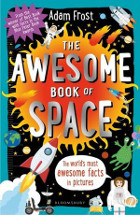
The awesome book of space: The world's most awesome facts by Adam Frost
Bloomsbury, 2018. ISBN 9781408896501
(Age: 8+) Highly recommended. Subjects: The Universe. Space. General
Knowledge. Award-winning UK author Adam Frost continues to deliver
another exciting information book jam-packed with the strange, the
record-breaking and the amazing. His focus is the Universe
beginning with Arthur the alien, who wants to return home using
helium balloons! For his size - 26 kgs - he will need over 2000
balloons! Written in a conversational style directly addressing the
reader, Frost takes us on a wild ride, up into the thermosphere,
then looks at freefalling back to Earth being caught in a giant net.
How many pairs of underpants would you need for a year on a space-
station? There are no washing machines, so what happens to the used
ones - they become shooting stars! What happens when the next
asteroid hits the earth? Scientists have suggested catching it with
a giant drawstring bag and setting robot drills to eat the rock and
return the smaller pieces into space.
Each double page spread is creatively designed with bold
backgrounds, fun fact boxes, colourful diagrams, graphs and
cartoons. Hero or Zero discusses the impact of zero gravity in a
space station, tears just stay under your eyes, magnetic cutlery is
needed and your bed is strapped to the wall or ceiling.
Adam Frost has gathered information from all over the Universe,
recorded alien sightings, birthdays on other planets, even extreme
exoplanets. The awesome book of space is a mini-almanac of information
that can be enjoyed by the space enthusiast, shared with family and
friends or as an excellent resource for the classroom and library.
Rhyllis Bignell
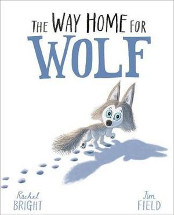
The way home for Wolf by Rachel Bright
Ill. by Jim Field. Orchard, 2019. ISBN 9781408349205
(Age: 4+) Highly recommended. Themes: Friendship, Caregivers, Lost.
Assured wolf cub Wilf thinks he can do anything. He is full of
confidence, itching to be grown up and lead the pack. When the pack
needs to move because another animal has taken over their den, they
must roam many miles, searching for a new home, through the snow and
ice of the North Pole. Midwinter with the borealis lighting the
night sky, they trudge on through snowfalls and blizzards. Wilf
strays behind and when he recovers he has lost the pack. He has gone
astray and is unsure of what to do. Setting down for the night the
ice cracks beneath him and falling he is taken up by a watery
unicorn who gathers him onto her tusk and lifts him onto the shore.
Here she passes him over to her friend, Mr Walrus and he takes the
young cub to Musk-Ox.
Each time he is passed from one animal to another readers will be
excited to predict the rhyming word as they turn the page. The story
is in four line rhyming stanzas, encouraging children to predict the
last word of the next line, and marvel at the way the story is
expressed. It makes easy reading and many of the phrases will stop
the readers as they ponder the image presented. I loved the "howling
of wolves" and the "wafting of fish" amongst others, and found
myself reading it over again to check out the rhymes and word
images.
The illustrations reflect the story, taking the reader into the cold
and bleak northern Arctic, feeling lost with Wilf as he attempts to
navigate the white and grey expanse. Field's use of white and grey,
the dark and the shadows, is wonderful, making every reader feel
alone in the wilderness with the wolf cub.
Wilf passes through a number of hands before he is reunited with his
pack, and they huddle and cuddle their lost cub, welcoming him back
to the pack. He is a wiser little cub.
A wonderful read aloud, this cautionary tale will be loved by all
readers as they recognise the comfort of friendship and family,
welcoming him home despite his bravado which helped him get lost in
the first place.
Fran Knight
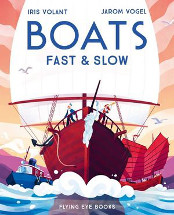
Boats: Fast and Slow by Iris Volant and Jarom Vogel
Flying Eye Books, 2018. ISBN 9781911171928
(Age: 7-10) Subjects: Boats, Ships, Sea craft. Boats: Fast and
Slow introduces in a simplified format the history of boats
from the earliest rafts of woven reeds and Native American log
canoes and on to boat festivals and modern sailing boats. The facts
are presented in an easy to read format, beginning with a
uncomplicated definition that 'boats carry people across water' and
they are powered by sails, engines or human effort.
Not all boats are the same is such an obvious statement, why include
it? Very basic overviews are included, without a depth of
information that even young boat enthusiasts are keen to read. War
boats introduces the Corinthian trireme used for battle by the
Ancient Greeks. Three rows of oarsmen powered the sailing ship which
had a ramming device at the bow of the ship. The seafaring Vikings
built strong and sturdy longships capable of taken them across the
seas to raid the Northern European countries.
Jumping to the early 19th century, we read of the Chinese pirate
queen, Ching Shih, who commanded 300 ships and 30,000 pirates.
Famous naturalist Charles Darwin and his sailing ship the HMS Beagle
is included, with his scientific expedition to the Galapagos Islands
noted. Steam-powered vessels are presented, manufactured in iron and
steel, with coal furnaces to propel them across the oceans. From
ancient Dragon Boat Festivals to the America's Cup, boats have been
used for 'sport and leisure since the earliest times.'
Jarom Vogel's digital images sweep across the pages, the stylised
boats, ships and recreational craft add interest to this historical
look at seafaring history. Boats: fast and Slow is a useful
resource for a Middle Primary class as a springboard into exploring
the history of transport.
Rhyllis Bignell
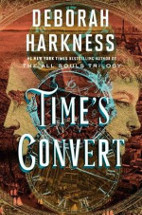
Time's convert by Deborah Harkness
All soul's trilogy. Headline, 2018. ISBN 9780399564512.
(Ages: 16+) Recommended. Themes: Vampire/Historical fiction. Marcus
MacNeil is a centuries-old vampire who was made during the time of
the American revolution. This novelis split between Marcus's
memories of the past in 18th century America and his presence in the
21st century with his lover Phoebe as she begins to make the
transformation from human to vampire. He relives his own trials and
turmoils and ultimately discovers what family truly means to him and
to those he holds dear.
The characters of Time's convert were authentic to what time
frame they were set in and felt realistic and likeable as they
acted in ways that were true to what the novel painted them to be
e.g. the mentor or the villain. Since many of the characters in this
story were vampires the reader was able to see their attitudes and
beliefs from a much older time and how these ideas conflicted with
modern times. It was satisfying to see how the characters'
relationships with each other grow and their thinking shifts to fit
with the modern age as the experiences they endure shape them to be
wiser and more mature or the opposite. In turn, the reader's
relationship grows deeper as we see them struggle and overcome
challenges which give us a feeling of being connected to Marcus and
Phoebe.
The tone of the novel reads as a diary as Marcus tells us personally
the challenges and triumphs he faced as a newly made vampire and
Diana's a new mother and then Phoebes a newly made vampire in the
21st century. This creates a feeling of closeness with Marcus as we
watch him essentially grow up in front of our eyes. The reader ends
up caring deeply about what happens to Marcus and the people he
holds dear in the story. The switching point of views in the story
was an interesting a much-needed addition as we can see the
thoughts, feelings and trails of Diana, Phoebe and Marcus through
their own eyes. This was an effective way of driving the message of
the story about the meaning of family dynamics and maternal
relationships whilst also making it clear to the reader as each
character's experience is different and thus the reader can look at
the overarching theme from many angles.
The dialogue of Time's convert sounded extremely authentic
for the 18th century and modern day. This made it easy for the
reader to imagine what life was like in the different time frames
and feel more fully immersed in the story itself. Another
contributing factor to the story's allure was that each character
had a distinctive voice which showed rather than told the reader the
age, personality or even what religion the character was. This
helped in not only making the characters more memorable but also
aided in creating connections with the reader.
Amy Folker (Year 11 student)
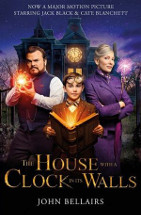
The house with a clock in its walls by John Bellairs
Piccadilly, 2018. ISBN 9781848127715
(Age: 10+) Highly recommended. Themes: Fantasy. Film tie-in. USA.
Orphans. When Lewis Barnavelt is orphaned and sent to live with
Uncle Johnathan, a man he has never met, his aunts are dismayed. But
Lewis is thrilled: his uncle is endlessly interesting, a man of many
talents, a magician to boot, and later, Lewis finds out that he is a
wizard. And there is a mystery in his amazing house - apart from the
unusual Mrs Zimmerman from next door, who cooks for them, the walls
seem to tick.
This wholly engrossing story was first published in 1973 by United
States' author, John Bellairs, and has been released as a film,
starring Jack Black and Cate Blanchett.
The ticking walls draw Uncle Johnathan from his sleep and his
prowling the walls each night wakens Lewis. Eventually they both
meet during their nightly prowlings and Johnathan is forced to tell
Lewis some of the story. But Lewis is having trouble fitting in at
school. He hates sport and wears glasses. One boy seemed to take an
interest and when this wains, Lewis betrays some of Johnathan's
secrets to entice him back to being his friend. At the graveyard one
Halloween, Lewis practises some of the wizardry he has been shown
and releases the old owner of the house from his grave. The Izards
used to live in Johnathan's house and their clock is ticking along
nicely, ticking off the end of the world.
Lewis must do something to repair what he has done, and Mrs
Zimmerman is there to help. This lively and engrossing book is most
unusual, not your usual fantasy fare, but one that intrigues with
the idea of a clock ticking within the walls of the house, spelling
out impending doom.
Lewis is an amiable character with all the flaws of youth, trying
desperately to find a friend in a new school, willing to do anything
to keep him, despite the bullying and name calling. I will be
interested to see how far the film strays from the book.
Fran Knight
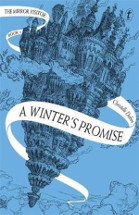
A Winter's Promise by Christelle Dabos
The Text Publishing Company, 2018. ISBN 9781925603828
(Age: 12+) Recommended. Themes: Fantasy. A mix of misfit and
misunderstood genius, Ophelia possesses two special gifts: the
ability to read the pasts of objects and to travel through mirrors.
Her peaceful existence on the ark of Anima is interrupted when she
is promised in marriage to Thorn, a member of a powerful clan from a
distant ark, the cold and icy Pole. Ophelia must follow her fiance
to the floating city of Citaceleste, where nobody can be trusted. In
the company of her inscrutable future husband, Ophelia realises she
is a pawn in a plot that will have consequences not only for her but
for her entire world.
Dabos weaves a story of politics and manipulation in which the
stakes are heightened by the fantastical setting and the characters'
magical abilities; however, the story's messages still ring true for
our society. The clever use of mirrors as a metaphor highlighted the
need to search for truth in a society filled with subterfuge,
manipulation, incredibly complex relationships, and social dynamics.
The rich imagery was delightfully whimsical and was detailed enough
to make the scene feel intimately real.
The main character Ophelia stands out in her mannerisms and
attitudes; an unlikely protagonist at times, but as a mirror walker
with a thirst for truth, she suits the story and grows along with
it. The growth and development of her and many other characters in
response to the trying times endured is thought provoking, providing
a glimpse into the inner workings of our own society and how we as
humans respond to pressures.
The pacing of the novel was overall steady, but sometimes slowed and
became sluggish due to the long building of a revelation, or raced
by as the characters whirled from place to place and emotion to
emotion.
It was a great read with a wonderfully twisty plot as Ophelia
unravels the secrets hidden from her. While the revelations were
never expected, they always reinforced the poisonous nature of
deceit and the need for candour.
This novel was a compelling analysis of society and gives rise to
many questions about human nature.
Stephanie Lam
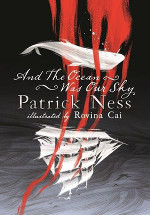
And the ocean was our sky by Patrick Ness
Ill. by Rovina Cai. Walker, 2018. ISBN 9781406383560
(Age: 14+) If Patrick Ness was to write a fractured fairy tale then
this is it. It is the story of Moby Dick but turned completely
upside down and inside out. The protagonist is 'the devil himself'
the elusive Toby Wick who travels the ocean on a man ship.
In this story, the whales are the hunters and man is the prey. The
whales travel the beneath the ocean in upside down ships led by
captains who are supported by their crews of apprentices and
'sailors'. The crew on this ship is led by Captain Alexandra and one
of her apprentices asks the reader to call her 'Bathsheba' (not her
real name but is a biblical reference) and we see this tale unfold
through her eyes.
The hunt for Toby Wick is cruel, bloodthirsty, and appears to be
driven by a myth or legends of the past where the only reason for
being is to avenge the deaths of those before them. In Bathsheba's
case, it is her mother's death that drives her hunt.
Bathsheba is not as ruthless as her captain Alexandra even though
the memory of her mother's death haunts her and this is depicted
through the relationship she has with a human male prisoner,
Demetrius, held captive on their ship. Captain Alexandra believes
Demetrius holds information to where they can find Toby Wick and
instructs Bathsheba to do whatever necessary to extract the
information out of him. Demetrius knows he is doomed to die by the
hands of the whales whether he gives the information or not.
The ending comes to a crescendo where we see the results of the
whale's quest, of Bathsheba's relationship with Demetrius and the
final confrontation with Toby Wick.
In Patrick Ness style, it is a dark and graphic story and supported
perfectly by the illustrations that enhance the story.
Gerri Mills
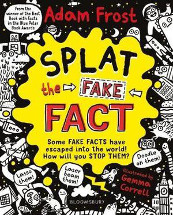
Splat the Fake Fact! by Adam Frost
Ill. by Gemma Correll. Bloomsbury, 2018. ISBN 9781408889503
(Age: 8+) Splat the Fake Fact is a puzzle activity book
filled with information that has escaped from popular author Adam
Frost's Amazing Fact series. He encourages you to splat
them, doodle on them or even lasso them! After the disclaimer is
signed, he asks that you take any measure needed to completely
obliterate the wrong facts. Which Barmy Beasts has Frost created, is
it the bone-eating zombie-worm, the Javanese Tree Sheep or the
Raspberry Crazy Ant. Luckily the answers are easy to find. For those
who love fart facts and gross jokes there are plenty. There is a
vast array of weird, wacky and unusual information on topics like
Mad Monarchs, Camel Claptrap, Killer Creatures and Leonardo's Lab.
Guess which Surreal Sports is an imposter! Is it Worm Charming,
Toilet Racing maybe Wife Carrying? There are disgusting facts about
snot, vomit, ridiculous rules and exploding underpants. Frost's fake
facts are fun to share, sometimes the most obvious answer is
incorrect!
Gemma Correll's cartons, doodles, diagrams and crazy characters add
to the humour of Frost's fact collection.
This is a fun activity book with plenty of opportunities to
embellish, lasso, draw, solve the codes, decipher hieroglyphics and
identify the truth.
Rhyllis Bignell
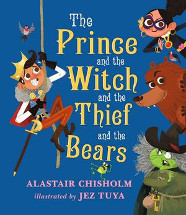
The Prince and the witch and the thief and the bears by Alistair Chisolm
Ill. by Jez Tuya. Walker, 2018. ISBN 9781406365139
(Age: 4-7) Highly recommended. Themes: Storytelling, Fairy tales,
Bedtime.
"What kind of story shall we have tonight? asked Dad . . . "A made up one!
said Jamie.
As Dad tuck his son into bed, they are ready to share a bedtime
story, a creative one filled with a cast of fairy tale characters.
Jamie's level of excitement increases as he constantly adds another
person and creature, changes the plot and questions then redirects
the actions. Dad's enthusiasm and his willingness to accommodate his
son adds to the delight of this story. The youngster even questions
his father's choice of the prince riding off to rescue the princess
trapped in the dark tower. They decide that the prince can do it,
this time. They often digress: How evil is the witch?
Can she turn you into stone or even jelly? When the villain falls to
her death, Jamie's a little hesitant. Dad's imagination changes the
fairy tale again because the former princess really a jewel thief
uses her grappling hook to catch the falling evil witch-ninja.
Jez Tuya's vibrant digital illustrations imbue each character with
attitude and make Alistair Chisolm's cumulative fairy tale comical.
Inside a star-filled border, a handsome prince rides his dappled
grey stallion whilst an ugly witch, a beautiful princess and a
flying fire breathing dragon wait ready for the story to begin. Atop
the tall mountain is a lofty castle and there's a large brown bear
lurking at the edge of the forest. The stallion sits back on his
hind legs, helps with the map and waits for the prince to work out
how far away is his kingdom. When Dad mentions the fierce bears and
dragons, Jamie needs a clear definition on their ferocity, so the
illustrator adds enormous shaggy coats and vicious claws. Each
double-page spread is filled with big, bold pictures that
delightfully express Jamie and Dad's dramatic fairy tale.
Alistair Chisolm's fast-paced story is a perfect read aloud with
many twists and turns. Jez Tuya completely captures the humour and
builds the drama through his energetic and colourful visual
storytelling. The Prince and the Witch and the Thief and the Bears is an
enchanting narrative for Junior Primary classes to engage with plot,
setting and characterisation, stereotypes and the structure of fairy
tales.
Rhyllis Bignell
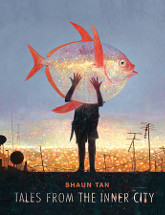
Tales from the inner city by Shaun Tan
Allen and Unwin, 2018. ISBN 9781760523534
(Age: middle school to adult) Highly recommended. Themes: Design,
Cities, Animals. Twenty five stories about the relationship between
humans and animals is explored in this richly illustrated book from
Tan, a companion volume to Tales from Outer Suburbia (2008)
and one Tan has been working on ever since. Every page has something
startlingly new, making the reader pause and read again, then pore
over the illustrations, making sure they have absorbed every nuance,
before starting again.
His last chapter begins, "We tell each other the same story" but the
details of Shaun Tan's stories are entrancing. His sometimes
dystopian view of the city and its relationship with animals is
highly individual, placing animals in the oddest of settings:
crocodiles living on the eighty seventh floor, an eagle in an
airport, deer peering out of an office window, making us question.
One of the first sequences in the book, "Once we were strangers",
devotes forty pages to a dog, at first wary of the human with a
spear in one hand, but over time becoming a companion, ending as a
dog on a lead walking with its human. The illustrations reflect the
passage of time. The broad strip between the human and the dog
begins as a wide black expanse, the void of the early cosmos
perhaps, then it becomes a track, changing to a bridge, a railway
line, a road, and finally the double page is fully paved. Time has
passed, reflecting the changes in our environment as well as the
changed relationship between humans and animals.
Shaun Tan talks
about his work providing insight into his book as he provokes, prods
and perplexes his readers.
Each of his works in this volume initiates a response, the richly
illuminated and detailed images giving more as the reader looks,
ponders and talks about what they see. The almost poetic text forces
the reader to read it again, viewing the illustration with new
ideas, evaluating the links between the two.
People and animals may live in each other's shadow, but they are
still very visible in Tan's work, from the tiger strolling by the
similarly coloured wall on the last endpaper, or the rhino watching
over the traffic or the killer whale in the night sky.
Light in various forms is shown to advantage: city lights on the
front cover, the coloured light of the crowds of butterflies, the
light behind the snails on the bridge, the light pouring in through
the classroom windows, the light coming out of the high rise flats,
contrasting with the many dark and gloomy images redolent of a
dystopian landscape, stressing the tension within the city, leading
to the last page of the book with its apocalyptic image.
The inner city is shown in images of crumbling high rise buildings,
homeless people, train tracks, telegraph poles and animals, all
giving a different perspective than the one expected. The teacher in
the classroom is hugging a sheep, the boy on the cover holding a
glass fish, owl's eyes peer out at the reader from the hospital
ceiling, a bear is led up the steps, a shark rises up out of the
landscape, but unlike the lonely vistas of Jeffrey Smart's cities,
Tan's images of the concrete structures force the reader to
reevaluate the connection between human and beast.
I found this book totally captivating, sometimes unsure that I had
missed something, but always satisfied at the myriad of references,
allusions and journeys down unexpected pathways that Tan takes his
readers. Teacher
notes can be found on the Allen and Unwin site.
Fran Knight
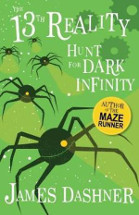
The 13th reality: Hunt for Dark Infinity by James Dashner
The 13th Reality series. Scholastic, 2018 ( First
published by Simon and Schuster in 2008). ISBN 9781742998190
(Age: 11+) Recommended. Themes: Fantasy; Alternate realities;
Adventure; Heroism. Atticus Higginbottom (best known as Tick to his
friends) has again been needed to restore some order to the world
(and worlds of alternate realities). With his friends Sofia and
Paul, and the other odd assistant Master George Deems they needed to
solve the incredible tweaks of strangeness that have entered the
world and Tick is the one who seems destined to be the solution.
Unleashing the most incredible bravery, intelligence and
uncontrolled capacity for power, Tick is again required to be a
hero. In the first book in this series, Tick was revealed as having
extraordinary capabilities with Chi'karda - part of the wisdom and
magical power of the unconventional world where quantum physics seem
to explain alternate realities. In Hunt for Dark Infinity
Tick is needed to respond to a challenge that seems to send him on a
course of potential destruction in opposition to Mr Chu - the evil
'alternate' to his favourite science teacher. The forces surrounding
the Dark Infinity seem to be both evil and insane and Tick is needed
again to solve puzzles and make things right. But his powers seem to
be operating messily without rules. Where will it all end, and what
was the message that his mother nearly 'spilled' before the
adventure spun out of control?
Yet again James Dashner has unveiled a tense and riveting adventure
tale of fantasy, with more than a dash of science fiction, involving
young teen protagonists. This is best read as soon as possible after
the first book, Journal
of Curious letters, in order to maintain the flow. Young
readers will probably want to binge read this series in the same way
they devour a Harry Potter fantasy. It has a similar good vs evil
atmosphere and the pace is charged with the same serious intensity.
It is not quite as long as J K Rowling's books and more science
fiction fantasy than magical fantasy, although there are points of
similarity. And yes, there are more books in the series.
Recommended for fantasy lovers, aged 11+
Carolyn Hull
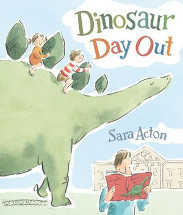
Dinosaur day out by Sara Acton
Walker Books, 2018. ISBN 9781760650049
(Age: 2-6) Recommended. Themes: Dinosaurs, Museums. Dinosaur Day
Out by author/illustrator Sara Action will entertain and
excite its young audience with a multi-layered approach. While we
read the story of Sally and Max's day out with Dad and their visit
to the museum, there is so much more happening in the visual
storytelling.
Sally and Max love dinosaurs and are keen to see the dinosaur
exhibition. Unfortunately, the area is closed with a large sign
stating "Dinosaurs Unleashed . . . dino's day off!" The children are
upset and their father buys them a book all about their favourite
animals. Off to the park they head, with "paths to explore and trees
to climb." Dad keeps up their spirits by reading dinosaur facts
aloud, "did you know about the diplodocus, the pterodactyl or the
stegosaurus?" While their father is busy reading and eating Sally
and Max are thoroughly enjoying the dinosaurs' day out! Hanging
upside down on a branch with the pterodactyl, feeding the diplodocus
leaves and watching it drink from the fountain. Even the t-rex
enjoys a triple scoop ice-cream when they stop for a treat. Their
day ends with Dad piggy-backing Sally as they walk back through the
park observed by a pack of dinosaurs.
Sally Acton's wonderful pictures seamlessly blend the dinosaurs into
the familiar park and city settings, natural tones of green and
brown sweep across the spreads. She shows Max and Sally's enjoyment,
their liveliness and interaction with the dinosaurs, a story within
a story that will enchant the reading audience. Dinosaur Day Out
is both an imaginative and informative picture book just right for
sharing with pre-schoolers and junior primary students.
Rhyllis Bignell