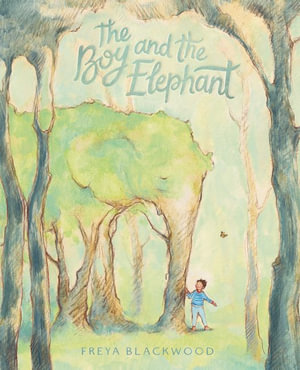
A lonely boy lives in an apartment building in the city. Evocative pencil and watercolour illustrations cover the first few pages, revealing his routinely solitary life. Alone, he gets out of bed, dressing himself and getting ready for school, no one else in evidence, hurrying by himself through the noisy streets filled with people, cars and trams, sitting by himself in the playground once he gets to his inner city school surrounded by concrete. At home dad works in the study, no time for the forlorn lad fending for himself. He makes his tea and takes a tray to the lot next door to sit with his friends. The stunning illustrations paint a sadness, an uninterrupted loneliness encompassing the boy’s life. We feel his loneliness, his anonymity in the crowds: home and school devoid of any comfort.
But next door is an overgrown space where he goes to read and visit.
Blackwood weaves the trees into shapes of animals that befriend him, animals that comfort him in his solitary life. And readers will all breath a sigh of relief: he is not alone. But another twist appears as the block of land is sold and each tree marked with a cross, ready to be cut down. Readers will gasp in horror with the boy as he sees what will happen, appalled that his friends should be destroyed. Blackwood’s illustrations lead the reader to feel with the child as he ponders what to do. And he finds a solution.
Blackwood’s amazing images are outstanding. Out of a forest of captivating images, several stand out for me: the elephant is part of the tree the boy sits beneath, the foliage coming together to make his shape, the pale greens contrasting with the night views as the trees escape the developers, their shadows looming against the blues of the buildings at night. And I love the looks inside the boy’s house, the stairs, detritus, the bedroom with the things he loves. His loneliness is palpable, and all readers will have heart stopping moments as the tale unfolds. Every page held me, as it will for every one who reads it.
Blackwood’s work is a meld of softness and hardness: we see hints of a broader environmental theme - the destruction of habitats, contrasting with the heart stopping images of a lonely boy doing what he can to save it. This gentle wordless picture book shows that we can all take a stand.
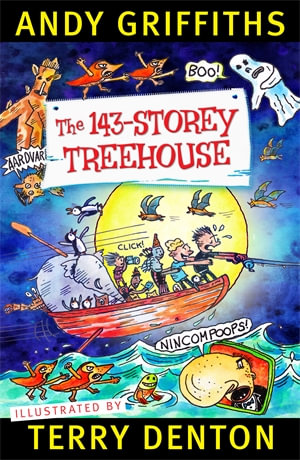
The 143-Storey treehouse by Andy Griffiths. Illus. by Terry Denton
Pan Macmillan Australia, 2021. ISBN: 9781760786236. (Age:6+) Highly recommended.
I found this book very entertaining. The illustrations are hilarious in this fast-paced, action-filled novel by Andy Griffiths. Some of the new levels to the treehouse include a word-o-matic, recycling depot, camping ground, and super big stuff storey.
The adventure begins with Andy and Terry playing scrabble, and Andy getting angry, again! He decides he needs a holiday, just the two of them. Not sure of this though, because their previous experiences haven’t been all that pleasant. However, they are due to write another book, so Mr. Big Nose sends a reporter and a photographer with them to do an exclusive story of their holiday.
The holiday turns out not to be just the two of them, and not quite as relaxing as they thought it might be especially when Andy gets chopped in half by the pax (axe). His two halves have to be stapled back together.
What’s a camping trip without having to make do with what you have? What’s the fun if you bring all the food with you? You wouldn’t have the experience of going fishing in a boat built for two, but with many more people occupying it. Toasted marshmallows by the fire, and spooky ghost stories to end the day sounds good, doesn’t it? Well, maybe, just maybe, that doesn’t go as planned either.
Do the friends escape the hobyahs? They sound very scary. After saying they weren’t scared of anything, they will have to follow Jill on the hunt for hobyahs. She assures them they are close, because she has seen their footprints. Just what have they done to all their friends? You’ll have to read the book to find out!
Themes Adventure, Fantasy, Friendship.
Natalie Fisher
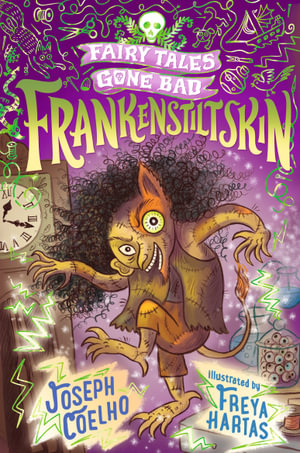
Frankenstiltskin by Joseph Coelho. Illus. by Freya Hartas
Frankenstiltskin Fairy Tales Gone Bad, written by Joseph Coelho is a story cleverly written in poem, and with a wildly wicked twist on the Brothers Grimm classic Rumpelstiltskin. Using ingenious alliteration and rhyme throughout story, the reader is easily immersed and enthralled in the storyline.
Briony is a taxidermist and the king searches for an expert to not only stuff animals but bring them back to life. As with the storyline of Rumpelstiltskin, her father gets carried away with his tales of his daughter’s greatness and agrees that she can in fact bring “life back to the dead”. The king immediately takes her to his mystical castle. There she is told to bring back to life all his son’s dead creatures. The king is not fond of animals and doesn’t realise or appreciate the beauty of nature. Briony is the opposite. She is very in tune and even has the ability to delve into the animals’ past life before she performs her taxidermy role. However, she has never been able to make them breathe and walk and run again. Enter the little ugly creature who has this ability. How far will Briony go to appease the king? Will this strong and determined girl be able to change her circumstances, flee her captors, change their outlooks on nature and survive to tell another story?
Coelho is a highly acclaimed author of poetry, plays and picture books. This bold yet bizarrely twisted story is the second of a three-part series of the classics and brings back the brilliance of the old masterpieces, looking at the morals and underlying meanings of each tale. The book is also filled with engaging illustrations by Freya Hartas. These give the reader another opportunity to connect with the text and provide extra visualisation of the story.
Frankenstiltskin Fairy Tales Gone Bad is a story that will keep readers engaged and eager to find out how everything will end. It will also make a great read aloud with its poetic flow of rhyme, rhythm and awesome alliteration. I can’t wait to read the next one!
Themes The Classics, Problem solving, Storytelling, Nature.
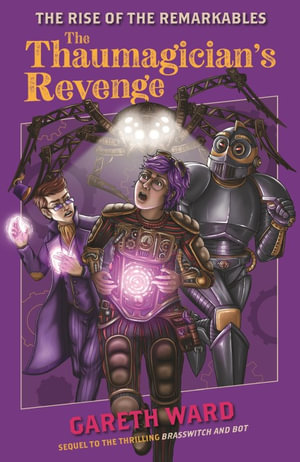
After Plum's devastating betrayal where Wrench only just managed to stop his evil plan as well as just scraping through the Minster Schism event, Wrench finds her powers are diminished and her faith in others hanging by a thread. As Cabal Thirteen's Brasswitch, her low level powers are a safety issue, and her mechanoid boss, Bot, instructs her to continue practicing with the new thaumagician, Vexanna. All the while Wrench and Bot continue to investigate rouge remarkables, and trying to locate Plum. As Wrench struggles with her confidence, the Cabal Thirteen team is continually battling with Captain Flemington who wants to destroy them and all other Remarkables. Unsure if she can trust anyone anymore, unsure if she will ever regain her full power, Wrench faces numerous challenges. Lucky she has the Remarkables of Thirteen to give her support.
The second book in The Rise of the Remarkables steampunk series, following Brasswitch and Bot, The Thaumagician's Revenge is action packed, dramatic and humorous. Well suited to middle grade students, this steampunk book set in the Victorian era gives readers adventure and mystery while weaving magic throughout. Covering relevant topics such as self-doubt and confidence issues, prejudice, trust and relationships, readers will find Wrench relatable. Delving deeper into Wrench's history, the book also covers revenge and the difficulty of letting go. The characters called Remarkables face prejudice and as a Remarkable, Wrench attempts to battle her mixed emotions as well as helping to educate others. With plenty of laughs as well as action, this steampunk novel is enjoyable.
Themes Steampunk, Prejudice, Good and Evil, Magic, Revenge, Mystery.
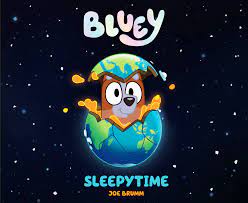
Bluey Sleepytime is a captivating story about Bingo who decides that she wants to be a big girl and sleep in her own bed. Mum reads her a bedtime story about space, before tucking her in and reminding her that she is always here if Bingo needs her.
Taking her soft toy Floppy to bed with her, Bingo dreams about going on an intergalactic space trip. The reader sees the world as an egg, cracked open by Bingo who trips off on her adventure. She passes another planet egg that has been cracked open and wonders who has left it. On the next page the reader sees that Bluey has woken up, wanting a glass of water, but by the time Mum gets it, he has gone to bed with Dad. Meanwhile Bingo finds a cosy spot between Bluey and Dad, while Mum curls up in Bingo’s bed. All the bedhopping will bring smiles to the adult reader’s face, as Mum and Dad struggle to get some sleep.
Sleepytime, was named by the New York Times as one of the Best Television Episodes of 2020 and the book reflects that quality. It is large, with a hard cover, showing Bingo cracking open the world egg, with splashes of yolk spilling over the sides, all against a black night background. There are surprises for the reader with large fold out pages, and the iconic figures will please the young child.
Sleepytime is a heart-warming story about a young child moving towards independence, surrounded by loving family members who are always nearby if she needs them.
Themes Bedtime, Independence, Family love.
Pat Pledger
Mr Bat wants a hat by Kitty Black and Laura Wood
New Frontier, 2021. ISBN: 9781922326218. (Age:3-6)
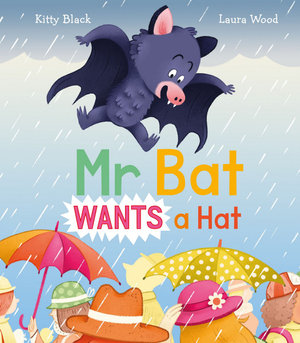
Mr Bat is a happy bat. He loves swooping, flapping and making friends with insects (before he eats them!). But when he spots people wearing hats he realises what he has been missing all his life. He simply MUST have one. It is the most beautiful, glittery, flowery hat that makes his eyes pop with love, and after snatching it from a helpless baby's head Mr Bat has two voices in his head: the first says 'Oh. A sad baby. She likes hats too', while the second says 'Too bad!'. Children may be awed or amused by Mr Bat's absolute selfishness as he awards himself the 'Best Dressed Bat Award' to an exasperated audience of animals. But his conscience finally gets the better of him; he swoops in and returns the hat to the still-screaming baby. 'I like hats too, but this one belongs to you', he whispers. Young listeners will see how his good behaviour is rewarded, as the baby hands him her socks. Mr Bat is delighted - 'hats are so last season anyway'. The last page, showing Mr Bat coveting a pair of roller-skates, provides perfect post-reading discussion material.
This is a good book for conversations about not taking things that belong to others, doing the right thing, fixing mistakes and about kindness begetting kindness. The moral of the story is completely front and centre and it acknowledges the difficulty of making the right choices and how sometimes we can be conflicted between getting something we want and being kind to others. The simplicity of the story is what makes this perfect for the target age group, all of whom will identify with Mr Bat's dilemma or of being in the position of the baby and how it feels to have something precious taken from them. This can lead to discussions about how we can pause to look at things from someone else's perspective before taking action. It also provides opportunity to talk about what to do if you have a friend like Mr Bat, as in the story the friends are just going along with his appalling behaviour rather than calling it out. Some people might be put off by Mr Bat being rewarded for giving the hat back, considering he stole it in the first place, but I think for children it's a perfect example of how mistakes can be fixed, and if taking the perspective of the baby, how we can be forgiving.
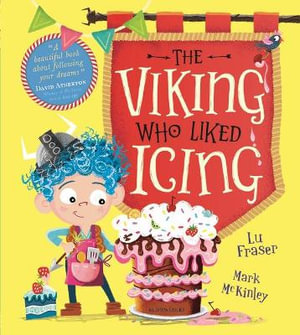
In wonderfully infectious verse, the story of Nut the Viking unfolds, irresistible to all kids listening to the tale of someone who does not quite fit in. Born into the Viking clan in a cold region of the world, Nut’s sister Leaf does all the things Vikings do. She loves her sword ands practises with it as Nut reads recipe books, she bravely swings out over the water, while Nut practises in the kitchen, she can fire an arrow and hit the target, whereas Nut’s attempts cause people to hide. But Nut’s worst day of the Viking calendar is here; Viking Sports Day. He will be expected to do all the things his sister does: fire an arrow, run heartily, swim and climb, and he knows that he will come last for every event. And he does. He falls into the water while running, sinks while trying to swim and fires his arrow into Erikson’s bottom. But worse is to come. It is the horn throwing competition. All the entrants unscrew their horns and throw them, but Nut does not have a horn so he throws the only thing at hand: a cake.
It hits the Chief on the head and as the pink icing falls down on his face, he wipes it with his tongue. It is delicious. He decides then and there that Nut will be in charge of the next banquet, because at baking cakes he is the first.
This delightful tale of being who you are, of being yourself, will make kids laugh out loud as they recognise the problems associated with not fitting in. Nut’s tale encourages them to stand up for who they are, of not being expected to be what others want them to be, in an easily digested verse story.
Grace and the Christmas angel by Lucinda Riley and Harry Whittaker
Macmillan, 2021. ISBN: 9781529049800. (Age:5-8) Recommended as a gift book.
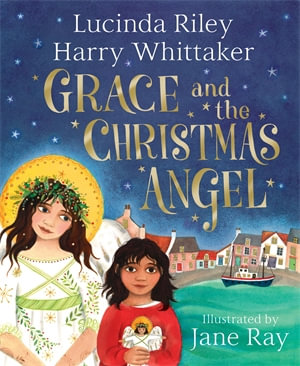
Set within a northern hemisphere fishing town just prior to Christmas, Grace and her younger brother Nicholas are ready for the school Christmas Eve concert, appearing as shepherd and sheep. Grace is also ready to perform a solo, and to share Christmas Day with their fisherman father . . . if he can escape the wild ocean to get back in time. The storm upsets Grace and her pleas for the storm to stop are heard by a guardian angel called Hope who does not understand the word “impossible”. The Christmas Day miracle has a magical quality and ultimately Grace gets to delight her father with her solo carol singing.
With mother and son authors, this book may yet be part of a series of guardian Angel books written with a magical quality rather than an overtly faith-based message. The book opens with an introduction with the idea of Guardian angels explained as helpful agents in times of distress. The rest of the picture book is a longer narrative which could be enjoyed by readers 5-8 years old, with winsome and detailed colourful illustrations by Jane Ray. For Australian children the idea of Christmas with school concerts, cold weather and roaring log fires is perhaps slightly foreign, but the mysterious intervention of a Guardian Angel (acting like a wish fairy) fits with some people’s notion of the magical quality of Christmas. The hardback book also includes a ribbon bookmark with an angel attached.
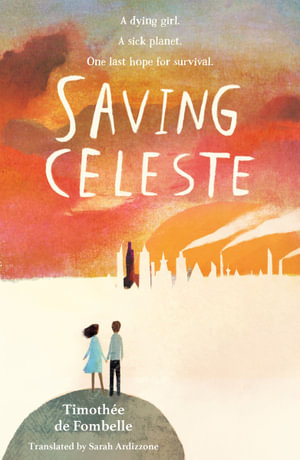
Saving Celeste is a modern dystopian fable. The 14-year-old boy who tells this highly unique and slightly disturbing tale is nameless. He lives alone in a vast apartment on the 40th floor of the !mmencity Tower. His mother is a corporate executive for !ndustry who he barely talks to, instead dealing with his mother’s PA. Fortunately he has a friend called Bryce who visits him to help eat the monstrous food deliveries and play the computer games organised by the PA. Based on a past romantic humiliation he is very wary when he meets Celeste a new student at school. Yet he is also very drawn to her. She doesn’t return to school so he tries to find her, but when he finds her she is very unwell with strange marks on her skin. His attempts to help her turn sinister, and he finds ways to trick his mother and authorities into helping save Celeste.
This is a very slim volume but it packs a punch. It is an English translation by the author of another unique story, Toby Alone. Timothee de Fombelle creates a truly original setting of kilometre high buildings which tower into the polluted air. There are carparks of vertically stacked cars like bookshelves and lifts which also have shops in them. It conjured up Shaun Tan illustrations for me as I read this. Although you hope the boy saves Celeste and you feel empathy for his solitary bizarre life, it is the mystery of what is happening to Celeste that is important and the driver of the story. It’s a book with depressing undertones however it also has a message of hope for the power of humanity to find solutions for a better world. It is a book worthy of discussion in middle grades classes.
Themes Dystopian world, Climate crisis.
Jo Marshall
The What on Earth Institute of Wonder by Lisa Nicol
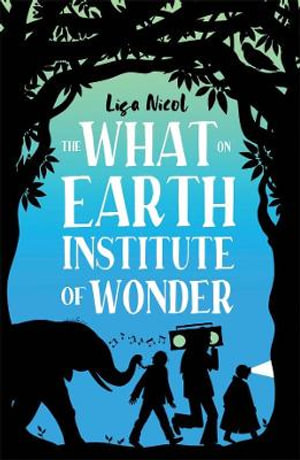
Twelve-year-old Sal has a connection with animals, her younger brother is a prepper (for any disaster known to man or boys) and her mother has begun to study the moon obsessively, and they all are missing Sal’s Dad who recently left them unexpectedly. Each of them is perhaps demonstrating some strangeness, but Sal’s animal connection has even enabled her to talk to the kakapo who is now a semi-permanent resident. When the elephant arrives in town and follows young teen and next-door neighbour, Bartholomew, and his boom-box music, Sal and Roy’s life takes an unexpected turn. They become advocates for the inexplicably displaced elephant and attempt to rescue her. However, they get themselves in trouble with the local obnoxious Postman and their small-town community. Sal must decide if standing up for the environment is important enough to persist in the face of opposition.
This is a delightful story with elements of fantasy, environmental activism, family dilemmas and friendship all woven together with whimsy to create a charming story for young readers. The humour is gentle, but chuckle-worthy and even the issues of crime, bullying, family distress and environmental concern have a comic veneer. Despite some tears and challenges, this story is ultimately uplifting and warm, and quirkily appealing with a touch of the impossible. Readers aged 9-12 will enjoy this book.
Fearless with Dad by Cori Brooke. Illus. by Giuseppe Poli
New Frontier, 2021. ISBN: 9781925059625. (Age:2+) Highly recommended.
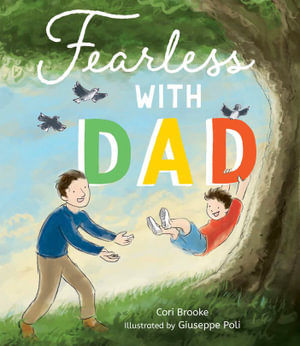
Originally published in 2015, entitled Fearless with my dad, here is what the reviewer had to say about it (and I think that it would be very appropriate to read to very young children):
(Age: 6+) Highly recommended. Fearless with my Dad is a beautiful picture book, following a young boy and his dad. Together they are pirates, flying like an eagle and travelling to the moon. The underlying theme is a child can be anything and do anything as long as they have their dad there to support them.
The beautifully illustrated text will engage younger readers and encourage new vocabulary as children and their carers discuss all the amazing adventures of this boy and his dad. Older readers could create their own version and the main character could be changed to a girl.
It would make a great gift for a father on Father's Day - no matter their age - but would be a great gift for a first time dad.
Highly recommended for all readers - whether they read it independently (aged 6+) or with a parent.
Kylie Kempster
Themes Fathers, Imagination.
No one is angry today by Toon Tellegen and Marc Boutavant
Gecko Press, 2021. ISBN: 9781776573455. (Age:9+)
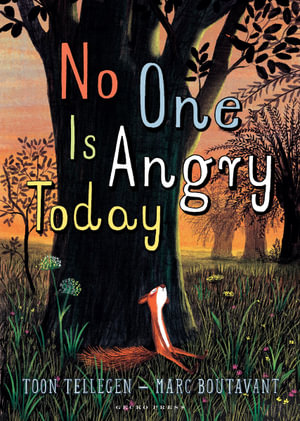
No One is Angry Today is a picture storybook written by Toon Tellegen who was born in the Netherlands. The book has been translated into English and provides ten short stories discussing responses to anger. The interactions between the animals and how they manage their feelings of anger is at times confusing and unusual. Some of the stories are reasonably gentle and others are quite confronting, particularly the first story, 'The Firebelly Toad and the Hedgehog'. The bullying behaviour of the toad is both violent and completely unexplainable. His unrestrained anger and the nasty actions that follow are trying to provoke the other animals to match his feelings, but they almost appear shocked by what has transpired, and their reactions are more muted. Each story appears to portray a different level of anger and how each animal deals with it. For younger readers this book would be better shared with an adult as there would need to be further explanations and follow-up discussions. The illustrations by French artist, Marc Boutavant, are both appealing and complementary to the text. Anger wears many disguises and is often misunderstood and hidden. This book may be trying to open more dialogue about this complex feeling.
Themes Animals, Anger, Short Stories.
Kathryn Beilby
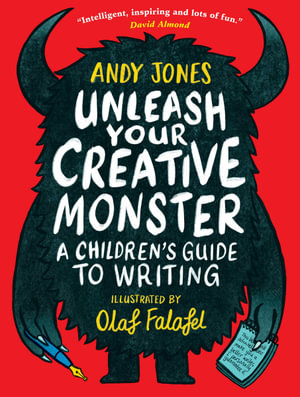
Unleash your creative monster by Andy Jones. Illus. by Olaf Falafel
This new release aimed for the middle primary to early secondary student market provides an honest and entertaining guide to the creative writing process for children. The book is full of tools and tips on how to write and has wonderful story prompts to engage both the reader and budding writer. Written in the first person, author Andy Jones has cleverly used his wit and writing skills to give younger writers a step-by-step guide through the process of creating a story.
The book has a detailed Contents section divided into four sections: Training your Creative Monster, Monster Mistakes, When your Monster Gets Stuck and Feeding your Creative Monster. Each section is then sub-divided further into short chapters. The book begins with an introduction to both the author and illustrator and then moves onto an explanation of the use of the monster analogy. These imaginative and detailed monster illustrations spread throughout the book, add so much to the text and are often accompanied by speech bubbles, labels and amusing information.
The book has been written in a way that the reader/writer can either work through at their own pace as there is clear pathway to be followed in each section or chapter with lots of ideas and the all-important story prompt at the end. Or the book also could also be used as a quick reference for a particular writing skill when required.
Classroom teachers may find this book a very valuable resource when working through narratives with their students. The humorous approach provided by both the author and illustrator will entertain and provide reassurance that narrative writing can be fun.
There are two worthwhile YouTube clips that would be perfect to share with children before using the book:
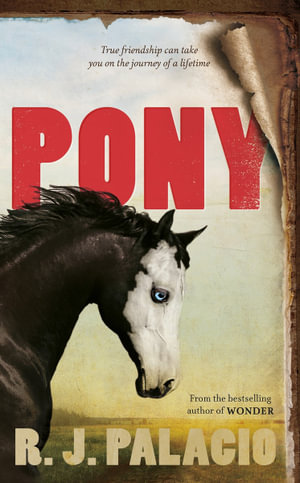
Pony is an extraordinary story by the American author of Wonder. The central voice is a 12-year-old boy called Silas Bird. It begins in a small town called Boneville, Ohio, in 1860. Silas’ beloved only parent, Pa, is kidnapped by a bunch of outlaws. Against Pa’s wishes Silas chooses to risk his life and follow them, riding a mysterious pony which seemingly returns for him. He faces personal fears in the woods and fortunately convinces a Marshal to take him on his quest to hunt down the kidnappers. Pa has been targeted because of his ability to take photographs using new scientific techniques. Their intention is to use his skills for counterfeiting money. Fortunately, Silas has an imaginary friend only he can see called Mittenwool. Mittenwool guides Silas on his perilous adventure. Silas likens Mittenwool to a ghost/spirit and Silas realizes he can communicate with other such spirits.
There are many great characters in Pony. Silas is a philosophical principled boy who grows stronger and wiser as he faces violent and nail-biting challenges. Sherriff Chalfont’s and the gruff Deputy’s relationship with Silas add humour and kindness. The spirit/ghosts are not light weight and silly but feel real. There are interesting seeds sewn in the plot, such as the violin case Silas inexplicably takes with him. Historical and scientific tidbits also enrich the story.
I particularly enjoyed the authentic language and unfamiliar words and phrases like “I don’t cotton to folderol like that”. As an Australian who is not so familiar with US children’s literature, I found myself drawing on films like True Grit by the Coen Brothers to understand the time and place. Also, Little Women since it is set in the times of the Civil War. This book is gutsy with shoot-outs and deaths but also has emotional impact and strong themes of goodness and love. Each chapter has a quote to ponder and an old photograph of a person whose image inspired Palacio. It was refreshing to read such a unique story and I believe it will be appreciated by both young adults and adults alike.
Themes Love, Kindness, Courage, Goodness.
Jo Marshall
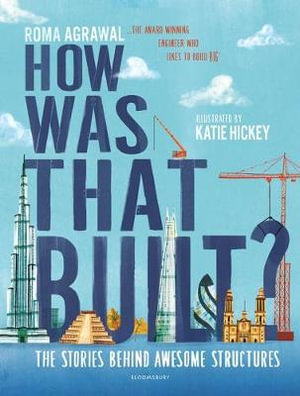
How was that built? by Roma Agrawal. Illus. by Katie Hickey
How Was That Built? written engineer Roma Agrawal and illustrated by Katie Hickey is a beautifully presented non-fiction book which focuses on stories behind awesome structures from all over the world. The Contents page contains fourteen “How to build…” chapters which includes ideas of how to build long, clean, a dome, across, stable, in outer space, in the sea, as well as others. Each chapter explains the technology behind a famous construction related to each individual topic with an explanation of how it was built, other interesting fact-related material and ideas for trying things at home.
In the How to Build Tall chapter The Shard in London is described in great depth. The author, who worked on the design of this building, includes information about what makes a building stand and introduces the reader to several technical terms. The How to Build Stable chapter provides a comprehensive look at the Te Matau A Pohe, a bridge in earthquake prone New Zealand. To resist earthquakes the engineers left a small gap between the moving and fixed parts so during an earthquake, they are unable to damage each other. The final chapter looks at Building into the Future and is followed by an extensive glossary and finally a snapshot of some very talented engineers.
The detailed and softly coloured illustrations by Katie Hickey include large scale cross sections and drawings of each structure as well as examples of the engineering techniques shown to the reader. The drawings are clearly labelled when necessary and provide an important visual display to accompany the text.
This book will be a valuable resource for STEM when looking at man-made structures. There are many ideas for budding engineers or builders and so much to learn. A worthwhile purchase for home, school or public libraries.